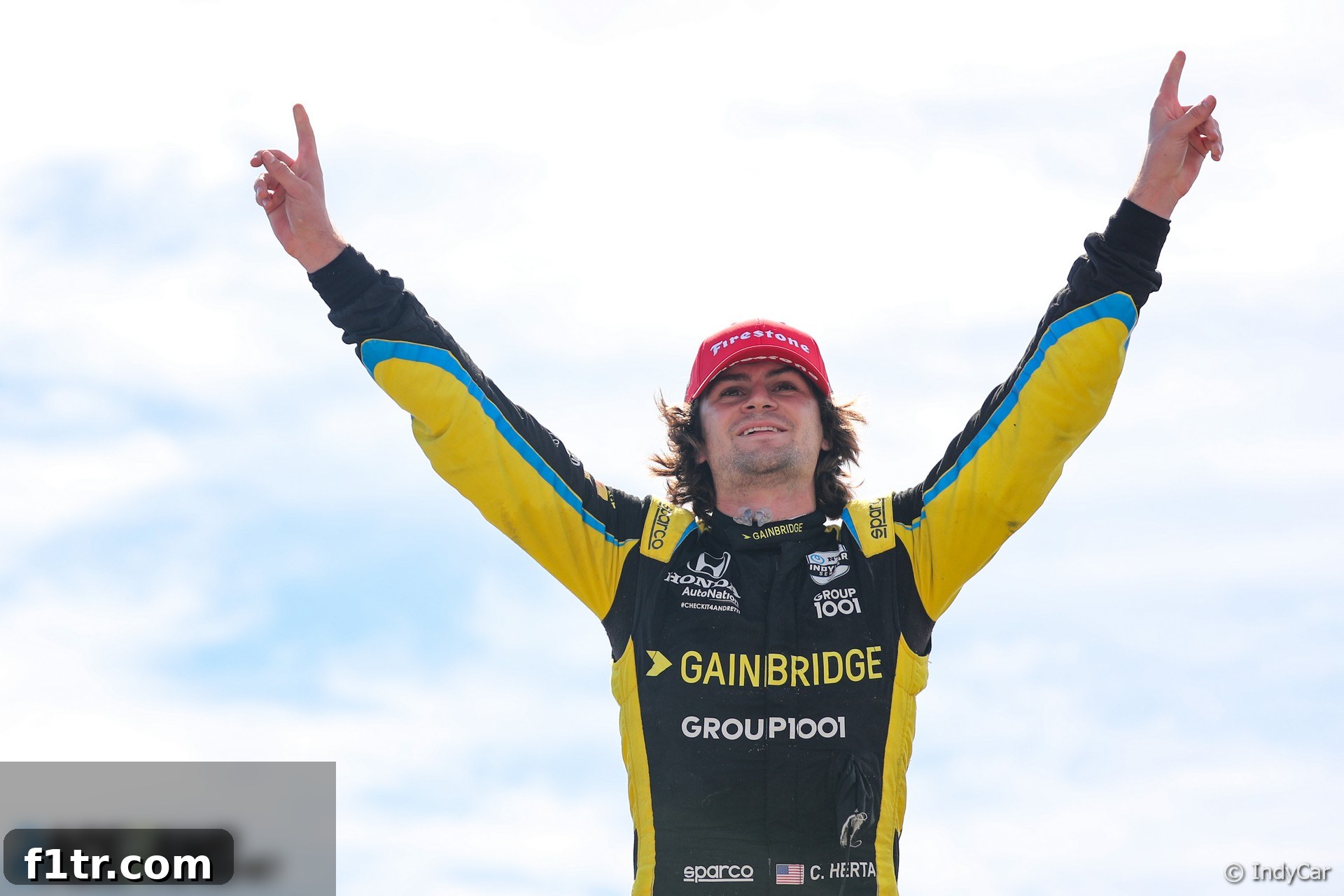
Fernando Alonso, a two-time Formula 1 world champion and a respected figure across various motorsport disciplines, has voiced his support for IndyCar race-winner Colton Herta, suggesting he would be an excellent fit for Formula 1 should the opportunity arise. This endorsement from a driver of Alonso’s stature, who himself has competed at the Indianapolis 500, adds significant weight to the growing conversation around Herta’s potential transition to the pinnacle of open-wheel racing.
Herta, a standout American talent in the NTT IndyCar Series, has been at the center of speculation regarding a move to Formula 1. These rumors gained significant traction following reports that his current team owner, Michael Andretti of Andretti Autosport, was exploring the acquisition of Sauber, which operates the Alfa Romeo-branded F1 team. Such a move would naturally position Herta as a prime candidate to become the first American Grand Prix driver in over six years, fulfilling a long-held desire within Formula 1 to feature a strong US presence on its grid.
Colton Herta: The IndyCar Prodigy Eyed by Formula 1
Colton Herta’s career trajectory has been nothing short of impressive. At just 21 years old, he has already etched his name into the IndyCar record books as the youngest race winner in the series’ history. His raw speed, consistent performance, and aggressive yet controlled driving style have made him one of the most exciting prospects in American motorsport. Alonso, who raced alongside Herta at the Indianapolis 500, offered high praise for the young driver, describing him as “a very good driver, very talented, very young.” He further elaborated, highlighting Herta’s strong foundation with Andretti Autosport, stating, “He’s the youngest IndyCar race winner and I think he has a very good organisation with Andretti. He would be a good fit for Formula 1, for sure.”
Herta’s Achievements and the Formula 1 Dream
Herta’s resume speaks volumes about his capabilities. With six victories in the highly competitive IndyCar Series, two top-five finishes in the championship standings, and a runner-up position in the 2018 Indy Lights series, he has consistently demonstrated his winning potential. These accomplishments firmly establish him as one of North America’s premier racing talents. For many, including fans and pundits alike, his progression to Formula 1 seems a natural next step, especially given F1’s increasing focus on the lucrative American market.
The Superlicence Conundrum: A Hurdle for IndyCar Talent
Despite his undeniable success and the enthusiastic backing from figures like Alonso, Colton Herta faces a significant hurdle: the FIA’s superlicence regulations. Under the current criteria, Herta has accumulated 32 points, falling short of the mandatory 40 points required to qualify for a Formula 1 superlicence. This discrepancy has sparked considerable debate within the motorsport community, drawing attention to how various racing series are weighted in the FIA’s points system.
The superlicence system is designed to ensure that only drivers with proven experience and success at high levels of motorsport are eligible to compete in Formula 1. While the intention is sound, its application, particularly concerning series outside of Europe’s traditional feeder categories, has come under scrutiny. IndyCar, considered by many as one of the most challenging and competitive open-wheel championships globally, awards fewer superlicence points than series like Formula 2 and even Formula 3. This disparity leads to situations where highly accomplished drivers like Herta find their path to F1 obstructed not by lack of talent, but by bureaucratic points allocation.
FIA Regulations and the “Force Majeure” Clause
The FIA regulations do offer a glimmer of hope for drivers who have scored at least 30 points, allowing them to qualify if they are “judged at the sole determination of the FIA as unable to qualify” under normal criteria “due to circumstances outside their control or reasons of force majeure.” The governing body has already demonstrated some flexibility, relaxing the licence threshold due to the global COVID-19 pandemic, which extended the eligibility period for qualifying championship results from three years to four. However, whether Herta’s situation would fall under such an exemption remains to be seen and would require a specific ruling from the FIA.
IndyCar driver Patricio O’Ward, another formidable talent, echoed the sentiments of many in the paddock, telling RaceFans that IndyCar is “very undervalued” when compared to European feeder series that award a higher total of superlicence points. This sentiment highlights a broader perception within the motorsport world that the FIA’s current points system does not accurately reflect the competitive intensity and talent pool of championships like IndyCar.
Alonso’s Call for Re-evaluation
When questioned about the superlicence points allocation for IndyCar performances, Fernando Alonso diplomatically stated it was “more a question for the FIA or whoever it is dealing with the licencing.” However, he did not shy away from expressing his personal view, asserting, “I think there are categories like IndyCar that has the level high enough that you should get the necessary points like you do in other categories in Europe.” Alonso’s statement underscores the belief held by many experienced drivers that IndyCar’s competitive standard warrants a higher valuation within the superlicence framework, aligning it more closely with Formula 2.
Beyond Formula 1: Alonso’s Broader View of Motorsport Excellence
While acknowledging Herta’s suitability for F1, Alonso also offered a more nuanced perspective on a racing driver’s career path. He emphasized that not every driver’s ambition is, or should be, solely pinned on Formula 1. “Each of us has a different plan in his career and I don’t know what Colton has in his head at the moment because I’m sure that he’s happy with IndyCar,” Alonso remarked. He drew parallels with Alex Palou, who clinched the IndyCar championship, noting Palou’s deep commitment to US racing and his enjoyment of competing in the States.
Alonso, having ventured into diverse racing disciplines such as IndyCar, the World Endurance Championship (where he won Le Mans twice), and the Dakar Rally before returning to F1, holds a unique and respected view on the motorsport landscape. He challenged the common perception that Formula 1 is the absolute zenith for every driver, stating, “Sometimes there is not only one target, Formula 1. Motorsport is much more than Formula 1. Even here inside this bubble, some people feel that this is the the top, top, top. Which, it is probably the top, but there are other super categories.” This perspective highlights the rich tapestry of global motorsport, where excellence is found across various disciplines, each demanding unique skills and offering different rewards.
Respect for Diverse Disciplines
The Spanish champion passionately argued for greater respect for drivers competing in categories outside of Formula 1, emphasizing their specialized skills and dedication. “I do respect a lot all the drivers in every category,” he affirmed. “I think they are the best in their business and their discipline, in their driving style, techniques. That is different in each of the categories.” This acknowledgment stems from his personal experience of adapting to new racing environments, where he encountered specialists whose mastery of their chosen craft was unparalleled.
Alonso illustrated this point with examples: “Maybe the most extreme one is probably Dakar or the rally raid where I think the specialists are nearly unbeatable. Wherever you come from and whatever discipline you won in the past, you will never beat them in pure pace.” He applied the same logic to IndyCar, noting that its drivers are “the best on IndyCar circuit and an IndyCar machine.” This perspective suggests that while F1 requires a particular set of skills, transitioning between categories necessitates an adaptation period for even the most elite drivers. “And if they join Formula 1, they need the normal adaptation that we need if we go to an IndyCar machine. So it’s no different and I think we all have the same level, which is top level for each category,” Alonso concluded, advocating for mutual respect and understanding across the motorsport spectrum.
Ultimately, Colton Herta’s potential move to Formula 1 remains a captivating narrative. It brings into sharp focus not only the individual aspirations of a talented young driver but also broader issues within motorsport, including the valuation of international championships, the fluidity of driver movement between series, and F1’s strategic efforts to deepen its roots in the American market. Whether Herta makes the leap, and under what conditions, will be a storyline closely watched by fans and industry insiders alike, potentially signaling a shift in how talent is recognized and pathways to Formula 1 are defined.
Related Articles and News: 2021 United States Grand Prix
- Mercedes encouraged despite ‘toughest race for a long time’ in Austin
- For the sake of the title fight, F1 must get a grip on its track limits problem
- Pit stop problems costing Ferrari “quite a lot of points” – Sainz
- Sold-out crowd of 380,000 at COTA shows F1 can add third US race – Brawn
- While the pressure’s off I can “push myself” more – Russell
Browse all 2021 United States Grand Prix articles