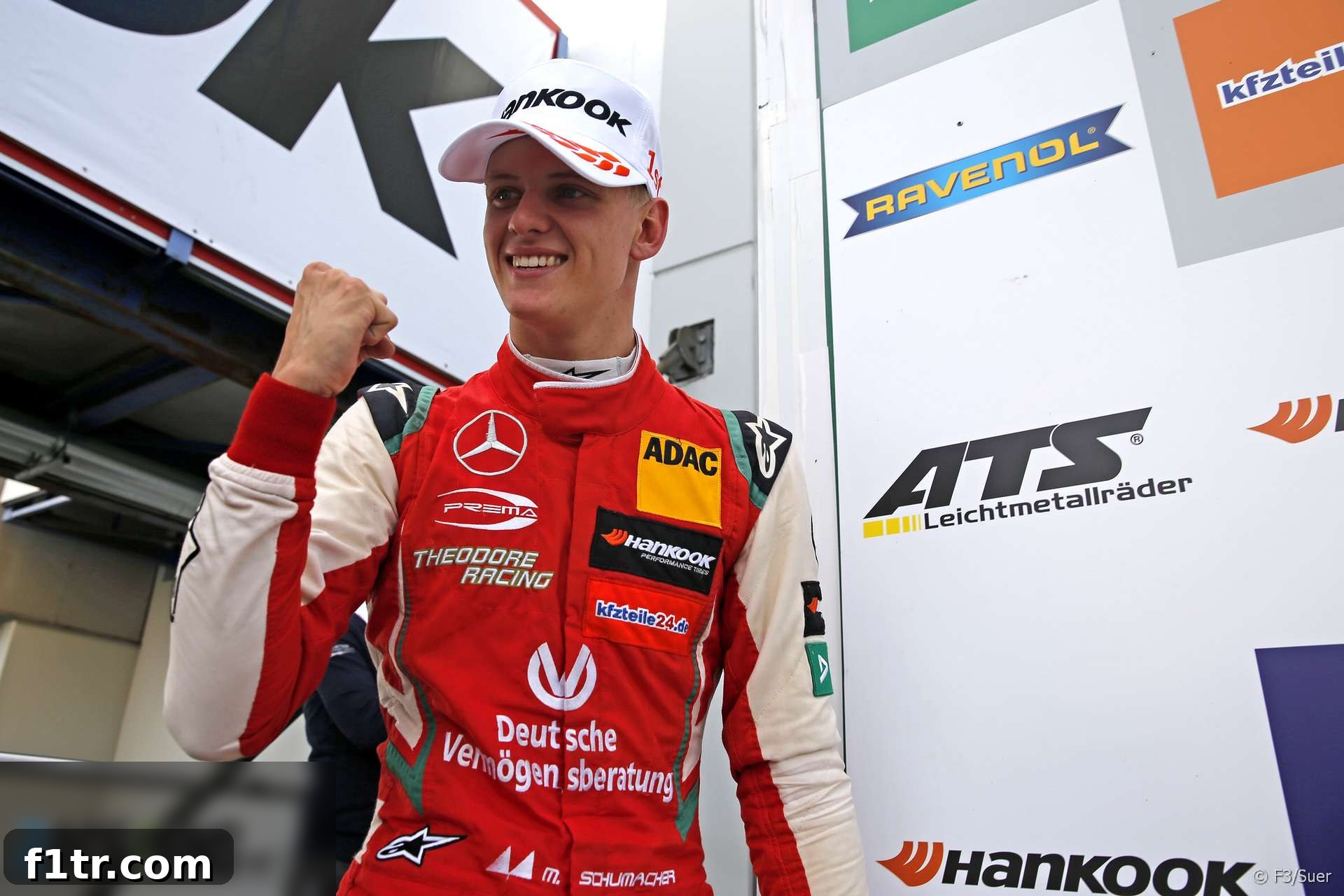
The motorsport world is abuzz with anticipation as Mick Schumacher, son of seven-time Formula 1 world champion Michael Schumacher, continues to make impressive strides in the European Formula 3 Championship. His recent mid-season surge has not only propelled him up the standings but has also firmly placed him on the radar of top Formula 1 teams, most notably Ferrari – the legendary constructor his father graced with an unparalleled era of dominance.
At just 19 years old, Schumacher has demonstrated remarkable talent and resilience. He has been in a blistering run of form, securing six victories in the last ten races. This incredible performance has seen him climb from a modest 10th position in the championship standings to an impressive second place, now trailing Red Bull-backed rival Dan Ticktum by a mere three points. Such a dramatic turnaround halfway through the season is a clear indicator of his burgeoning skill and potential, fueling speculation about his future in the upper echelons of motorsport.
The gravity of the Schumacher name, combined with Mick’s undeniable on-track success, has naturally drawn the attention of the F1 paddock. Ferrari, in particular, finds itself in a unique position. The bond between the Schumacher family and the Scuderia runs deep, forged during Michael’s era of five consecutive world championships with the team. Ferrari team principal Maurizio Arrivabene openly acknowledged Mick’s “very, very good” recent results, a testament to the young German’s talent. However, Arrivabene also urged caution, emphasizing the importance of allowing Mick to develop at his own pace, free from the immense pressure that inevitably accompanies his surname.
“The most important thing is to let him grow without giving pressure,” Arrivabene stated, fully aware of the historical weight of the Schumacher name within Ferrari’s storied legacy. He underscored that “the door at Maranello is always open, of course,” but cautioned against prematurely rushing Mick through the ranks. Arrivabene stressed the need for a measured approach, highlighting that such a decision would ultimately rest with the Schumacher family, ensuring Mick can “have fun” and “grow up slowly but certainly.” The sentiment was clear: while the allure of the Schumacher name is irresistible for Ferrari, the priority is Mick’s organic development rather than a hasty promotion based solely on legacy. “How can you say no, in Maranello, to a name like this?” he mused, encapsulating the complex mix of sentiment and strategy.
The path from junior categories to Formula 1 is notoriously challenging, and the step from Formula 3 to the pinnacle of motorsport is considered one of the most significant. Frederic Vasseur, team principal of Sauber (now Alfa Romeo Racing), a team that successfully brought Ferrari’s current rising star Charles Leclerc into F1 from F2 this year, shared a pragmatic view. Vasseur suggested that a direct leap from F3 to F1 in 2019 might be “too much, too soon” for Mick Schumacher.
“I think there is a huge step between F3 and F1 and with the small number of test days we have during the winter,” Vasseur explained. “I don’t want to say impossible because we will see, but it’s quite difficult to do the step.” He articulated the consensus among many within the sport that a transitional period in Formula 2 would be a more sensible and beneficial route for Schumacher. “It will make sense probably for him to do Formula Two or something like this,” he suggested, outlining a structured progression that allows young drivers to acclimatize to faster cars, more complex race strategies, and intense competition before tackling the ultimate challenge of Formula 1. Vasseur also highlighted alternative avenues for preparation, such as forging “a link with a Formula One team” or participating in “some FP1” (Free Practice 1) sessions, which provide invaluable experience and integration into an F1 environment without the full-time commitment.
Mick Schumacher’s journey into the competitive world of motorsport began not with the Schumacher name prominently displayed but initially as Mick Betsch, his mother’s maiden name. This move was a deliberate attempt to shield him from the intense scrutiny and expectations that would inevitably follow a child of Michael Schumacher. His early karting career was marked by steady progress and success, culminating in wins in various national and international championships. Transitioning to single-seater racing, he entered Formula 4 in 2015, immediately showcasing his raw speed and learning curve. His move to European F3 in 2017 with Prema Powerteam, a highly respected outfit, was a natural progression, preparing him for the rigorous demands of a championship widely regarded as one of the best proving grounds for future F1 talent. The F3 cars, with their significant downforce and powerful engines, are a critical stepping stone, demanding precision, aggression, and intelligent racecraft – qualities Mick has demonstrated in abundance during his standout 2018 season.
The shadow of Michael Schumacher’s legacy is both a blessing and a burden for Mick. Michael’s illustrious career, particularly his five world titles with Ferrari between 2000 and 2004, transformed him into a global icon and indelibly linked the Schumacher name with unparalleled success in Formula 1. For Mick, this translates into immediate recognition and unparalleled interest, but also the daunting expectation to emulate, or at least approach, his father’s achievements. Navigating this pressure while carving out his own identity as a racer is arguably Mick’s biggest challenge. So far, he has handled it with remarkable maturity, letting his driving do the talking and focusing on his own development rather than succumbing to external comparisons.
For Ferrari, the prospect of a Schumacher racing for them again is more than just a marketing dream; it could be a potent emotional and strategic asset. The Tifosi (Ferrari fans) hold a special place in their hearts for the Schumacher family, and the return of the name could ignite a new wave of passion. However, Ferrari, like any top team, must prioritize talent and readiness. Their approach to young drivers, exemplified by their investment in the Ferrari Driver Academy and the promotion of talents like Charles Leclerc through affiliated teams such as Sauber/Alfa Romeo and Haas, demonstrates a commitment to a structured development path. This pragmatic approach suggests that while the “door is always open,” it will open when Mick is truly ready, not before.
Advert | Become a Supporter & go ad-free
The step to Formula 2, as recommended by Vasseur, is widely considered crucial. F2 cars are powerful, challenging machines, often seen as miniature F1 cars, and the championship itself is highly competitive, featuring weekend formats that closely mirror F1. Success in F2 demonstrates a driver’s ability to manage high-pressure situations, execute complex race strategies, and perform consistently over a full season against a field of equally ambitious talents. Most F1 rookies in recent years, including George Russell, Lando Norris, and Alexander Albon, have come directly from successful F2 campaigns, underscoring its importance as the final proving ground.
Should Mick Schumacher move to F2 in 2019, he would likely be a strong contender, benefiting from the momentum of his F3 success. A year or two in F2 would provide him with the necessary experience and polish, making him a more complete and prepared driver for Formula 1. Opportunities for F1 integration, such as simulator work with a top team, test sessions, or even a few FP1 appearances during Grand Prix weekends, would further accelerate his learning curve, allowing him to familiarize himself with the F1 environment and procedures.
The future for Mick Schumacher looks incredibly bright, yet equally demanding. He possesses the raw talent, the competitive drive, and crucially, the revered surname that opens many doors. However, the ultimate key to his success will be his continued hard work, dedication, and the wisdom to choose the right developmental path. The excitement surrounding his potential F1 debut is palpable, but a patient and well-planned ascent through the junior ranks is paramount. The world awaits to see if Mick Schumacher can indeed write his own illustrious chapter in the annals of Formula 1, carving out a legacy that stands tall alongside, yet distinct from, that of his legendary father.
Advert | Become a RaceFans supporter andgo ad-free
2018 F1 season
- F1 feared “death knell” for Drive to Survive after Ferrari and Mercedes snub
- McLaren staff told us we were “totally crazy” to take Honda engines in 2018 – Tost
- ‘It doesn’t matter if we start last’: How Red Bull’s junior team aided Honda’s leap forward
- Honda’s jet division helped F1 engineers solve power unit problem
- McLaren Racing losses rise after Honda split
Browse all 2018 F1 season articles