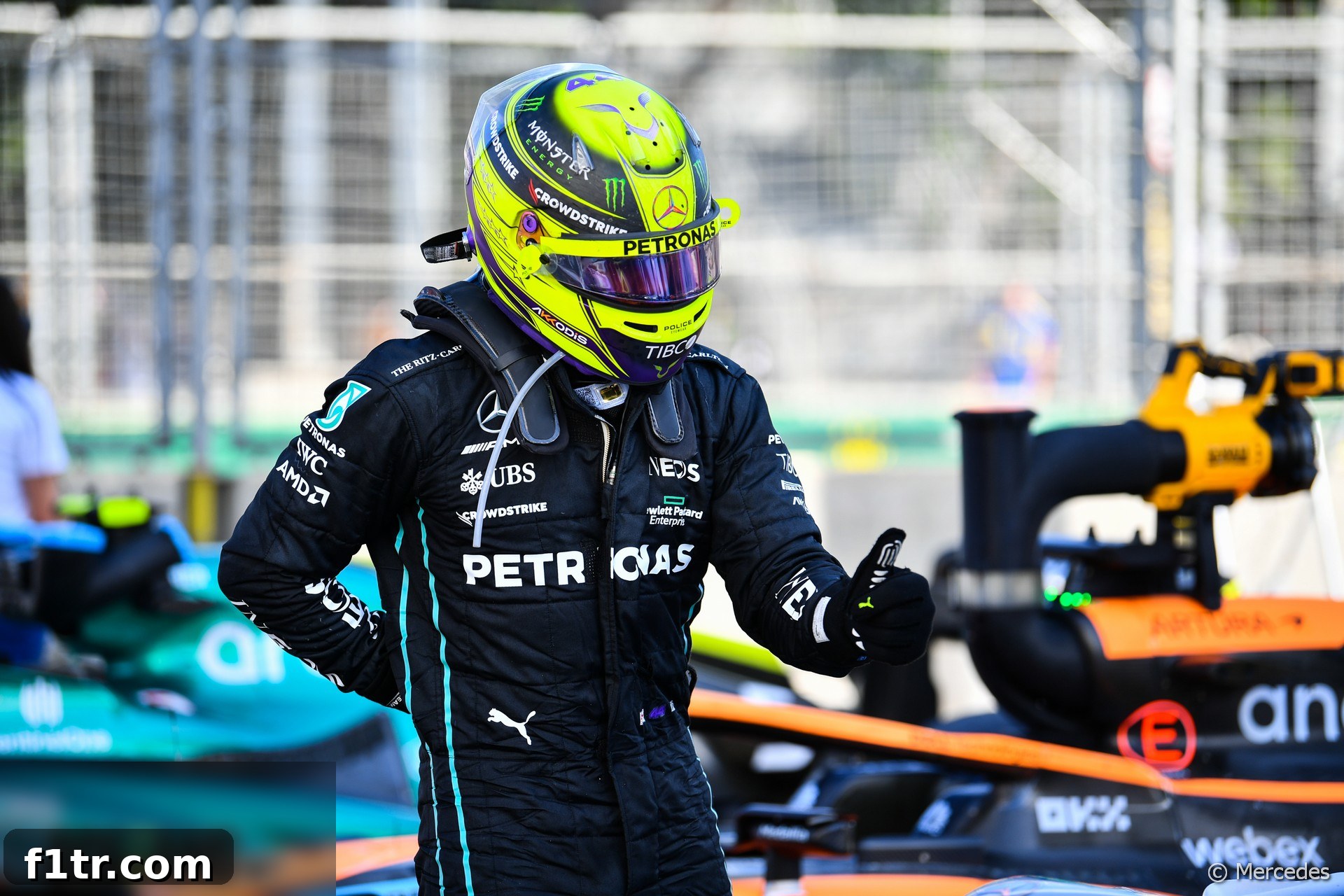
The punishing Azerbaijan Grand Prix served as a stark reminder of the immense physical toll Formula 1 racing can exact on its drivers, with none other than Lewis Hamilton visibly struggling with back pain at the race’s conclusion. His discomfort ignited fresh debate over the contentious phenomenon of ‘porpoising’ and its potential long-term health implications for those behind the wheel. The demanding Baku Street Circuit, known for its high speeds and tight corners, amplified the issue, pushing drivers and their cutting-edge machines to the absolute limit. This weekend diary offers an exclusive, behind-the-scenes glimpse into the challenges and drama unfolding across four intense days in Azerbaijan.
Thursday: The Grueling Journey and Paddock Insights
Embarking on the journey from London to Baku is rarely a simple affair, especially during a demanding Formula 1 season. Direct flights are notoriously scarce, and the official F1 charters fill up almost instantly. My own travel odyssey began at midday UK time, involving a flight to Hungary, a three-hour layover, followed by a final leg to Baku. This arduous journey spanned a good ten hours, stretched further by unforeseen delays, meaning I didn’t touch down in the Azerbaijani capital until just after 4 am on Thursday morning – a mere few hours before media obligations were set to commence. Despite the exhausting travel, as the first rays of dawn kissed the horizon and the city awoke with its early morning chorus, I made my way to the hotel, snatching a few precious hours of rest before an afternoon of engagements with the AlphaTauri drivers.
Thursdays at a Grand Prix are crucial for media, offering invaluable opportunities to connect with drivers and team principals before the track action truly begins. My schedule included a visit to the Haas garage, where I was slated to meet the team’s enigmatic principal, Guenther Steiner, and experienced driver Kevin Magnussen, but first, I had an exclusive session with Mick Schumacher. The young German, whose Formula 1 future has become increasingly uncertain following a string of high-profile incidents and costly crashes, sat to my right. A Netflix camera loomed, capturing every candid response as I posed questions about his next steps in the sport and the immense pressure he was undoubtedly under. His hands were clasped tightly in his lap, a subtle indicator of the intensity of the moment.
Following Schumacher’s session, his boss, Guenther Steiner, took his turn. Schumacher remained nearby, seated at an adjacent table, as the discussion once again turned to his future within the team. Steiner, known for his no-nonsense approach, was both tough and fair in his assessment of his driver’s performance, delivering remarkably straightforward answers to a barrage of questions. He emphasized the team’s precarious parts situation, making it abundantly clear that Haas could not afford any further costly damage. I directly inquired whether serious conversations would be necessary should Schumacher bend another chassis during the upcoming weekend. Steiner’s concise and pointed reply left no room for doubt: “I would say so.” This exchange underscored the immense pressure on young drivers and the unforgiving nature of Formula 1, where every mistake has significant financial and competitive repercussions.
Friday: Paddock Encounters and Press Day Dynamics
After an engaging media event on Thursday evening, I awoke relatively early, bracing myself for another of Formula 1’s notoriously long “2022-spec” Fridays. At least the official press conferences began at the more humane hour of 11:30 am. The morning walk to the circuit was a delightful experience; the modern, tall buildings of Baku glistened under the bright sunshine, creating a stunning backdrop as locals navigated their way to work, expertly dodging the numerous road closures that transform the city into a world-class racing circuit. This unique blend of urban life and high-octane motorsport always provides a fascinating atmosphere.
The media centre itself is conveniently located within the rather opulent Hilton Hotel, a favored accommodation choice for many teams. As I passed through its grand revolving doors, I was immediately greeted by a beaming Harry Bull, McLaren’s cheerful PR representative, patiently awaiting his driver, Lando Norris, who was en route to the first press conference of the day. The paddock, a hive of activity and guarded exclusivity, often feels like a world apart. Yet, amidst the controlled chaos, unexpected moments of connection sometimes arise.
After the formal press conferences had concluded, I paused briefly to exchange a few words with one of Lewis Hamilton’s dedicated security guards, only to realize I was inadvertently positioned directly in the seven-time world champion’s path. Much to my surprise, he flashed a warm smile and offered a friendly “hello” before swiftly dashing back into the heart of the paddock. Such an unscripted, direct encounter with a driver of Hamilton’s stature is exceptionally rare, particularly when he is seen “in the wild,” away from the usual throngs of fans and his team entourage. It offered a fleeting, personal glimpse into the human side of a global icon, usually only seen from afar.
Saturday: TikTok and Trackside Adventures
Entering the press conference room on Saturday morning, I was met with the unexpected sound of Toto Wolff, the distinguished Mercedes team principal, discussing none other than TikTok. Naturally, my journalistic curiosity was piqued, and I immediately interjected, asking if he, too, was lurking on the popular social media platform. With a chuckle, he replied, “No, but I had to give my email for some sort of verification, so who knows…” It was a lighthearted moment that offered a rare glimpse into the personal side of one of Formula 1’s most formidable figures, highlighting how even those at the sport’s pinnacle must engage with modern digital trends.
Later that day, seeking a different perspective, I opted to go trackside. My destination was the critical Turn 16, the last “proper” corner on the circuit. This particular turn is crucial, as a good exit sets up the immensely long, flat-out drag to the start/finish area – a prime overtaking spot. Getting to these trackside vantage points is an adventure in itself. We whizzed along the picturesque edge of the Caspian Sea in the back of a golf buggy, heading towards the far side of the circuit. Eventually, finding what appeared to be a permissible gap in the fencing, we were promptly stopped by local police. Explaining our purpose as journalists and pointing to our official tabards as proof of our trackside access, we were still met with considerable resistance.
After a series of discussions with no fewer than four different marshals, each scrutinizing our credentials, we were finally granted passage. However, our presence remained under constant surveillance; every ten minutes or so, various officials would approach us, specifically inquiring about the location of our cameras. This persistent questioning underscored the tight security and controlled environment of an F1 street circuit, where even accredited media face scrutiny to ensure compliance and safety. The qualifying session itself proved challenging for the written press in the media pen. A notable lack of television screens meant we were often left to piece together the unfolding drama based on limited information. The organizers, however, very kindly promised to arrange a dedicated screen for us on race day, a small but significant gesture to improve our working conditions.
Sunday: Race Day, Resilience, and the Porpoising Debate
Walking through the blistering streets of Baku on race day, I was struck by how unusually empty the city appeared. Typically, on a Grand Prix Sunday, the areas surrounding the circuit are a scene of vibrant chaos, with throngs of people bustling and rushing to gain entry to the track. I recalled the miles-long tailbacks experienced in Spain. The unexpected ease of walking into the venue with virtually no queues was, undoubtedly, a welcome bonus at this particular Grand Prix, offering a stark contrast to other popular events on the calendar.
Baku traditionally draws one of the smaller crowds of the Formula 1 season. This year, attendance had been further impacted by external factors, notably Russia’s invasion of Ukraine, as both countries historically constitute a significant portion of Azerbaijan’s tourism market. The paddock, a dynamic and often intense environment, is a relatively short walk from the media centre, but it’s a journey that demands careful time management, especially when one is rushing. Heading down to the grid for the exhilarating start of the race, I had a fortuitous encounter with Angela Cullen, Lewis Hamilton’s physiotherapist. Angela had been exceptionally busy throughout the weekend, tending to the reigning world champion’s back, which had endured immense punishment from Mercedes’ stiff 2022 car and the notoriously bumpy Baku track.
She greeted me with a huge, warm hug, and we briefly chatted about a subject close to both our hearts: female representation in the paddock. It’s a topic that resonates deeply, as there are still relatively few regular female written media journalists covering Formula 1. I shared my pride in being able to “fly the flag” for women in this highly competitive and often male-dominated environment, striving to inspire greater diversity. Although those of us in the media pen had finally been provided with a television screen to follow the race on, it was, unfortunately, positioned in direct sunshine, rendering it almost useless. Despite this minor setback, we remained fully alert to the significant developments of the afternoon, particularly the early appearance of two notably glum Ferrari drivers, signaling a challenging day for the Scuderia.
After the chequered flag had waved, marking the end of the race, Lewis Hamilton was among the very last drivers to speak to the media. I couldn’t help but notice he was still visibly clasping his back in discomfort, a clear indication of the pain he was enduring. Considering the punishing circumstances of the race, he was remarkably in relatively good spirits, yet the physical toll of 95 minutes of relentless porpoising and the car bottoming out was undeniably evident on him, as it was on many of his colleagues. When I inquired about his well-being, he candidly admitted it had been one of the toughest races of his illustrious career. “I don’t want to have that bouncing again,” he winced, adding with conviction, “I’ll do anything to avoid having that again.” His comments highlighted the serious health and safety concerns gripping the paddock.
However, a subsequent conversation with Red Bull team principal Christian Horner offered an entirely different and notably cynical take on the porpoising debate. Horner suggested that rival teams might be strategically exaggerating their concerns over porpoising in an attempt to push for rule changes that could benefit their own performance. This sharp contrast in perspectives underscored the complex interplay of driver welfare, team politics, and competitive advantage that often defines Formula 1. With those insightful, yet conflicting, viewpoints, our demanding weekend in Baku drew to a close. Despite a largely unexciting race on track, the Grand Prix undoubtedly provoked several compelling storylines, setting the stage for Formula 1’s highly anticipated and long-overdue return to Canada the following weekend.
2022 Azerbaijan Grand Prix
- FIA should black-flag cars if their porpoising endangers drivers’ safety – Horner
- Transcript: Why Norris reluctantly complied with McLaren’s Baku team orders
- Montreal is “going to hurt” in stiff 2022 cars say drivers hoping for bouncing fix
- Leclerc was heading to a ‘comfortable win’ before retirement – Ferrari
- F1 should penalise those who ‘obviously’ slow on purpose in qualifying – Norris
Browse all 2022 Azerbaijan Grand Prix articles