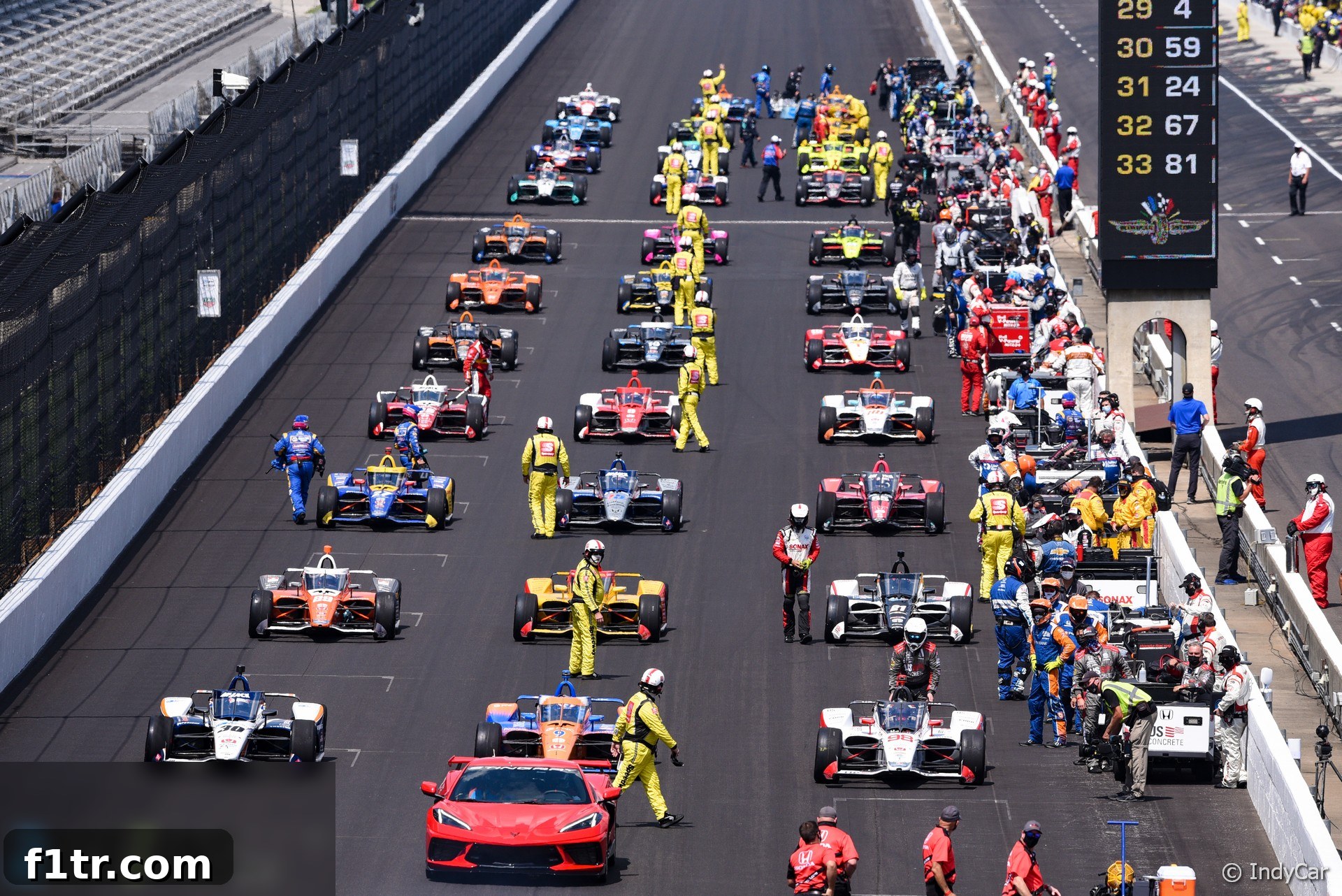
The 105th running of the Indianapolis 500 on Sunday promises to be an event steeped in unparalleled excitement, potentially rewriting the record books for speed and delivering the fierce, wheel-to-wheel competition that fans crave. After two exhilarating days of time trials, the elite 33-car field achieved an astonishing average qualifying speed exceeding 230 miles per hour over their grueling four-lap runs. Should race day conditions prove favorable, spectators could witness a new 500-mile speed record, surpassing the current benchmark of 186.563 mph (just over 300 kilometers per hour). This pursuit of raw velocity, while inherently thrilling, is just one facet of what makes the Indy 500 legendary. True racing aficionados yearn for more than just speed; they crave a dynamic spectacle, a race filled with plentiful opportunities for daring overtakes and relentless, side-by-side battling.
The memory of last year’s Indianapolis 500, held atypically in August and behind closed doors due to global health circumstances, still lingers, and not entirely for the right reasons regarding race quality. Drivers reported significant difficulties in making overtakes, leading to a race with a mere 21 lead changes – a stark contrast to the record 68 official lead changes seen in more competitive years. Beyond the predictable reshuffling during mid-race restarts, passing on track proved to be a formidable challenge. This struggle was largely attributed to the introduction of the protective aeroscreen on the Dallara IR18 chassis. While the aeroscreen undeniably achieved its primary objective of enhancing driver safety, its added weight and aerodynamic drag had unintended side effects, creating turbulent air that made close-quarters racing and following other cars incredibly difficult.
Recognizing the need to elevate the quality of racing for its flagship event, IndyCar proactively embarked on extensive aerodynamic research and development during the off-season. Beginning with a crucial test on October 29th, engineers meticulously examined various aerodynamic configurations. The primary goal was to mitigate the negative impact of turbulent air on the front wings and to enhance downforce, thereby making it easier for cars to follow closely and execute overtakes. The resulting modifications include the strategic addition of small winglets to the forward section of the car’s floor, coupled with optional barge boards positioned at the front of the sidepods. These subtle yet significant changes are designed to clean up the airflow, allowing cars to maintain more consistent downforce even when running in another car’s wake, promising a return to the exhilarating on-track action that defines the Indy 500.
This isn’t the first time IndyCar has grappled with aerodynamic challenges at the Indianapolis Motor Speedway. The IR18’s debut in the 2018 Indy 500 also saw drivers express concerns about the difficulty of following other cars, particularly when exiting corners at high speed. This immediately prompted further off-season testing and aero refinements, which ultimately led to a much-improved and widely praised 2019 race. Coincidentally, the 2018 event was also one of the hottest on record, with ambient temperatures soaring above 32°C (90°F). High temperatures significantly impact tire degradation and engine performance, adding another layer of complexity to the racing dynamic. Fortunately, this year’s forecast for the Indy 500 anticipates much cooler conditions, well below the “average” Indy 500 temperature of 25°C (77°F). This return to more temperate weather aligns perfectly with the race’s traditional May calendar slot and is expected to further contribute to closer, more exciting racing. If the aerodynamic enhancements, combined with cooler temperatures, deliver their intended effect, cars will be able to stick to each other through corners and carry more momentum, translating directly into a more competitive and thrilling race experience for everyone watching.
Beyond the technical innovations and favorable weather, the sheer caliber of the 33-driver field itself guarantees a race of exceptional quality. Nine of the competitors are past winners of the Indy 500 – the highest number of former champions to start the race since 1992. This incredible depth of talent ensures that almost every driver on the grid possesses the skill, experience, and hunger to contend for victory. But even more significant than the myriad contenders and the lingering questions of whether this race will etch itself into history as an all-time classic, a contemporary disappointment, or something in between, is the most welcome and sorely missed addition from last year: the passionate fans filling the stands of the Indianapolis Motor Speedway.
Operating at a carefully planned 40 percent capacity, the iconic Indianapolis Motor Speedway will warmly open its gates to an estimated 135,000 spectators. Should every available ticket be sold and every seat in the grandstands be filled, this colossal gathering would proudly stand as the largest sporting event globally since the initial wave of the novel coronavirus pandemic swept across the world last spring. This historic return of fans symbolizes far more than just a sporting spectacle; it represents a powerful beacon of hope and a tangible step towards reclaiming the sense of normalcy and collective experience that the world yearns for. The roar of the crowd, the vibrant atmosphere, and the shared anticipation will undoubtedly invigorate the drivers and create an unforgettable experience. As the checkered flag eventually falls, and the triumphant driver streaks across the hallowed yard of bricks to claim victory, we collectively hope that they, along with the 33 courageous drivers and every dedicated member of their crews, return home safely, carrying with them the memories of a truly special day at the Brickyard.
Dixon Leads IndyCar’s New Stars at the Front of a Formidable 33-Car Field
Among the nine previous Indy 500 winners gracing the starting grid, the venerable 2008 champion, Scott Dixon, stands out as the odds-on favorite for victory in 2021. Dixon’s illustrious career boasts six IndyCar championships and a staggering 51 career victories, making him the most successful active driver by a significant margin. Yet, for a driver of his unparalleled pedigree, a single Indy 500 triumph often feels like an insufficient mark on an otherwise flawless curriculum vitae. “A second Indy win is goal number one,” Dixon stated with conviction. “I think it’s the first goal that we set for the team all year, then you focus on the championship. That’s never changed. I think the first time you step into this place, come with one of the best teams, that’s the obvious sort of goal for us to try and achieve that.”
Dixon vividly recalled the frustration of last year’s race, where he led a phenomenal 115 laps but ultimately finished second to Takuma Sato. “Last year was frustrating,” he admitted. “Again, this place owes me nothing. We got to keep knocking on that door and hopefully one day again, one day soon, that opens up.” That “one day soon” could very well be this Sunday. However, to achieve his coveted second victory, Dixon will need to fend off a formidable challenge not only from the other eight previous winners and a host of seasoned veterans still seeking their first Indy 500 win but also from the burgeoning force of IndyCar’s dynamic youth movement. This new guard represents a serious threat to the established order.
Leading this exciting influx of young talent is a quartet of exceptionally gifted drivers, all under the age of 25, who have already claimed a race victory each this season: Colton Herta, Patricio O’Ward, Rinus VeeKay, and Dixon’s own Ganassi teammate, Alex Palou. These rising stars are strategically positioned within the first four rows of the grid, with Herta and VeeKay impressively starting alongside Dixon on the front row. Both young men are keenly focused on breaking a nearly 70-year-old record to become the youngest Indy 500 winner in history. O’Ward, who will launch his challenge from the fourth row, also remains eligible to break this prestigious age record, highlighting the immense potential and audacious ambition of this youthful contingent.
On the other side of the spectrum, among the former winners, 2018 champion Will Power endured a dramatic and harrowing qualifying session, ultimately starting from the very last row of the grid. He narrowly avoided the indignity of being bumped out of the field entirely, a fate that can befall even the most accomplished drivers at the Indy 500. “I had to hold it wide open – otherwise I wouldn’t make the show,” Power revealed after qualifying a woeful 32nd place, his last lap punctuated by a terrifying brush with the wall. Power’s struggles are emblematic of a broader challenge faced by the entire Penske fleet, a team typically synonymous with dominance at Indy. Rookie Scott McLaughlin, qualifying 17th, emerged as the sole relative bright spot for the storied camp. Reigning series champion Josef Newgarden qualified a disappointing 21st, while 2019 Indy 500 winner Simon Pagenaud found himself even further back in 26th position. This unexpected dip in form for Penske, one of the most successful teams in IndyCar history, adds another intriguing layer to the race narrative.
Furthermore, the Penske-supported upstart team, Paretta Autosport, and driver Simona de Silvestro had to fight tooth and nail just to secure the 33rd and final grid position. De Silvestro, the only woman in the race, drives for a team primarily staffed by women working as mechanics, engineers, spotters, and other crucial crew members. Their inspiring journey to make the grid against significant odds highlights the dedication and perseverance required to compete at this elite level and underscores the growing diversity within motorsport. This contrasts sharply with the fortunes of Chip Ganassi Racing, who demonstrated overwhelming strength by having all four of their drivers – Scott Dixon, Alex Palou, third-year driver Marcus Ericsson, and the legendary 2013 winner Tony Kanaan – advance to the Fast Nine qualifying session. At 46 years old, Kanaan’s presence is particularly poignant, as this will likely mark his final appearance at the iconic Indy 500, a fitting farewell for a beloved champion.
Andretti Autosport, another powerhouse team, experienced mixed results throughout time trials, with their fleet of cars spread across the grid. Alongside the impressive Colton Herta, former Indy winners Ryan Hunter-Reay and the fearless Alexander Rossi secured strong starting positions within the first four rows. Former pole winner James Hinchcliffe, after enduring agonizing struggles in 2018 and 2019 where he failed to qualify, made the race without drama this year, a testament to his resilience and the team’s improved performance. Andretti’s technical support has also proven invaluable for the two-car Meyer Shank Racing effort. Three-time Indy 500 winner Helio Castroneves, a fan favorite, will start from the third row as he continues his relentless quest to become only the fourth driver in history to achieve an elusive fourth Indy 500 victory. His teammate, Jack Harvey, also solidly qualified and is hoping for his own breakthrough performance at Indy. However, last year’s pole winner Marco Andretti found himself deep in the field this year, and a returning Stefan Wilson barely escaped the last-row shootout in Andretti Autosport’s fifth and sixth entries, respectively, highlighting the intense competition even within top-tier teams.
The narratives of aging athletes chasing elusive championships at the twilight of their careers are a compelling and timeless aspect of any sport, and the Indianapolis 500 is certainly no exception. Driver/owner Ed Carpenter, a beloved hometown favorite from Indianapolis, is making his 18th career start, fiercely determined to win his home race. He once again commands a fast car, impressively defying the challenges that his engine partner, Chevrolet, has faced in contrast to the rival Honda teams, proving that local pride and experience can overcome significant hurdles. Further back on the grid is the accomplished four-time national champion Sébastien Bourdais, who has amassed 37 victories over two uniquely brilliant stints in American open-wheel racing. Despite his decorated career, the Indy 500 victory remains elusive, having competed in eight previous starts without success – a major goal that continues to drive him.
The aforementioned Marco Andretti, a third-generation racing driver, is still passionately chasing the Indy win that agonizingly slipped away from him as a teenager in 2006. Another legacy driver hungry for his inaugural Indy 500 victory is Graham Rahal, who, at 32 years old, has accumulated 13 previous starts without a win. He aspires to follow in the esteemed footsteps of his father and team director, Bobby Rahal, the victorious 1986 winner. One could also persuasively argue that the clock may be beginning to tick for Josef Newgarden to finally claim his first Indy 500 win, even though he is still relatively young and very much in his competitive prime, having secured numerous championships and race wins elsewhere. The pressure to win at Indy is immense, even for the sport’s biggest stars.
Should there be an Indianapolis 500 upset in the making, reminiscent of the late Dan Wheldon’s shocking victory as a part-time entrant a decade ago, it could very well come from the fighting minnows of Dale Coyne Racing. Their duo of talented young drivers, piloting unexpectedly fast cars, have flown somewhat under the radar throughout practice and qualifying. The returning Ed Jones impressively upstaged Formula 1 legend Fernando Alonso in his 2017 Indy 500 debut with Coyne, demonstrating his raw speed and potential. Meanwhile, rookie Pietro Fittipaldi carries Indy 500 success in his very bloodline, as the grandson of two-time Indy winner Emerson Fittipaldi, a heritage that often fuels extraordinary performances. These under-the-radar contenders often produce the most memorable moments at the Brickyard.
Speaking of two-time Indy 500 winners, the eagerly anticipated return of Juan Pablo Montoya after a four-year hiatus further enriches an already competitive field with yet another seasoned champion. While his first race back proved challenging, and he hasn’t quite matched the blistering speed of his younger Arrow McLaren SP teammates O’Ward and Felix Rosenqvist, Montoya has demonstrably never lost the fierce competitive fire that defined his youth. His tactical brilliance and uncompromising aggression will make him a formidable presence on race day. And let’s not forget the two-time and defending champion of the Indianapolis 500, Takuma Sato. The seemingly ageless Sato possesses the remarkable ability to win this race for a third time, an extraordinary feat given that all of his Indy 500 victories would have occurred after his 40th birthday. Should this happen, any debate over who the greatest Japanese racing driver of all time is would undoubtedly begin and end with Sato standing above all others. Furthermore, he would instantly enter a different, more exclusive discussion, solidifying his place among the Indy 500’s greatest champions of the modern era. The stage is set for an epic showdown, where legends and rising stars alike will battle for glory in “The Greatest Spectacle in Racing.”
Starting Grid and Spotters’ Guide
Follow the Indy 500 with RaceFans
For live updates throughout Sunday’s Indy 500, follow RaceFans Live on Twitter:
- RaceFans Live on Twitter
IndyCar News and Features
- IndyCar driver McLaughlin cleared of injury after crashing through barrier at Barber
- Schumacher says his IndyCar feels like ‘an F2 car, just with better tyres’
- IndyCar “way faster than Formula 1” in some corners, says Grosjean
- FIA to award more F1 superlicence points to IndyCar drivers from 2026
- Schumacher to race full-time in IndyCar with RLL in 2026
Browse all IndyCar articles