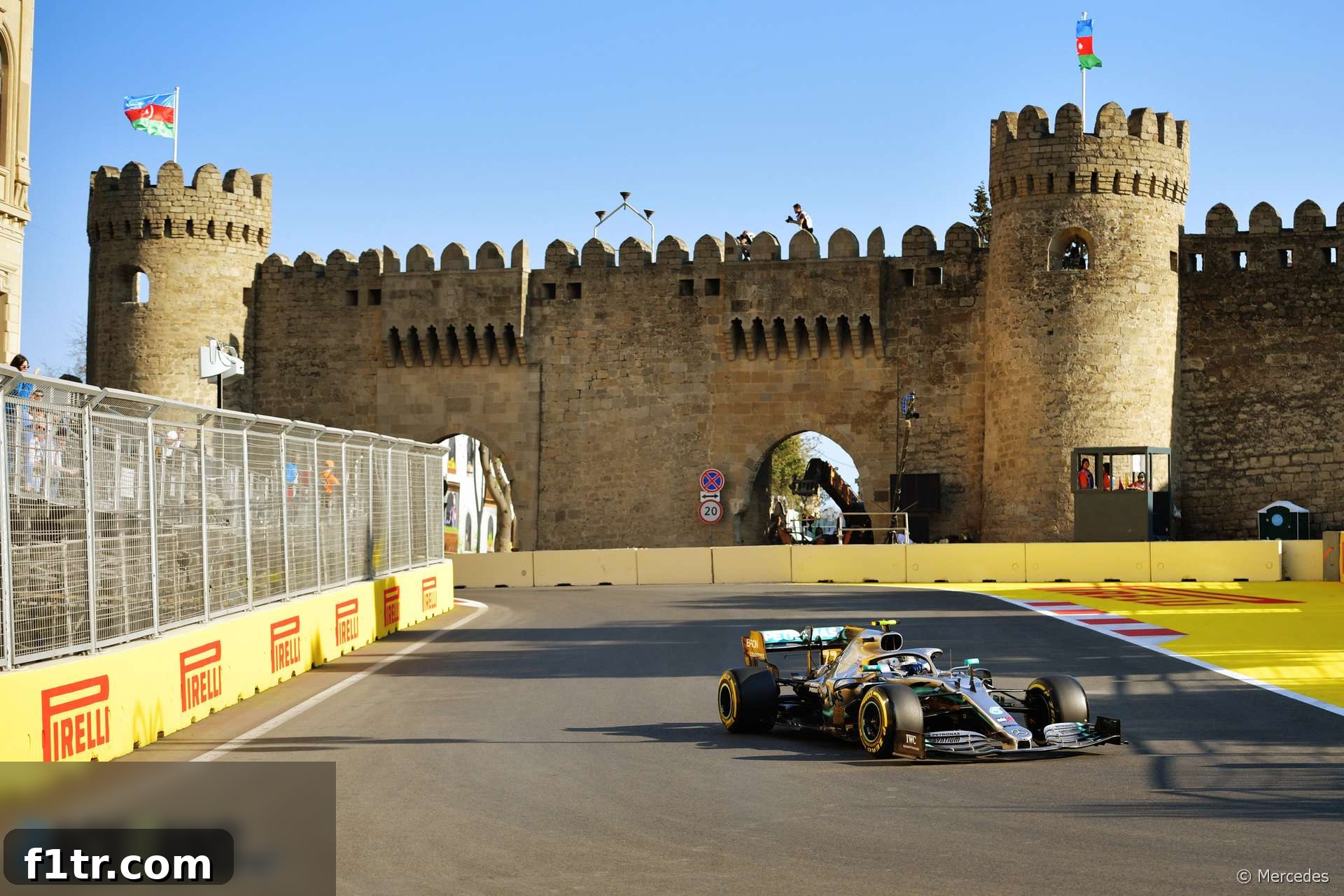
2019 Azerbaijan Grand Prix: Valtteri Bottas Claims Pole in Thrilling Baku Qualifying Session
The 2019 Formula 1 season delivered another captivating chapter at the challenging Baku City Circuit for the Azerbaijan Grand Prix. Renowned for its unique blend of incredibly high-speed straights and a notoriously tight, winding castle section, this street circuit consistently promises drama and unpredictability. The qualifying session for the 2019 event was no exception, unfolding as a thrilling spectacle that saw the Mercedes-AMG Petronas Motorsport team continue their formidable start to the season. Amidst intense competition, impressive individual performances, and several surprising incidents, it was Valtteri Bottas who ultimately emerged victorious in the battle for pole position, narrowly edging out his teammate Lewis Hamilton in a nail-biting finish.
Bottas’s blistering lap time of 1’40.495 secured him the coveted top spot on the provisional grid, marking a significant moment in his championship campaign. His performance underlined Mercedes’ dominance in the early stages of the 2019 season, placing them in a commanding position for Sunday’s race. The provisional starting grid, reflecting the qualifying results and subsequent penalties, set the stage for what promised to be an electrifying and strategically complex Grand Prix in the Azerbaijani capital.
The Provisional Starting Grid: Mercedes Secures a Commanding Front-Row Lockout
The qualifying session for the 2019 Azerbaijan Grand Prix cemented Mercedes’ formidable form, with both their drivers securing a crucial front-row lockout. This perfect start to the weekend highlighted the Silver Arrows’ strong package and the sheer talent of their drivers on a circuit that demands absolute precision, courage, and unwavering focus. The full provisional grid, including the qualifying times and team affiliations, is detailed below, providing a snapshot of the intense competition that unfolded on the streets of Baku. Each position tells a story of ambition, skill, and sometimes, unexpected challenges.
| Row 1 | 1. Valtteri Bottas 1’40.495 Mercedes |
|
| 2. Lewis Hamilton 1’40.554 Mercedes |
||
| Row 2 | 3. Sebastian Vettel 1’40.797 Ferrari |
|
| 4. Max Verstappen 1’41.069 Red Bull |
||
| Row 3 | 5. Sergio Perez 1’41.593 Racing Point |
|
| 6. Daniil Kvyat 1’41.681 Toro Rosso |
||
| Row 4 | 7. Lando Norris 1’41.886 McLaren |
|
| 8. Charles Leclerc No time Ferrari |
||
| Row 5 | 9. Carlos Sainz Jnr 1’42.398 McLaren |
|
| 10. Daniel Ricciardo 1’42.477 Renault |
||
| Row 6 | 11. Alexander Albon 1’42.494 Toro Rosso |
|
| 12. Kevin Magnussen 1’42.699 Haas |
||
| Row 7 | 13. Lance Stroll 1’42.630 Racing Point |
|
| 14. Romain Grosjean 1’43.407 Haas |
||
| Row 8 | 15. Nico Hulkenberg 1’43.427 Renault |
|
| 16. George Russell 1’45.062 Williams |
||
| Row 9 | 17. Antonio Giovinazzi* 1’42.424 Alfa Romeo |
|
| 18. Robert Kubica** 1’45.455 Williams |
||
| Row 10 | 19. Kimi Raikkonen*** 1’43.068 Alfa Romeo |
|
| 20. Pierre Gasly**** No time Red Bull |
Analyzing the Top Contenders and Midfield Surprises
The battle at the very front of the grid was, as anticipated, a fierce contest primarily between the Mercedes and Ferrari drivers. Valtteri Bottas’s sensational final lap secured him pole position by a razor-thin margin of just 0.059 seconds over teammate Lewis Hamilton. This exceptional performance underscored Bottas’s impressive start to the 2019 season, demonstrating his growing confidence, raw pace, and ability to deliver under pressure. Hamilton, despite missing out on pole by such a slender gap, ensured a critical Mercedes front-row lockout, placing the dominant Silver Arrows in a commanding strategic position for the race.
Sebastian Vettel, driving for Ferrari, secured the third spot on the grid, just over three-tenths behind Bottas. While a strong starting position, it highlighted Ferrari’s continued struggle to convert their strong practice pace into pole positions, especially after his teammate Charles Leclerc’s unfortunate crash in Q2. Max Verstappen, representing Red Bull Racing, continued to demonstrate his impressive consistency and blistering speed, qualifying in a strong fourth place. His performance was crucial for Red Bull, firmly establishing them as key contenders should the Mercedes falter or if strategic opportunities arise during the race.
The midfield battle, as always, proved to be incredibly tight and full of standout performances. Racing Point’s Sergio Perez delivered a truly remarkable lap to qualify fifth, showcasing both the potential of his car and his exceptional skill on demanding street circuits like Baku. Daniil Kvyat, in the Toro Rosso, also impressed significantly by securing sixth place, further solidifying his return to form in Formula 1. These results were particularly noteworthy given the strong aspirations and capabilities of the McLaren and Renault teams in the competitive midfield pack.
Lando Norris, the promising young McLaren sensation, continued to impress in his rookie season by qualifying seventh. His consistent pace, maturity beyond his years, and ability to extract maximum performance from his car were evident throughout the session. Unfortunately, Charles Leclerc’s weekend took a dramatic turn during Q2 when he lost control and crashed at Turn 8, bringing out a red flag. Despite showing immense potential and having looked like a genuine pole contender earlier in the weekend, the incident meant he failed to set a time in Q3 and was provisionally placed eighth. This forced the Ferrari driver to face an immense challenge, needing to fight hard and strategically manage his race from further down the grid.
Rounding out the provisional top ten were Carlos Sainz Jnr for McLaren in ninth position, further illustrating the team’s upward trajectory and improved competitiveness, and Daniel Ricciardo for Renault in tenth. Ricciardo’s performance was a solid effort for the French manufacturer, placing him in a reasonable scoring position, albeit with the task of navigating the challenging opening laps.
The Drama of Penalties: Reshaping the 2019 Azerbaijan Grand Prix Grid
The 2019 Azerbaijan Grand Prix qualifying session was not only defined by thrilling fast laps and intense competition but also by a series of significant penalties that dramatically reshaped the provisional starting grid. These sanctions, an integral part of Formula 1 regulations designed to ensure technical compliance and fair play, are often a source of frustration for drivers and teams alike. For Baku, these penalties had a profound impact, adding layers of complexity, strategy, and intrigue to the Sunday race, forcing several talented drivers to start out of position and undertake recovery drives.
Antonio Giovinazzi faced a substantial ten-place grid penalty, a direct consequence of exceeding the allowed number of power unit elements for the season. This meant that despite his on-track qualifying time of 1’42.424, which would have placed him significantly higher, he was relegated to the 17th position on the grid. Such penalties highlight the delicate balance teams must maintain between performance upgrades, reliability, and strict engine component limits throughout a demanding F1 calendar, often forcing difficult strategic decisions regarding power unit management.
Robert Kubica, driving for Williams, endured a particularly challenging weekend marked by a significant crash during Saturday’s qualifying session. Following the incident, his team opted for extensive set-up changes to his car. According to Formula 1 regulations, undertaking such changes after qualifying mandates a pit lane start for the race. This strategic choice, while allowing the team to make crucial adjustments and repairs to ensure the car was safe and competitive, meant Kubica would commence the Grand Prix from the very back of the field, facing an uphill battle on the unforgiving streets of Baku.
Kimi Räikkönen’s qualifying result also faced invalidation, leading to a mandatory pit lane start. The veteran Alfa Romeo driver was regrettably excluded from the qualifying results after his car failed a stringent front wing deflection test during post-session scrutineering. This technical infringement, even if deemed minor by some, directly contravenes strict FIA regulations designed to prevent aerodynamic advantages gained through flexible components. His exclusion was a significant blow for Alfa Romeo, further diminishing their prospects for scoring valuable championship points from their initial grid positions.
Perhaps the most penalized driver of the entire weekend was Red Bull’s Pierre Gasly, whose weekend was plagued by a cascade of infringements, ultimately leading to a pit lane start. Firstly, he missed the mandatory weigh bridge during a free practice session, an oversight that carries an immediate and unavoidable pit lane start order. This was then compounded by a five-place grid penalty for an unscheduled gearbox change, a critical component whose premature replacement carries mandatory sanctions to discourage strategic component swaps. Finally, and most severely, he was disqualified from the qualifying results for exceeding the maximum fuel flow limit during his fastest qualifying lap. This unprecedented trifecta of penalties underscored a challenging and error-strewn weekend for the young Frenchman, forcing him to commence the race from the most disadvantageous position imaginable and embark on a formidable recovery drive.
The Unpredictable Challenge of the Baku City Circuit
The Baku City Circuit is justly celebrated for its unique blend of attributes, making it one of the most exciting and unpredictable venues on the Formula 1 calendar. Its ultra-long main straight, where cars exceed staggering speeds of 340 km/h, presents prime overtaking opportunities, thrilling drivers and spectators alike. Conversely, the narrow, winding sector around the old city walls demands pinpoint accuracy, unwavering courage, and absolute precision from every driver. These contrasting characteristics often lead to thrilling races, replete with multiple safety car periods, bold strategic gambles, and a penchant for delivering unexpected outcomes. The 2019 qualifying session, with its share of on-track incidents and numerous grid penalties, only served to heighten the anticipation for Sunday’s Grand Prix, promising a spectacle of high-speed drama and tactical brilliance.
Looking Ahead to Race Day: High Stakes in Azerbaijan
With Valtteri Bottas on pole position, flanked by his formidable teammate Lewis Hamilton, Mercedes had established a formidable advantage on the starting grid. However, the unique and often unpredictable nature of the Baku City Circuit, combined with the presence of strong competitors like Sebastian Vettel and Max Verstappen right behind them, meant that nothing was guaranteed. The various grid penalties also introduced an intriguing element of chaos, with several fast and determined drivers starting out of position, eager to make up ground and climb through the field.
The 2019 Azerbaijan Grand Prix was perfectly poised to be a tactical masterclass and an ultimate test of nerve for all twenty drivers. They would battle not just each other, but also the unforgiving street circuit itself, renowned for punishing even the slightest error. Fans worldwide eagerly awaited the green light, anticipating a race that would undoubtedly add another memorable and dramatic chapter to the rich history of Formula 1.
Advert | Become a RaceFans supporter andgo ad-free
2019 Azerbaijan Grand Prix
- Leclerc impressed by Binotto’s handling of Baku crash
- Top ten pictures from the 2019 Azerbaijan Grand Prix
- 2019 Azerbaijan Grand Prix Star Performers
- Mercedes start season with record-breaking fourth consecutive one-two
- Paddock Diary: Azerbaijan Grand Prix day four
Browse all 2019 Azerbaijan Grand Prix articles
2019 F1 grids
Browse all 2019 F1 grids