FIA Revamps Formula 1 Penalty Guidelines for 2026 Season: Enhancing Driver Conduct and Race Integrity
The Fédération Internationale de l’Automobile (FIA) has announced significant revisions to Formula 1’s Penalty Guidelines, set to take effect for the highly anticipated 2026 season. These updates aim to refine the standards of driver conduct, ensuring fairer competition and increased safety across the pinnacle of motorsport. With new technical regulations also on the horizon for 2026, these revised guidelines underscore the FIA’s commitment to maintaining clarity and consistency in stewarding decisions.
Central to these changes is a comprehensive overhaul of the section pertaining to ‘causing a collision’. This particular area has historically been a source of debate and contention, highlighting the fine line between aggressive, hard racing and dangerous, unsporting conduct. The new wording provides stewards with more precise frameworks for evaluating incidents, ranging from the most innocuous contact to actions deemed extremely severe.
Clarifying Collision Penalties: From Minor Touches to Extreme Intent
One of the most welcomed clarifications within the updated guidelines addresses the nature of contact between cars. The document explicitly states that the mere existence of contact is no longer sufficient grounds for a penalty. This means that “A ‘collision’ which involves very minor contact e.g. a touch or ‘kiss’ may result in no penalty.” This particular amendment seeks to encourage closer racing and allow drivers more latitude for wheel-to-wheel battles without fear of instant reprimand for every brush. It acknowledges the inherent physicality of racing at the elite level and aims to differentiate genuine racing incidents from deliberate fouls.
However, while minor contact might be overlooked, the FIA has simultaneously armed its stewards with far greater powers to penalise the most serious infractions. The guidelines now stipulate that where a driver is found to have caused a collision “with apparent deliberate or reckless intent,” the consequences can be draconian. For “very extreme cases,” the updated document states that penalties could extend to “disqualification or suspension from the next race.” This significant escalation in potential sanctions serves as a powerful deterrent against dangerous driving and malicious actions, sending a clear message that such conduct will not be tolerated in Formula 1.
This stark increase in potential penalties for deliberate or reckless actions represents a pivotal shift. Historically, proving intent has been a challenging aspect for stewards, often leading to subjective decisions. By explicitly defining “very extreme cases” and outlining the potential for disqualification or suspension, the FIA aims to provide a clearer framework for dealing with the most egregious breaches of sporting conduct. Such penalties are rarely seen in modern Formula 1, making their inclusion a testament to the FIA’s intent to crack down on any actions that could genuinely endanger competitors or bring the sport into disrepute.
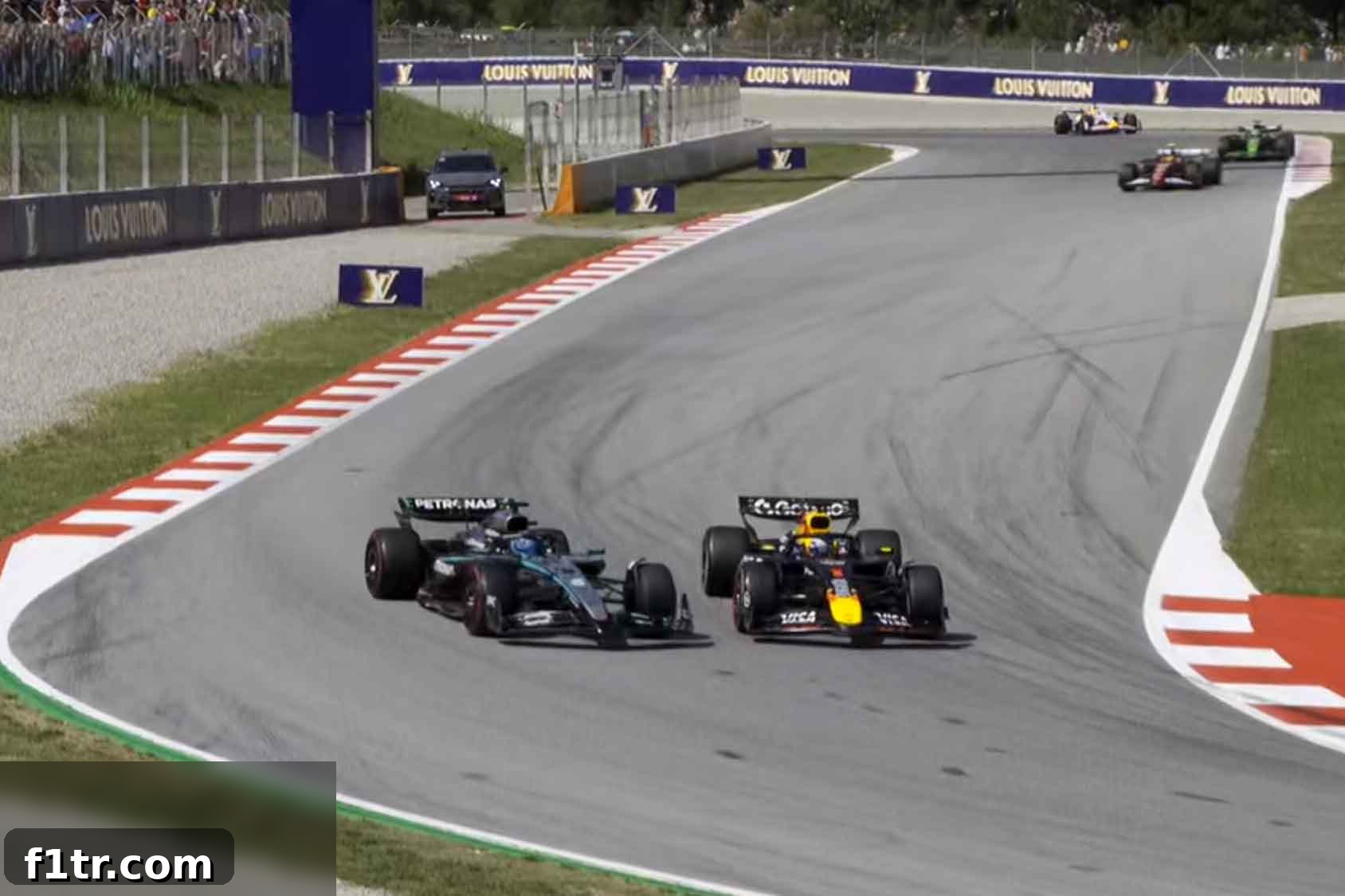
As was the case last year, the standard penalty for incidents deemed to involve “apparent deliberate or reckless intent” remains a 10-second stop-and-go penalty, coupled with four penalty points on a driver’s super license. While this specific penalty was not issued to any driver last season, its retention highlights the FIA’s consistent approach to serious, albeit not “very extreme,” transgressions. The only driver to receive as many as three penalty points for contact in the previous season was Max Verstappen, during the Spanish Grand Prix, demonstrating the high threshold for such sanctions even before these latest revisions.
In the aforementioned Spanish Grand Prix incident, the Red Bull driver also received a 10-second time penalty for colliding with George Russell. It is crucial to note that this was a standard time penalty, not the more punitive stop-and-go variety, and the stewards explicitly did not describe that particular collision as “deliberate” or “reckless”. This distinction further illustrates the nuanced approach taken by the stewards, who carefully evaluate each incident based on the available evidence and the precise wording of the regulations. The updated guidelines aim to provide even greater clarity in such assessments, ensuring that penalties are proportionate to the severity and intent behind the action.
Reinforcing Fair Play: Forcing a Driver Off Track
Beyond collisions, another critical area addressed by the new guidelines is the offence of “forcing a driver off the track.” This maneuver, often seen during aggressive overtaking attempts or defensive blocking, directly impacts track limits and the integrity of racing lines. Previously, stewards had the discretion to issue tougher penalties if a driver committed this offence “recklessly”. The updated definition significantly broadens this scope, now encompassing actions taken “recklessly or dangerously or deliberately.”
This expanded phrasing empowers stewards to address a wider range of scenarios where a driver compromises a competitor’s racing space in an unfair manner. The inclusion of “dangerously” explicitly highlights the safety implications of such actions, while “deliberately” directly targets malicious intent. This ensures that whether a driver aggressively squeezes another off track out of poor judgment, in a perilous manner, or with clear intention, the stewards have the appropriate regulatory tools to impose a suitable penalty. It reinforces the principle that drivers must afford each other fair racing room, particularly at high speeds where even minor deviations can lead to significant incidents.
Enhanced Safety Car Procedures: Precision and Safety First
Following allegations and discussions surrounding incidents during Safety Car periods in the previous season, the relevant guidelines have also undergone a significant rewrite. Safety Car procedures are paramount for managing track conditions and ensuring driver safety during hazardous situations. Any ambiguities or inconsistencies in their application can have serious consequences.
The former infringement of “failing to keep within 10 car lengths of the car in front” has been revised for greater precision and flexibility. It now reads: “failing to keep within maximum allowable gap to the car in front.” This change allows race control to define the specific gap that must be maintained, adapting it to various track layouts, conditions, and the specific phase of the Safety Car deployment. This move away from a fixed “10 car lengths” rule introduces a dynamic element, potentially preventing scenarios where strict adherence to a static rule might inadvertently create bunching or other unsafe situations. It gives the race director more control and adaptability, ensuring optimal safety during crucial phases of a Grand Prix.
Furthermore, the revised guidelines clarify that only “incidents with significant safety implications” will attract penalty points during Safety Car periods. This pragmatic approach suggests a focus on genuine safety breaches rather than minor procedural infractions that do not pose a direct threat. It aims to reduce the instances of drivers receiving penalty points for trivial errors, reserving these sanctions for actions that genuinely compromise the safety of the field or the efficacy of the Safety Car operation.
The Evolving Role of Stewards and the Pursuit of Consistency
These comprehensive revisions to Formula 1’s Penalty Guidelines reflect the FIA’s ongoing commitment to evolving the sport’s regulatory framework. The role of the stewards is undeniably one of the most challenging in motorsport, requiring them to make split-second decisions under immense pressure, often with vast implications for championship outcomes. The goal of these updated guidelines is to provide them with clearer, more robust criteria upon which to base their judgments, fostering greater consistency and reducing the element of subjectivity where possible.
By articulating distinct categories for collisions, from minor contact to those involving deliberate or reckless intent, and by expanding the definition of forcing a driver off track, the FIA aims to create a more transparent and equitable system. This not only aids the stewards in their difficult task but also provides drivers with a clearer understanding of the boundaries of acceptable conduct, which is vital for fair competition.
The introduction of harsher penalties for “very extreme cases,” including disqualification or suspension, underscores a zero-tolerance policy for actions that deliberately endanger competitors or bring the sport into disrepute. While such instances are rare, their impact is profound, as illustrated by historical precedents such as the infamous collision between Ayrton Senna and Alain Prost in 1990 – an incident that might well attract the description “very extreme” under today’s definitions.
Ultimately, these revised guidelines are designed to uphold the integrity of Formula 1. They seek to strike a delicate balance: promoting thrilling, wheel-to-wheel racing that fans adore, while simultaneously safeguarding the drivers and ensuring that competition remains fair and within the bounds of sporting ethics. As Formula 1 hurtles towards its exciting 2026 season with new technical landscapes, these refined penalty guidelines will play a crucial role in shaping driver behaviour and the spectacle of Grand Prix racing.
The updated Penalty Guidelines can be read in full here, providing comprehensive details on all the amendments and their implications for the future of Formula 1.