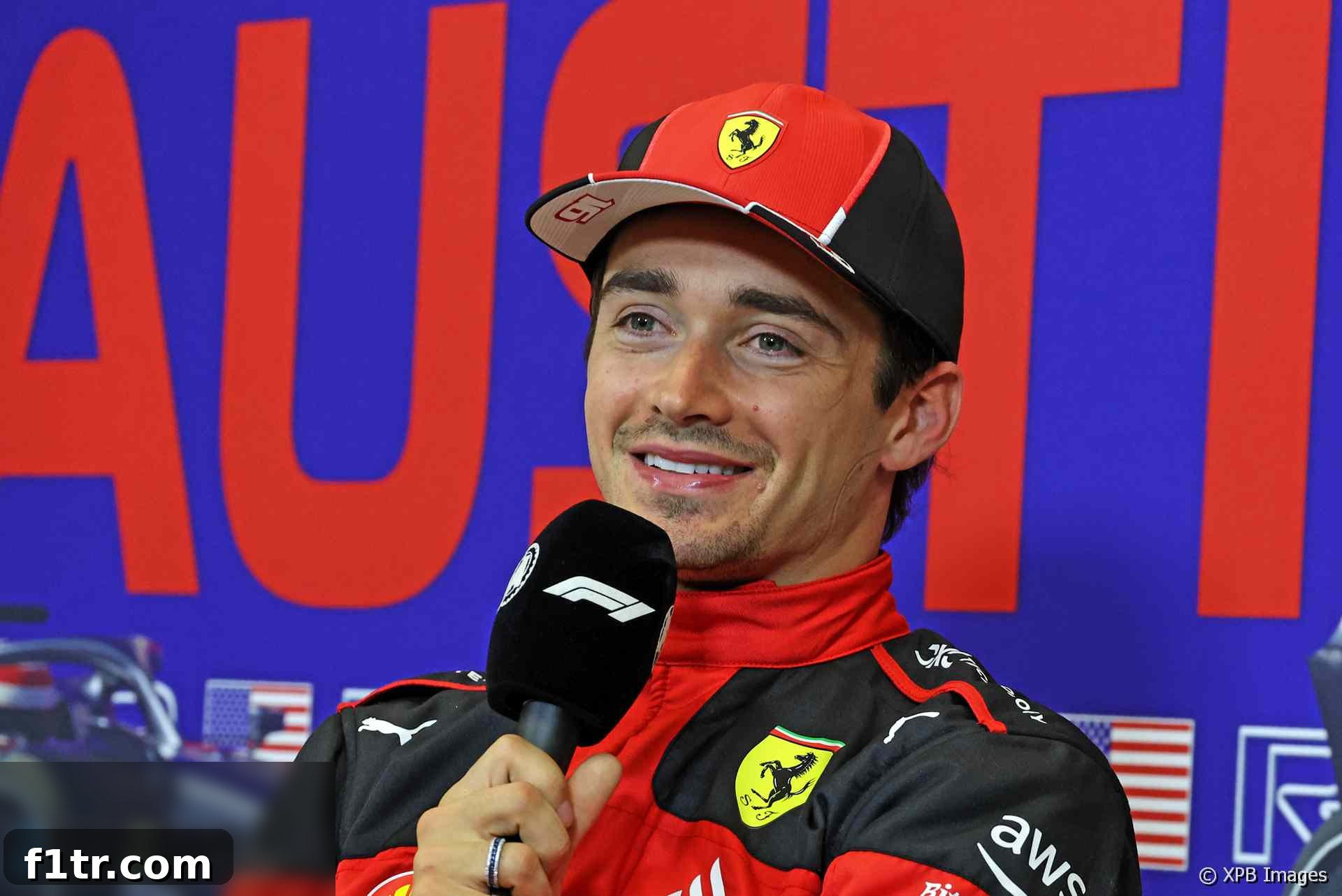
In a season often defined by Red Bull’s dominance and Ferrari’s fluctuating fortunes, Charles Leclerc delivered a masterful performance to snatch pole position for the United States Grand Prix. His unexpected triumph at the Circuit of the Americas (COTA) was not just a testament to his raw speed but also highlighted the enigmatic nature of Ferrari’s SF-23 car. Following his impressive qualifying lap, Leclerc candidly admitted that he had long abandoned attempts to predict where Ferrari would truly be competitive, underscoring the team’s perplexing journey through the 2023 Formula 1 season.
The Scuderia Ferrari’s performance graph throughout the year has been anything but linear. Prior to the summer break, the iconic Italian team found itself outscored by both Mercedes and Aston Martin, struggling to consistently challenge at the sharp end of the grid. Yet, glimpses of their potential were evident, notably when they broke Red Bull’s formidable streak of pole positions in Azerbaijan earlier in the season. This unpredictable competitive ebb and flow has been a recurring theme, keeping both the team and its dedicated fanbase on tenterhooks.
However, a noticeable shift began to occur in the latter half of the championship. Ferrari started to turn their season around, culminating in a landmark victory in Singapore, where they became the only team to beat Red Bull to a grand prix win in 2023. This resurgence has seen them steadily climb the constructors’ standings, overtaking Aston Martin and significantly closing the gap on Mercedes in the four rounds leading up to the race in Qatar. The momentum was clearly building, but even with this renewed vigor, the COTA pole position was a delightful surprise.
Leclerc’s journey to pole at the Circuit of the Americas was far from straightforward. The sole practice session saw him finish a respectable second, just a tenth of a second behind the formidable Max Verstappen. Despite this promising start, the Ferrari driver revealed he harbored no serious expectations of securing pole position at that point. “I don’t think anymore, I stopped thinking a long time ago, because this year I cannot quite understand where we are,” Leclerc stated, articulating the frustration and bewilderment that has often accompanied Ferrari’s 2023 campaign. He emphasized the difficulty in anticipating the team’s competitive standing from one weekend to the next.
“For now, we are just focused on ourselves. The car felt good,” he continued, reflecting on the practice session. “I was positively surprised because even if everything felt really good, I did not expect to be fighting for pole.” This admission perfectly encapsulates the underlying unpredictability that has characterized the SF-23’s performance envelope. One weekend the car struggles for pace, the next it can challenge for the top spots, making it a constant puzzle for the engineers and drivers alike. This fluctuating form demands a different kind of mental resilience from the drivers, one where expectations must be managed and opportunities seized when they unexpectedly arise.
The Austin circuit is renowned for being one of the bumpiest tracks on the Formula 1 calendar, a characteristic that appeared to have intensified since its last race twelve months prior. This specific track condition played unexpectedly into Ferrari’s hands. Leclerc highlighted that the SF-23’s ride quality, often considered a strength, proved particularly advantageous on the challenging Texas asphalt. “It’s very bumpy here and the car definitely felt good on bumps today, which gives you quite a bit of confidence to push in all the high-speed, which normally is our weakness,” he explained. This insight is crucial, as it suggests that certain track characteristics can either expose or mask a car’s inherent design traits.
Ferrari’s SF-23 has, at times, struggled with high-speed corners, but at COTA, its ability to handle the bumps allowed Leclerc to maintain confidence and push harder through those sections, effectively negating some of their typical disadvantages. “Maybe because our car was good on those bumps, we could at least match the others,” he pondered. Furthermore, the car’s established strengths in medium and low-speed corners contributed significantly to its overall competitiveness around the demanding American track. “Our car was strong in the medium and low speeds. So again, it’s very difficult to understand where you’re going to be coming into a weekend. But for some reason, this weekend, we are the strongest until now, which is good,” Leclerc concluded, his words echoing the team’s ongoing quest to unlock the car’s full, yet elusive, potential.
Despite his inherent uncertainty regarding the SF-23’s weekend-to-weekend competitiveness, Leclerc affirmed that Ferrari has gained a far deeper understanding of the car’s behavior compared to the early stages of the season. This learning curve has been instrumental in their improved form. “We’ve learned a massive amount since the start of the second part of the season,” he revealed. This period of intense analysis and refinement, rather than significant aerodynamic upgrades, has been the catalyst for their progress. “We haven’t brought massive upgrades since then but we learned how to maximise our car.” This learning process involved a meticulous review of data, extensive simulator work, and a closer collaboration between engineers and drivers to fine-tune setups and extract optimal performance from the existing package.
This enhanced understanding has translated into more consistent performances, allowing Ferrari to operate closer to their theoretical maximum more regularly. “That helped us to be a bit more regularly at our 100% and today is once again the proof. So it’s a good time for the future,” Leclerc stated, expressing optimism for what this newfound insight could mean for the remainder of the 2023 season and into the critical development phase for the 2024 challenger. The ability to consistently hit their performance targets, even if those targets vary from circuit to circuit, is a significant step forward for the Maranello-based squad.
The qualifying session itself was a nail-biting affair, culminating in a dramatic conclusion. Leclerc’s pole position time was initially narrowly eclipsed by Max Verstappen’s final effort in Q3. However, the Red Bull driver’s blistering lap was subsequently deleted due to a track limits infringement at Turn 19, an all-too-common occurrence on modern F1 circuits. This penalty elevated Leclerc back to the top spot, sealing a pole position that felt both earned and fortuitous. Reflecting on his own Q3 laps, Leclerc admitted there was still more pace to be extracted from his final run, but expressed satisfaction with his overall approach to the session.
“The first one was much cleaner, I put more or less everything together,” he described, highlighting a measured and precise initial attempt. “The second lap was a bit more ‘let’s go for it and see what happens’. And when you have this kind of mentality, then you have a bit more mistakes.” This strategic distinction between a safe banker lap and an all-out, risk-laden charge is a hallmark of top-tier qualifying. Despite a few minor errors on his audacious final attempt, Leclerc felt the increased risk was worthwhile. “But all in all, I gained more by taking risks than what I’ve lost with a small mistake. So it was just a bit more difficult to put everything together once I started really pushing in that last lap, but it paid off. So I’m happy.” His contentment stemmed from the successful execution of a high-risk, high-reward strategy, demonstrating both his driving prowess and his mature approach to pressure situations. This pole position, therefore, represented more than just a single fast lap; it was a symbol of Ferrari’s improving understanding, Leclerc’s undiminished talent, and the thrilling unpredictability that still resides within Formula 1.
2023 United States Grand Prix
- US GP was Mercedes’ best race of 2023 despite disqualification – Wolff
- Singapore and Austin retirements cost me top 10 championship place – Ocon
- United States Grand Prix result unchanged as FIA rejects Haas’ call for review
- Sargeant admits he’s ‘struggled to use all the downforce at times’ in F1
- Mercedes’ Brazilian GP set-up was “conservative” after US GP disqualification
Browse all 2023 United States Grand Prix articles