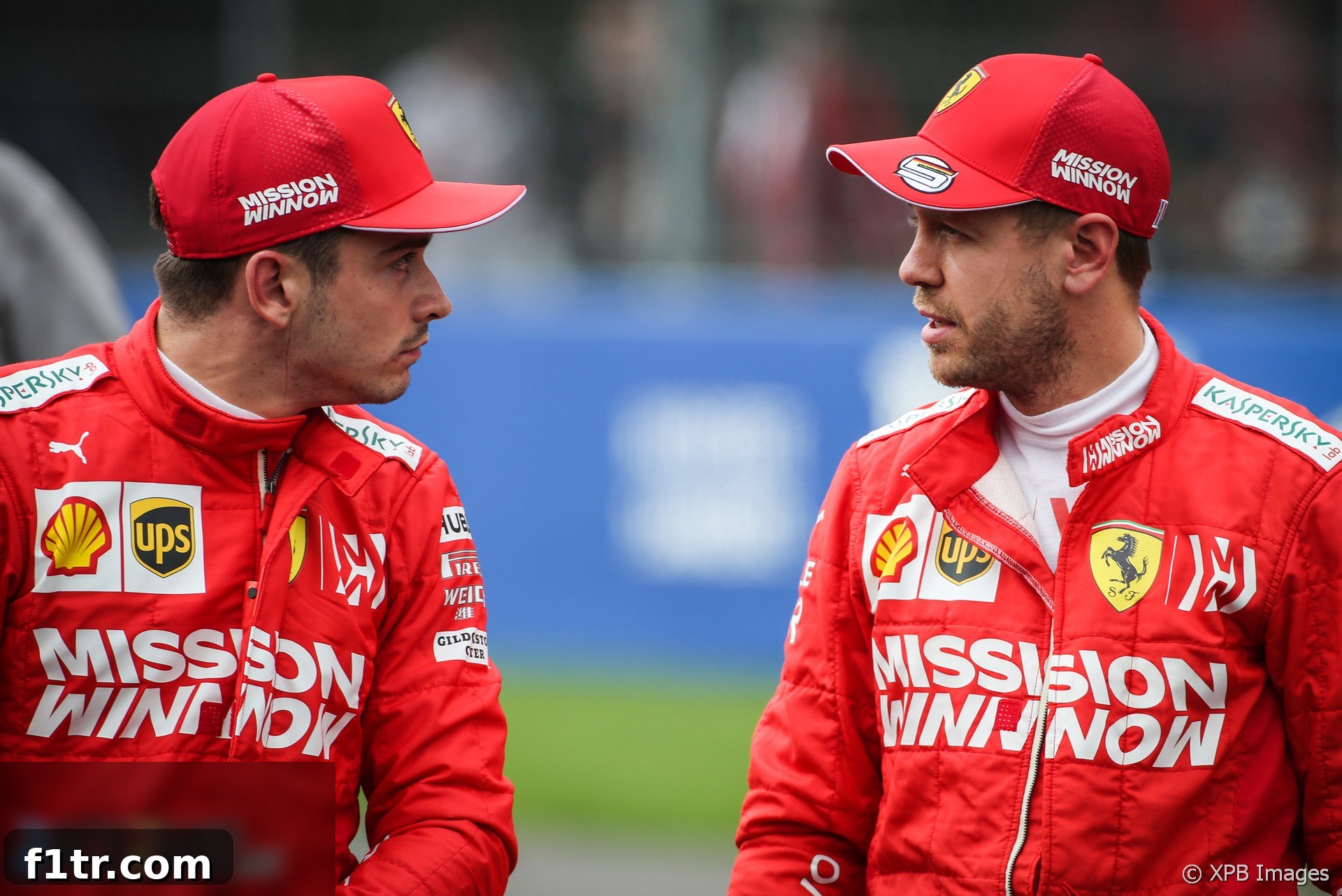
Leclerc vs. Vettel: The 2019 Ferrari Battle That Redefined a Legacy
Ferrari’s bold decision to promote the promising Charles Leclerc to their senior Formula 1 team after just a single season in the sport sparked immediate intrigue. This move, made in the preceding year, posed a pivotal question for the future of the iconic Maranello squad: Was it a quiet acknowledgment that the team’s faith in veteran driver Sebastian Vettel was wavering, or a deliberate strategic move to nurture a generational talent poised to eventually step into a leadership role, perhaps even as Vettel’s successor? Twelve months later, the 2019 season unfolded with dramatic clarity, providing a compelling answer. By nearly every critical metric, Leclerc’s inaugural season in the illustrious red overalls surpassed Vettel’s performance. When considering the vast disparity in experience between the seasoned four-time world champion and the burgeoning young star, Leclerc’s exceptional debut year for Ferrari truly stood out as a harbinger of exciting times.
The Unfolding Drama: Team Orders and Early Season Shocks
From the very outset of the 2019 season, Scuderia Ferrari attempted to establish a clear hierarchy, implementing a strategy of team orders designed to manage the two drivers. This was evident in the closing stages of the opening race in Melbourne, where Leclerc was explicitly instructed to hold station behind Vettel, refraining from any overtake attempts to ensure the team secured its positions without incident. The intent was clear: Vettel was to be the primary driver, with Leclerc playing a supporting role in his rookie year with the team.
However, Leclerc’s raw speed and formidable talent quickly made such rigid plans untenable. It took him remarkably little time to challenge and ultimately force the team’s hand. In Bahrain, the very next race, Leclerc demonstrated his blistering pace by out-qualifying Vettel by a significant three-tenths of a second, seizing pole position. He then proceeded to dominate the race, seemingly on course for a commanding victory until an unfortunate engine issue severely curtailed his power, relegating him to a still impressive third place. Under immense pressure from the aggressive charging of Lewis Hamilton, a rattled Vettel made an uncharacteristic error, spinning his car in a desperate attempt to defend his position. This early season dynamic immediately signaled that the established order within Ferrari was far from secure, igniting a captivating internal battle.
Shifting Tides: Leclerc’s Qualifying Prowess Emerges
While the Bahrain Grand Prix marked a pivotal moment, it wasn’t a sudden, one-sided shift. Indeed, for the initial seven races of the season, Vettel often held the upper hand, frequently starting and finishing ahead of his younger teammate. This period saw Vettel leveraging his experience, finding ways to extract performance when it counted. However, the tide began to turn dramatically at the French Grand Prix held at Paul Ricard. It was here that Leclerc seemingly unlocked a crucial secret to extracting explosive one-lap pace from the SF90, a breakthrough that largely eluded Vettel for a significant portion of the remaining season. This newfound ability transformed Leclerc into a formidable qualifying specialist, consistently challenging for pole positions and often outperforming his teammate on Saturdays.
The qualifying battle became one of the most compelling narratives of the season. Despite Vettel’s considerable experience and initial advantage, Leclerc ultimately won the Saturday fight, out-qualifying Vettel 11-9 over the course of the year. This was a remarkable turnaround, especially considering he had trailed Vettel 1-7 after the opening eight rounds. This consistent edge in qualifying showcased Leclerc’s innate talent and his rapid adaptation to the Ferrari machinery. While Vettel’s race craft often shone through, securing more finishes ahead when both cars completed the race (a score of 9-7 in his favor, excluding the chaotic Brazilian Grand Prix where both crashed but were classified), the raw speed demonstrated by Leclerc in qualifying was a powerful indicator of his potential.
The Pressure Cooker: Errors, Incidents, and a Deepening Rivalry
The intense internal rivalry and the immense pressure to perform for Ferrari undoubtedly contributed to several high-profile errors from both drivers throughout the season. While Charles Leclerc’s season was not entirely devoid of mistakes – a natural part of a young driver’s learning curve – Sebastian Vettel’s tendency to “implode” under pressure became a recurring theme, surprising given his illustrious career and multiple world championships. These unforced errors often came at critical moments, raising questions about his mental fortitude and ability to consistently deliver.
A prime example occurred at the Italian Grand Prix in Monza, Ferrari’s home race, where expectations were sky-high. Perhaps agitated by Leclerc’s perceived failure to offer him a slipstream during the crucial Q3 session, Vettel made an uncharacteristic error during the race, spinning his car. He then compounded this mistake by rejoining the track unsafely, leading to contact with Lance Stroll, earning him a penalty. This incident was a stark illustration of the pressure building within the team and Vettel’s reaction to it. However, the nadir of his season arrived two months later at the Brazilian Grand Prix, when, in a clumsy and inexplicable maneuver, he strayed into Leclerc while his teammate was attempting an overtake. This disastrous collision forced both Ferraris out of the race, a catastrophic outcome that epitomized the escalating tensions and underscored the challenge Ferrari faced in managing their two fiercely competitive drivers.
It was not, however, a one-sided narrative of Vettel’s struggles. There were also instances where Leclerc displayed moments of youthful exuberance and aggression that veered into raggedness, while Vettel maintained a more composed approach. The German Grand Prix stood out as a clear example of this dynamic. Leclerc, pushing the limits in tricky wet conditions, spun into a barrier, ending his race prematurely. In contrast, Vettel, starting from the very back of the grid after a qualifying issue, delivered a masterful recovery drive, steadily progressing through the field to claim a remarkable second place. Although he almost squandered this effort on the final lap, getting overly ambitious in pursuit of the fastest lap bonus point, his controlled performance on a challenging day highlighted his enduring class and resilience when not under direct dueling pressure with his teammate.
A New Era Dawns: Leclerc’s Ascendancy and Ferrari’s Future
The 2019 Formula 1 season undeniably marked a significant turning point for Scuderia Ferrari, signaling a clear generational shift within the team. Charles Leclerc, with his electrifying pace, audacious overtaking maneuvers, and fearless approach, rapidly established himself not just as a future star, but as a current front-runner. His two race victories – at Spa-Francorchamps and, perhaps most symbolically, at Monza – demonstrated his ability to convert pole positions into wins, a crucial attribute for any championship contender. More than just statistics, Leclerc brought a fresh energy and a palpable sense of excitement to the team, igniting the Tifosi’s hopes for a renewed challenge for the world championship.
For Sebastian Vettel, 2019 was a profoundly challenging year, one that perhaps saw him confront his toughest internal battle since his difficult 2014 season alongside Daniel Ricciardo. Being outscored by a teammate for the first time in such a long period was a telling statistic, highlighting the seismic shift in dynamics. The pressure of a young, hungry teammate immediately performing at a championship-contending level evidently impacted Vettel, leading to a string of uncharacteristic errors and moments of frustration. While his experience and occasional flashes of brilliance remained, the consistency and unwavering confidence that defined his championship years seemed to waver under the intense glare of Leclerc’s ascent.
Navigating the Tensions: What Lies Ahead for Ferrari?
Looking ahead, with a full year of experience under his belt in the demanding Ferrari environment, Charles Leclerc is poised to push Sebastian Vettel even harder. The inherent tension this rivalry provoked in 2019 is likely to intensify, regardless of how much Ferrari attempts to downplay it publicly. The challenge for the team management, led by Team Principal Mattia Binotto, will be to find an effective and sustainable solution to manage this potent internal dynamic. This task becomes exponentially more complex if the team finds itself in a genuine championship fight, where every point and every strategic decision will be magnified, and the stakes for both drivers will be at an all-time high.
Ferrari’s decision to embrace this young talent was a gamble, but one that largely paid off in 2019 by injecting new life and a competitive edge into the team. The question that remains is how they will harness this dual force without letting it destabilize their ultimate goal: returning to the pinnacle of Formula 1. The 2019 season offered a compelling preview of a fascinating new chapter in Ferrari’s storied history, defined by the thrilling, complex, and sometimes volatile relationship between two of the sport’s most talented drivers.
Performance Analysis: Key Metrics of the 2019 Rivalry
When examining the intricate performance metrics of the 2019 season, the story of Sebastian Vettel versus Charles Leclerc becomes even clearer. While specific graphical data is not presented here, a comprehensive review of their season would typically highlight several crucial areas of comparison. These include overall points scored, which saw Leclerc ahead, a significant achievement for a driver in his first year with a top team. Furthermore, a breakdown of podium finishes and race victories would illustrate Leclerc’s ability to capitalize on opportunities, securing two wins compared to Vettel’s one.
Sebastian Vettel vs Charles Leclerc: Key Stats Overview
A detailed statistical summary for their 2019 performance would encompass total points, podiums, wins, fastest laps, and DNF (Did Not Finish) counts. Leclerc’s slight edge in overall points and his two victories (Spa, Monza) were critical highlights. Vettel secured one victory (Singapore) and several podiums, but his season was marred by crucial errors that cost him valuable points and often overshadowed his moments of brilliance.
Sebastian Vettel vs Charles Leclerc: Who Finished Ahead at Each Round
| AUS | BAH | CHI | AZE | SPA | MON | CAN | FRA | GBR | AUT | GER | HUN | BEL | ITA | SIN | RUS | JAP | MEX | USA | BRA | ABU | ||
| Sebastian Vettel | Q | |||||||||||||||||||||
| R | ||||||||||||||||||||||
| Charles Leclerc | Q | |||||||||||||||||||||
| R |
Note: The cells above are intentionally left blank to represent the original table structure. A full analysis would populate these with positions for each driver in qualifying (Q) and the race (R).
Sebastian Vettel vs Charles Leclerc: Qualifying Gap Insights
Analyzing the qualifying gap between the two drivers is crucial for understanding their raw speed. While specific graphical representations would show this dynamic visually, the trend indicated that Charles Leclerc increasingly found a way to extract maximum performance from the Ferrari SF90 over a single lap, particularly in the latter half of the season. Instances where Leclerc was significantly faster in Q3 became more common, putting immense pressure on Vettel. Conversely, early in the season, Vettel occasionally demonstrated his veteran ability to find a crucial tenth or two. The overall pattern, however, showcased Leclerc’s ascendancy in qualifying, often with negative values indicating Vettel was faster in early races, progressively shifting to positive values as Leclerc dominated the Saturday sessions. This indicated a substantial psychological victory for the younger driver, forcing Vettel to play catch-up.
Go ad-free for just £1 per month
>> Find out more and sign up
Explore More from the 2019 F1 Season
For a deeper dive into the thrilling events and key performances of the season, browse our comprehensive collection of 2019 F1 season review articles. From driver insights to race analyses, uncover every angle of a memorable year in Formula 1.
Browse all 2019 F1 season review articles