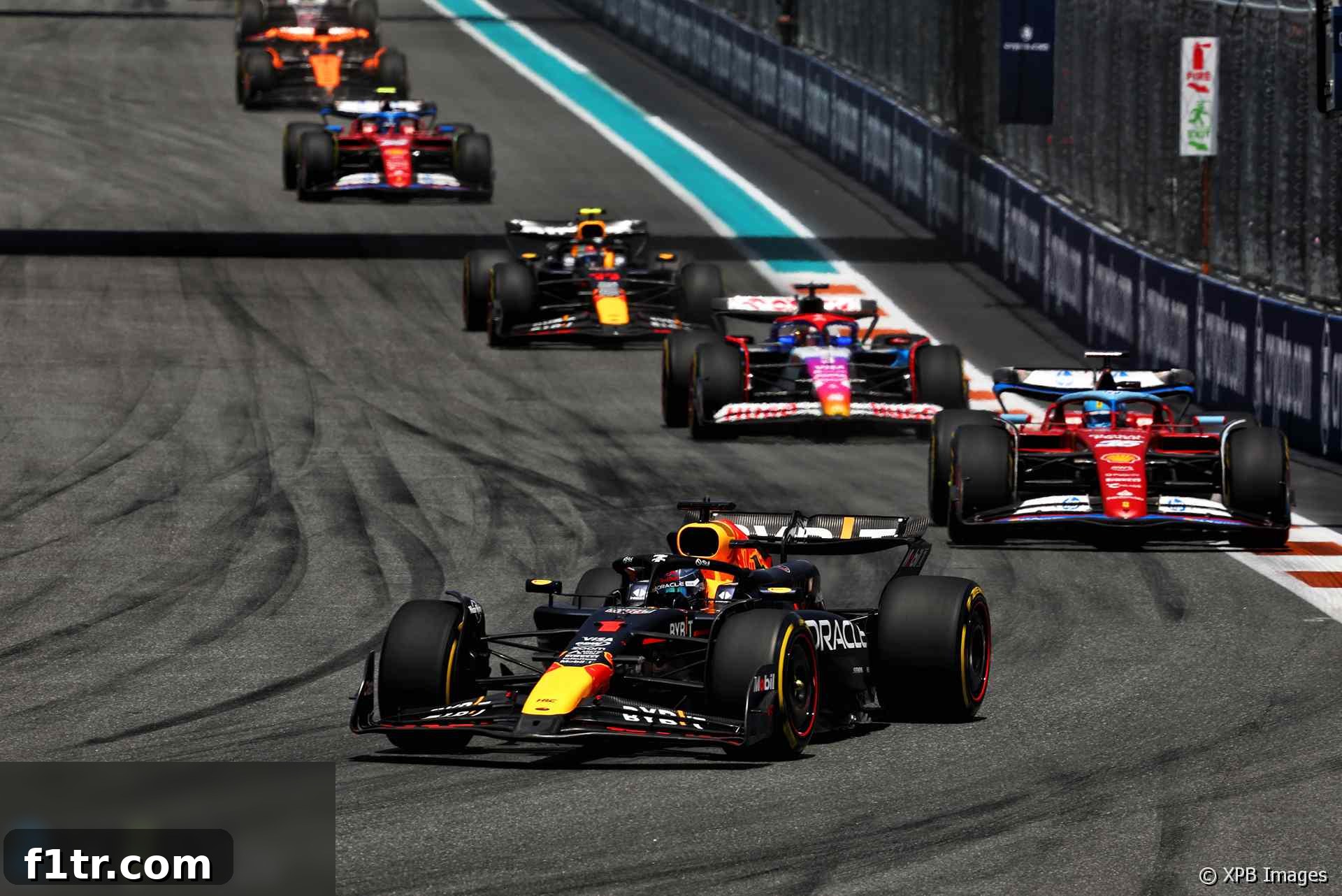
The Miami Grand Prix stands as one of the most vibrant and challenging events on the Formula 1 calendar, and the 2024 edition promises to deliver an exhilarating spectacle. Last year, Max Verstappen demonstrated his unparalleled skill by charging from ninth on the grid to claim a sensational victory, a performance widely regarded as one of his most impressive of the 2023 season. This year, the reigning world champion has put himself in an even stronger position to repeat that feat, securing a dominant pole position – his sixth in as many races at the start of the championship. Fresh from a seemingly effortless cruise to victory in Saturday’s sprint race, few would dare to bet against Verstappen adding another win to his formidable tally today.
However, while Verstappen’s sprint race victory appeared comfortable, his margin over second-placed Charles Leclerc was notably narrower than in the previous sprint round in Shanghai. This closer gap hints at a potentially more competitive grand prix, where Ferrari, with Leclerc at the helm, will be striving to apply maximum pressure on the championship leader over the full race distance. Beyond the battle for the top spot, considerable intrigue lies further down the grid, as several competitive teams are poised for intense battles over the valuable lower points positions, ensuring a captivating race from front to back.
Weather Conditions: A Key Factor in Miami’s Challenge
Drivers experienced remarkably consistent weather conditions throughout Saturday’s sessions, with both the sprint race and qualifying held under ambient temperatures hovering around 28°C and track temperatures ranging between 45-47°C. Current meteorological forecasts for Sunday indicate a continuation of these conditions for the grand prix, which is scheduled to commence at the same local time as qualifying, 4 pm. Such stable, warm weather typically leads to high track temperatures, which can significantly influence tire degradation and overall car performance, demanding precise management from both drivers and strategists.
One notable difference observed between the sprint race and qualifying was a significant increase in wind speed during the early evening. Wind velocities picked up from approximately 7 km/h during the sprint race to a more substantial 15 km/h by Q3. A prevailing southerly wind sweeps across the two longest straights of the Miami International Autodrome. Crucially, this wind direction will create a tailwind exiting the final corner, propelling cars down the run to Turn 1. This could have a profound impact on the effectiveness of the opening DRS (Drag Reduction System) zone, which has historically proven to be one of the circuit’s prime overtaking opportunities. Drivers will need to adapt quickly to these changing aerodynamic forces, as Carlos Sainz Jnr aptly put it after qualifying: “Every lap is a bit of an adventure with the wind. You don’t know what’s going to happen.” The subtle yet powerful influence of the wind adds another layer of complexity to an already demanding race, potentially creating unexpected advantages or challenges for teams throughout the field.
The Crucial Start: Verstappen vs. Leclerc at Turn 1
For the second time in just 24 hours, Max Verstappen will find Charles Leclerc positioned alongside him on the front row of the grid, with the Monegasque driver eager to challenge for the lead into the very first corner. While Verstappen successfully maintained his position off the line in Saturday’s sprint race, Leclerc undeniably achieved a superior launch. Such was the potency of his start that his front wheels were almost level with the Red Bull’s rear wheels by the time both drivers had to aggressively brake for the notoriously tight Turn 1. Had the Miami International Autodrome featured a longer run to Turn 1, as is common at many other circuits, Verstappen could very well have lost his grip on the lead in that crucial opening moment.
Reflecting on the sprint race start, Leclerc openly admitted that he could have pushed the issue more aggressively into Turn 1. However, he made a calculated decision not to take excessive risks, weighing the potential rewards against the significant risk of a collision, especially with the grand prix qualifying session just a few hours away. “The first corner is obviously always important and Max has a very strong race pace,” Leclerc explained. “So yeah, it’s definitely an opportunity to attack. But that’s only if there is an opportunity to attack. This morning, there was – I didn’t make the pass. Tomorrow, if we manage to make it, then I will be happy. And if not, we’ll be a bit more patient and try to keep those tyres to attack later on.” This measured approach suggests a more strategic mindset for the main event, where the race is not just about the first corner, but about managing tires and opportunities across the entire grand prix distance. The short run to Turn 1 at Miami frequently creates intense, wheel-to-wheel action and carries an inherent risk of multi-car incidents, making the opening lap a critical phase for all competitors.
Strategic Pit Stop Decisions: Pirelli’s Insights
Race strategy at the Miami Grand Prix is typically characterized by its straightforward nature. Last year, all 20 drivers opted for a single visit to the pit lane, with the vast majority commencing their race on the medium compound tires before switching to the more durable hard compound for their second, longer stint. Of the top five finishers, only Max Verstappen – who started from a challenging ninth position – strategically chose to begin his race on the hard tires, a decision that ultimately paid dividends as he carved his way through the field.
For this year’s grand prix, with the same Pirelli tire compounds (C2 hard, C3 medium, C4 soft) and similar ambient and track conditions anticipated, Pirelli’s motorsport director Mario Isola fully expects the one-stop strategy to be the predominant choice across the entire field once again. “There is little doubt that a one-stop is clearly the quickest option,” Isola confirmed. However, he also highlighted the critical nuances regarding the specific compounds and the order in which they will be utilized by different teams. “While the drivers found the C4 [soft] harder to read over a flying lap, the sprint race demonstrated that it cannot be ruled out for the grand prix. The C2 [hard] will definitely be the outright favorite, but all combinations of it with the C3 [medium] and C4 [soft] are viable on paper.”
The C2 (hard) compound offers maximum durability and consistency, making it ideal for longer stints, especially in the demanding Miami heat. The C3 (medium) provides a good balance of grip and longevity, often serving as the primary starting tire. The C4 (soft), while offering peak performance and initial grip, degrades more quickly, making its use in the grand prix a more aggressive, high-risk, high-reward proposition. Teams will carefully weigh the trade-offs, considering factors like track position, traffic management, and potential Safety Car interruptions that could open up opportunities for alternative strategies. The chosen strategy will be crucial for maintaining tire performance and achieving optimal lap times over the race distance, with any deviation potentially leading to significant gains or losses.
Mastering Overtaking Challenges in Miami
Saturday’s sprint race in Miami vividly illustrated the significant challenge of overtaking on this circuit, especially outside of the top three runners. The majority of the 19-lap race was characterized by the formation of DRS (Drag Reduction System) trains, where over half of the 18 drivers who survived the first lap found themselves consistently within a second of the car ahead. This phenomenon makes it exceedingly difficult for drivers to make clean passes, even with the benefit of DRS. Charles Leclerc emphasized this after qualifying, stating that his primary chance of offering a genuine challenge to Max Verstappen would hinge on his ability to remain within DRS range of the Red Bull driver over the crucial first lap of the grand prix.
The experience of Kevin Magnussen during the sprint race served as a stark demonstration of the vital importance of staying within DRS range of a rival. Following a Safety Car restart, Magnussen initially held within a second of his Haas teammate Nico Hulkenberg. However, he gradually fell adrift, losing critical ground and eventually finding himself almost six seconds behind by the time he was finally overtaken by Yuki Tsunoda and Lewis Hamilton on lap 15. Despite Magnussen’s self-described “stupid tactics” – employing aggressive defense and strategic weaving to try and keep Hamilton behind him – the Mercedes ultimately found a way past. His struggle highlighted that even with defensive maneuvers, falling out of DRS range makes a driver highly vulnerable.
In response to their sprint race performance, Mercedes made a strategic decision to reduce the wing angle on their cars. This adjustment aims to improve the top-end speed of both Lewis Hamilton and George Russell, thereby assisting them in attacking rivals on the long straights that feature multiple DRS zones. However, this comes with an inherent compromise: a slight reduction in downforce through the twisty opening sector of the track. This trade-off means that while they might be faster in a straight line, they could find it marginally harder to navigate the more technical sections and get into prime attacking positions. Furthermore, the stewards had an exceptionally busy day on Saturday, and they may be in for another prolonged shift on Sunday. Miami’s major overtaking spots naturally encourage drivers to push the limits, often leading to incidents. The exit of Turn 11, where the white line runs perilously close to the outside barrier, and the fiddly chicane of Turns 14 and 15, which many drivers are likely to cut – whether intentionally or otherwise – are prime locations for infringements. Consequently, it is highly probable that the grand prix will feature numerous complaints flooding the radio waves and a multitude of incidents for the stewards to investigate, potentially leading to post-race penalties that could significantly alter the final points allocations, especially given the expected fewer pit stops compared to most other tracks on the calendar.
The Ever-Present Threat of Safety Cars
The Miami International Autodrome has, in its relatively short history on the Formula 1 calendar, established itself as a circuit with a particularly treacherous opening sequence. Saturday’s sprint race regrettably underscored this characteristic, witnessing the third significant collision in the opening corners across just three race starts at this venue. Once again, the incident occurred amidst the tightly packed midfield, with Lewis Hamilton fortunate to evade a penalty for what could generously be termed an ambitious dive to the inside at Turn 1. This aggressive maneuver ultimately claimed Lando Norris and Lance Stroll as innocent victims, forcing both drivers into an early retirement from the sprint.
Miami’s unique circuit layout, characterized by its long, DRS-supported straights that are intercut with tight, intricate, and often unforgiving twisty sections, almost seems engineered to encourage the formation of DRS trains. This architectural characteristic means that, throughout the grand prix, there will likely be several tightly bunched packs of cars stretching across the field. Such close-quarters racing inherently increases the probability that a driver will misjudge an overtaking attempt, make a small error, or simply lose patience, culminating in a yellow flag incident. Any deployment of a Safety Car or even a Virtual Safety Car has the potential to completely overturn established race strategies, providing significant opportunities for some teams while simultaneously creating unforeseen challenges for others. The unpredictability introduced by such disruptions adds another thrilling layer to the strategic chess match unfolding on track, making every lap a high-stakes affair for both drivers and strategists.
Driver Spotlight: Logan Sargeant’s High-Stakes Home Race
For Logan Sargeant, the Miami Grand Prix is far more than just another race on the Formula 1 calendar. As the sole American driver currently on the grid, and a native of Florida, Miami truly represents his ‘home’ grand prix among the three races held in the United States each season. This local connection amplifies the pressure on the young Williams driver, who has been under increasingly intense scrutiny following an underwhelming start to his second season in Formula 1. Sargeant himself has acknowledged that he was fortunate to secure a seat for 2024 after a challenging and often rocky rookie campaign in 2023.
The stakes for Sargeant are exceptionally high this weekend. Rumours have been swirling throughout the paddock, suggesting that his team, Williams, might be making moves behind the scenes to find a potential replacement, with names like Andrea Kimi Antonelli frequently mentioned as a possible early debutant. Such speculation only adds to the immense pressure on Sargeant’s shoulders as he fights for his future in the pinnacle of motorsport. While he might not have matched the outright pace of his teammate, Alexander Albon, over the course of the Miami weekend, Sargeant did manage a respectable performance in the sprint race, gaining several positions to finish 12th. Initially, this might have appeared to be a benefit of starting on soft tires, but the reality was that he gained most of those crucial places by skillfully avoiding the multi-car collision in the first corner, rather than through direct on-track passes.
Even so, Sargeant’s ability to navigate the chaos and bring his car home safely demonstrated a level of race craft and opportunistic awareness. It showed that he has the capability to be in the thick of the midfield battle when given the chance and a clean run. What he desperately needs now is to translate that potential into a tangible result in the grand prix. A top-ten finish, securing valuable championship points, would not only be a massive boost to his confidence but could also be truly transformative for both his individual career trajectory and his team’s season as a whole, potentially silencing critics and demonstrating his worth under immense pressure on his home turf.
Over to You
With all the intriguing storylines and strategic possibilities, the 2024 Miami Grand Prix promises to be an unmissable event. Who do you think will offer the closest challenge to Max Verstappen? Will Charles Leclerc mount a successful assault, or will a dark horse emerge from the midfield? Share your predictions and views on how the race will unfold in the comments section below. We look forward to hearing your thoughts!
2024 Miami Grand Prix Related Content
- McLaren had superior pace before Verstappen’s damage in Miami – Norris
- Sainz ‘struggles to understand’ why he got penalty when Perez didn’t
- Alonso’s unusual brake problem and more unheard Miami team radio
- McLaren’s Miami upgrade success points to even stronger form in coming races
- Norris expects more wins this year and believes “100%” in 2025 title bid
Browse all 2024 Miami Grand Prix articles