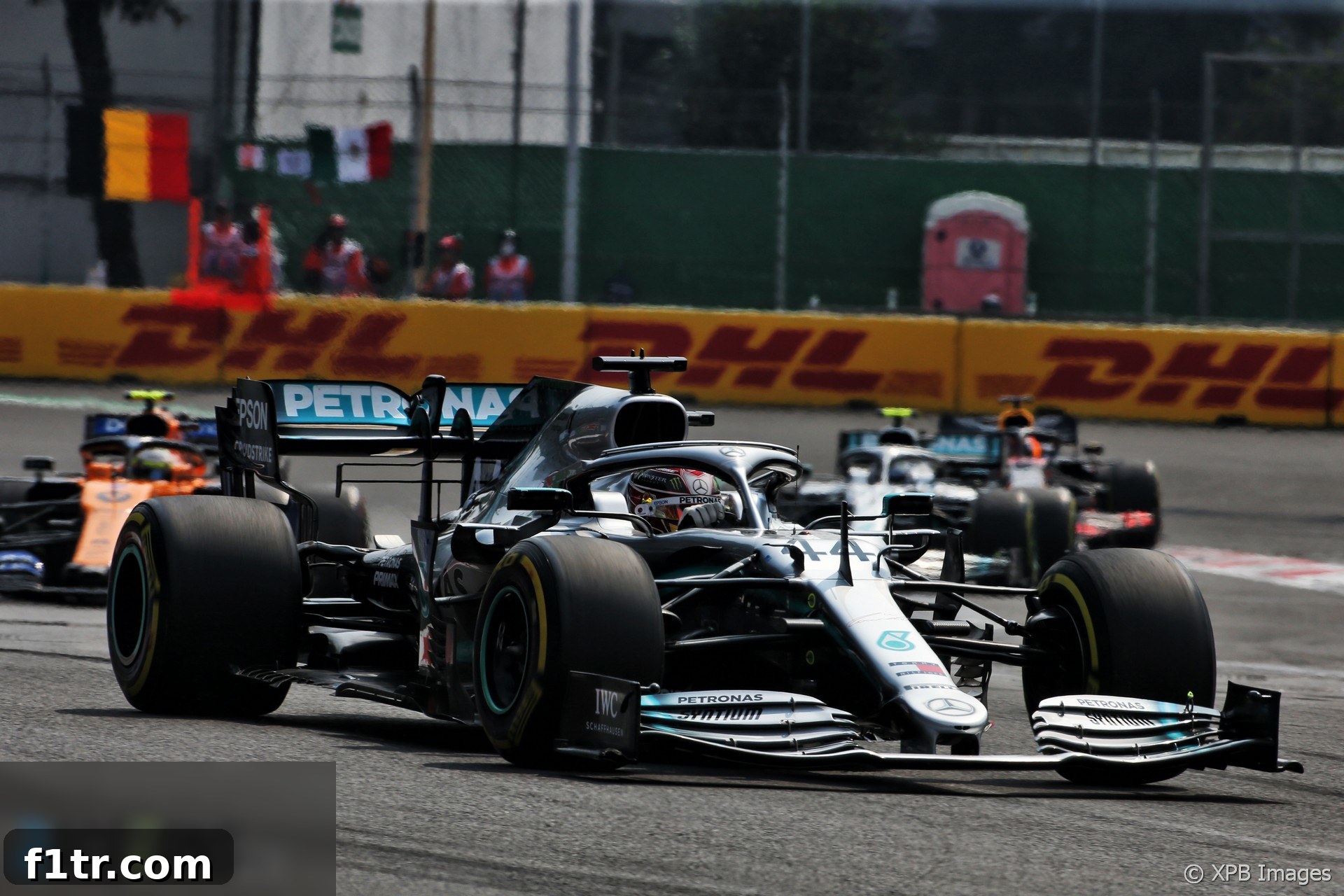
Lewis Hamilton showcased a masterclass in strategic execution, steering his Mercedes to a compelling second victory at the Mexican Grand Prix. The triumph, marked by resilience and tactical brilliance, further solidified his dominant season, though it wasn’t quite enough to clinch his sixth world championship title on this occasion.
Hamilton’s Audacious Strategy Amidst Early Chaos
The race at the Autodromo Hermanos Rodriguez began with an unexpected flurry of drama for the eventual race winner. From the very first lap, Lewis Hamilton found himself in challenging positions, making contact not once, but twice. Initially, he clashed wheels with Sebastian Vettel, an incident that set the tone for a high-tension opening. Moments later, a more significant entanglement occurred with the aggressive Red Bull of Max Verstappen, forcing Hamilton wide and momentarily compromising his track position. These early skirmishes could have derailed a less experienced or resolute driver, but Hamilton, demonstrating his seasoned expertise, managed to navigate the chaos with minimal damage and maintain his composure.
It was from this challenging start that Mercedes and Hamilton engineered a bold strategic gamble that ultimately paid dividends. Opting for an exceptionally long first stint on hard compound tyres, a decision many viewed as risky, Hamilton embarked on a marathon drive. This choice contrasted sharply with many of his rivals who were planning two-stop races. The effectiveness of this strategy hinged entirely on the Mercedes W10’s ability to manage tyre degradation and Hamilton’s peerless driving style, which is renowned for its tyre preservation capabilities. As the race unfolded, Hamilton skillfully conserved his hard tyres, allowing him to extend his run far beyond what was initially thought feasible. This extended stint not only propelled him into the lead but also created a significant advantage, putting him in a strong position to withstand pressure from his competitors in the latter stages of the race.
Vettel’s Persistent Pursuit and Ferrari’s Strategic Misjudgment
Sebastian Vettel, piloting his Ferrari, also adopted a single-stop strategy, mirroring Hamilton’s approach in terms of pit lane visits but not necessarily tyre management. Running a spirited race, Vettel displayed consistent pace and managed to keep Hamilton within his sights for much of the Grand Prix. Despite having tyres that were 14 laps fresher than Hamilton’s in the closing stages, the German driver found himself unable to bridge the gap and launch a definitive attack. His relentless pursuit was admirable, yet the outright pace and strategic execution of Mercedes proved to be just out of reach.
Ferrari’s race strategy, while seemingly straightforward with the one-stop, was tinged with a significant miscalculation concerning Hamilton’s tyre durability. Throughout the latter half of the race, the Ferrari pit wall repeatedly communicated to Vettel that Hamilton’s tyres were on the brink of hitting a ‘cliff’ – a term used to describe a sudden and rapid drop-off in tyre performance. This expectation led Ferrari to believe that Hamilton would inevitably be forced into a second pit stop, or at least suffer a severe loss of pace, thereby opening a window for Vettel to challenge for the lead. However, this anticipated ‘cliff’ never materialized. Hamilton’s masterful tyre management, combined with the W10’s inherent efficiency, ensured that his hard tyres held their performance remarkably well until the very end, frustrating Ferrari’s hopes and solidifying Hamilton’s strategic victory.
Championship Battle Intensifies: Bottas Delays the Title Clinch
Lewis Hamilton’s tenth victory of the season was a testament to his extraordinary form and consistency throughout the year. However, despite the win, the mathematical possibility of clinching his sixth world championship title at the Mexican Grand Prix slipped through his fingers, albeit temporarily. This was largely due to the strong performance of his Mercedes teammate, Valtteri Bottas, who secured a crucial third-place finish. Bottas’s podium position ensured that enough points remained on the table to keep the championship fight technically alive for at least another race, postponing Hamilton’s coronation. While the outcome was inevitable, Bottas’s robust drive under pressure underscored his determination and his role in the Silver Arrows’ overall constructors’ championship dominance.
Leclerc’s Race Unravels: From Pole to Puzzling Strategy
Charles Leclerc, starting from pole position, initially commanded the race with a strong lead, showcasing Ferrari’s raw pace over a single lap. However, his race quickly descended into a series of unfortunate events and strategic missteps. Ferrari opted for an early pit stop for Leclerc, switching him to a second set of medium compound tyres. This decision locked him into an aggressive two-stop strategy, a gamble that ultimately did not pay off on the Autodromo Hermanos Rodriguez circuit, which generally favored a single-stop approach.
The strategic call was compounded by execution issues. Leclerc’s second pit stop was notably slow, costing him valuable seconds and track position. Furthermore, upon rejoining the track, he found himself stuck behind Carlos Sainz Jnr, losing crucial time while battling to get past. These combined factors – the two-stop strategy, the slow pit stop, and the traffic – systematically eroded his chances of a podium finish, ultimately relegating him to a disappointing fifth place after starting from the front of the grid. It was a race of missed opportunities for Leclerc and Ferrari, highlighting the fine margins that separate success from struggle in Formula 1.
Verstappen’s Tumultuous Day: Clashes, Puncture, and a Valiant Comeback
For Max Verstappen, the Mexican Grand Prix was a rollercoaster of extreme highs and lows, culminating in an unimpressed sixth-place finish, over a minute behind the winner. The Red Bull driver, known for his aggressive racing style, was at the heart of much of the early race drama. He engaged in a fiery clash with Lewis Hamilton on lap one, a testament to his relentless pursuit of position. However, his most significant incident occurred when he made a daring lunge down the inside of Valtteri Bottas at Turn 12.
While the move itself was a superb display of audacious driving, it came with a heavy cost. The slightest contact between the Mercedes and the Red Bull resulted in a puncture for Verstappen’s tyre. This forced an unscheduled pit stop, sending him plummeting to the very back of the field. From that point, Verstappen embarked on a tenacious fight back, showcasing his exceptional overtaking skills and raw pace as he carved his way through the pack. Despite his valiant efforts to recover, the time lost due to the puncture and subsequent pit stop proved too great to overcome, leaving him frustrated yet determined.
Midfield Battles and Unpredictable Outcomes
Amidst the battles at the front, the midfield provided its own share of excitement and drama. Home favourite Sergio Perez delivered a commendable performance for Racing Point, delighting the local crowd by rising through the ranks to secure a strong seventh-place finish. His consistent pace and strategic drive ensured valuable points for his team on home soil.
Behind Perez, Daniel Ricciardo brought his Renault home in eighth position, demonstrating steady form. However, his teammate Nico Hulkenberg was involved in one of the most bizarre incidents of the final lap. In a chaotic sequence of events, Hulkenberg was unceremoniously knocked into the Turn 16 barrier by Daniil Kvyat. Despite the significant damage, which included a missing rear wing, Hulkenberg managed to limp his car across the finish line, albeit in a compromised state.
The immediate post-race results saw Kvyat and his Toro Rosso teammate Pierre Gasly cross the line in ninth and tenth places respectively. However, the stewards swiftly investigated the incident involving Kvyat and Hulkenberg. A post-race time penalty was subsequently imposed on Kvyat, dropping him to eleventh place and out of the points. This decision elevated Pierre Gasly to ninth, securing him additional championship points, and crucially, promoted Nico Hulkenberg to the final points-scoring position of tenth, a remarkable recovery after his dramatic final lap.
McLaren’s Difficult Day: Strategic Errors and Handling Woes
McLaren endured a particularly challenging and disappointing Grand Prix in Mexico. What started with promising pace quickly devolved into a series of unfortunate events. For Lando Norris, a critical pit stop error proved to be his undoing. A mishap during his tyre change led to significant time loss and ultimately ended his chances of scoring valuable championship points, dashing hopes that had been high after strong qualifying performances.
Meanwhile, Carlos Sainz Jnr also faced a tough afternoon, battling persistent handling imbalances throughout the race. Despite his best efforts, the car simply lacked the stability and pace required to compete effectively within the top ten. Sainz ultimately finished outside the points, marking a rare dual-failure for McLaren after a season that had otherwise seen them make significant strides forward.
The Road Ahead: Championship Implications
Lewis Hamilton’s victory in Mexico was a testament to his unparalleled skill and Mercedes’ strategic prowess, even if the world championship title remained mathematically elusive for one more race. The intricate dance of tyre strategy, on-track battles, and unforeseen incidents made for a captivating spectacle. While Hamilton edged closer to his sixth crown, the performances of Sebastian Vettel and Valtteri Bottas ensured the championship narrative would continue to unfold with bated breath at the subsequent races. The Mexican Grand Prix delivered all the thrills and spills expected from Formula 1, setting the stage for an even more dramatic conclusion to the season.