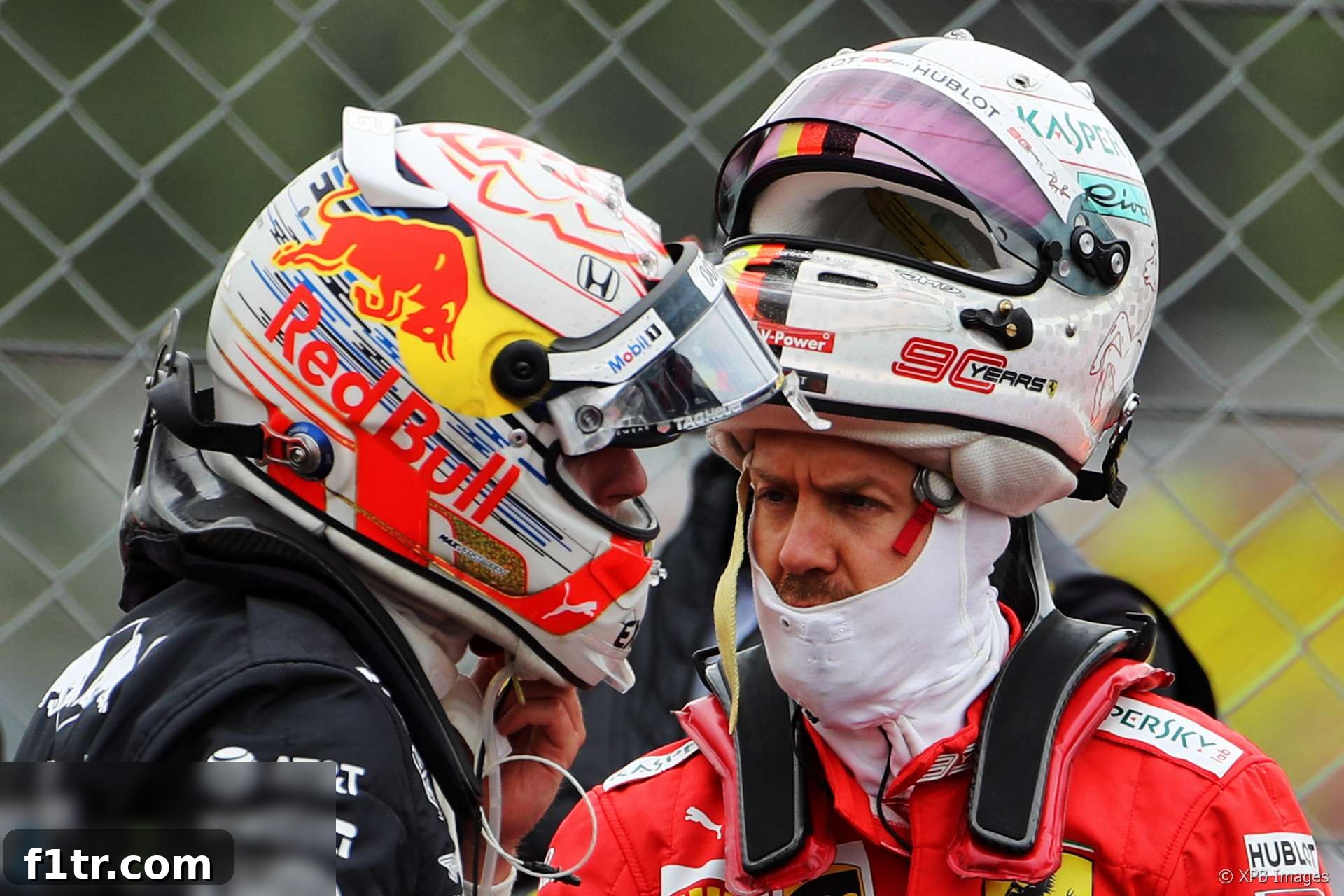
Sebastian Vettel, a four-time Formula 1 world champion, found himself at the center of attention following a controversial collision with Red Bull Racing’s Max Verstappen during the thrilling British Grand Prix. Despite receiving a penalty for the incident, Vettel publicly downplayed the significance of the stewards’ decision, emphasizing that his immediate apology to Verstappen held far greater personal importance and demonstrated his commitment to sportsmanship.
The incident, which occurred at the iconic Silverstone circuit, saw the Ferrari driver incur a 10-second time penalty, significantly impacting his race result. In addition, two penalty points were added to his super license, bringing his total to six. This accumulation of penalty points is a critical aspect of Formula 1 regulations, as reaching twelve points within a 12-month period results in an automatic race ban, highlighting the severity of such infractions.
Vettel’s collision with Verstappen quickly became a talking point among fans and pundits, with many drawing comparisons to past racing incidents. Notably, parallels were drawn to a similar clash between Daniel Ricciardo and Verstappen at the Baku Grand Prix the previous year, where Ricciardo escaped without punishment. This perceived inconsistency in stewarding decisions often sparks debate within the F1 community, raising questions about the fairness and clarity of racing rules and their interpretation by officials.
Addressing the media, including a direct question from RaceFans, Vettel offered a candid account of his perspective. “Of course, initially I thought there was a gap and the gap closed,” he admitted, reflecting on the heat of the moment during the race. However, after reviewing the incident and having some time to process it, his view shifted. “But after some laps, I realized it was my mistake. So I went up to Max and told him what I thought. That for me counts more than any stewards’ decision, to be honest.” This statement underscored Vettel’s belief in personal accountability and the value of direct communication between competitors.
The veteran driver elaborated on the sequence of events that led to the crash. Verstappen, known for his aggressive and decisive overtaking maneuvers, had just passed Vettel with relative ease before Turn 15. “Obviously, he was a bit faster, closing quite quickly and passed very easily before Turn 15,” Vettel explained. It was during the immediate aftermath of this overtake that Vettel saw what he believed was an opportunity to regain his position. “But then he ran a bit wide, so I thought I can sneak back. I thought there was a gap which then turned out not to be there. It’s a misjudgment from my side.” His frank admission of a misjudgment showcased a level of maturity and self-awareness often praised in elite athletes, recognizing the fine line between aggressive racing and an error in judgment.
Max Verstappen, despite the disappointment of being involved in a collision that compromised his own race, confirmed Vettel’s swift act of sportsmanship. “When he jumped out of his car, he immediately came to me,” the young Red Bull star recounted. “He apologized, said he misjudged the braking, [his] fault.” Verstappen’s comments painted a picture of mutual respect between two fierce competitors, even in the face of an on-track incident. While acknowledging the immediate apology, Verstappen also conveyed his frustration, stating, “It’s disappointing, but you can’t change it now.” This sentiment is common among drivers who, despite understanding the dynamics of racing, feel the impact of lost points or a compromised race result.
The Dynamics of Racing Incidents and Stewarding in Formula 1
Racing incidents are an inherent part of Formula 1, a sport where drivers push the limits of physics and human capability at speeds exceeding 200 mph. The British Grand Prix collision between Sebastian Vettel and Max Verstappen serves as a prime example of the intense pressure and split-second decision-making required in wheel-to-wheel combat. Every Grand Prix weekend sees stewards, appointed by the FIA, scrutinize these incidents, often under immense public and media pressure. Their role is to ensure fair play, uphold safety standards, and apply the sporting regulations consistently.
The comparison drawn with the Daniel Ricciardo and Max Verstappen incident in Baku highlights a recurring challenge for Formula 1: consistency in stewarding. While two incidents may appear similar on the surface, the specific circumstances – such as the corner type, speed, driver intentions, and even the immediate aftermath of the contact – can lead to different interpretations and penalties. Stewards often take into account factors like whether a driver was “wholly or predominantly to blame,” which can be subjective. The ongoing debate around such decisions underscores the complexity of officiating high-octane motorsport and the fine margins that define a legal maneuver versus a punishable offense. This constant scrutiny often leads to calls for clearer guidelines or more transparent decision-making processes to enhance fan understanding and ensure perceived fairness across the paddock.
The Significance of Sportsmanship and Driver Conduct
Beyond the technicalities of penalties and regulations, Sebastian Vettel’s immediate apology to Max Verstappen speaks volumes about sportsmanship in Formula 1. In a highly competitive environment where every point matters for championship aspirations and team pride, admitting fault is not always an easy or common reaction. Vettel’s gesture resonated positively with many, demonstrating a commitment to integrity and respect among competitors. Such acts help maintain the spirit of fair competition and remind us that even at the pinnacle of motorsport, personal character and ethical conduct remain highly valued. This behavior sets an example for younger drivers and reinforces the idea that while winning is paramount, it should not come at the cost of honesty and mutual respect.
The implications of penalties extend beyond individual race results. For drivers, accumulating penalty points can be a source of significant concern, as it brings the threat of a race ban closer. For teams, a driver penalty can cost valuable constructors’ championship points, impacting financial rewards and overall standing. These consequences underscore the importance for drivers to manage risk effectively and for teams to support their drivers with strategies that balance aggression with compliance to regulations. The incident at Silverstone, therefore, was not merely a momentary clash but a reminder of the intricate web of rules, consequences, and personal conduct that define the world of Formula 1.
The British Grand Prix incident between Sebastian Vettel and Max Verstappen encapsulated many facets of modern Formula 1: intense on-track battles, split-second judgments, the critical role of race stewards, and the enduring importance of sportsmanship. While the penalty was imposed, Vettel’s candid admission of error and his swift apology demonstrated a commendable level of integrity, emphasizing that human responsibility often transcends mere regulatory compliance. This commitment to personal accountability continues to be a defining characteristic of top-tier athletes, cementing Vettel’s legacy beyond his impressive championship titles.
Further Reading and Related Topics:
- Understanding Formula 1 Racing Rules
- The History of Silverstone Circuit
- FIA Stewards and Penalty Decisions
- Explore F1 Driver Profiles