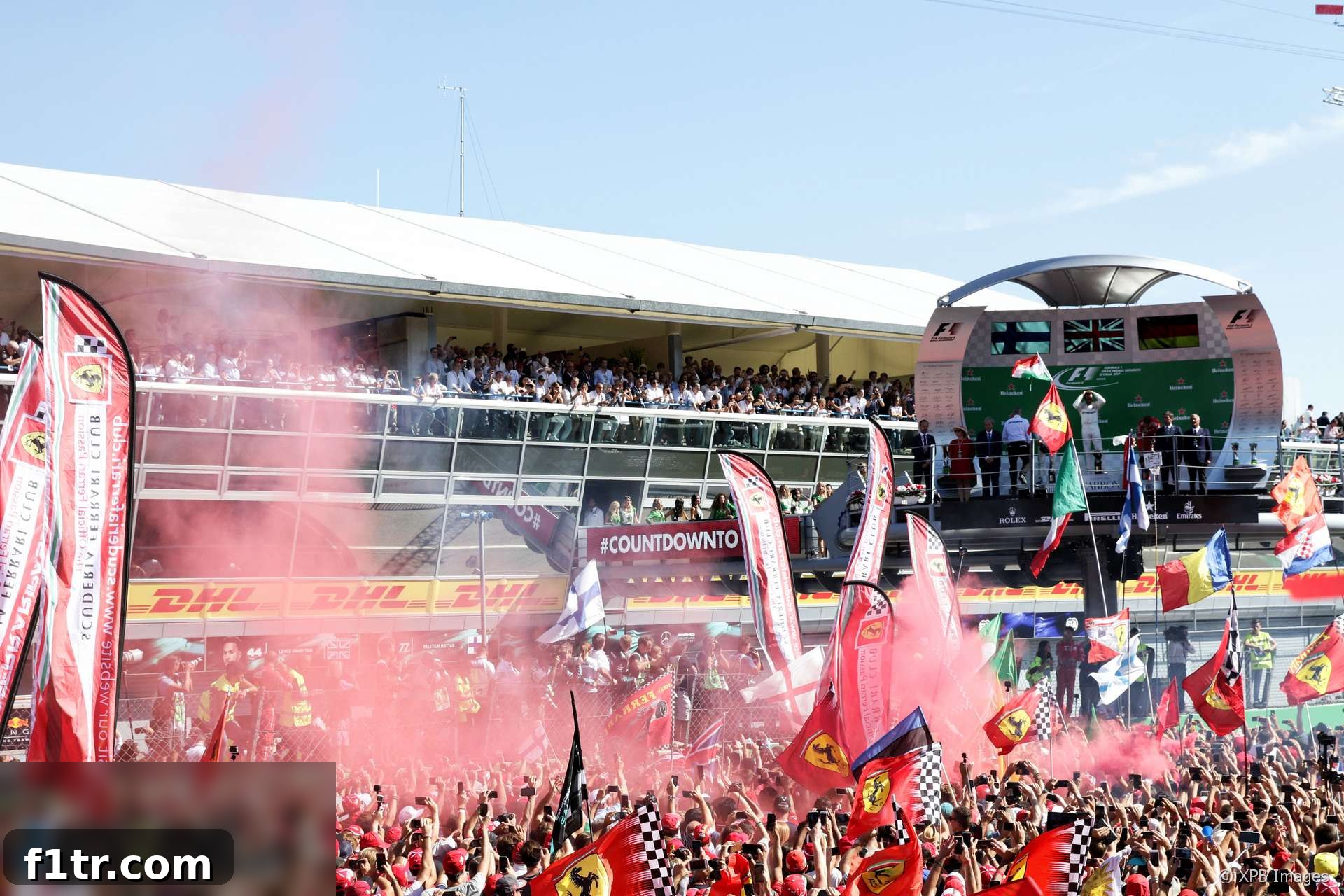
Monza Grand Prix Future in Jeopardy: Promoters Demand Drastic Fee Reduction and Enhanced Terms
The legendary Autodromo Nazionale Monza, an undisputed cornerstone of Formula 1’s rich history, is currently at a critical juncture in its relationship with the sport. Promoters of the Italian Grand Prix are actively seeking a substantial reduction in their F1 race fee, a move that underscores the evolving economic landscape of Grand Prix hosting and the challenges faced by historic circuits.
Nestled just north of Milan, this hallowed circuit has graced the Formula 1 calendar in almost every single season since the championship’s inception in 1950, a testament to its enduring legacy. As it prepares to celebrate its momentous centenary in 2022, the future of the Italian Grand Prix at Monza hangs in the balance, with its current F1 contract slated to expire well before this significant milestone.
Monza’s Contractual Challenge: A Quest for Financial Viability
The storied “Temple of Speed” secured its most recent three-year agreement in 2016, a deal that guaranteed its place on the calendar through the 2019 F1 season. However, with the clock ticking, negotiations for an extension are intensifying. Angelo Sticchi Damiani, the esteemed President of the Automobile Club d’Italia (ACI), has openly expressed his strong desire to forge a new partnership that will ensure Monza remains a staple of Formula 1 for years to come.
“I hope to write a new contract for ’20, ’21, ’22, ’23 and ’24,” Sticchi Damiani conveyed, his words echoing the sentiment of countless F1 enthusiasts and the passionate Tifosi. His hopeful declaration, “I hope,” encapsulates the crucial nature of these discussions and the deep commitment from the Italian organizers to preserve Monza’s place in top-tier motorsport.
Advert | Become a Supporter & go ad-free
The Price of Prestige: Demanding a Substantial Fee Cut
At the heart of the current negotiations lies a pivotal demand: a drastic reduction in the race fee. The promoters are set to pay a formidable $24 million for next year’s race, an increase from the $20 million initially stipulated at the commencement of their current contract. This escalating cost highlights the significant financial burden placed on traditional circuits, particularly those operating without substantial government subsidies. For the Italian Grand Prix to secure its place on the 2020 F1 calendar and beyond, organizers are targeting a more sustainable fee of $15 million.
This proposed reduction of nearly $10 million is not merely about cost-cutting; it represents a strategic effort to ensure the long-term sustainability and viability of hosting a Formula 1 event in an increasingly competitive global market. The economics of Grand Prix hosting have become a major talking point, with many historic European venues grappling with the escalating demands of Formula 1’s commercial rights holders. Maintaining accessibility and affordability for fans is also a key consideration for promoters seeking to reduce their overheads.
Beyond Fees: A Desire for Greater Control and Partnership
Sticchi Damiani further elaborated on the broader aspirations for the new contract with Liberty Media, emphasizing a desire for a more equitable and collaborative relationship compared to the previous agreement, which was negotiated under the tenure of former F1 supremo Bernie Ecclestone. “The [current] agreement is in general too… we want to have more convenience, not just lower the fee but more rights, more hospitality, more percentile of the sponsorship that now [we don’t] have,” he explained.
This statement reveals a fundamental shift in the demands of race promoters. They are no longer solely focused on the bottom line of the hosting fee but are actively seeking a more integrated partnership model. This includes a greater share of commercial rights, increased opportunities for hospitality packages, and a larger percentage of sponsorship revenues generated at the circuit. Such provisions would allow Monza to enhance the event experience, attract more investment, and ultimately, make the Grand Prix a more lucrative and sustainable venture for all stakeholders involved, fostering a stronger local economy around the race.
Monza: A Symbol of Formula 1 Heritage
The Autodromo Nazionale Monza is more than just a racetrack; it is an iconic symbol of Formula 1’s enduring spirit and a pilgrimage site for motorsport enthusiasts worldwide. Its history is inextricably woven into the fabric of the sport, having hosted the very first Formula 1 World Championship race in 1950 and only missing one season since. This rich heritage and the passionate Italian “Tifosi” provide an unparalleled atmosphere that few other circuits can match, creating an electric energy unique to the Italian Grand Prix.
For decades, Monza has challenged drivers with its legendary high-speed straights and demanding chicanes, earning its moniker, the “Temple of Speed.” The circuit has been the stage for countless unforgettable moments in F1 history, from legendary victories by local heroes to dramatic championship deciders. Its unique characteristics and storied past contribute significantly to Formula 1’s identity, making its potential absence from the calendar an almost unthinkable prospect for many dedicated fans and historians of the sport. The preservation of such venues is often seen as vital for the sport’s soul.
The Ecclestone Era vs. Liberty Media’s Vision
The distinction between the current contract, penned during the Bernie Ecclestone era, and the desired new agreement under Liberty Media’s stewardship, is a crucial aspect of these negotiations. Ecclestone’s commercial strategy for Formula 1 was famously characterized by high hosting fees and stringent terms, often leaving promoters with limited flexibility and a smaller share of auxiliary revenues. His “take it or leave it” approach, while highly profitable for F1, often strained relationships with traditional venues and prioritized securing the highest possible fee.
In contrast, Liberty Media, since acquiring Formula 1 in 2017, has articulated a vision focused on broader fan engagement, digital expansion, and fostering more collaborative partnerships with circuits and local promoters. While still a global business driven by profit, their approach aims to empower local organizers, allowing them more avenues to capitalize on the Grand Prix beyond just ticket sales. This shift in philosophy – from a purely transactional relationship to one of partnership – is precisely what Monza’s promoters are hoping to leverage to secure a more favorable and holistic deal that benefits both parties.
Global Competition and the Future of Classic Venues
Monza’s situation is not isolated; it reflects a broader challenge facing many traditional European circuits. Venues like Spa-Francorchamps and Suzuka, both iconic in their own right, have also found themselves in similar predicaments, actively seeking new deals to secure their places on the ever-expanding F1 calendar. The increasing influx of new, purpose-built tracks from burgeoning markets in the Middle East, Asia, and the Americas, often backed by significant government funding, intensifies the competition. These new venues frequently offer highly lucrative hosting fees and state-of-the-art facilities, putting immense pressure on established European races to justify their value not just in terms of heritage but also financial return.
The economic impact of a Formula 1 Grand Prix on a local region is substantial, bringing in tourism, media attention, and significant revenue for hotels, restaurants, and other local businesses. However, the balance between these benefits and the exorbitant hosting fees has become increasingly precarious. For circuits like Monza, which operate within different financial models and often lack the same level of state sponsorship as some newer venues, negotiating a sustainable fee is paramount to their survival on the F1 schedule and their ability to continue contributing to local economies.
Advert | Become a RaceFans supporter andgo ad-free
The Stakes for Formula 1
The potential loss of a circuit as historically significant as Monza would represent a significant blow to Formula 1’s identity and its connection to its roots. While the sport continues to evolve and embrace new markets, there is a strong sentiment among fans, teams, and drivers alike that certain classic venues are indispensable. These circuits offer a unique blend of challenge, history, and atmosphere that cannot be replicated elsewhere, providing a tangible link to F1’s glorious past.
Liberty Media faces the delicate task of balancing commercial expansion with the preservation of F1’s heritage. Ensuring that iconic venues like Monza remain on the calendar while simultaneously exploring new opportunities in key growth markets is a testament to the complex strategic decisions facing the sport’s leadership. The outcome of these negotiations will not only determine Monza’s future but also set a precedent for how Formula 1 values its past as it speeds towards its future, aiming for a calendar that is both profitable and respectful of tradition.
While Monza already has a deal in place for next year’s race, it’s worth noting that three other existing rounds on the calendar were also seeking new deals for 2019 at the time of this report, underscoring the constant state of negotiation and flux within the F1 calendar as circuits worldwide vie for a coveted spot.
Looking Ahead: Securing Monza’s Legacy
As the negotiations unfold, the motorsport world watches with bated breath. The Automobile Club d’Italia, led by Angelo Sticchi Damiani, is fighting not just for a contract, but for the continuation of a legacy. Their demands for a reduced fee and a more comprehensive partnership reflect a pragmatic approach to securing Monza’s future in Formula 1 amidst changing economic realities. The challenge for Liberty Media will be to find common ground that honors Monza’s historic significance while also aligning with their commercial objectives for the sport’s global expansion.
The Italian Grand Prix at Monza is more than just a race; it is a cultural institution deeply embedded in the hearts of motorsport fans. Its continuation on the Formula 1 calendar is vital for maintaining the sport’s connection to its past, satisfying the passionate fanbase, and ensuring that the “Temple of Speed” continues to roar for generations to come. A successful negotiation would be a victory not just for Monza, but for the very soul of Formula 1, affirming that heritage and commercial success can indeed coexist.
2018 F1 season
- F1 feared “death knell” for Drive to Survive after Ferrari and Mercedes snub
- McLaren staff told us we were “totally crazy” to take Honda engines in 2018 – Tost
- ‘It doesn’t matter if we start last’: How Red Bull’s junior team aided Honda’s leap forward
- Honda’s jet division helped F1 engineers solve power unit problem
- McLaren Racing losses rise after Honda split
Browse all 2018 F1 season articles