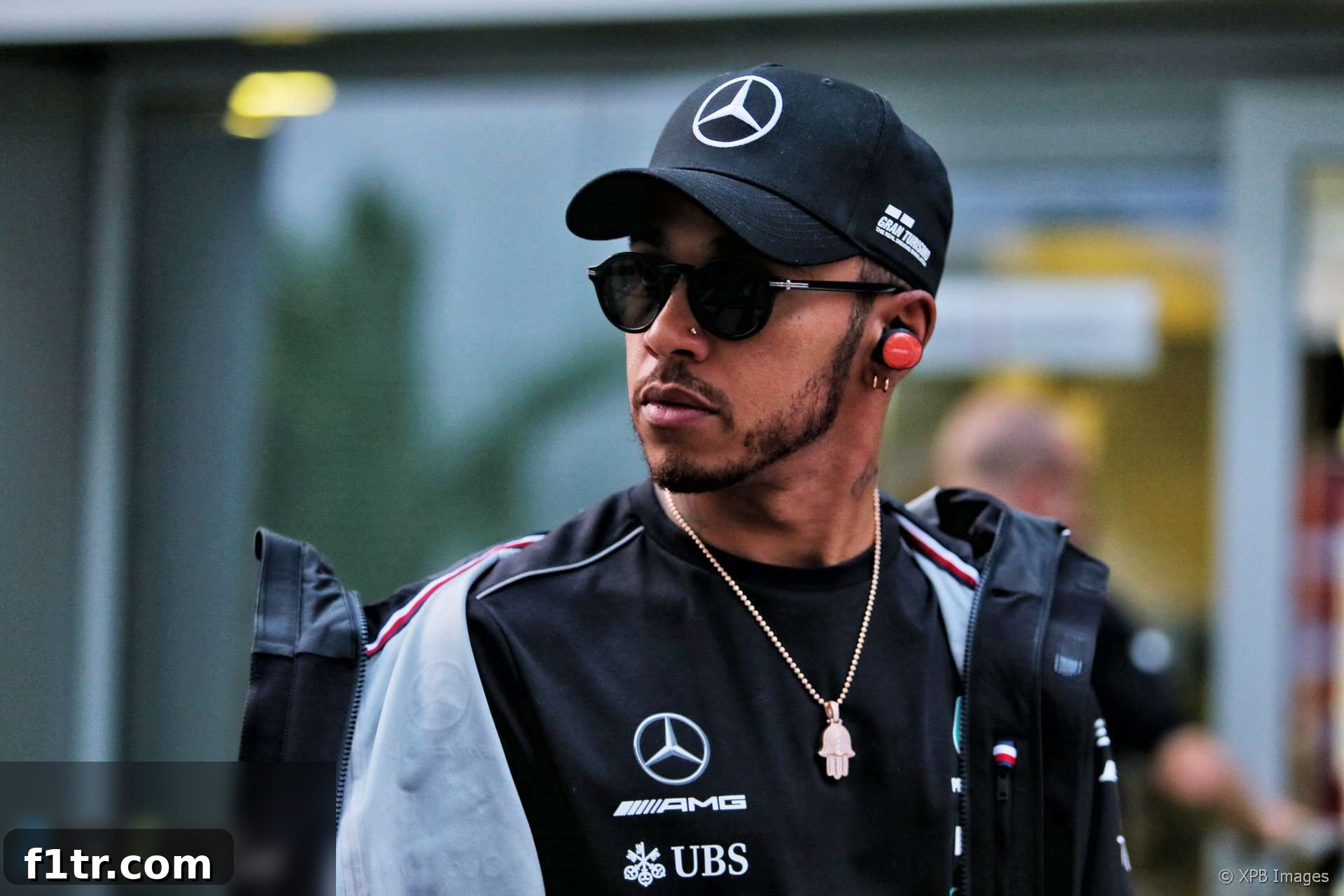
The highly anticipated Russian Grand Prix at the Sochi Autodrom often brings with it a unique set of challenges, and for top drivers like Lewis Hamilton, these challenges can sometimes overshadow the excitement. Following the initial practice sessions for the 2018 event, the Mercedes star expressed palpable pessimism regarding the potential for an engaging and thrilling race weekend. His concerns were primarily centered around the inherent difficulties of close-quarters racing and the anticipated impact of tyre strategy on the overall spectacle, casting a shadow over what fans hoped would be a captivating contest.
Hamilton’s frustration stemmed from firsthand experience on the Sochi track, a circuit that has historically garnered mixed reviews for its racing dynamics. He highlighted the significant struggle to maintain proximity to other cars, even when his vehicle possessed a clear performance advantage. “As soon as you get within a few seconds of another car it’s pretty difficult to even get close,” he remarked, underscoring a fundamental aerodynamic limitation that plagues many modern Formula 1 circuits. This challenge was starkly evident during practice, where he found himself battling to close the gap on a competitor running on softer tyres, despite his own car being equipped with the faster hypersoft compound. The inability to effectively utilize a tyre advantage to facilitate overtakes pointed to a deeper issue with the track layout and its interaction with contemporary F1 car designs.
The intricacies of Formula 1 aerodynamics dictate that cars lose significant downforce when following closely behind another, an effect commonly referred to as “dirty air.” This turbulent air drastically reduces grip, making it incredibly difficult for a trailing car to maintain speed through corners or even to get into a position to attempt an overtake on straights. Sochi’s layout, characterized by its long, sweeping turns and relatively smooth asphalt, appears to exacerbate this problem. Hamilton’s comments, “That’s the bad thing about this track, unfortunately. I don’t really know what they can to do to make it better,” reflected a widespread sentiment among drivers regarding the circuit’s inherent design limitations for promoting wheel-to-wheel action. The track’s design, winding around the Olympic Park, offers a distinct character but often at the expense of dynamic racing opportunities, pushing drivers to manage their pace and preserve tyres rather than attack.
Beyond the challenges of following other cars, Hamilton also expressed deep reservations about the impact of tyre strategy on the race’s excitement. He predicted that the Russian Grand Prix would most likely unfold as a one-stop race, a scenario that often translates into a less thrilling experience for fans. “Unfortunately it’s most likely going to be something like a one-stop race which means it’s going to be boring for the fans,” he stated, adding, “Immediately I already know it’s going to be boring because it’s so hard to follow.” A one-stop strategy inherently reduces the strategic variability and on-track drama that multi-stop races can offer, leaving little room for unexpected twists or significant positional changes through pit stops. This predictability can drain much of the suspense from a Grand Prix, turning it into a procession rather than a fierce competition.
Pirelli, the sole tyre supplier for Formula 1, also weighed in on the tyre dynamics anticipated for the Sochi race, confirming Hamilton’s concerns. Mario Isola, Pirelli’s Motorsport Director, indicated that the higher levels of tyre degradation observed during Friday’s practice sessions would likely compel teams to adopt a cautious approach, managing their pace for a substantial portion of the race. Isola admitted, “As happened in the last races we know that teams will manage the pace. And this is not good because we prefer to see a race where they are pushing, not where they will managing the pace.” This admission highlights a recurring dilemma in modern F1: while increased degradation is intended to promote strategic variation, it often leads to drivers conserving their tyres rather than pushing their limits, thereby reducing the intensity of the racing. The tendency to manage degradation to avoid an extra pit stop transforms what could be a high-stakes tactical battle into a more conservative affair, where preserving tyre life becomes paramount over aggressive racing. This strategic compromise, while logical for teams seeking optimal race results, often comes at the expense of fan entertainment.
The Sochi Autodrom, since its debut in 2014, has presented a unique environment for Formula 1 racing. Its smooth track surface and specific corner profiles contribute to relatively low tyre wear in some sections, yet other parts, particularly long traction zones, can induce significant degradation. This combination means that while a two-stop race might seem appealing for action, the actual performance window for the tyres often pushes teams towards a single stop, seeking to optimize track position and minimize time lost in the pits. The difficulty in overtaking further complicates matters, as a driver who can manage their tyres effectively often finds themselves in a strong defensive position, regardless of raw pace differences. This scenario often puts the onus on qualifying performance, making the Saturday session critically important for track position, which then heavily dictates Sunday’s outcome.
For the average F1 enthusiast, the prospect of a “boring” race, as described by Hamilton, is disheartening. Fans tune in for the thrill of close battles, daring overtakes, and unpredictable strategic plays. When these elements are diminished due to track characteristics and tyre management mandates, the sport’s appeal can suffer. The dialogue between drivers, tyre suppliers, and race organizers continually revolves around how to strike the right balance between technical challenge, safety, and entertainment. Hamilton’s outspoken criticism served as a reminder that even at the pinnacle of motorsport, the fundamental ingredients for captivating racing are not always guaranteed, and sometimes, specific circuits pose inherent challenges that are difficult to overcome with current regulations and car designs. The pursuit of an exciting Grand Prix experience remains a constant goal, but the reality on tracks like Sochi can sometimes fall short, leading to frustration among both competitors and spectators alike.
The 2018 season, like many others, saw teams and drivers navigating complex regulations and the constant push for performance. The feedback from drivers like Hamilton and insights from Pirelli’s Isola were crucial in understanding the dynamic challenges faced during that era of F1. While every Grand Prix holds its own unique narrative, the concerns raised at Sochi highlighted a broader conversation within the sport about circuit design, tyre compounds, and the ultimate aim of delivering a truly spectacular race for fans worldwide. The drive for continuous improvement in these areas remains a core part of Formula 1’s evolution, with the aim of ensuring that future races are anything but boring.
2018 F1 Season Insights
- F1 feared “death knell” for Drive to Survive after Ferrari and Mercedes snub
- McLaren staff told us we were “totally crazy” to take Honda engines in 2018 – Tost
- ‘It doesn’t matter if we start last’: How Red Bull’s junior team aided Honda’s leap forward
- Honda’s jet division helped F1 engineers solve power unit problem
- McLaren Racing losses rise after Honda split
Browse all 2018 F1 season articles