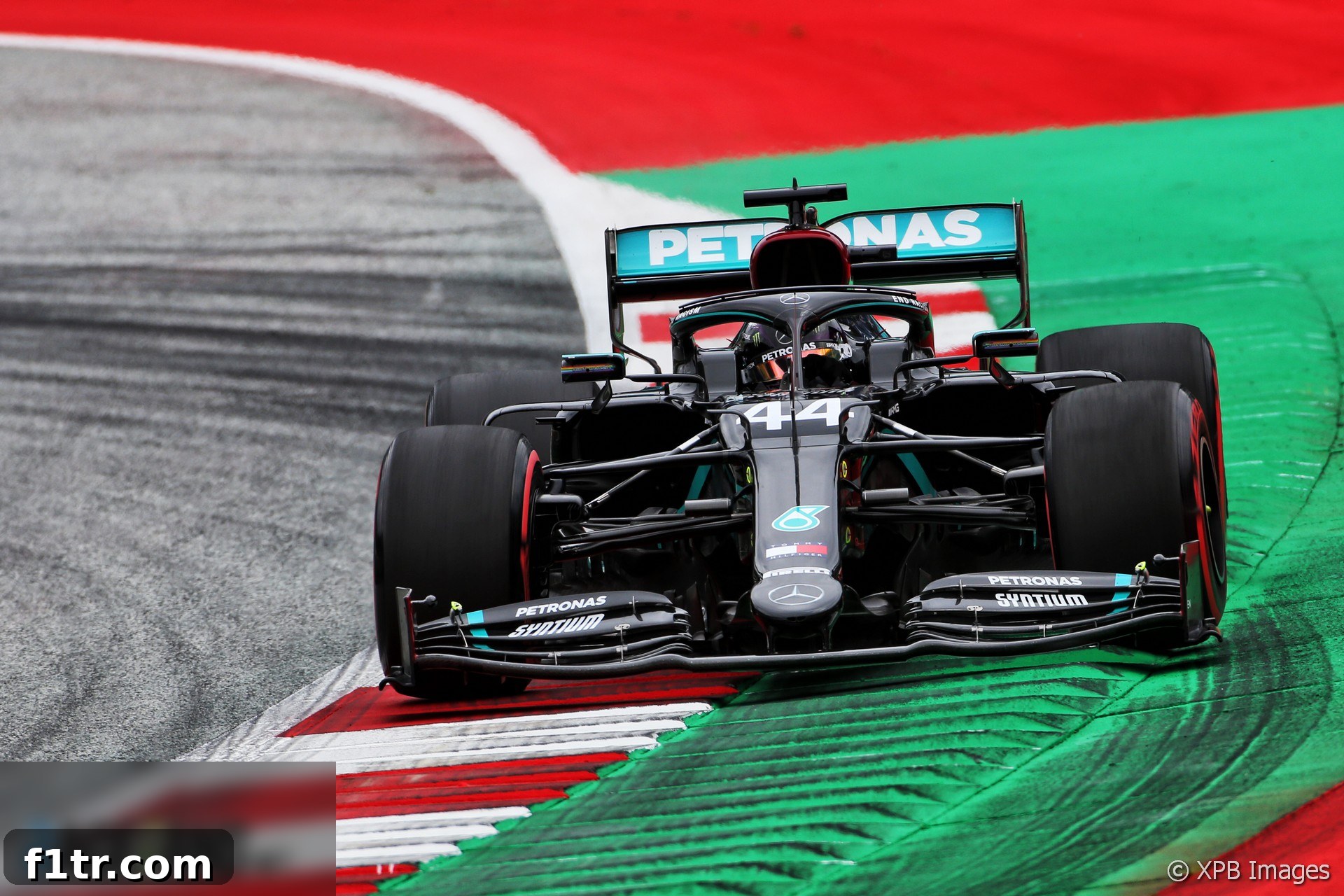
The 2020 Formula 1 season roared back to life at the Red Bull Ring in Spielberg, Austria, and the second practice session for the Austrian Grand Prix offered a compelling glimpse into the pecking order for what promises to be an unpredictable season opener. Unsurprisingly, Mercedes continued to assert their dominance, with reigning world champion Lewis Hamilton once again topping the timing charts, leading a commanding one-two for the Silver Arrows alongside his formidable teammate Valtteri Bottas.
Advertisement | Support Independent F1 Journalism & Go Ad-Free
For the second consecutive session, the black Mercedes cars appeared untouchable, their raw pace proving a significant challenge for their closest rivals. Both Ferrari and Red Bull Racing, widely considered the primary challengers, found themselves trailing by a substantial margin. Ferrari’s best efforts were approximately six-tenths of a second shy of Mercedes’ benchmark, while Red Bull languished even further behind, nearly nine-tenths adrift over the 64-second lap around the picturesque Austrian circuit. This consistent gap across two sessions highlighted a potential performance disparity that could set the tone for the entire weekend.
The battle behind Mercedes, however, proved to be far more intense and unpredictable. Sebastian Vettel’s Ferrari narrowly missed out on a top-three spot, being edged out by a surprisingly strong performance from Sergio Perez in his Racing Point. Perez, piloting what many in the paddock have dubbed the ‘Pink Mercedes’ due to its striking resemblance to last year’s championship-winning car, demonstrated impressive pace and consistency. Vettel’s teammate, Lance Stroll, might have been closer to backing up the four-time world champion’s time, but encountered traffic during his crucial qualifying simulation run, losing valuable seconds behind Valtteri Bottas.
The upper echelons of the timing sheets painted a vibrant picture of midfield competition, with five different constructor teams represented within the top six positions. Daniel Ricciardo put in a commendable performance, guiding his Renault to fifth place. The French outfit experienced a delayed start to the session after Esteban Ocon’s car shed a piece of bodywork during the first practice, possibly due to an impact with a kerb, necessitating extensive checks and repairs. Despite this setback, Ricciardo’s pace was encouraging for the team. Close behind him, showcasing the efficacy of similar power units, was Lando Norris in his McLaren, securing a solid sixth position.
For Red Bull Racing, their home track proved to be a source of frustration rather than celebration. Neither Max Verstappen nor Alexander Albon could climb higher than eighth and thirteenth respectively. Both drivers experienced unsettling off-track excursions, reminiscent of the handling struggles observed during pre-season testing. Albon’s spin at Turn 1 particularly echoed a similar incident involving Verstappen during the earlier practice session, underscoring potential underlying balance issues with the RB16. Behind the last year’s race winner, Verstappen, came last year’s pole sitter, Charles Leclerc, who placed ninth for Ferrari. Carlos Sainz Jnr rounded out the top ten in the second McLaren, further cementing the Woking-based team’s strong showing.
Romain Grosjean, driving for Haas, managed to complete a substantial amount of running during the session, a welcome change after grappling with significant issues in the morning practice. However, his day was not without its complaints, as the Frenchman expressed clear dissatisfaction with his car’s braking performance, reporting consistent lock-ups and instability under deceleration. This highlighted ongoing challenges for the American team as they sought to extract more performance from their VF-20 chassis.
Meanwhile, the Williams team showed encouraging signs of progress. While rookie Nicholas Latifi had a few minor offs as he continued to acclimatize to Formula 1 machinery, his teammate George Russell delivered another standout performance. Russell skillfully lifted the team’s other car out of the bottom two places, demonstrating his exceptional talent. He managed to edge out experienced campaigner Kimi Räikkönen into 19th, after the Alfa Romeo driver had an off-track moment at Turn 5 during the session, further highlighting the competitive nature of the field, even towards the rear.
Advertisement | Become a RaceFans Supporter andEnjoy an Ad-Free Experience
2020 Austrian Grand Prix Second Practice Session Lap Times: Detailed Analysis
The second practice session at the Red Bull Ring was critical for teams to gather data on long-run pace, tire degradation, and qualifying simulations. Lewis Hamilton’s blistering 1’04.304 set the standard, demonstrating Mercedes’ overwhelming speed. Valtteri Bottas was just under two-tenths behind, solidifying the team’s dominant position. The consistency of their laps and overall car balance appeared to be in a league of their own. It’s worth noting the sheer number of laps completed by both Mercedes drivers, indicating strong reliability and extensive data collection.
The third fastest time of Sergio Perez for Racing Point was a clear highlight. His 1’04.945 placed him ahead of Sebastian Vettel, suggesting that the RP20 is a truly capable machine, especially in the hands of the experienced Mexican driver. This performance has undoubtedly sent ripples through the midfield, and potentially even amongst the front-runners, given the car’s origins. Sebastian Vettel’s fourth-place finish, a mere 0.016 seconds behind Perez, underlined Ferrari’s ongoing struggle to match the top pace, even if it placed him as the fastest Ferrari driver. His 48 laps provided crucial data, but the consistent gap to Mercedes remains a significant concern.
Daniel Ricciardo’s fifth position, just 0.011 seconds behind Vettel, was an impressive showing for Renault, particularly considering Esteban Ocon’s earlier issues. This indicates that the RS20 might have more potential than initially anticipated, and Ricciardo’s ability to extract performance could be a key factor for the team this season. Lando Norris, in sixth, continued McLaren’s strong form from last season, showing excellent pace in the MCL35. The McLaren-Renault package seems well-balanced and competitive, setting them up nicely for a battle at the sharp end of the midfield.
Lance Stroll, despite his traffic woes, managed seventh, reinforcing Racing Point’s strong performance. Max Verstappen, usually a consistent front-runner at his home track, could only manage eighth, nearly a second off Hamilton’s pace. This will be a source of significant worry for Red Bull, as both drivers struggled with the car. Charles Leclerc, in ninth, and Carlos Sainz Jnr, in tenth, completed the top ten, showcasing the competitive nature of the midfield. Leclerc’s gap of almost a full second to Hamilton highlighted Ferrari’s work cut out for them.
Further down the field, Esteban Ocon’s recovery to eleventh, Daniil Kvyat’s twelfth for AlphaTauri, and Alexander Albon’s thirteenth for Red Bull highlighted various team positions. Albon’s significant gap to his teammate Verstappen, and even more so to the Mercedes, is a point of concern for the Milton Keynes squad. Antonio Giovinazzi and Kevin Magnussen showed consistent running for Alfa Romeo and Haas respectively. Romain Grosjean, despite his braking complaints, completed the most laps of anyone in the session (50), providing valuable data for Haas. Pierre Gasly placed seventeenth for AlphaTauri. George Russell’s eighteenth position for Williams was a remarkable achievement given the car’s overall pace, while Kimi Räikkönen and Nicholas Latifi rounded out the twenty drivers, with Latifi notably quite far off the pace as he grapples with the demands of Formula 1.
| Pos. | No. | Driver | Car | Best lap | Gap | Laps |
|---|---|---|---|---|---|---|
| 1 | 44 | Lewis Hamilton | Mercedes | 1’04.304 | 42 | |
| 2 | 77 | Valtteri Bottas | Mercedes | 1’04.501 | 0.197 | 37 |
| 3 | 11 | Sergio Perez | Racing Point-Mercedes | 1’04.945 | 0.641 | 48 |
| 4 | 5 | Sebastian Vettel | Ferrari | 1’04.961 | 0.657 | 48 |
| 5 | 3 | Daniel Ricciardo | Renault | 1’04.972 | 0.668 | 36 |
| 6 | 4 | Lando Norris | McLaren-Renault | 1’05.087 | 0.783 | 38 |
| 7 | 18 | Lance Stroll | Racing Point-Mercedes | 1’05.135 | 0.831 | 49 |
| 8 | 33 | Max Verstappen | Red Bull-Honda | 1’05.215 | 0.911 | 41 |
| 9 | 16 | Charles Leclerc | Ferrari | 1’05.298 | 0.994 | 46 |
| 10 | 55 | Carlos Sainz Jnr | McLaren-Renault | 1’05.352 | 1.048 | 37 |
| 11 | 31 | Esteban Ocon | Renault | 1’05.415 | 1.111 | 42 |
| 12 | 26 | Daniil Kvyat | AlphaTauri-Honda | 1’05.443 | 1.139 | 34 |
| 13 | 23 | Alexander Albon | Red Bull-Honda | 1’05.453 | 1.149 | 47 |
| 14 | 99 | Antonio Giovinazzi | Alfa Romeo-Ferrari | 1’05.608 | 1.304 | 49 |
| 15 | 20 | Kevin Magnussen | Haas-Ferrari | 1’05.678 | 1.374 | 44 |
| 16 | 8 | Romain Grosjean | Haas-Ferrari | 1’05.908 | 1.604 | 50 |
| 17 | 10 | Pierre Gasly | AlphaTauri-Honda | 1’06.016 | 1.712 | 51 |
| 18 | 63 | George Russell | Williams-Mercedes | 1’06.125 | 1.821 | 40 |
| 19 | 7 | Kimi Raikkonen | Alfa Romeo-Ferrari | 1’06.278 | 1.974 | 44 |
| 20 | 6 | Nicholas Latifi | Williams-Mercedes | 1’07.124 | 2.820 | 45 |
Second Practice Lap Time Gaps
The gap analysis from the second practice session at the Austrian Grand Prix provides a clear illustration of the performance disparities and competitive clusters across the field. Lewis Hamilton set the benchmark, showcasing the immense potential of the Mercedes W11. His time of 1’04.304 stands as the undisputed reference point for the weekend so far.
Valtteri Bottas, just 0.197 seconds adrift, ensured a dominant Mercedes one-two, highlighting the formidable pace of the team and the consistency of both drivers. This sub-two-tenths gap between the two Silver Arrows drivers suggests a tight internal battle, even within the team’s overall dominance.
Sergio Perez, with a gap of 0.641 seconds, marked Racing Point as a serious contender for the ‘best of the rest’ title, impressively slotting into third. His performance was particularly notable as he outpaced Sebastian Vettel, who was just 0.657 seconds off Hamilton’s pace. This tiny margin between Perez and Vettel underlines the intense fight for positions just behind the dominant Mercedes.
Daniel Ricciardo demonstrated strong form for Renault, with his lap time being 0.668 seconds slower than Hamilton’s, placing him firmly in the mix with Racing Point and Ferrari. Lando Norris followed closely, 0.783 seconds behind, keeping McLaren competitive in the upper midfield.
Lance Stroll, only 0.831 seconds back, showed that Racing Point’s strong pace wasn’t a fluke, with both their cars in the top seven. Red Bull’s struggles were evident, with Max Verstappen almost a full second off the pace (+0.911s), a worrying sign for the team at their home event. Charles Leclerc, at +0.994s, and Carlos Sainz Jnr, at +1.048s, completed the top ten, both just over a second behind the leading Mercedes.
Esteban Ocon (+1.111s), Daniil Kvyat (+1.139s), and Alexander Albon (+1.149s) formed a tight cluster in the lower half of the top 15, indicating fierce competition for every tenth of a second. Albon’s larger gap to the front, compared to his teammate, will be a point of analysis for Red Bull. Antonio Giovinazzi (+1.304s) and Kevin Magnussen (+1.374s) represent Alfa Romeo and Haas respectively, showing the consistent gaps further down the grid.
Romain Grosjean, despite his braking issues, managed a lap time 1.604 seconds slower than Hamilton’s, indicating the challenges faced by Haas. Pierre Gasly (+1.712s) was just behind. George Russell continued to impress, bringing his Williams to within 1.821 seconds of the leader, a significant achievement for the struggling team. Kimi Räikkönen (+1.974s) and rookie Nicholas Latifi (+2.820s) completed the field, with Latifi notably facing a substantial deficit as he gains experience in Formula 1. The drivers more than ten seconds off the pace are omitted as per standard practice, though in this session all drivers were within a reasonable margin.
Advertisement | Become a RaceFans Supporter andEnjoy an Ad-Free Experience
Further Insights and Coverage from the 2020 Austrian Grand Prix
For more in-depth analysis, breaking news, and exclusive content surrounding the thrilling opening weekend of the 2020 Formula 1 season at the Austrian Grand Prix, explore our comprehensive coverage. Stay updated on all the developments as teams battle for supremacy in this unprecedented F1 calendar. From corrected results to driver outlooks and interactive data, we have every angle covered.
- FIA issues new Austrian GP results after correcting Kvyat error
- Russell sees Mercedes as only possible alternative to Williams in 2021
- Hamilton: No “bad blood” with Albon after second collision in three races
- 2020 Austrian Grand Prix interactive data: lap charts, times and tyres
- 2020 Austrian Grand Prix Star Performers
Browse all 2020 Austrian Grand Prix articles