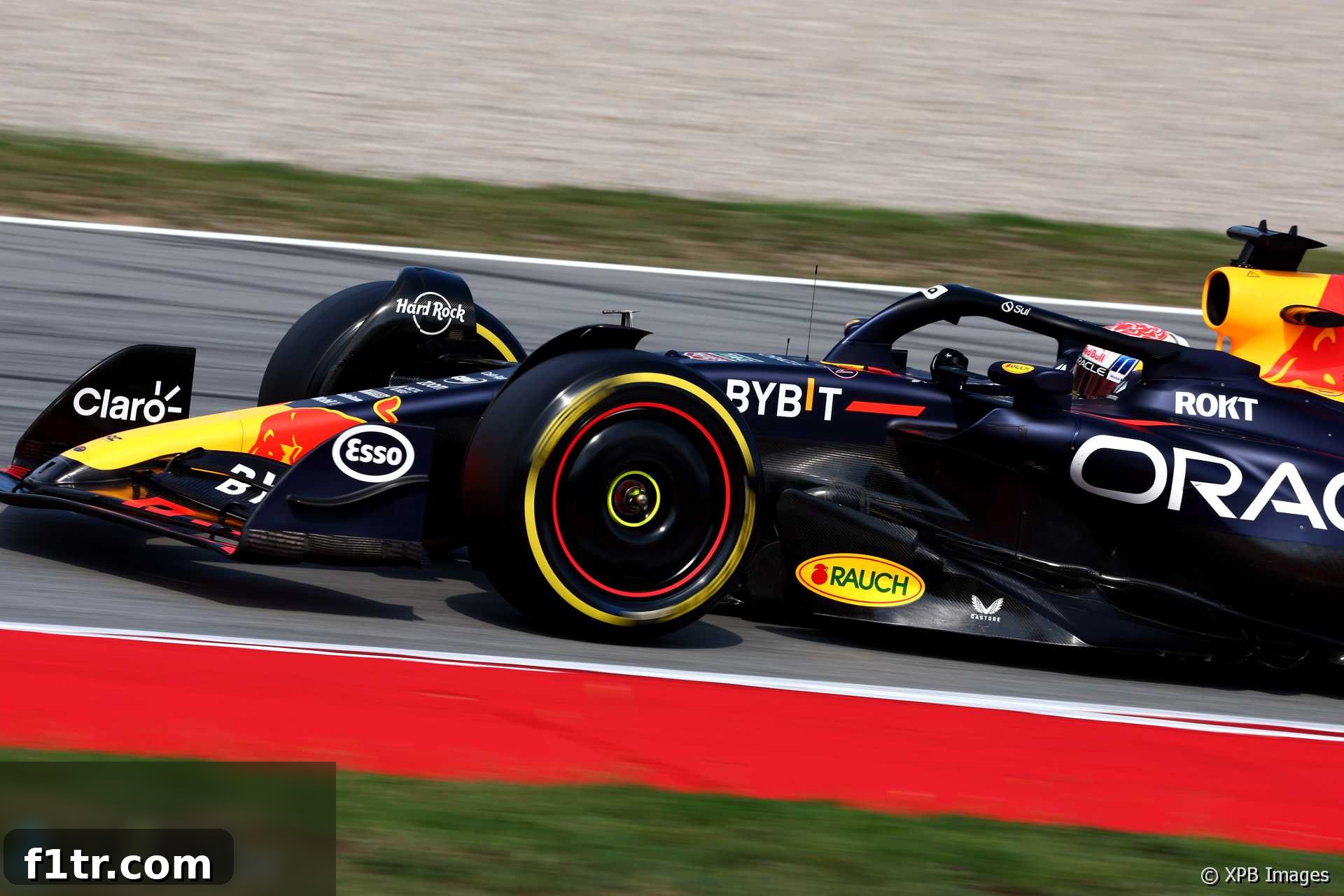
The Circuit de Barcelona-Catalunya, a familiar testing ground and a staple on the Formula 1 calendar, played host to an exhilarating second practice session for the Spanish Grand Prix. As teams fine-tuned their machines and drivers pushed the limits, Max Verstappen once again asserted his dominance, topping the timesheets. However, the session was far from a one-man show, with local hero Fernando Alonso thrilling the home crowd by getting within two tenths of a second of the Red Bull ace, and Nico Hulkenberg delivering a truly surprising performance to secure third fastest.
Verstappen Sets the Pace as Teams Unpack Barcelona Updates
Friday’s second practice session for the 2023 Spanish Grand Prix saw Max Verstappen maintain his formidable form. The reigning world champion was the only driver to dip below the 1 minute 14-second barrier, marking a significant benchmark on the notoriously technical Barcelona circuit. His blistering pace in the Red Bull RB19 underscored his comfort and the car’s strong performance at a track that often exposes any weaknesses in a chassis design. Just 0.170 seconds adrift, Fernando Alonso demonstrated the impressive gains made by Aston Martin this season, showcasing their potential to challenge the front-runners even at circuits demanding high aerodynamic efficiency.
Perhaps the most unexpected headline of FP2 came from Nico Hulkenberg. The Haas driver, in a remarkable display of skill and car performance, posted the third-fastest time. This unexpected turn of events sent ripples of intrigue through the paddock, hinting at the potential for Haas to be a dark horse in the midfield battle throughout the weekend. Such a strong showing in practice provides valuable confidence and data for the American team, suggesting they might have found a sweet spot with their VF-23 in Barcelona.
Track Conditions and Strategic Tyre Evaluations
The second practice session commenced under clear skies, a welcome sight after the ominous clouds that had gathered towards the end of the morning’s opening hour. Despite earlier meteorological warnings, there was no sign of rain affecting running, allowing teams to proceed with their planned programs without interruption. Conditions remained largely consistent with the latter part of FP1, with the track temperature gradually cooling as the session progressed. This subtle shift in conditions is crucial for data analysis, as it impacts tyre degradation and overall grip levels, forcing teams to adapt their strategies for qualifying and the race.
A key element of Friday’s running involved the evaluation of prototype Pirelli tyres. These experimental compounds, slated for introduction as race tyres at the upcoming British Grand Prix, offered teams a vital opportunity to gather data on their characteristics. Red Bull, Aston Martin, and Mercedes opted to send both their drivers out on these prototype tyres at the start of FP2, eager to understand their behaviour and potential performance benefits. In contrast, Ferrari took a different approach, immediately deploying Charles Leclerc and Carlos Sainz Jnr on the softest available compound. This strategic divergence provided an early glimpse into different philosophies for approaching the weekend, especially with Ferrari also running their newly updated bodywork on the SF-23, hoping to unlock a new level of performance.
Intense Lap Time Battles and Early Challenges
The session quickly heated up with drivers pushing for representative lap times. Carlos Sainz Jnr, buoyed by the upgrades on his SF-23, wasted no time in improving on Ferrari’s best from the opening session. He clocked a rapid 1’14.999, briefly putting him at the top of the timesheets. His teammate, Charles Leclerc, was just over two tenths slower, slotting his Ferrari into second place and highlighting the immediate impact of the team’s updates. Both Ferrari drivers demonstrated strong single-lap pace, which bodes well for their qualifying prospects. Meanwhile, for Mercedes, George Russell continued to grapple with persistent porpoising, a phenomenon where the car bounces violently at high speeds. Despite the team’s efforts, Russell reported discomfort and a lack of confidence through the high-speed right-handers of turns three and nine, indicating that Mercedes still has work to do to fully resolve their car’s instability issues.
The battle for supremacy intensified as the session progressed. Max Verstappen, initially on the prototype tyres, switched to a set of medium compounds and immediately jumped to the front with a 1’14.968, marginally quicker than Sainz. Not one to be outdone, Sainz responded with a fresh set of soft tyres, extracting almost seven tenths off Verstappen’s time to reclaim the top spot. However, the lead was fleeting. His teammate, Leclerc, then edged him out by an incredibly tight margin of less than three hundredths of a second, showcasing the razor-thin differences in performance at the pinnacle of motorsport and the internal competition within Ferrari.
Verstappen, not content with second place, returned to the track equipped with another set of soft tyres. It was on this run that he unleashed a lap time that reset the benchmark for the day, breaking the 1’14 barrier for the first time with an exceptional performance. This move firmly placed him back at the top of the timesheets, underscoring his raw pace and the Red Bull’s capabilities. Fernando Alonso, ever the competitor, then embarked on a push lap on softs, moving up to second place. While his effort was commendable, he remained over a tenth off Verstappen’s scorching best, a testament to the Red Bull driver’s exceptional form.
Focus Shifts to Race Simulations and Long Runs
As the second half of the session unfolded, the focus for most teams shifted from outright single-lap pace to longer, higher-fuel runs – crucial race simulation exercises. This phase is vital for understanding tyre degradation, fuel consumption, and consistent performance over a race distance. Verstappen ventured out for an extended run on the medium compound tyres, gathering valuable data on their longevity and pace. Many of his key rivals, meanwhile, opted to conduct their race simulations on the soft compound, which offers more grip but typically degrades faster. Verstappen eventually pitted to switch to the red-marked soft tyres himself, allowing Red Bull to compare data across different compounds for race strategy. The entire field continued to conduct these race simulation runs throughout the final third of the session, meticulously collecting information that will inform their setup choices and strategic plans for Sunday’s Grand Prix.
Despite the intensive long-run efforts, there were no further improvements in the ultimate lap times during the closing stages of the session. This meant that Max Verstappen confidently retained his position at the very top of the timesheets, a clear indicator of his strong form heading into the weekend. Fernando Alonso solidified his impressive second place, finishing just 0.170 seconds behind the championship leader. The biggest surprise of the day, Nico Hulkenberg, held onto his remarkable third position, capping off an outstanding Friday for Haas and generating considerable excitement for their prospects.
Final Standings and Weekend Outlook
Rounding out the top ten, Sergio Perez secured fourth position in the second Red Bull, indicating the team’s overall strength, though he was several tenths adrift of his teammate. Esteban Ocon delivered a solid performance for Alpine, placing fifth and showcasing the French team’s competitive potential. The two Ferraris, with their recent updates, finished sixth and seventh, with Charles Leclerc just ahead of Carlos Sainz Jnr, suggesting they still have work to do to match Red Bull’s single-lap pace. George Russell’s Mercedes could only manage eighth, highlighting their ongoing struggles with the W14’s characteristics at Barcelona. Valtteri Bottas continued Alfa Romeo’s consistent season with a ninth-place finish, while Pierre Gasly completed the top ten for Alpine. The close margins throughout the midfield promise an exciting qualifying session and a fiercely contested race on Sunday.
2023 Spanish Grand Prix Second Practice Result
| Position | Number | Driver | Team | Model | Time | Gap | Laps |
|---|---|---|---|---|---|---|---|
| 1 | 1 | Max Verstappen | Red Bull-Honda RBPT | RB19 | 1’13.907 | 33 | |
| 2 | 14 | Fernando Alonso | Aston Martin-Mercedes | AMR23 | 1’14.077 | 0.170 | 29 |
| 3 | 27 | Nico Hulkenberg | Haas-Ferrari | VF-23 | 1’14.177 | 0.270 | 31 |
| 4 | 11 | Sergio Perez | Red Bull-Honda RBPT | RB19 | 1’14.219 | 0.312 | 29 |
| 5 | 31 | Esteban Ocon | Alpine-Renault | A523 | 1’14.242 | 0.335 | 29 |
| 6 | 16 | Charles Leclerc | Ferrari | SF-23 | 1’14.246 | 0.339 | 31 |
| 7 | 55 | Carlos Sainz Jnr | Ferrari | SF-23 | 1’14.274 | 0.367 | 31 |
| 8 | 63 | George Russell | Mercedes | W14 | 1’14.392 | 0.485 | 31 |
| 9 | 77 | Valtteri Bottas | Alfa Romeo-Ferrari | C43 | 1’14.448 | 0.541 | 31 |
| 10 | 10 | Pierre Gasly | Alpine-Renault | A523 | 1’14.457 | 0.550 | 28 |
| 11 | 44 | Lewis Hamilton | Mercedes | W14 | 1’14.549 | 0.642 | 30 |
| 12 | 81 | Oscar Piastri | McLaren-Mercedes | MCL60 | 1’14.583 | 0.676 | 29 |
| 13 | 24 | Zhou Guanyu | Alfa Romeo-Ferrari | C43 | 1’14.585 | 0.678 | 28 |
| 14 | 4 | Lando Norris | McLaren-Mercedes | MCL60 | 1’14.694 | 0.787 | 29 |
| 15 | 20 | Kevin Magnussen | Haas-Ferrari | VF-23 | 1’14.713 | 0.806 | 23 |
| 16 | 21 | Nyck de Vries | AlphaTauri-Honda RBPT | AT04 | 1’14.785 | 0.878 | 33 |
| 17 | 22 | Yuki Tsunoda | AlphaTauri-Honda RBPT | AT04 | 1’14.840 | 0.933 | 34 |
| 18 | 18 | Lance Stroll | Aston Martin-Mercedes | AMR23 | 1’15.010 | 1.103 | 30 |
| 19 | 23 | Alexander Albon | Williams-Mercedes | FW45 | 1’15.056 | 1.149 | 31 |
| 20 | 2 | Logan Sargeant | Williams-Mercedes | FW45 | 1’15.415 | 1.508 | 32 |
2023 Spanish Grand Prix Related Articles
- Ben Sulayem raises safety concerns over “too many people on the grid” at races
- Why Ferrari say their change in design is the result of “discipline”, not “copying”
- Hamilton and Russell were seeking tow from Sainz when they collided – Mercedes
- Red Bull’s Spanish GP diffuser update was ‘inspired by rivals’ including Williams
- Why McLaren always doubted second-row start in Spain would lead to points finish
Browse all 2023 Spanish Grand Prix articles