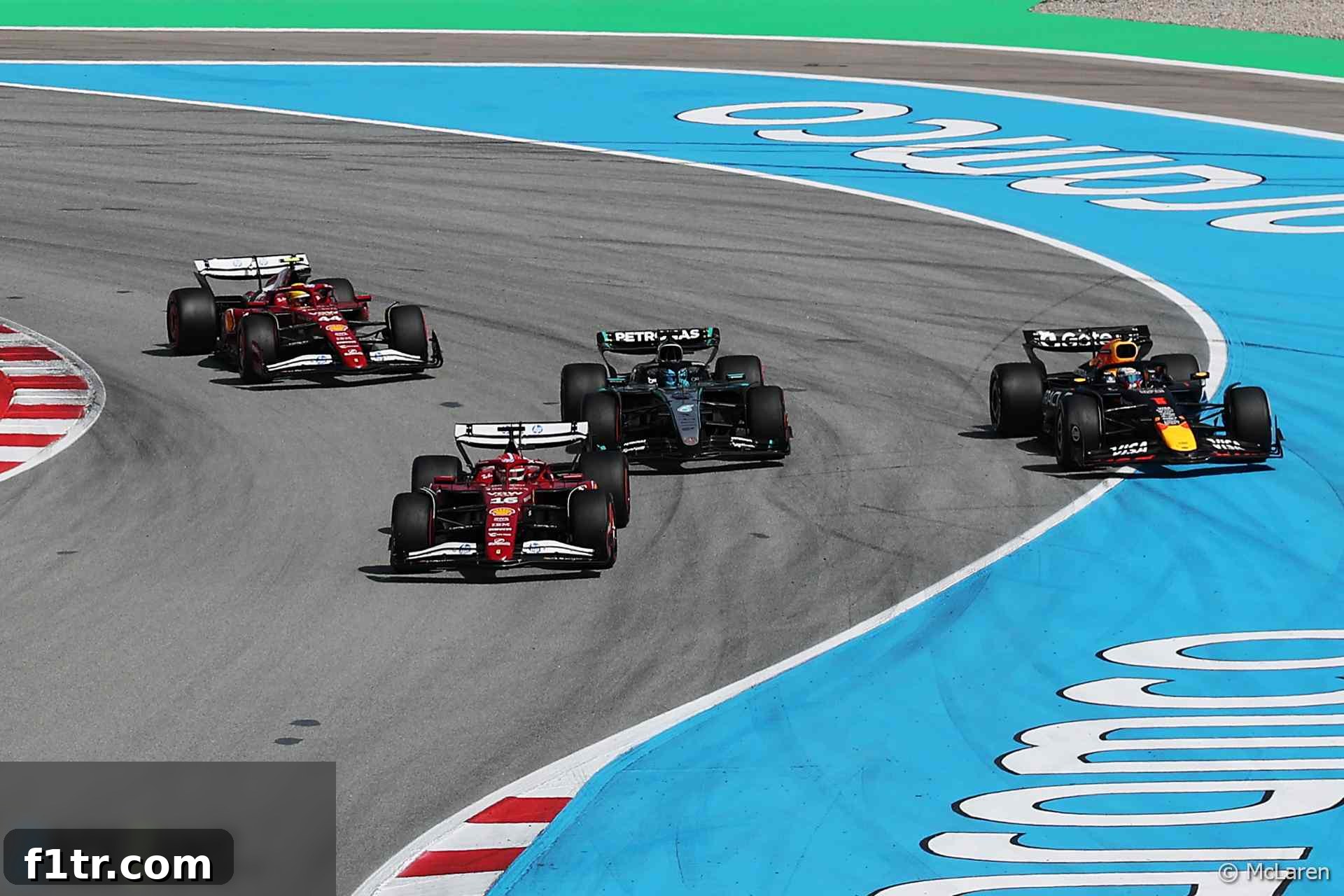
Red Bull team principal Christian Horner has shed light on the critical misstep the team made during the recent Spanish Grand Prix, explaining the controversial decision to instruct star driver Max Verstappen to surrender a position to Mercedes’ George Russell. This pivotal moment, intended to mitigate a potential penalty, instead escalated into a series of unfortunate events, leaving Verstappen on the brink of an automatic race ban and sparking widespread debate across the Formula 1 community.
Advert | Become a Supporter & go ad-free
Advertisement
Red Bull’s Costly Misjudgment: Unpacking the Verstappen-Russell Clash at the Spanish GP
The incident at the heart of the controversy unfolded dramatically. Following a safety car restart on lap 61, George Russell attempted an audacious overtake on Verstappen into Turn 1. The two drivers made contact, resulting in Verstappen running wide off the track, yet crucially maintaining his position ahead of the Mercedes. What seemed like a straightforward racing incident quickly spiraled into a complex dilemma for Red Bull Racing, culminating in a team order that would spectacularly backfire.
The Turn 1 Tangle: A Race-Defining Moment
As the race resumed, the tension was palpable. Russell, eager to gain ground, launched an attack on Verstappen. Accounts suggest Russell was significantly alongside on the inside as they approached the apex. However, the contact forced Verstappen off the track, who then rejoined without losing a place. Russell, understandably agitated, immediately took to his team radio, exclaiming, “I was up the inside, he just went…” His race engineer, Marcus Dudley, swiftly acknowledged the situation, “I saw it, I saw,” indicating a recognition of the unfolding drama but offering no immediate further discussion on the matter.
Red Bull’s Dilemma: Navigating the Grey Areas of F1 Rules
Just two laps after the initial contact, Red Bull made the fateful call, instructing Verstappen to allow Russell back past. Christian Horner revealed the team’s rationale was rooted in a genuine fear of incurring a penalty from the stewards if they failed to act. F1 regulations stipulate a narrow window for such decisions, often requiring teams to react within a single lap. “We have a process,” Horner explained to Sky. “The problem is you have one lap to make that decision as per the regulations.”
The team’s analysis, based on still images, suggested that Russell’s car was “axle to axle” ahead of Verstappen’s at the point of contact. This, combined with Russell’s vocal complaints over the radio – “George was on the radio making a large noise about ‘yeah, he needs to give that back, he needs to give that back'” – put Red Bull under immense pressure. They believed that failing to yield the position would almost certainly result in a time penalty, potentially costing them valuable championship points.
Advert | Become a RaceFans supporter andgo ad-free
Advertisement
The Steward’s Verdict: A Post-Facto Justification for Verstappen
In a twist of irony, the stewards ultimately ruled that Verstappen was entitled to keep his position. Their reasoning centered on the fact that Russell had lost control of his car during the overtaking maneuver, thereby forcing Verstappen off the track. Red Bull, in their immediate assessment, had focused on the proximity of the two cars, particularly Russell’s car drawing fully alongside Verstappen’s, rather than the intricate details of Russell’s car control.
Horner drew a direct comparison to an incident at the Saudi Arabian Grand Prix earlier in the year, where Verstappen was indeed penalized for leaving the track and rejoining ahead of Oscar Piastri. In that instance, Piastri had cleanly passed Verstappen on the inside, maintaining full control of his car. “It was so marginal,” Horner reflected on the Spanish GP incident. “Obviously the argument [is] ‘was he fully in control of the car’? George would have argued that he was, but as painful experience showed in Jeddah it was all about where that front axle was.” This highlights the razor-thin margins and subjective interpretations that often define racing incidents in F1.
Further complicating their decision-making, Red Bull had attempted to seek clarification from race control on the incident. However, as Horner noted, race control stopped advising teams on racing incidents three years ago, leaving teams to make these high-stakes judgments independently. “It had been referred to the stewards,” Horner explained. “We’d asked race control for their feedback and nothing came back in that so you’re trying to pre-empt what three stewards and the race director are thinking. And at that point [we] felt, ‘do you know what, for two points, we need to concede this place’. So that was the decision we made and it’s so, so marginal.”
The Costly Aftermath: Collision, Penalty, and a Near-Ban
The team’s instruction, intended to avert a penalty, ironically triggered an even more severe consequence. Verstappen, frustrated by the demand to yield, reacted impulsively, leading to a second collision with Russell as he attempted to let him past. This subsequent contact prompted the stewards to impose a 10-second penalty on Verstappen, dropping him five places to 10th in the final race classification. More significantly, he was handed three penalty points on his Super Licence, bringing his total precariously close to the 12-point threshold that triggers an automatic race ban.
Advert | Become a RaceFans supporter andgo ad-free
Advertisement
Verstappen’s Emotional Drive: A Double-Edged Sword
Following the race, Horner confirmed that Max Verstappen had apologized to the team. “Max apologised to the team,” said Horner. “He knows that the penalty that obviously went with that was severe and you’re always learning in this life and there will be lessons taken from that race for sure.” However, Verstappen’s conduct has frequently drawn criticism in the past. His career is punctuated by a series of high-profile on-track incidents with rivals such as Lewis Hamilton and Lando Norris. A notable off-track outburst occurred in the paddock during the 2018 Brazilian Grand Prix, where he confronted Esteban Ocon after an on-track clash.
Horner, while acknowledging his driver’s fiery temperament, defended it as a characteristic shared by many of F1’s greatest champions. He admitted Verstappen can react “emotionally,” but framed this as integral to his exceptional talent. “He’s a driver that drives [with] a huge amount of emotion and it’s part of [what] gives him the brilliance that he has, the emotion that he drives with,” Horner explained. “He wears his heart on his sleeve and occasionally you make misjudgements and we’ve seen it with all the greats, whether it was Senna or Schumacher or all the great champions over the years.” This perspective suggests that while the intensity can lead to errors, it is also a fundamental component of what makes Verstappen a formidable competitor.
Lessons Learned and Future Implications
The Spanish Grand Prix served as a stark reminder of the complexities and pressures inherent in Formula 1. The fine line between aggressive racing and punishable conduct, combined with the instantaneous decisions required from teams and drivers, creates an environment ripe for controversy. Red Bull’s misjudgment, despite being made with the best intentions, underscores the critical importance of accurate real-time assessment and effective communication.
For Max Verstappen, the incident adds another chapter to his reputation as an uncompromising, yet sometimes volatile, driver. While his speed and determination are unquestionable, his proximity to a race ban will undoubtedly place increased scrutiny on his future on-track battles. The lessons from Spain will resonate throughout the paddock, prompting teams to re-evaluate their strategies for handling ambiguous racing incidents and challenging the notion of when ’emotion’ crosses the line into recklessness.
Miss nothing from RaceFans
Get a daily email with all our latest stories – and nothing else. No marketing, no ads. Sign up here:
Advert | Become a RaceFans supporter andgo ad-free
Advertisement
2025 Spanish Grand Prix: Related Articles and Further Reading
- Verstappen: Don’t blame Spanish GP penalty for hitting Russell if I narrowly lose title
- Russell’s radio comments influenced Red Bull’s decision to let him past Verstappen
- Verstappen says he won’t make any changes to his driving to avoid a ban
- ‘No issues’ with Verstappen but ‘it’d be different if he’d taken me out’ – Russell
- Ferrari “don’t want us to talk much” about “massive” Spanish GP problems – Hamilton
Browse all 2025 Spanish Grand Prix articles