The Defining Controversies of the 2021 Formula 1 Season: Verstappen vs. Hamilton
The 2021 Formula 1 season stands as one of the most fiercely contested and, arguably, most controversial championships in the sport’s illustrious history. It pitted two titans against each other: the relentless challenger Max Verstappen and the seven-time world champion Lewis Hamilton. What began as a season-long battle of sheer driving talent and strategic brilliance quickly escalated into a saga marked by hotly disputed decisions, intense wheel-to-wheel racing, and constant scrutiny of the sport’s officiating bodies.
From their very first encounter in Bahrain to the highly contentious finale in Abu Dhabi, controversy was a consistent companion. The spotlight often fell on the sport’s referees – primarily FIA F1 Race Director Michael Masi and the stewards – whose interpretations and enforcement of the regulations became critical flashpoints. The consistency, or perceived inconsistency, of penalties, the policing of track limits, and the legality of various on-track maneuvers frequently ignited heated debates, ultimately playing a pivotal role in shaping the championship narrative and, indeed, its outcome. This season pushed the boundaries of the rulebook and tested the officials to their limits, prompting a widespread review by the FIA in its aftermath.
Round 1 – Bahrain Grand Prix: The Track Limits Precedent
The very first race of the season set an immediate precedent for the controversy that would follow. Before the Bahrain Grand Prix commenced, Race Director Michael Masi issued guidance that track limits at the exit of Turn 4 would not be monitored for “setting a lap time.” However, he crucially reminded teams that Article 27.3 of the sporting regulations, which prohibits leaving the track to gain a “lasting advantage,” would still be applied.
Throughout the race, Lewis Hamilton was observed consistently running wide of the white lines at Turn 4’s exit. Initially, no action was taken, but Mercedes eventually received a warning regarding both their cars from race control. This inconsistency in enforcement drew criticism and set a precedent for ambiguous track limit rules.
In the tense closing stages, Max Verstappen, rapidly closing on Hamilton, launched a challenge for the lead. He executed a bold move around the outside of Turn 4, momentarily taking the lead. However, it was evident that he had done so by exceeding track limits. Red Bull, acting quickly on race control’s instruction, advised Verstappen to cede the position back to Hamilton, which he immediately did. Despite his best efforts, Verstappen couldn’t find another opportunity to overtake, settling for second place as Hamilton claimed the opening victory.
This incident highlighted the difficulties in consistently policing track limits and sparked early debates about the interpretation of “lasting advantage,” laying the groundwork for similar disputes throughout the year.
- **Hamilton exceeding track limits (Turn 4):** Received a warning from race control after multiple infringements.
- **Verstappen overtakes Hamilton (Turn 4) off-track:** Instructed by race control to yield position immediately, which he did.
Round 2 – Emilia-Romagna Grand Prix: Red Flag Fortunes
The rivalry intensified at Imola, where Hamilton and Verstappen clashed early in the rain-affected race. Running side-by-side into Turn 1, the pair made wheel-to-wheel contact, sending Hamilton bouncing over the inside kerb of Turn 2. The stewards deemed this a racing incident, requiring no investigation.
Later, as the track dried and drivers switched to slick tyres, Hamilton suffered a significant setback. On lap 31, after lapping George Russell, Hamilton slid off the track at the Tosa hairpin and became momentarily stuck in the gravel trap. He lost over a minute extricating his car and was subsequently lapped by Verstappen when he pitted for repairs, seemingly out of contention for a top finish.
However, fortune intervened dramatically on the very next lap. A high-speed collision between George Russell and Valtteri Bottas approaching the Tamburello chicane caused extensive debris and necessitated a red flag. This race suspension proved to be a lifeline for Hamilton. Under red flag regulations, Mercedes was permitted to repair his damaged car, and all lapped drivers, including Hamilton, were allowed to unlap themselves before the restart, effectively giving him his lap back and a clean slate to restart from a much better position.
Seizing this unexpected opportunity, Hamilton mounted an impressive comeback drive, carving his way through the field to finish a remarkable second place, while Verstappen secured the victory. This incident underscored how race procedures, particularly red flag rules, could heavily influence championship battles, transforming a near-certain defeat into a significant points haul.
- **Verstappen and Hamilton contact (Turn 1):** Minor contact, deemed a racing incident with no investigation.
- **Red flag for debris (Lap 33):** Mercedes allowed to repair Hamilton’s car, and lapped drivers (including Hamilton) permitted to unlap themselves, as per regulations, aiding his recovery.
Round 3 – Portuguese Grand Prix: More Track Limit Troubles
Portugal saw Verstappen once again fall afoul of the sport’s track limit regulations, impacting both his qualifying and race performance. On Saturday in Q3, he ran wide at Turn 4 on what was a blistering lap. This infringement led to his lap time being deleted, a lap that would have been quick enough for pole position. Instead, he was forced to start the Grand Prix from third on the grid, already a significant disadvantage.
A similar error occurred during the race, costing him a valuable bonus point for the fastest lap. On a crucial late-race charge, Verstappen again strayed beyond the white lines at Turn 14. This invalidated his fastest lap time, and the single bonus point, which could prove critical in a tight championship, was instead awarded to Valtteri Bottas. These incidents further highlighted the strict enforcement of track limits in Portugal, a stark contrast to some interpretations seen elsewhere, and demonstrated the fine margins separating success from penalty in the high-stakes world of F1.
- **Verstappen exceeds track limits (Turn 4, Q3):** Fastest lap time deleted, impacting grid position.
- **Verstappen exceeds track limits (Turn 14, Race):** Fastest lap time deleted, losing bonus point.
Round 4 – Spanish Grand Prix: Close Quarters at the Start
The Spanish Grand Prix delivered another instance of the burgeoning rivalry, though this time without a penalty. Starting from the front row, Verstappen and Hamilton hurtled towards Turn 1. At the apex, they made minor contact as Verstappen, holding the inside line, successfully took the lead of the race. The stewards quickly reviewed the incident and determined that no investigation was necessary, classifying it as a hard but fair racing maneuver. While Verstappen initially led, Hamilton ultimately showcased superior pace and strategy in the final stint, catching and passing his rival to claim victory. This race, despite the early contact, was decided by performance, setting a different tone compared to the track limit debates.
- **Verstappen and Hamilton contact (Turn 1):** Minor contact at the apex, deemed a racing incident, no investigation.
Round 7 – French Grand Prix: Run-off Advantage?
At Paul Ricard, Verstappen started from pole position and led Hamilton into the challenging first corner. However, a snap of oversteer saw Verstappen overshoot Turn 1, forcing him to take to the inside run-off area of Turn 2, effectively missing the corner. This error allowed Hamilton to sweep into the lead, with Verstappen rejoining in second place. Despite the clear advantage gained by Hamilton due to Verstappen’s mistake, and Verstappen rejoining the track after gaining a better line by going off-track, the incident was quickly assessed by race control, who deemed no investigation necessary. This decision sparked some debate, as typically a driver running wide and gaining a position or advantage would be expected to yield. However, in this instance, Verstappen lost the lead, so no further action was taken, further adding to the perceived inconsistencies in stewarding over the season.
- **Verstappen misses Turn 2 and loses lead:** No investigation, as the driver lost a position rather than gained one.
Round 10 – British Grand Prix: The Silverstone Collision
The British Grand Prix at Silverstone marked a dramatic escalation in the championship battle, culminating in a high-speed collision that sent shockwaves through the F1 world. On the opening lap, Hamilton and Verstappen engaged in an intense wheel-to-wheel fight for the lead. As they approached the incredibly fast Copse corner, running side-by-side, Hamilton attempted an overtake on the inside. The two cars made contact, with Hamilton’s front left tyre clipping the rear right of Verstappen’s Red Bull. This impact sent Verstappen’s car violently into the barriers at immense speed, resulting in a 51G impact and effectively ending his race.
The race was red-flagged to allow for the extensive barrier repairs and for medical teams to attend to Verstappen, who was later taken to hospital for precautionary tests. During this stoppage, Mercedes was able to repair Hamilton’s car. The stewards launched a thorough investigation into the collision, ultimately finding Hamilton to be “predominantly at fault” for the incident. They subsequently issued a ten-second time penalty, to be served during the restarted race, along with two superlicence penalty points.
Despite the penalty, Hamilton displayed remarkable resilience. After serving his ten-second penalty, he mounted a charge through the field, eventually catching and passing Charles Leclerc in the closing laps to claim a hugely significant home victory. The incident was a major talking point, dividing fan opinion and intensifying the rivalry between the two drivers and their respective teams, with Red Bull particularly incensed by the outcome and the perceived leniency of the penalty.
- **Hamilton makes contact with Verstappen (Copse corner):** Verstappen crashes out of the race.
- **PENALTY (Hamilton):** Ten-second time penalty for causing a collision, plus two superlicence penalty points.
Round 11 – Hungarian Grand Prix: Bottas’s Opening Lap Carnage
The Hungarian Grand Prix began in damp conditions, with drivers on intermediate tyres. What followed was an opening lap chaos largely triggered by Valtteri Bottas. Under braking for Turn 1, Bottas misjudged his braking point, hitting Lando Norris’s McLaren. The impact propelled Norris’s car into Verstappen’s Red Bull, causing significant damage, and initiating a multi-car pile-up that collected several other competitors. Verstappen’s car sustained heavy damage, particularly to its bargeboards and floor, which severely compromised its aerodynamic performance.
Despite the extensive damage, Verstappen was able to continue after the subsequent red flag, but his car’s compromised state made any meaningful progress up the field impossible. He ultimately limped home to a tenth-place finish, salvaging a single point. The stewards investigated the incident and concluded that Bottas was “fully to blame” for causing the collision. He was handed a five-place grid drop for the Belgian Grand Prix and two superlicence penalty points. This incident severely hampered Verstappen’s championship charge, costing him crucial points in a season where every single point mattered, through no fault of his own.
- **Verstappen suffers heavy damage:** Caused by Bottas colliding with Norris at the start.
- **PENALTY (Bottas):** Five-place grid drop for the Belgian Grand Prix for causing a collision, plus two superlicence penalty points.
Round 12 – Belgian Grand Prix: A Race That Never Was
The Belgian Grand Prix at Spa-Francorchamps became notorious for being the shortest “race” in Formula 1 history, and a significant point of contention regarding the awarding of championship points. Persistent, torrential rain created treacherous conditions, severely impacting visibility and making a safe start impossible. Multiple attempts were made to get the race underway behind the safety car, but the extreme weather conditions consistently rendered a green flag start unfeasible, much to the frustration of teams, drivers, and fans.
After many hours of delays and uncertainty, the decision was finally taken to abandon the race. However, controversially, because the cars had completed more than two laps behind the safety car, the event was officially classified as a race. Max Verstappen, who had qualified on pole, was declared the victor based on the order from just a single “racing” lap conducted entirely under safety car conditions. Crucially, half championship points were awarded to the top ten finishers. This decision was met with widespread criticism, with many arguing that awarding points for a race that never truly ran under green flag conditions undermined the integrity of the championship, especially given the tight battle at the top. The farcical nature of the event left a bitter taste for many, adding another layer of controversy to an already tumultuous season.
- **Race abandoned due to weather:** Classification taken from a single lap behind the safety car, half points awarded.
Round 14 – Italian Grand Prix: Monza Double DNF
Monza, the Temple of Speed, hosted the second major collision between Verstappen and Hamilton, resulting in a dramatic double DNF. Early in the race, Lando Norris’s McLaren initially separated the title rivals. After Verstappen made his pit stop, Hamilton pitted two laps later. Crucially, Hamilton rejoined the track side-by-side with a charging Verstappen, creating an immediate and dangerous confrontation.
As they navigated the notoriously tight and narrow Rettifilo Chicane, neither driver yielded. They collided, resulting in Verstappen’s Red Bull launching over the top of Hamilton’s Mercedes, with one of Verstappen’s wheels narrowly missing Hamilton’s head thanks to the halo safety device. Both cars were instantly out of the race, a catastrophic outcome for their championship aspirations.
The stewards investigated the crash after the race and determined Verstappen to be “predominantly to blame” for the incident. They handed him a three-place grid penalty for the subsequent Russian Grand Prix, along with two superlicence penalty points. This incident, just weeks after Silverstone, further inflamed tensions between the two teams and drivers, painting a picture of a championship where neither contender was willing to back down, even at the cost of a collision.
- **Verstappen and Hamilton collide (First chicane):** Both drivers retire from the race.
- **PENALTY (Verstappen):** Three-place grid drop for the Russian Grand Prix for causing a collision, plus two superlicence penalty points.
Round 15 – Russian Grand Prix: Power Unit Penalties for Verstappen
Following the three-place grid penalty from the Monza collision, Red Bull made a strategic decision at the Russian Grand Prix. To mitigate future reliability concerns and gain a performance advantage, they opted to install a completely new power unit in Verstappen’s car, exceeding the maximum allowed components for various elements (fourth ICE, turbocharger, MGU-H, MGU-K, and a third energy store and control electronics). This decision automatically triggered a grid penalty, forcing Verstappen to start the race from the very back of the grid, compounding his Monza penalty.
Despite this significant setback, Verstappen delivered a masterclass in damage limitation and opportunism. He systematically worked his way through the field, and crucially, took full advantage of a late rain shower that caught many drivers out. His timely pit stop for intermediate tyres propelled him up the order, culminating in an astonishing second-place finish behind Hamilton. This remarkable recovery minimised the points loss and kept his championship hopes very much alive, turning a potentially disastrous weekend into a strong result through strategic brilliance and adaptable driving.
- **Red Bull exceeds maximum power unit components:** New ICE, turbocharger, MGU-H, MGU-K, energy store, and control electronics installed.
- **PENALTY (Verstappen):** Forced to start the race from the back of the grid.
Round 16 – Turkish Grand Prix: Hamilton’s Power Unit Disadvantage
Just as Red Bull had done with Verstappen, Mercedes found themselves in a similar strategic predicament at the Turkish Grand Prix. To ensure reliability and potentially unlock more performance in the crucial final races, Mercedes opted to install a fourth Internal Combustion Engine (ICE) in Hamilton’s car. This change exceeded the season’s allocated component limit, automatically incurring a ten-place grid penalty for the seven-time champion.
Hamilton responded by delivering a sensational qualifying performance, setting the fastest time. However, due to his penalty, he started the wet Turkish Grand Prix from tenth on the grid. Undeterred, Hamilton showcased his exceptional wet-weather driving skills, methodically navigating his way through the field. Despite the challenging conditions and the grid penalty, he climbed to a respectable fifth-place finish by the chequered flag, limiting the damage to his championship aspirations. This mirrored Verstappen’s Russian GP recovery and highlighted the strategic trade-offs teams were willing to make, even if it meant taking penalties, to secure a performance edge or mitigate risks in the intense title fight.
- **Hamilton takes fourth ICE of the season:** Exceeding maximum allowed power unit components.
- **PENALTY (Hamilton):** Ten-place grid penalty awarded.
Round 17 – United States Grand Prix: Practice Race and Finger Wagging
Even in a Friday practice session at the United States Grand Prix, the simmering tension between Hamilton and Verstappen flared up. During the second practice session, the two championship rivals found themselves in an impromptu drag race down the start/finish straight. Verstappen, eager to stay alongside the Mercedes, briefly exceeded track limits. He eventually had to concede the unofficial “position” to Hamilton as the Mercedes pulled away. In a moment of frustration, Verstappen was seen making an unambiguous gesture with his middle finger towards Hamilton’s car. While this displayed the intense personal nature of their rivalry, race control deemed no investigation necessary for the on-track incident or the gesture, classifying it as typical practice session banter, albeit highly charged. This incident, though minor, served as a vivid reminder of the psychological warfare being waged alongside the on-track battle.
- **Verstappen and Hamilton side-by-side in practice:** Verstappen goes off-track to stay alongside, no investigation.
Round 18 – Mexican Grand Prix: Hamilton’s Reprimand
The Mexican Grand Prix saw Hamilton incur his first sporting reprimand of the season, another instance where driver conduct off the racing line came under scrutiny. During Friday’s first practice session, Hamilton made a mistake into Turn 1 and ran onto the grass. However, instead of following the prescribed procedure – which mandated drivers stay to the left of a bollard at Turn 3 when rejoining – Hamilton opted to rejoin the track through Turn 2. Race Director Michael Masi had specifically instructed drivers on this procedure to prevent gaining an advantage or creating dangerous situations.
The stewards investigated Hamilton’s deviation from the race director’s instructions. While not impacting his race result, the incident resulted in a sporting reprimand, his first of the season. This type of reprimand carried significance, as accumulating three could trigger a grid penalty. It served as a reminder that even seemingly minor procedural infringements were being closely monitored in the high-stakes environment of the 2021 championship.
- **Hamilton fails to follow race director’s instructions:** Does not stay left of the Turn 3 bollard after going off-track.
- **PENALTY (Hamilton):** Sporting reprimand for breaching Article 12.2.2.1 i) of the FIA Sporting Code.
Round 19 – Sao Paulo Grand Prix: DRS Scandal and Unpunished Defense
The Sao Paulo Grand Prix was arguably the most controversial weekend of the season prior to Abu Dhabi, featuring a cascade of incidents and penalties. Mercedes strategically installed a fifth ICE on Hamilton’s car, ensuring a five-place grid drop for Sunday’s Grand Prix. Hamilton then qualified fastest for the sprint qualifying race. However, a significant controversy erupted when Max Verstappen was observed touching and examining the rear wing of Hamilton’s Mercedes in parc fermé, an illegal act under parc fermé regulations.
Stewards investigated the DRS of Hamilton’s car and ultimately disqualified him from qualifying, citing a breach of technical regulations regarding the maximum slot gap of his DRS (exceeding 85mm). This forced Hamilton to start the sprint race from the very back of the grid. Verstappen, despite his physical interaction with Hamilton’s car, received only a €50,000 fine, with the stewards acknowledging that it had become a “habit” for drivers to touch competitors’ cars, but that it was still a breach.
Hamilton, starting last in the sprint, delivered an extraordinary performance, recovering to finish fifth, which meant he would start the Grand Prix from tenth. In the main race, he again scythed through the field, eventually engaging Verstappen for the lead. During a crucial battle at Descida do Lago, Hamilton attempted an overtake around the outside. Verstappen defended aggressively, appearing to push Hamilton wide off the track and then running off circuit himself, but crucially retaining his position. Despite strong protests from Mercedes and widespread condemnation from commentators, race control controversially decided that “no investigation was necessary” for this incident.
Hamilton eventually passed Verstappen and won the race, completing one of his most memorable comeback drives. However, even on the cool-down lap, Hamilton loosened his seat belts before returning to parc fermé, earning him a €5,000 fine with a further €20,000 suspended until the end of 2022. This weekend encapsulated the blend of strategic gambles, sporting brilliance, and contentious stewarding that defined the 2021 season, with the “no investigation necessary” call for Verstappen’s defense remaining a major talking point.
- **Hamilton uses fifth ICE of the season:** Strategic power unit change.
- **PENALTY (Hamilton):** Five-place grid drop for Sunday’s Grand Prix.
- **Verstappen illegally examines Hamilton’s rear wing in parc fermé:** Found in breach of Article 2.5.1 of FIA Sporting Code.
- **PENALTY (Verstappen):** €50,000 fine.
- **Hamilton’s DRS found in breach of technical regulations:** Exceeded maximum slot gap.
- **PENALTY (Hamilton):** Disqualification from qualifying for breaching Article 3.6.3 of the Technical Regulations, forcing him to start the sprint race from the back.
- **Verstappen defends aggressively, pushes Hamilton off-track and leaves circuit himself while retaining position:** No investigation.
- **Hamilton loosens seat belts on cool-down lap:** Breaching Appendix L, Chapter III, Article 4 of the FIA Sporting Code.
- **PENALTY (Hamilton):** €5,000 fine, with an additional €20,000 fine suspended until the end of 2022.
Round 20 – Qatar Grand Prix: Yellow Flag Penalties
The Qatar Grand Prix brought more grid penalties, this time stemming from yellow flag infringements during qualifying. Hamilton secured pole position, but the focus quickly shifted to Max Verstappen and Valtteri Bottas, who were investigated for allegedly failing to slow down under yellow flags at the very end of Q3. The yellow flags were deployed due to Pierre Gasly’s AlphaTauri stopping on the pit straight, creating a potential hazard.
After reviewing telemetry and video evidence, the stewards issued penalties. Valtteri Bottas received a three-place grid penalty for failing to slow under single waved yellow flags. However, Verstappen’s infringement was deemed more severe, as he failed to slow under double waved yellow flags. Consequently, his fastest lap time was deleted, and he was handed a five-place grid drop. This crucial penalty demoted him from second to seventh on the grid, significantly impacting his race strategy.
Despite starting seventh, Verstappen once again demonstrated his ability to fight through the field, recovering to finish a strong second behind Hamilton. This penalty underscored the strict enforcement of safety regulations, particularly regarding yellow flags, and proved to be another critical juncture in a championship where every grid position and every point was invaluable.
- **Verstappen fails to slow for double yellow flags (Final qualifying lap):** Breach of Appendix H, Article 2.5.5 b) of the FIA Sporting Code.
- **PENALTY (Verstappen):** Lap time deleted and five-place grid drop.
Round 21 – Saudi Arabian Grand Prix: Chaos in Jeddah
The inaugural Saudi Arabian Grand Prix on the narrow, high-speed Jeddah Corniche Circuit was a truly chaotic and controversial event, pushing the championship battle to its absolute boiling point. The weekend began with traffic problems and a near-miss in practice. Hamilton was initially investigated for failing to slow under yellow flags in Saturday morning practice, but this was later dismissed when it was discovered the marshal lights had been accidentally activated for a fraction of a second.
Later in the same session, Hamilton was found guilty of impeding Nikita Mazepin. The Haas driver almost collided with a slow-moving Mercedes around a blind corner, forcing Mazepin to take evasive action and abandon his timed lap. The stewards, while acknowledging the “challenges” of the circuit layout, handed Hamilton a reprimand and fined his Mercedes team €25,000.
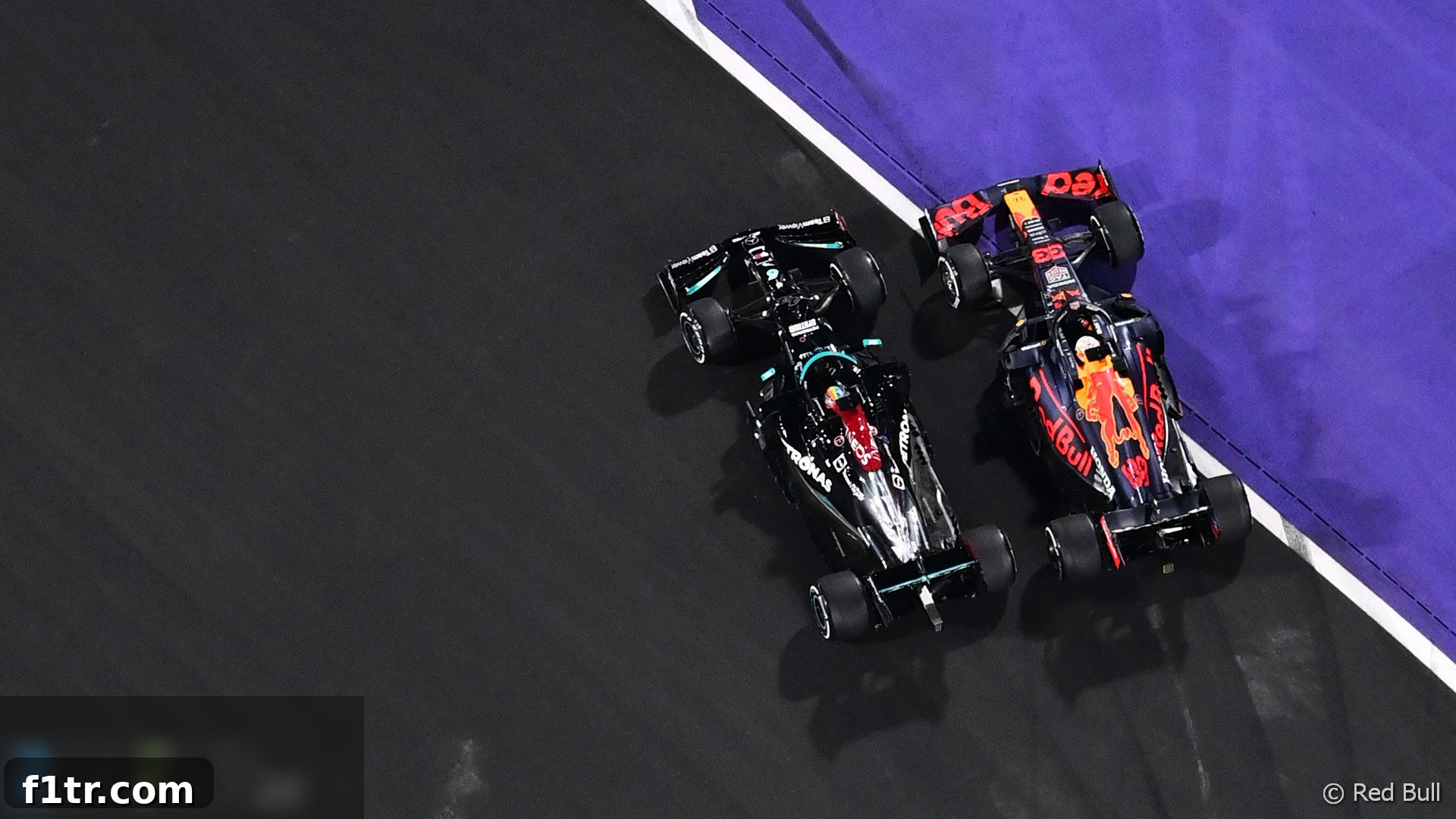
The race itself was a spectacle of incidents, red flags, and highly contentious decisions. After an early red flag for Mick Schumacher’s crash, the race resumed with a standing restart. Hamilton initially got the better start, but Verstappen fought hard on the outside, ran off the track, and rejoined at the apex of Turn 2, forcing Hamilton wide and allowing Esteban Ocon to slip past both. The race was immediately red-flagged again after a multi-car pile-up shortly after the restart.
During this second red flag, Race Director Michael Masi engaged in a direct negotiation with Red Bull. He offered them a deal: if Red Bull accepted Verstappen restarting from third position (behind Hamilton and Ocon), he would not refer the initial incident (Verstappen leaving the track and retaining position) to the stewards. Red Bull accepted, and Verstappen restarted from third, a decision that sparked widespread debate about the fairness and transparency of F1 stewarding.
Later in the race, Hamilton challenged Verstappen for the lead around the outside of Turn 1. Verstappen aggressively defended the inside, ran off the track, and missed the apex of Turn 2. Masi again instructed Red Bull that Verstappen must cede the lead to Hamilton. As Verstappen slowed on the approach to the final corner to give the position back, Hamilton, confused by the sudden deceleration, also backed off. The two then collided, with Hamilton’s front wing sustaining minor damage. Verstappen eventually let Hamilton through, but then immediately re-passed him into the final corner, an act that was quickly deemed illegal. Verstappen was instructed to give the position back a second time, and the stewards later awarded him a five-second time penalty for leaving the track and gaining an advantage.
To compound the drama, the stewards further investigated the collision between the two and handed Verstappen an additional ten-second time penalty for causing the impact. Despite accumulating 15 seconds in penalties, Verstappen still retained his second-place finish due to the gaps behind him. The Jeddah race was an unprecedented display of on-track aggression and off-track controversy, leaving both teams and fans bewildered by the rapidly changing decisions and the chaotic nature of the event.
- **Hamilton investigated for failing to slow under yellow flags:** No further action, due to accidental activation of marshal lights.
- **Hamilton impedes Mazepin (Third practice):** Found guilty of impeding, breaching Article 31.5 of the Sporting Regulations.
- **PENALTY (Hamilton):** Sporting reprimand and €25,000 fine for Mercedes.
- **Verstappen goes off-track at restart and retains position:** Race Director negotiates with Red Bull, Verstappen moved to third position for the second restart.
- **Verstappen leaves track at Turn 1 defending from Hamilton, keeps lead:** Instructed to let Hamilton past.
- **PENALTY (Verstappen):** Five-second time penalty for breaching Article 27.3 of the Sporting Regulations, plus one superlicence penalty point.
- **Hamilton and Verstappen collide at reduced speeds:** On approach to final corner.
- **PENALTY (Verstappen):** Ten-second time penalty for breaching Article 2 (e), Chapter IV, Appendix L of the FIA Sporting Code, plus two superlicence penalty points.
Round 22 – Abu Dhabi Grand Prix: The Title Decider
The 2021 Formula 1 season culminated in the Abu Dhabi Grand Prix, where Max Verstappen and Lewis Hamilton entered the final round level on points, making it a winner-takes-all scenario. Verstappen, starting from pole, lost the lead to Hamilton off the line, setting the stage for a tense battle.
On the opening lap, Verstappen attempted a daring slipstream move down the long back straight, diving to the inside of Hamilton into Turn 6. Hamilton, in defending, went off the track and cut Turn 7, crucially retaining the lead. Verstappen, in his attempt, remained within track limits. Race control controversially announced “no investigation necessary” for this incident, a decision that immediately sparked debate, with Red Bull arguing Hamilton gained an unfair advantage by leaving the track.
The race proceeded with Hamilton largely in control, seemingly cruising towards his record eighth world championship. However, a late safety car deployment to recover Nicholas Latifi’s crashed Williams fundamentally altered the outcome. Verstappen immediately pitted for fresh soft tyres, while Hamilton stayed out on much older hard tyres to maintain track position.
Crucially, there were five lapped cars separating Hamilton and Verstappen. Race control initially announced that no lapped cars would be allowed to overtake the safety car, which would have ensured Hamilton’s victory. Then, in a stunning reversal, Race Director Michael Masi issued a revised instruction, explicitly allowing *only* the five lapped cars between the title contenders to unlap themselves. This decision left Hamilton vulnerable, as Verstappen was now directly behind him with significantly fresher and softer tyres.
With just one lap remaining, the safety car was brought in, and the race resumed for a thrilling final lap shootout. Verstappen, with his superior tyre advantage, effortlessly passed Hamilton to take the win and, consequently, the 2021 Formula 1 World Championship. Mercedes immediately lodged two protests: one against Verstappen for allegedly overtaking under the safety car before the restart, and a second against the results of the race, disputing that the safety car procedure had not been correctly followed. Both protests were swiftly dismissed by the stewards.
Undeterred, Mercedes informed the FIA of their intention to appeal these decisions to the FIA’s International Court of Appeal (ICA). This prolonged the uncertainty of the championship for several days. However, after extensive deliberation and pressure, Mercedes eventually announced they would not pursue the appeal with the ICA, thereby confirming Max Verstappen as the legitimate world champion. The dramatic and controversial conclusion of the Abu Dhabi Grand Prix sparked global outrage and debate, leading to a comprehensive review of the FIA’s race management procedures and ultimately resulting in Michael Masi’s removal from his role as Race Director. It remains one of the most talked-about and divisive finishes in F1 history.
- **Hamilton leaves circuit and retains lead (Opening lap, Verstappen attack):** No investigation.
- **Mercedes protests Verstappen for overtaking under safety car:** Protest dismissed by stewards.
- **Mercedes protests race classification (Safety car procedure dispute):** Protest dismissed by stewards.
- **Mercedes announces intent to appeal with FIA ICA, then drops plans:** Confirms Verstappen as World Champion.
The Legacy of a Contentious Season: FIA Reforms and Beyond
The 2021 Formula 1 season, marked by its relentless intensity and the captivating rivalry between Max Verstappen and Lewis Hamilton, left an indelible mark on the sport. While celebrating Verstappen’s maiden world championship, the season’s conclusion, particularly the events of Abu Dhabi, ignited a fierce global debate about the fairness, consistency, and transparency of Formula 1’s officiating. The constant back-and-forth between teams and race control, the perceived inconsistencies in penalties, and the ad-hoc application of rules created an environment of distrust and confusion that overshadowed much of the on-track brilliance.
In response to the unprecedented level of controversy and the widespread public outcry, the FIA, motorsport’s governing body, undertook a comprehensive analysis of the 2021 season finale and its wider race management procedures. This review culminated in significant reforms aimed at enhancing the robustness and clarity of officiating. Key changes included the removal of Michael Masi from his role as Race Director, the implementation of a new Race Control structure featuring rotating Race Directors, the introduction of a Virtual Race Control Room to provide real-time support, and a renewed emphasis on clarifying and consistently applying sporting regulations, particularly regarding safety car procedures and track limits.
The 2021 season served as a critical inflection point, forcing Formula 1 to confront its governance and operational protocols. It underlined the immense pressure on officials in a high-stakes, multi-billion-dollar sport, and the profound impact their decisions can have on the outcome of a championship. While the memories of the season will forever be intertwined with its contentious moments, the subsequent reforms aimed to restore confidence in the sport’s integrity and ensure that future championships are decided predominantly by the drivers and their machines, rather than by procedural ambiguities or disputed interpretations.
The epic duel between Verstappen and Hamilton will long be remembered as a classic, not just for the exceptional talent displayed, but also for the profound questions it raised about the very nature of competition and governance at the pinnacle of motorsport.
Further Reading: 2021 F1 Season Insights
- Masi ‘basically gifted the championship’ to Verstappen says 2021 FIA steward Sullivan
- Las Vegas race backers looking to extend F1 deal beyond 2025
- Why Mercedes put ‘a reminder of joy and pain’ on display in their factory lobby
- Verdict on error in GT race suggests Mercedes would have lost 2021 Abu Dhabi GP appeal
- Title ‘stolen’ from Mercedes made us ‘underdogs people cheer for’ – Wolff
Browse all 2021 F1 season articles