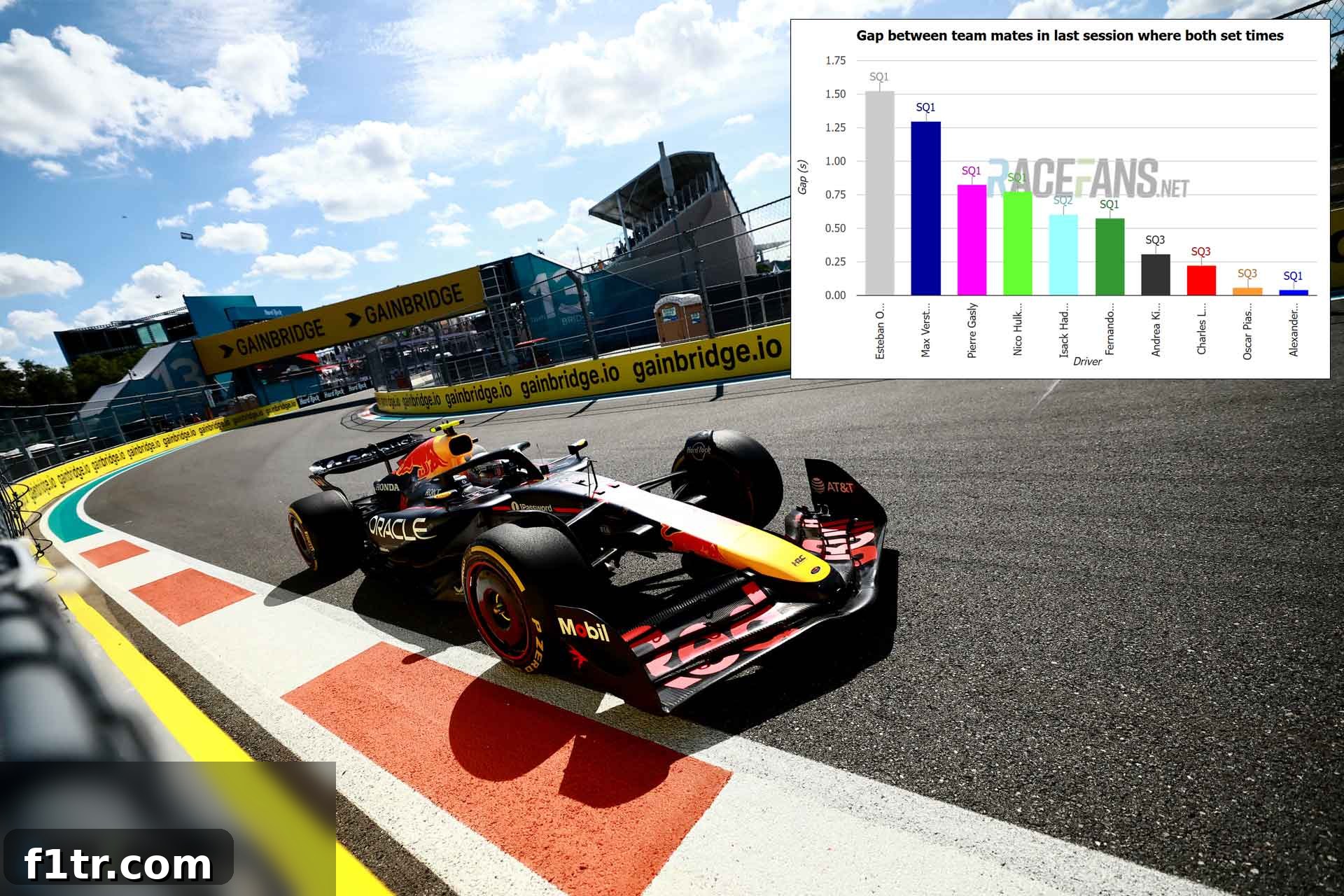
The exhilarating atmosphere of the Miami International Circuit recently played host to a captivating sprint race qualifying session, where the established order of speed was dramatically challenged. Max Verstappen, a formidable force in Formula 1 and a previous record holder at this very track, witnessed his course record not just matched, but decisively surpassed by an impressive six drivers. This shift in performance dynamics signaled a significant evolution in the competitive landscape, highlighting both the relentless march of technological progress in F1 and the burgeoning talent across the grid.
Enhance Your F1 Experience: Explore Premium Content
However, amidst this flurry of record-breaking laps, one particular driver found himself notably adrift from the front-runners: Yuki Tsunoda, Verstappen’s relatively new teammate. His performance during the Miami sprint qualifying proved to be a stark contrast to the rapid pace set by his counterparts, and more tellingly, a significant deviation from the high expectations that had begun to form around him.
Tsunoda had initially impressed many within the paddock with his strong showing at the Japanese Grand Prix last month, where he stepped into the shoes of Liam Lawson. His initial pace relative to Verstappen hinted at a promising partnership, suggesting he might be able to consistently challenge the reigning champion. Yet, in the sessions that followed, a concerning trend emerged. Tsunoda’s qualifying pace has gradually slipped further away from Verstappen’s, culminating in a gap during yesterday’s Miami performance that was not only substantial but also wider than any recorded during Lawson’s three-race stint with the team. This growing disparity raises critical questions about Tsunoda’s consistency and his ability to unlock the full potential of his machinery under pressure.
Teams’ Performance Trajectories: A Look at Miami’s Evolution
Understanding the context of team performance at the Miami International Circuit requires a brief look back. The 2023 Miami Grand Prix marked a pivotal moment for McLaren, serving as the debut race for a significant upgrade package that would ultimately transform their season. While the initial impact wasn’t fully reflected in their qualifying results immediately, it laid the groundwork for their impressive resurgence throughout the rest of the year. Red Bull, as expected, continued to dominate proceedings 12 months ago, firmly establishing their benchmark.
Mercedes’ pace at this event last year, trailing the quickest time by approximately half a second, was quite typical of their overall performance curve for the 2023 season. It highlighted their struggles to consistently match the front-running teams, a narrative they have been desperate to change. The track’s unique layout, with its blend of high-speed straights and intricate street-circuit-like sections, often exposes the inherent strengths and weaknesses of each car’s aerodynamic and mechanical setup, making it an excellent barometer for year-on-year improvements.
Become a RaceFans Supporter and Enjoy an Ad-Free Experience
Unveiling Progress: Mercedes Takes Center Stage in Miami
The initial day of running in Miami has offered intriguing glimpses into the potential shifts in the competitive hierarchy, with Mercedes emerging as a particular point of interest. The team showcased remarkably promising signs of progress, most notably when rising star Andrea Kimi Antonelli sensationally claimed pole position for the sprint race. This unexpected pole position sent ripples of excitement through the paddock, hinting at a potential breakthrough for the Silver Arrows. Furthermore, their pace in the earlier practice sessions was equally impressive, suggesting a genuine step forward in car performance and setup optimization.
During the practice sessions, Mercedes drivers led the timings while utilizing the medium tyre compound, a strong indicator of their underlying pace. Historically, their performance on the softer rubber has tended to be a relative weakness this year, often leaving them vulnerable in crucial qualifying moments. Unfortunately, the full extent of their soft-tyre potential remained unseen in that session, as both Antonelli and George Russell were prevented from completing their final high-performance runs due to a red flag incident. This left many wondering just how much more speed the W16 might have in reserve.
The W16’s on-track behavior, characterized by an exceptional level of grip and seemingly effortless cornering, certainly caught the attention of their rivals. Alexander Albon, after closely trailing one of the Mercedes cars, openly remarked on his surprise, even going so far as to question the legality of its performance. Such comments, while often part of the psychological warfare in F1, underscore the visual impact of Mercedes’ improved pace. A possible explanation for this noticeable leap in performance could lie in the unique regulations surrounding sprint race weekends. Teams have the flexibility to alter their car setups between the sprint race and the main Grand Prix qualifying session. This allows some teams to run lower ride heights for the sprint, knowing their cars will be lighter due to reduced fuel loads for the shorter race distance. It is plausible that the Mercedes W16’s aerodynamic package and suspension setup are particularly well-suited to operate effectively at these lower ride heights, granting them a temporary, yet significant, performance advantage over other cars that might be more compromised by such a configuration.
Amidst these tales of progress and intrigue, one team, Alpine, stands out for a less flattering reason. They are the sole constructor yet to better its lap time from last year’s Miami Grand Prix. This lack of improvement highlights their continued struggles throughout the season. Their woes were palpable during the sprint race qualifying session, with Jack Doohan failing to progress beyond the first round, and Pierre Gasly adding to their misery by clipping a barrier in SQ2. Alpine’s inability to extract more performance from their package, compounded by driver errors, paints a challenging picture for their immediate future.
Support RaceFans and Enjoy Ad-Free Access
The Team Mate Dynamic: Tsunoda Under the Microscope
The intensely competitive world of Formula 1 leaves no room for significant performance gaps between teammates, especially within top-tier teams like Red Bull. Over the first three qualifying sessions of the earlier part of the 2026 season—one in Melbourne and two in Shanghai—Liam Lawson consistently showed an average deficit of 0.879 seconds to Max Verstappen. While the gap did shrink incrementally over this period, from 1.076 seconds at his debut race to a more respectable 0.75 seconds by his final outing, it wasn’t enough to convince Red Bull. Their leadership ultimately decided that Lawson, despite showing potential, might not be able to consistently get on terms with his formidable teammate, leading to his replacement by Yuki Tsunoda.
Tsunoda’s initial outing at Suzuka seemed to vindicate Red Bull’s decision. He managed to get within half a second of Verstappen’s pace, a performance that instantly raised his stock and suggested he was the right choice to push the team forward. This early success was crucial, offering a glimpse of the speed and consistency Red Bull craves from its second driver. However, the subsequent rounds have painted a less optimistic picture. The performance gap between Tsunoda and Verstappen has gradually crept upwards, moving uncomfortably close to a full second at the previous two Grand Prix weekends. This escalating deficit began to generate concern, but his latest performance in Miami sprint qualifying delivered a particularly harsh blow.
On Friday, Tsunoda qualified an alarming 1.293 seconds off Verstappen’s pace for the Miami sprint race. This significant underperformance pushed his average deficit to 0.895 seconds, a figure that now surpasses Lawson’s average. This regression is particularly troubling for a driver expected to be on an upward trajectory. Tsunoda undoubtedly possesses the raw talent and potential to deliver stronger results; he has demonstrated flashes of brilliance, such as producing better lap times in Q2 than in Q3 during both the Bahrain and Jeddah events. This suggests that the speed is there, but consistency and execution under pressure remain his Achilles’ heel.
His sprint race qualifying effort in Miami on Friday was particularly sloppy and riddled with self-inflicted errors. While he voiced frustration over Oliver Bearman emerging from the pits directly in front of him, the reality is that Tsunoda lost far more critical time through his own mistakes. A notable instance was running wide at Turn 17, a basic error that severely compromised his lap. Furthermore, he compounded his difficulties by failing to heed the repeated warnings and instructions from his race engineer, who was desperately trying to guide him to ensure he started his final flying lap on time. Such fundamental missteps highlight a need for improved discipline and focus during critical moments.
One could argue that Liam Lawson’s performances, especially given that he was driving on two tracks he had not previously experienced in a Formula 1 car, also demonstrated considerable potential. The context of unfamiliarity often explains larger gaps to a seasoned teammate. Regardless of who makes the stronger argument, the stark reality for any driver in Formula 1 is that qualifying positions are often decided by the tiniest of margins. An average deficit of almost 0.9 seconds, especially within the same team and car, is simply intolerable in this elite sport. The pressure is now squarely on Tsunoda’s shoulders to translate his undoubted potential into tangible, consistent results. His future within the Red Bull program, known for its ruthless pursuit of excellence, will depend heavily on his ability to close this critical gap.
The evolving landscape of the Miami International Circuit also saw Max Verstappen, despite his teammate’s struggles, being one of six elite drivers from four different teams who collectively shattered his own 2023 course record. This new benchmark signifies not just individual brilliance but also the rapid development cycle in Formula 1. Leading this charge was Andrea Kimi Antonelli, whose impressive lap lowered the best time by over three-tenths of a second, setting a blistering 1:26.482. However, with the main Grand Prix qualifying session still to come this afternoon, it is highly anticipated that this new record may fall even further, promising an even more thrilling display of speed and skill.
Become a RaceFans Supporter and Go Ad-Free: Elevate Your F1 Experience
Go ad-free for just £1 per month>> Find out more and sign up
Browse all 2025 Miami Grand Prix articles