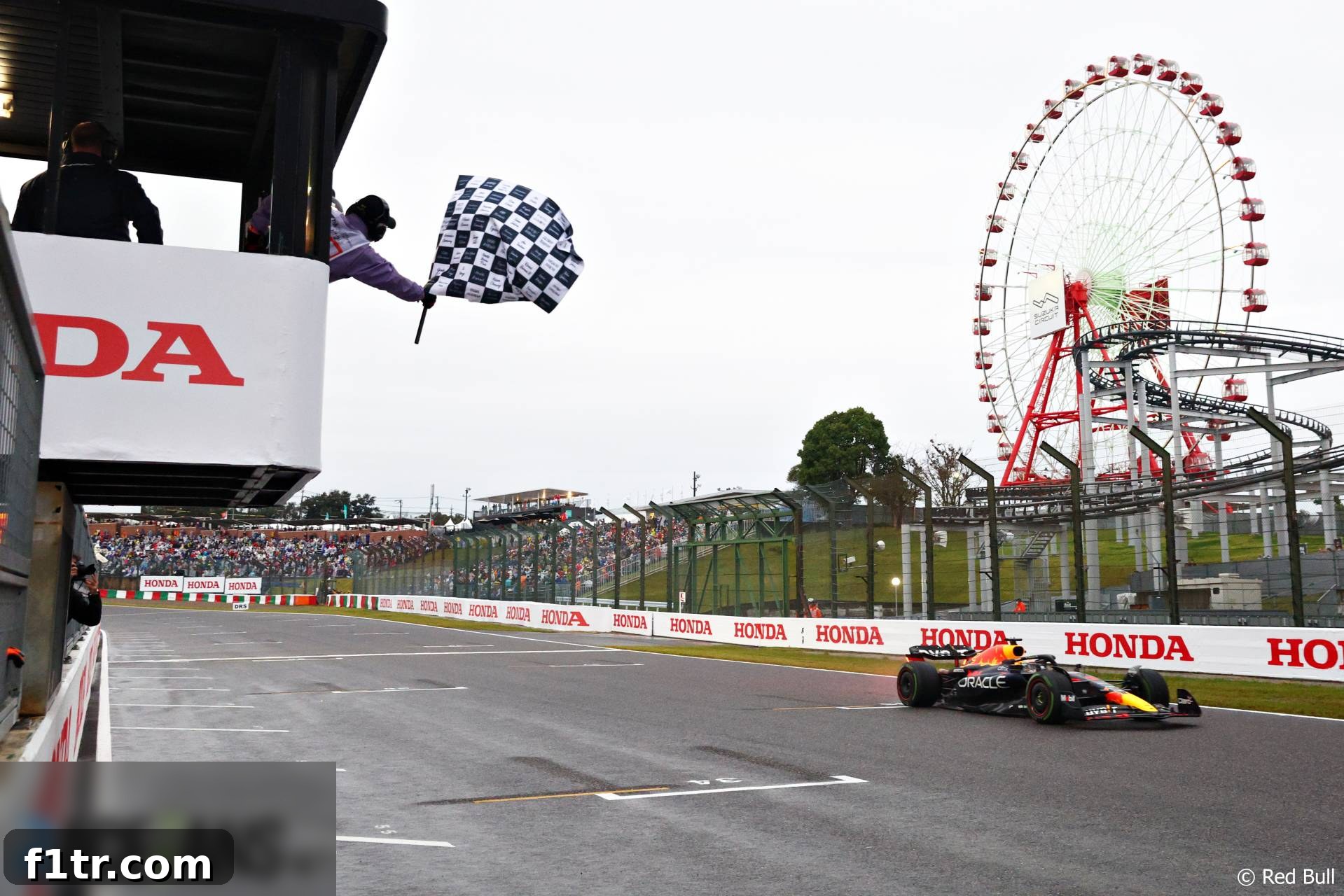
Horner Questions Full Points Award at Japanese GP as Verstappen Clinches Second Title
In a surprising turn of events following the rain-soaked 2022 Japanese Grand Prix, Red Bull Racing team principal Christian Horner voiced significant concerns over the FIA’s decision to award full championship points for the shortened race. Despite the fact that this very ruling instantaneously secured the Drivers’ World Championship for his star driver, Max Verstappen, Horner openly admitted his belief that the points allocation was a “mistake.” This unexpected statement cast a shadow of confusion over what should have been an unadulterated celebration of Verstappen’s dominant season.
The Unexpected Path to Verstappen’s Second Title
The Suzuka circuit witnessed a chaotic race day, heavily impacted by persistent heavy rain. Proceedings were halted for a significant two-hour period after just a few laps, leading to a drastically shortened event. Ultimately, the race concluded after only 28 laps out of the scheduled 53, meaning it ran to little more than half its intended distance. This scenario typically triggers a specific points system, yet the FIA’s final decision granted full championship points to all finishers, catching many teams, including Red Bull, completely off guard.
The confusion stemmed from new regulations introduced earlier in the season, specifically designed to prevent a repeat of the controversial 2021 Belgian Grand Prix. That notorious event saw half-points awarded for a race that officially consisted of a single lap behind the Safety Car, sparking widespread criticism regarding sporting integrity. The updated rules stipulated a tiered points system for races that fail to reach certain distance thresholds. For races running to less than 75% of their scheduled distance, the winner was expected to receive 19 points, rather than the usual 25.
However, the FIA’s interpretation hinged on a precise clause: reduced points are only applied “if a race is suspended in accordance with Article 57 and cannot be resumed.” Since the Japanese Grand Prix, despite its lengthy interruption, was eventually resumed and concluded under green flag conditions (even if limited), the governing body deemed that the full points system should apply. This strict, literal reading of the regulations directly contradicted the prevailing understanding among most teams and, according to Horner, the very spirit in which the rules were initially devised.
Horner’s Disbelief and the Spirit of the Rules
Christian Horner was vocal about his disappointment with the regulatory oversight, emphasizing that the rule changes implemented after the Spa 2021 fiasco were clearly intended to address situations like the one seen at Suzuka. “When you read the regulations, what I think was supposed to be fixed following Spa, perhaps is unspecified in the regs,” Horner commented. He highlighted the unintended consequence: “So unexpectedly we won, which is a phenomenal achievement by Max and the team.”
The Red Bull principal elaborated on his conviction that the regulations had not been adequately “mopped up” to prevent such ambiguity. He firmly believed that any race failing to meet the maximum 75% distance threshold should automatically trigger the reduced points system. “I think it’s a mistake that wasn’t included after the issues in Spa last year,” Horner stated. “The regulations obviously haven’t been mopped up because we were under the strong impression that only 75% points would be scored.”
This widespread expectation of reduced points led to significant strategic recalculations within the Red Bull garage. Before the final results were confirmed, the team genuinely believed they would be “one point short” of clinching the title for Max. This uncertainty even led them to consider a late-race pit stop for Verstappen in a bid to secure the bonus point for the fastest lap, a move that would have increased his chances of mathematically sealing the championship.

Leclerc’s Penalty: The Decisive Factor
The situation only became clear after the checkered flag, when Charles Leclerc, who had initially finished second, was handed a five-second time penalty. The Ferrari driver was penalized for leaving the track and gaining a lasting advantage while battling Sergio Perez for second place on the final lap. This penalty demoted Leclerc to third position, promoting Perez to second. It was this crucial shift in positions, combined with the full points allocation, that mathematically secured Verstappen’s second consecutive world title.
“So we felt we were going to be one point short. But in the end, Checo’s move on Charles nailed Max the championship. So you could see his surprise, the team’s surprise. But what a wonderful surprise,” Horner reflected, perfectly capturing the team’s initial confusion and subsequent elation. He further added that he is “certain” the rule will be revisited and changed to eliminate such ambiguities in the future, underscoring the need for greater clarity in the sport’s regulations.
Ferrari’s Perspective: Confusion and Acceptance
Red Bull’s championship rivals, Ferrari, shared similar sentiments of confusion regarding the points system. Team principal Mattia Binotto admitted, “We were confused ourselves. We thought it would not have been the full awards. So initially our calculation was such that [Verstappen] was not world champion.” This highlights how widespread the misunderstanding was across the paddock.
However, unlike Horner’s continued vocal questioning, Binotto expressed a degree of acceptance once the FIA’s clarification was provided. “But at the end a clarification has been given, which is an okay clarification. So I think it’s simply accepted and that’s the way it is, he’s world champion. I think that it’s clear enough,” Binotto concluded. While acknowledging the initial confusion, Ferrari chose to move past the debate, accepting the official interpretation and Verstappen’s well-deserved championship.
The Broader Implications for F1 Regulations
The controversy surrounding the points allocation at the Japanese Grand Prix underscores a critical area for Formula 1’s governing body: the precise and unambiguous wording of its sporting regulations. While the FIA’s strict interpretation of “suspended and cannot be resumed” might be legally sound, it clearly deviates from the general understanding and the perceived intent behind the rule changes introduced after the 2021 Belgian Grand Prix. This incident highlights the importance of not just having rules, but ensuring they are interpreted consistently and align with the spirit of fair competition.
For the future of Formula 1, this event will undoubtedly serve as another catalyst for reviewing and refining the points system, particularly concerning abbreviated races. The goal will be to eliminate any grey areas that can lead to confusion among teams, drivers, and fans alike, ensuring that championship outcomes are determined with absolute clarity and without unexpected surprises. Ultimately, while Max Verstappen’s second world championship was secured under unusual circumstances, his season-long performance was undeniably deserving of the title, irrespective of the final points calculation at Suzuka.
Explore More: 2022 Japanese Grand Prix Insights
- From F1 to Formula Ford, 2022 was the year of the championship anti-climax
- Suzuka points confusion didn’t take shine off title win – Verstappen
- FIA to publish findings of inquiry into use of crane during Japanese GP
- Does F1 only need slicks and wets? The case for dropping intermediate tyres?
- Hamilton’s work ethic “has not changed at all” in face of difficult 2022 campaign
Browse all 2022 Japanese Grand Prix articles