Lando Norris Calls Out Max Verstappen’s Aggressive Tactics in Miami: “He Ruined His Own Race”
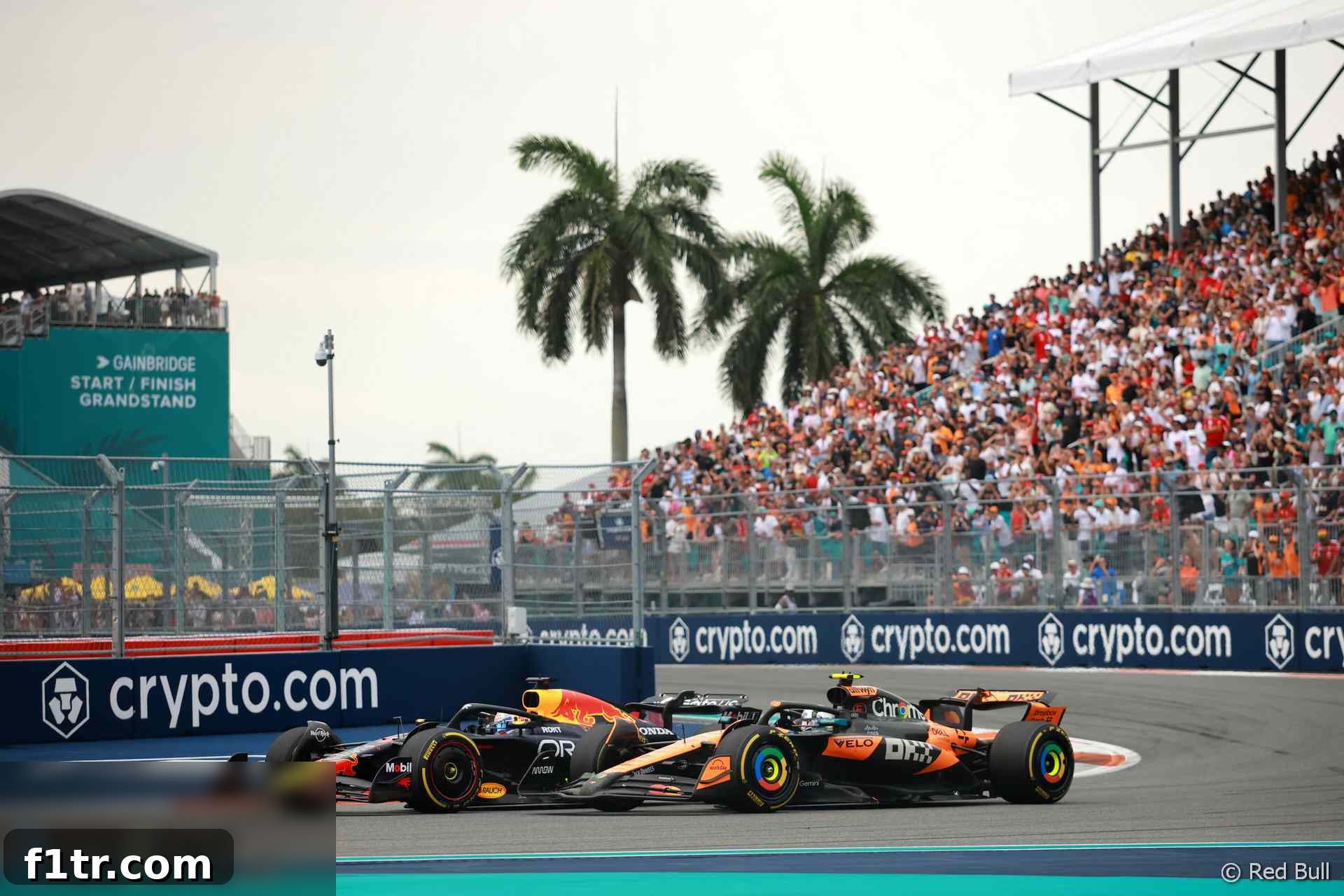
The intense rivalry between Formula 1’s brightest young talents, Lando Norris and Max Verstappen, ignited once again at the highly anticipated Miami Grand Prix. Following a hard-fought race characterized by wheel-to-wheel action and contentious defending, Norris, the McLaren sensation, did not mince words when discussing his on-track duel with the reigning world champion. Norris asserted that Verstappen’s overly aggressive defensive maneuvers not only frustrated his attempts to pass but ultimately cost the Dutchman a more favorable finishing position, preventing what could have been a stronger result for himself and potentially for Red Bull.
The contention between the two drivers was palpable throughout the Grand Prix weekend, culminating in a striking moment where the McLaren driver expressed his clear displeasure with Verstappen’s tactics. Caught on camera, Norris was seen raising a middle finger at his rival during a particularly heated exchange on the track. This gesture underscored the high stakes and the raw emotion inherent in top-tier motorsport, highlighting the friction between two competitors accustomed to pushing the absolute limits of racing etiquette and sporting aggression.
The Turn Two Tangle: A Race-Defining Moment for Norris
The drama began almost immediately after the lights went out, setting the tone for the contentious battle ahead. As the tightly packed grid streamed into the challenging Turn Two, Norris, keen to capitalize on an early advantage, attempted an audacious overtake around the outside of Verstappen. What followed was a near-miss that significantly reshaped the early stages of Norris’s race. Verstappen experienced a brief but critical moment of oversteer, causing a dangerous squeeze that left Norris with little room. To avoid what would have been a catastrophic collision and a potential race-ending incident for both cars, Norris was forced to take drastic evasive action, veering sharply into the run-off area.
This involuntary detour came at a considerable cost, as Norris plummeted from his initial second-place grid position down to sixth, losing crucial track position and valuable momentum in the opening laps. Reflecting on this pivotal moment later, in the cool-down room, Norris admitted the absolute necessity of his decision to back out of the move. He was acutely aware that a collision with Verstappen in that specific section of the track would have almost certainly resulted in a heavy impact with the unforgiving barriers lining the circuit. Such an incident could have ended his race prematurely and potentially caused significant injury, a risk he was unwilling to take despite his aggressive pursuit of position.
Relentless Defense and Norris’s Rising Frustration
Despite the early setback and the lost positions, Norris demonstrated remarkable resilience and impressive pace throughout the Grand Prix. As the race progressed, he steadily recovered, carving his way back through the field and eventually catching up to Verstappen once more. However, passing the tenacious Dutchman for a second time proved to be a monumental challenge. Verstappen employed a series of robust, and in Norris’s view, arguably borderline defensive moves that repeatedly thwarted the McLaren driver’s efforts to get ahead. On one notable occasion, Verstappen aggressively forced Norris wide at Turn One, leaving the McLaren driver with no option but to yield or risk a certain crash.
It was after one such intense encounter, as the two cars accelerated away from Turn Three, that Norris’s frustration visibly boiled over. The middle finger gesture, caught clearly by broadcast cameras and widely circulated, was a stark visual representation of the intense psychological battle unfolding between the two competitors. It served as a clear, albeit unprofessional, message from Norris, conveying his unequivocal belief that Verstappen’s defensive approach was not only aggressively persistent but also arguably unfair, pushing the very boundaries of what is considered acceptable on the race track and potentially risking the safety of both drivers.
The Breakthrough: Norris Finally Overcomes Verstappen
The relentless back-and-forth between Norris and Verstappen became a primary focal point of the race, captivating audiences and showcasing both drivers’ exceptional skill, unwavering determination, and competitive spirit. Norris, refusing to be deterred, eventually found his window of opportunity, making a daring move on the inside at Turn 11. This initial attempt, however, saw both drivers momentarily run wide as they battled for supremacy. The race stewards observed the incident closely, but no immediate penalty was issued, especially after Norris, in a display of either sportsmanship or perhaps shrewd tactical cunning, allowed Verstappen to re-pass him at Turn 17. This gesture likely helped him avoid a formal investigation and a potential time penalty that could have further jeopardized his race.
This momentary concession did not deter Norris from his ultimate goal. On the very next lap, armed with renewed determination and a clearer understanding of Verstappen’s defensive lines and vulnerabilities, Norris launched another calculated attack at Turn 11. This time, his maneuver was decisive, precise, and clean. He successfully overtook his rival for good, finally cementing his position ahead of Verstappen after what had been a prolonged, energy-sapping, and mentally taxing battle. This successful pass marked a critical turning point for Norris, allowing him to shift his focus from the immediate threat of Verstappen to the cars ahead, notably his teammate Oscar Piastri who had by then established a significant lead.
Post-Race Reflections: A Mix of Satisfaction and Scrutiny
Following the checkered flag, Norris crossed the line in an impressive second place, a testament to his remarkable recovery from the early incident and his consistently strong pace throughout the Grand Prix. While he ultimately finished behind his teammate Oscar Piastri, who had built a considerable lead during Norris’s extended battle with Verstappen, Norris was still visibly pleased with his performance and the team’s overall result. Verstappen, meanwhile, fell to fourth, behind George Russell, a finishing position that Norris believes was largely self-inflicted due to his aggressive tactics.
Speaking immediately after the race, Norris was quick to praise his team’s efforts and the performance of his McLaren car: “It’s never the best feeling [not winning], but the team have done an amazing job, so I can’t fault them at all. Good pit stops, great pace. We were up the road, so it was a good feeling. But Oscar drove well, Max put up a good fight as always, and I paid the price, but it’s the way it is.” This initial statement, while acknowledging Verstappen’s typical fighting spirit, clearly hinted at deeper frustrations that Norris would soon articulate more explicitly.
Norris’s Unfiltered Critique: The “Crash or Don’t Pass” Philosophy
It was in the subsequent press conference that Norris elaborated on his true feelings, delivering a pointed and unreserved assessment of Verstappen’s driving style and strategic choices. He characterized Verstappen’s approach as inherently risky and confrontational, stating with conviction, “It’s the way it is with Max, it’s ‘crash or don’t pass’.” This stark and unambiguous phrase encapsulates Norris’s view that racing against Verstappen often leaves opponents with an uncompromising ultimatum: either risk a potentially damaging collision or abandon the overtaking attempt entirely. He continued, “Unless you get it really right and you put him in the perfect position, then you can just about get there. But I paid the price for not doing a good enough job today. I’m still happy with second.”
Norris further expanded on his criticism, suggesting that Verstappen’s aggressive defense was not only unsporting but also strategically flawed and ultimately detrimental to his own race outcome. He argued that Verstappen’s preoccupation with battling Norris for an extended period cost him valuable time and ultimately prevented him from achieving a better result, possibly even a podium finish. “He’s fighting hard,” Norris conceded, acknowledging his rival’s competitive nature, “It’s up to him to do that. He’s ruined his own race. He’s not racing very smart. We probably could have finished one-two today and he didn’t because of that. He’s fighting hard, as always expected, but that’s the way it is.”
This powerful statement indicates that Norris firmly believed Verstappen’s tenacious efforts to hold him back were ultimately self-defeating, potentially costing the Dutchman a podium finish, or even a shot at challenging George Russell for third place. It highlights a recurring and often debated theme in modern Formula 1: the fine and subjective line between assertive, hard defense and compromising one’s own race pace and strategic objectives in a direct, protracted battle for track position.
A History of Tense Encounters and an Enduring Rivalry
The close call at Turn Two and the subsequent on-track skirmishes in Miami are by no means isolated incidents. The competitive rivalry between Lando Norris and Max Verstappen has seen several contentious moments throughout their careers, particularly during their intense battles for position in previous championship seasons. These recurring clashes underscore a compelling competitive dynamic where neither driver is willing to concede an inch, consistently leading to exhilarating but often controversial racing that keeps fans on the edge of their seats.
Norris acknowledged the challenging and often paradoxical position this aggressive rivalry places him in: “If I don’t go for it people complain, if I go for it people complain, so you can’t win.” This sentiment reflects the immense and multi-faceted pressure on Formula 1 drivers to perform at their peak, to entertain audiences with daring overtakes, and to adhere to complex racing etiquette, all while navigating the highly aggressive and often unpredictable tactics of their most formidable rivals.
The Implications for Future Battles and the Spirit of F1
The Miami Grand Prix served as a vivid and potent reminder of the high-stakes, cutthroat competition at the pinnacle of motorsport. Lando Norris’s candid remarks about Max Verstappen’s aggressive driving style will undoubtedly add another layer of intrigue and anticipation to their future encounters on the track. As both drivers continue to mature, hone their skills, and challenge for top honors in Formula 1, their battles are sure to remain a compelling highlight of the racing calendar, promising more drama and excitement.
Norris’s ability to recover from an early setback and ultimately pass Verstappen, despite the Dutchman’s tenacious and uncompromising defense, speaks volumes about his own growing prowess, resilience, and unyielding determination. The central question remains: will Max Verstappen adapt his aggressive tactics in light of such criticisms, or will the “crash or don’t pass” philosophy continue to define their thrilling, high-octane contests, shaping the narrative of one of F1’s most exciting rivalries for seasons to come?
Further Reading and Related Content
- McLaren Legality Never in Doubt Says Piastri as FIA’s Post-Race Check Clears Car
- McLaren Score Their Most Emphatic Win Since Hamilton’s 2008 Silverstone Triumph
- Albon Did Not Disobey Team Orders in Miami, Says Vowles After Sainz’s Complaint
For more in-depth coverage and comprehensive reports on the Miami Grand Prix and other Formula 1 events, explore our extensive archives.