The Dutch Grand Prix weekend at the iconic Zandvoort circuit kicked off with a typical mix of high drama and promising pace for some, while others faced immediate setbacks. For the Aston Martin F1 Team, Friday practice was a stark dichotomy: one part sheer brilliance, one part frustrating misfortune. While two-time world champion Fernando Alonso masterfully piloted his AMR25 to the second-fastest time of the day, missing the top spot by less than a tenth of a second, his teammate Lance Stroll endured a far less auspicious start, putting his car into the barrier at the challenging Hugenholzbocht corner. This contrasting start immediately set the tone for what promises to be an intriguing weekend of racing on the North Sea coast, highlighting the fine margins and inherent unpredictability of Formula 1.
Aston Martin arrived at Zandvoort following their most successful outing of the season in Hungary, where they secured a significant points haul that reignited their ambitions and solidified their position in the Constructors’ Championship battle. The team’s strong showing in Budapest had many anticipating another competitive performance at a circuit known for its technical demands and unforgiving nature—characteristics that often play into the strengths of a well-balanced car with skilled drivers. Alonso’s blistering pace in practice undoubtedly bolstered these expectations, suggesting the AMR25 might be exceptionally well-suited to Zandvoort’s flowing, high-downforce corners and unique banked turns. However, Stroll’s incident served as a potent reminder of the fragility of performance and the potential for any weekend to unravel rapidly, demanding immediate recovery and chassis repairs. While Aston Martin appears poised for a strong showing, a deeper look into Friday’s performances reveals that another team has made an even more remarkable leap forward compared to their form just 12 months ago.
Teams’ 2024 Performance in Context: A Year of Transformation on the Grid
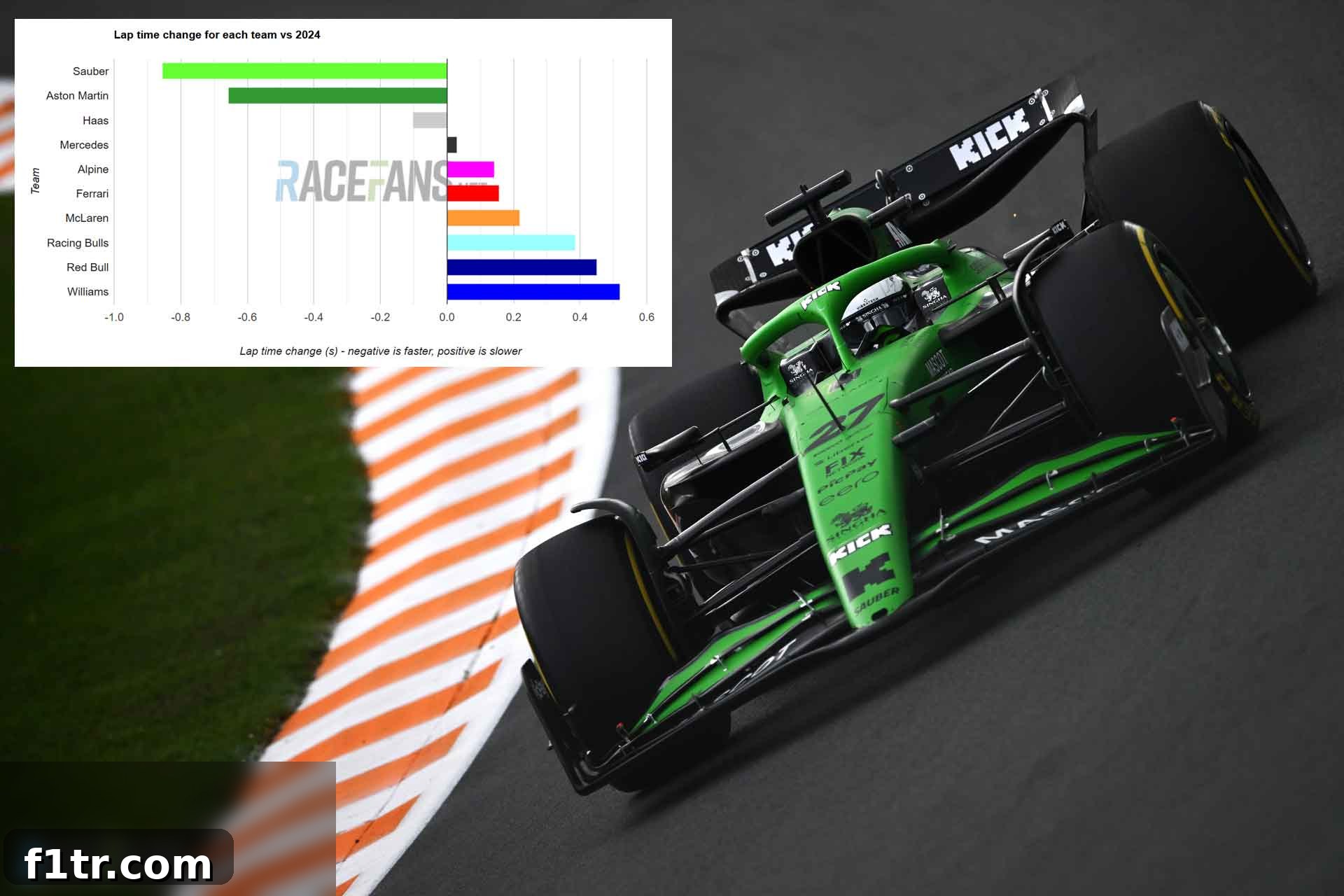
To truly appreciate the current competitive landscape of the Formula 1 grid, it’s essential to cast our minds back to the 2023 Dutch Grand Prix. Twelve months ago, the Sauber team (then operating under a different name) found themselves in an unenviable and challenging position. Their drivers, Valtteri Bottas and Zhou Guanyu, initially qualified on the very back row of the grid. Although they subsequently gained a few places due to penalties incurred by other competitors, their raw pace was demonstrably lacking. At that event, Sauber’s cars were consistently lapping the Zandvoort circuit more than 1% further from the ultimate pace than any other team, highlighting a significant performance deficit that left them struggling at the rear of the field. This stark contrast underscores the monumental progress the team has made in such a short period, illustrating a fundamental shift in their competitiveness.
Conversely, the 2023 Dutch Grand Prix was a standout event for McLaren, marking one of their strongest venues of the entire season. Lando Norris, in particular, delivered a phenomenal qualifying performance, securing a sensational pole position by an impressive three-tenths of a second. This translated to a significant lap time advantage of over 0.5% compared to his closest rival, Max Verstappen, showcasing the McLaren’s exceptional suitability to the Zandvoort layout and its rapid evolution throughout the season following their own substantial upgrade packages. Understanding these historical baselines provides crucial context for evaluating the strides made by various teams as they returned to the challenging Dutch circuit this year, setting the stage for surprising performances and unexpected challenges.
Unprecedented Progress: Sauber Leads the Charge in Year-on-Year Improvement
While Aston Martin justifiably caught the eye with Fernando Alonso’s impressive second-place finish in Friday’s practice sessions, effectively splitting the two formidable McLaren drivers, it is the Sauber F1 Team that has emerged as the true dark horse of the weekend, demonstrating the most significant year-on-year improvement in lap times at Zandvoort. Following a crucial and extensive upgrade package introduced earlier this season, Sauber has enjoyed a remarkable resurgence, consistently scoring points in the last six consecutive rounds leading up to this Grand Prix. This sustained period of strong performance is a testament to their dedicated development efforts, strategic execution, and perhaps a more profound understanding of their car’s characteristics.
Indeed, a deep dive into the telemetry and comparative lap times from 2023 versus 2024 reveals that Sauber has improved their pace at Zandvoort by an astonishing margin compared to their performance 12 months ago. They are not merely keeping pace with the midfield; they are actively dictating it, positioning themselves as a consistent threat for points. This transformation is a prime example of how focused engineering, strategic investment, and perhaps a change in operational philosophy can elevate a team from the back of the grid to a consistent points contender. Alongside Sauber, Haas is the only other team that has already posted quicker lap times at Zandvoort this year than they managed during the entire 2023 Grand Prix weekend, signaling a positive trajectory for both outfits as they reap the rewards of their development paths. The rest of the grid, while potentially improving, has yet to demonstrate such a marked and consistent step forward at this specific venue, highlighting the efficacy and impact of Sauber’s and Haas’s targeted performance upgrades.
Full Friday Practice Times: A Glimpse, Not the Full Picture Yet
Despite the intriguing performance metrics and the glimpses of pace from various teams, the full and definitive picture of their true potential and relative performance at the Dutch Grand Prix is yet to fully emerge. Friday’s second practice session, often considered the most representative for predicting qualifying and race pace simulations, was notably disrupted by a series of unfortunate events and incidents. Red flags brought proceedings to a halt on multiple occasions due to cars going off track or having mechanical issues, and a Virtual Safety Car (VSC) period was triggered by the stoppage of Isack Hadjar’s Racing Bulls car. These intermittent interruptions significantly impacted the running plans of several teams and drivers, making it challenging to draw conclusive performance comparisons and gather complete data sets.
Among those most affected by the stop-start nature of FP2 were Alpine’s Pierre Gasly and Williams’s Carlos Sainz Jnr, both of whom missed crucial opportunities to set representative lap times or complete their planned long runs on higher fuel loads. The fragmented nature of the session means that some drivers may have been caught out by the timing of the red flags, preventing them from maximizing their critical qualifying simulation runs on fresh soft tires or gathering essential data on high-fuel race pace. Therefore, while the raw lap times provided in the table offer an initial snapshot of Friday’s proceedings, they should be interpreted with significant caution, as the true pecking order may only become fully clear during Saturday’s final practice and, more importantly, the high-stakes qualifying session.
| P. | # | Driver | Team | FP1 time | FP2 time | Gap | Laps |
|---|---|---|---|---|---|---|---|
| 1 | 4 | Lando Norris | McLaren-Mercedes | 1’10.278 | 1’09.890 | 63 | |
| 2 | 14 | Fernando Alonso | Aston Martin-Mercedes | 1’10.841 | 1’09.977 | 0.087 | 45 |
| 3 | 81 | Oscar Piastri | McLaren-Mercedes | 1’10.570 | 1’09.979 | 0.089 | 61 |
| 4 | 63 | George Russell | Mercedes | 1’11.386 | 1’10.274 | 0.384 | 54 |
| 5 | 1 | Max Verstappen | Red Bull-Honda RBPT | 1’11.218 | 1’10.478 | 0.588 | 47 |
| 6 | 44 | Lewis Hamilton | Ferrari | 1’11.960 | 1’10.738 | 0.848 | 50 |
| 7 | 18 | Lance Stroll | Aston Martin-Mercedes | 1’10.779 | 1’11.975 | 0.889 | 32 |
| 8 | 22 | Yuki Tsunoda | Red Bull-Honda RBPT | 1’12.126 | 1’10.795 | 0.905 | 50 |
| 9 | 16 | Charles Leclerc | Ferrari | 1’11.951 | 1’10.834 | 0.944 | 55 |
| 10 | 43 | Franco Colapinto | Alpine-Renault | 1’12.276 | 1’10.957 | 1.067 | 53 |
| 11 | 27 | Nico Hulkenberg | Sauber-Ferrari | 1’11.875 | 1’11.080 | 1.190 | 55 |
| 12 | 87 | Oliver Bearman | Haas-Ferrari | 1’12.564 | 1’11.113 | 1.223 | 56 |
| 13 | 23 | Alexander Albon | Williams-Mercedes | 1’11.171 | 1’11.756 | 1.281 | 49 |
| 14 | 12 | Andrea Kimi Antonelli | Mercedes | 1’14.275 | 1’11.185 | 1.295 | 27 |
| 15 | 5 | Gabriel Bortoleto | Sauber-Ferrari | 1’11.509 | 1’11.320 | 1.430 | 55 |
| 16 | 30 | Liam Lawson | Racing Bulls-Honda RBPT | 1’11.753 | 1’11.339 | 1.449 | 54 |
| 17 | 31 | Esteban Ocon | Haas-Ferrari | 1’12.144 | 1’11.361 | 1.471 | 52 |
| 18 | 55 | Carlos Sainz Jnr | Williams-Mercedes | 1’11.458 | 1’11.682 | 1.568 | 63 |
| 19 | 10 | Pierre Gasly | Alpine-Renault | 1’11.613 | 1’12.122 | 1.723 | 58 |
| 20 | 6 | Isack Hadjar | Racing Bulls-Honda RBPT | 1’11.772 | No time | 1.882 | 31 |
Navigating the Zandvoort Challenge: What Friday Tells Us for the Weekend Ahead
The unique characteristics of the Zandvoort circuit, with its undulating profile, iconic banked corners like Tarzanbocht and Hugenholzbocht, and narrow, flowing sections, make it a stern test for both car and driver. Success here demands a finely tuned car capable of generating high levels of aerodynamic downforce, precise handling, and excellent mechanical grip through its challenging sequences. The insights gleaned from Friday’s practice, even with their inherent limitations due to the aforementioned interruptions, offer valuable clues and pointers for the rest of the weekend. Lando Norris’s consistent top performance for McLaren strongly suggests they remain formidable contenders for pole position and a strong race result. Their car seems to retain its impressive balance and aerodynamic efficiency, making them a significant threat to the usual front-runners.
Fernando Alonso’s exceptional pace for Aston Martin is equally encouraging, hinting at a potential challenge for a front-row start, provided the team can recover effectively from Stroll’s setback and ensure both cars are fully optimized for Saturday’s critical qualifying session. Red Bull’s Max Verstappen, despite not topping the timesheets on Friday, often holds back or focuses on specific testing programs during practice, and his true formidable pace will almost certainly emerge when it matters most in qualifying. The impressive strides made by Sauber and Haas also inject an exciting and unpredictable dynamic into the midfield, promising intense battles for vital championship points. Mercedes and Ferrari, while showing flashes of speed and potential, still appear to be working on perfecting their setups and unlocking their full performance, suggesting they might have more pace to find. The inherent unpredictable nature of Zandvoort, coupled with the variable conditions and the ever-present potential for further disruptions, ensures that the 2024 Dutch Grand Prix remains wide open, setting the stage for a thrilling qualifying battle and an even more dramatic race.
Miss nothing from RaceFans
Get a daily email with all our latest stories – and nothing else. No marketing, no ads. Sign up here:
2025 Dutch Grand Prix
- Williams’s Sainz penalty review success “will open the door to more challenges”
- Lawson now accepts Sainz collision was a “racing incident” after stewards’ U-turn
- Stewards’ U-turn over Zandvoort penalty shows ‘how far the FIA have come’ – Sainz
- The FIA’s stewards grabbed the chance to correct their mistake – unlike last time
- Sainz’s Dutch GP penalty points cancelled as stewards accept Williams’ request for review
Browse all 2025 Dutch Grand Prix articles