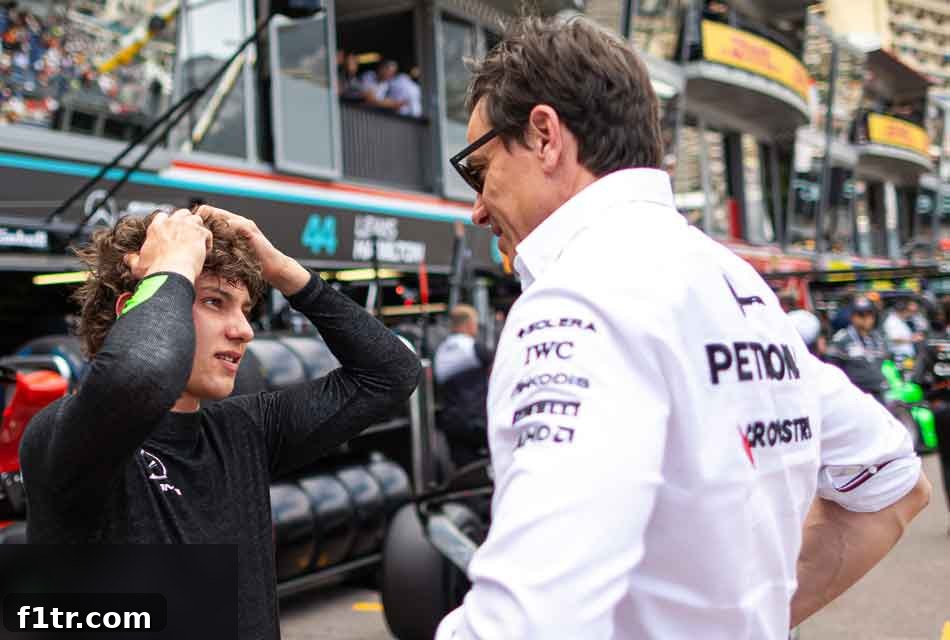
The exhilarating world of Formula 1 is currently buzzing with anticipation, centered around a significant development concerning Mercedes junior driver Andrea Kimi Antonelli. Last week, the FIA, the sport’s governing body, made a pivotal decision, opening the door for Antonelli to potentially make his Grand Prix debut before reaching his 18th birthday. This landmark rule modification has ignited speculation, hinting at a remarkably swift ascent for the young Italian talent.
While Mercedes itself may not have been the direct catalyst behind the request to review the stringent super licence regulations, and Antonelli isn’t expected to jump into a W15 car immediately, his name is firmly at the forefront of discussions for a coveted seat at the team in 2025. With the impending departure of seven-time world champion Lewis Hamilton, Mercedes faces the monumental task of finding a successor, and Antonelli represents an internal, high-potential candidate.
Team Principal Toto Wolff has consistently sought to temper expectations surrounding a driver who has been a cherished part of their junior programme for several years. His efforts to manage the hype, however, have proven increasingly challenging. All signs appear to be aligning perfectly for Antonelli, setting the stage for an extraordinary and rapid progression into one of Formula 1’s most prestigious cockpits.
The FIA’s Pivotal Rule Change: Paving the Way for Young Talent
The FIA’s recent regulatory adjustment highlights the urgency of the situation. The updated rule now grants the FIA the discretion to award a super licence dispensation to 17-year-olds, permitting them to compete in Formula 1 if they are deemed to possess sufficient talent and readiness. This change is particularly pertinent given Antonelli’s upcoming 18th birthday, which coincides with the Dutch Grand Prix at Zandvoort – a mere six races away. Without this dispensation, he would have been eligible for a super licence then anyway, making the timing of this rule change highly significant.
Furthermore, another critical change made last week was the removal of the requirement for super licence holders to possess a road car driving licence. This was a significant hurdle for Antonelli, who, under Italian law, cannot obtain a road licence until he turns 18. The simultaneous removal of both these age-related barriers strongly suggests an intent to facilitate an earlier F1 entry for a specific individual, namely Antonelli.
The most compelling inference to draw from these concurrent rule changes is that Andrea Kimi Antonelli is highly likely to feature on the starting grid of a Formula 1 race before his 18th birthday. Should this occur, he would become only the second 17-year-old to compete in the series since Max Verstappen’s impactful debut nine years ago. Ironically, Verstappen’s precocious entry into F1 was precisely what prompted the FIA to introduce the very age restriction rule that they have now devised a mechanism to circumvent, underscoring a fascinating full circle in the sport’s history.
Given the recency of these rule adjustments, an immediate race debut for Antonelli this weekend might be improbable. However, it would come as no surprise to see him participate in an upcoming opening practice session, following the path of his Prema Formula 2 teammate, Oliver Bearman, who has already gained such experience with Haas. The identical rule changes concerning race licences have also been applied to the ‘free practice-only super licence,’ which Antonelli requires for such outings. He already comfortably meets the requirement of accumulating 25 super licence points, further clearing his path.
Mercedes’ Strategic Dilemma: The Search for Hamilton’s Successor
The pathway for Antonelli to make his Formula 1 debut for Mercedes in 2025 now appears unequivocally clear, contingent only on Toto Wolff’s final decision. The strategy currently speculated involves Antonelli spending the remaining two-thirds of the current season undergoing an apprenticeship in a seat at a customer team. This is widely anticipated to be the Williams Racing car currently occupied by Logan Sargeant. Such a move would also facilitate a reunion with Williams team principal James Vowles, whom Antonelli knows well from their shared time at Mercedes, offering a familiar and supportive environment for his initial F1 foray.
If Mercedes subsequently opts to promote him for the 2025 season, Antonelli would be paired with another distinguished product of the Mercedes junior driver programme: George Russell. Russell’s journey to the factory team, however, was notably less accelerated than Antonelli’s anticipated trajectory, providing a fascinating point of comparison for Mercedes’ evolving approach to young talent.
A Tale of Two Talents: Antonelli vs. Russell’s Journey
The contrast between Antonelli’s and Russell’s career paths within the Mercedes orbit is stark. Antonelli famously bypassed Formula 3 entirely, signaling immense confidence from Mercedes in his capabilities. In contrast, Russell spent three formative years at that level (then known as GP3, where he won the title), meticulously honing his race craft. Russell also completed a full season in Formula 2, a step that appears increasingly unlikely for Antonelli. After three demanding seasons serving his apprenticeship at Williams, Russell finally earned his promotion to the Mercedes factory team at the age of 24.
Toto Wolff elaborated on Mercedes’ deliberate decision not to rush Russell’s promotion to the main team midway through his inaugural 2019 season at Williams, offering insights into his then-prevailing philosophy on driver development:
“I don’t think that you’re given the possibility to learn in a Mercedes because you’re being put in a car that is able to win races and championships in a high-pressure environment,” Wolff explained at the time. “And I think it can go terribly wrong for a young driver that has the talent to become a world champion if he’s thrown in that environment next to the best driver of his generation who has been with us for seven years. I wouldn’t want to burn George.” Wolff’s caution was understandable then, given the team’s dominant position and the immense pressure associated with driving for a championship contender alongside a legend like Hamilton.
However, it is imperative to recognize that the landscape of Formula 1 has shifted dramatically. These are inherently different times, characterized by altered circumstances within Mercedes, and arguably, Antonelli and Russell represent different types of drivers with distinct development trajectories.
The High-Stakes Gamble: Why Mercedes is Betting on Youth
When Wolff articulated his concerns five years ago, Mercedes reigned supreme as the undisputed team to beat in Formula 1. Introducing an unproven youngster into one of their cars carried an enormous inherent risk: a failure to perform could potentially cost the team a world championship title. In the season preceding Wolff’s comments, Mercedes secured an astounding 10 victories out of 12 races. Two of the first four races that year were won by Valtteri Bottas, the driver Russell eventually replaced, who also led the early stages of the championship. Consequently, Mercedes had minimal motivation to alter their established, winning line-up. Today, the situation is diametrically opposed, with the team facing a significant vacancy for the upcoming season and a pressing need to rebuild and secure its long-term future.
Finally, there is the fundamental difference in the drivers themselves. George Russell famously earned his place in Mercedes’ young driver programme through sheer persistence and a compelling pitch to Toto Wolff. He meticulously grafted, conquering the necessary championships, including back-to-back GP3 and F2 titles. He then proved his mettle in a succession of largely uncompetitive Williams chassis, consistently extracting performance far beyond the car’s capabilities. His standout performance as a substitute for Hamilton at the 2020 Sakhir Grand Prix, a race he arguably deserved to win, showcased his undeniable talent, though by then, it was too late to contemplate a line-up change for the subsequent year.
Andrea Kimi Antonelli, on the other hand, benefited from Mercedes’ backing from an exceptionally younger age, with his talent recognized early in his karting career. His progression towards F1 was gaining remarkable momentum even before Lewis Hamilton’s shocking off-season announcement to move to Ferrari. Mercedes’ decision for Antonelli to bypass Formula 3 entirely was made well in advance of this unexpected development, signaling a pre-existing conviction in his extraordinary abilities and an accelerated development plan tailored specifically for him.
The stars have now truly aligned for Antonelli. While the sheer speed of his ascension has caught some by surprise, the precedent set by Max Verstappen has vividly demonstrated just how effective and successful such rapid promotions can be for truly exceptional talents. Mercedes appears to suspect they possess a similar caliber of “rare talent” in Andrea Kimi Antonelli. This profound belief, combined with the dramatically altered circumstances within the team following Hamilton’s departure, has evidently prompted a significant shift in their philosophy regarding the magnitude of the gamble they are willing to take on youth. The Formula 1 grid awaits a potential new superstar, ready to write the next chapter in the sport’s rich history of nurturing young prodigies.