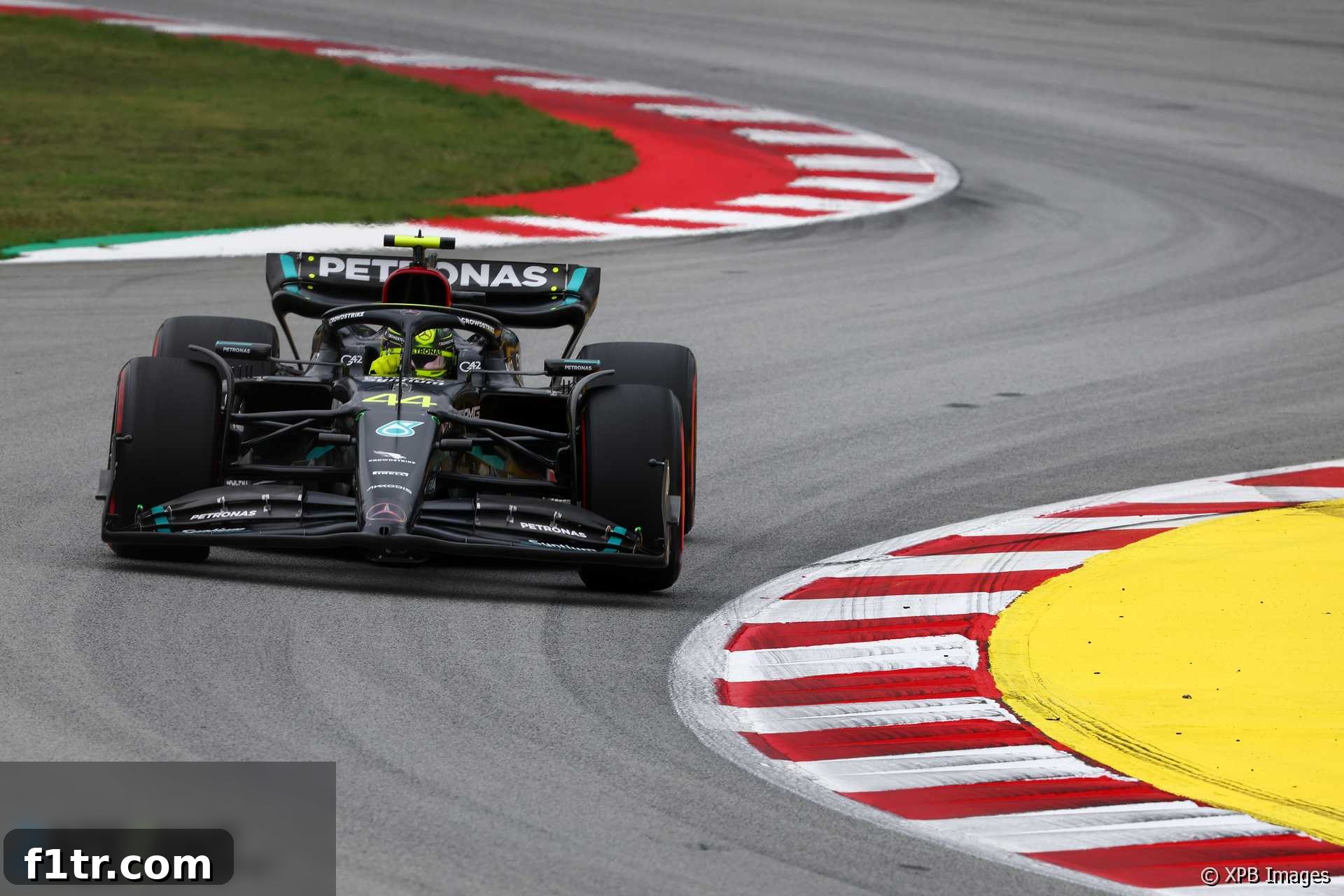
Mercedes’ Qualifying Puzzle: Wolff Reflects on Missed Front Row and Red Bull’s Unyielding Pace at the Spanish GP
Mercedes Team Principal Toto Wolff has openly expressed his belief that the Silver Arrows possessed the requisite pace to secure a coveted front-row starting position alongside Max Verstappen at the recent Spanish Grand Prix qualifying session. Despite this promising assessment, Wolff candidly admitted that the team remains a significant distance from challenging the Red Bull driver’s outright speed, even after introducing a comprehensive design philosophy overhaul at the preceding race.
Advert | Become a Supporter & go ad-free
Wolff characterized the team’s performance with their significant car upgrades as “solid,” noting that their internal projections and data from the morning’s Free Practice 3 session suggested they “should have been right behind Max.” This initial confidence, rooted in strong pre-qualifying pace, set the stage for a palpable sense of disappointment when the final grid positions were determined.
A Glimmer of Front Row Potential and Subsequent Disappointment
The qualifying session presented Mercedes with a genuine opportunity to challenge for a top-two spot. Lewis Hamilton had demonstrated impressive speed, finishing third fastest in final practice, closely trailing the two dominant Red Bulls. The path to the front row seemed even clearer when Sergio Perez, the other Red Bull driver, unexpectedly failed to advance from Q2, thereby eliminating one of Mercedes’ primary threats for a prime starting position.
“That’s why the disappointment is big because we expected more,” Wolff elaborated, his words echoing the team’s collective frustration. However, he also acknowledged the hyper-competitive nature of the midfield, noting, “Having said that, if you look at the gaps it was very, very compressed with everyone. You can get it wrong easily.” This sentiment underscores the razor-thin margins that define Formula 1 qualifying, where even a minor error or suboptimal setup can drastically alter grid positions.
Unpredictable Qualifying: Wind Shifts and Shocks Across the Grid
The Spanish Grand Prix qualifying session was not without its share of surprises and unexpected exits. Beyond Perez’s Q2 elimination, Ferrari’s Charles Leclerc also sensationally failed to progress beyond Q1, a highly unusual occurrence for a front-running team. Wolff pondered these baffling outcomes, stating, “You can see that Leclerc is out in Q1, Perez is out in Q2, so that’s a bit of a mystery today.”
He offered a plausible explanation for the erratic results experienced by some teams, attributing it to a significant environmental factor. “The wind changed 180 degrees and some were caught out, maybe, because of that,” Wolff suggested. Such a dramatic shift in wind direction can profoundly affect a car’s aerodynamic balance and stability, making it incredibly challenging for drivers and engineers to find the optimal setup and balance, especially on a track as sensitive as Circuit de Barcelona-Catalunya.
The Enigma of Red Bull: Verstappen’s Unmatched Dominance
Despite Mercedes’ internal aspirations, the stark reality of Red Bull’s commanding performance, particularly from Max Verstappen, was undeniable. Verstappen’s prowess was vividly illustrated when he secured pole position by a staggering margin of almost half a second over Carlos Sainz Jnr, even managing to abandon his final timed lap due to his comfortable advantage. Wolff confessed his uncertainty about the true extent of Red Bull’s lead, admitting he “simply doesn’t know” how far ahead they truly are.
Advert | Become a RaceFans supporter andgo ad-free
“I think Verstappen is just on a different level. It pisses me off to say that but that is the reality,” Wolff stated with a refreshing candour. This powerful admission highlights the sheer frustration felt by rival teams facing such an dominant force. He further acknowledged the undeniable fact of their competitor’s excellence: “There is a meritocracy, they’ve just done the best job, the driver’s driving excellent and they are just far away. And that is something which only we have in our hands to get under control.” This underscores the immense challenge ahead for Mercedes – a challenge that requires relentless innovation, meticulous execution, and a commitment to narrowing a substantial performance gap.
Mercedes’ New Design Philosophy: A Foundation for the Future
Despite the immediate qualifying results, Wolff articulated a growing confidence in the significant changes implemented in the W14 car at the preceding race. He emphasized that these modifications represent a crucial turning point for the team. “I believe in the package,” he affirmed, indicating a strategic shift rather than incremental updates.
This new approach is viewed as establishing a “new baseline,” a fundamental platform from which the team can build with greater certainty and direction. “It is from where we can continue to work on with a certain stability without needing to question certain parts of the car, whether it’s the bodywork, the floor, the front suspension that is now established,” Wolff explained. This stability is paramount in modern F1, allowing engineers to focus on refining performance rather than constantly re-evaluating core design principles. The ability to move forward with a clear understanding of the car’s foundational elements is a critical step in Mercedes’ long-term development strategy to return to championship contention.
Driver Performances: Contrasting Fortunes in Barcelona
The qualifying session saw a tale of two halves for the Mercedes drivers, Lewis Hamilton and George Russell, highlighting the fine margins and potential pitfalls of F1 setup and execution.
Lewis Hamilton’s Resilient Drive
Lewis Hamilton showcased his immense talent and resilience during the qualifying session. Despite a truly bizarre collision with his own team mate, George Russell, during Q2 – an incident that could easily have derailed his efforts – Hamilton maintained his composure and advanced to the crucial final Q3 segment. His competitive performance ultimately secured him a strong starting position of fourth on the grid, benefiting from a penalty handed to Pierre Gasly. This result underscored Hamilton’s ability to extract maximum performance from the updated W14, demonstrating his adaptability and skill even under challenging circumstances.
George Russell’s Setup Struggles
Conversely, George Russell experienced a far more challenging session, failing to progress beyond Q2. Wolff attributed Russell’s struggles directly to a suboptimal setup choice made by the team, acknowledging a clear misstep. “It was clear from the beginning that the set-up direction we went with George made the car worse,” he stated unequivocally.
Russell’s complaints painted a vivid picture of the car’s handling issues: he reported a distinct lack of grip, noticeable bouncing – a characteristic that had plagued Mercedes for much of the previous season – and an unexpected tendency for the car to understeer where it would typically oversteer. These issues combined to significantly hinder his ability to push the car to its limits and extract competitive lap times. “That’s something which we need to unwind now to understand exactly what we could have done differently,” Wolff concluded, emphasizing the critical need for post-qualifying analysis to learn from the errors and prevent similar occurrences in future sessions.
Looking Ahead: The Road to Recovery and Closing the Gap
The Spanish Grand Prix qualifying served as a powerful reminder of the monumental task facing Mercedes in their quest to return to the pinnacle of Formula 1. While the team identifies a promising “new baseline” for development and sees glimmers of potential, the formidable dominance of Max Verstappen and Red Bull remains a significant hurdle. The contrasting performances of Hamilton and Russell highlight the critical importance of both car development and meticulous setup. Mercedes’ journey to reclaim top honours will undoubtedly be long and arduous, demanding continuous improvement, strategic decision-making, and unwavering determination to bridge the performance chasm separating them from their rivals.
Bringing the F1 news from the source
RaceFans is dedicated to delivering its readers direct news and insights from the heart of Formula 1. This commitment to original journalism is made possible, in part, by the invaluable support of our RaceFans Supporters.
By contributing just £1 per month or £12 annually (or the equivalent in your local currency), you play a vital role in funding the extensive efforts involved in producing authentic F1 content. Your contributions help cover the essential costs of travelling to races, dedicated writing, content creation, website hosting, maintaining critical contacts, and ongoing platform development.
We are proud to have been sustained by the generosity of our readers for over a decade. If you value our independent, in-depth coverage of Formula 1, please consider becoming a RaceFans Supporter today. As an added benefit, all our esteemed Supporters can enjoy an ad-free browsing experience across the entire site. Learn more or sign up via the links below:
- Become a RaceFans Supporter
- RaceFans Supporter FAQ
Advert | Become a RaceFans supporter andgo ad-free
2023 Spanish Grand Prix
- Ben Sulayem raises safety concerns over “too many people on the grid” at races
- Why Ferrari say their change in design is the result of “discipline”, not “copying”
- Hamilton and Russell were seeking tow from Sainz when they collided – Mercedes
- Red Bull’s Spanish GP diffuser update was ‘inspired by rivals’ including Williams
- Why McLaren always doubted second-row start in Spain would lead to points finish
Browse all 2023 Spanish Grand Prix articles