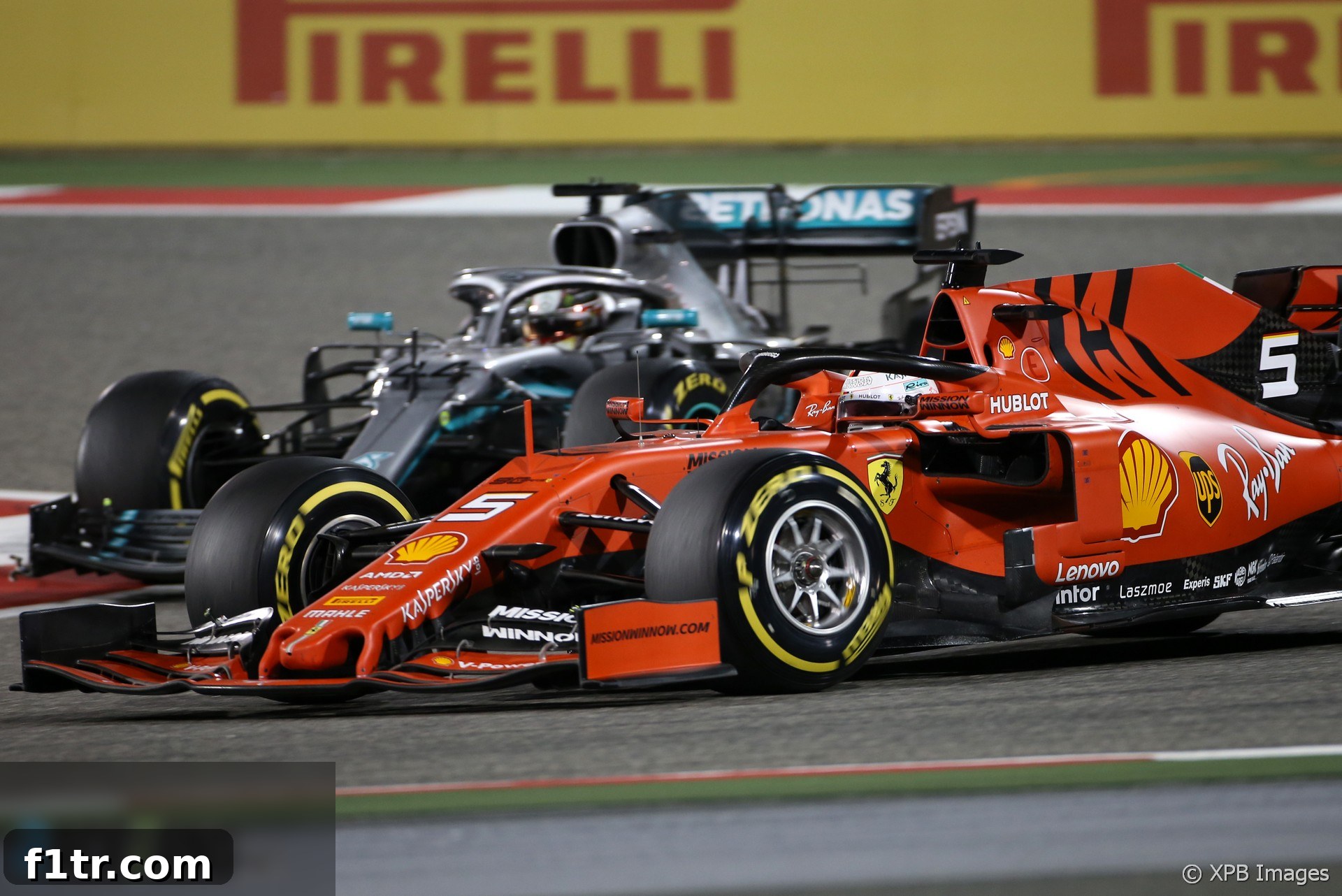
Ferrari, 2019 Formula 1 sezonunun erken aşamalarında şaşırtıcı bir hız sergileyerek rakip takımların dikkatini çekmişti. Özellikle Bahreyn Grand Prix’sinde gösterdikleri performans, Mercedes takım patronu Toto Wolff’un radarına takıldı. Wolff’a göre, Ferrari’nin Sakhir çölündeki üstünlüğü, aerodinamik avantajlardan ziyade, motorlarının sağladığı “saf güçten” kaynaklanıyordu.
Bu açıklama, Formula 1’in zirvesindeki iki güç merkezi arasındaki amansız rekabetin doğasını gözler önüne seriyordu. Wolff, yarışın ardından yaptığı ilk analizlerde, Ferrari’nin düzlüklerdeki inanılmaz hızının büyük ölçüde güç ünitesine bağlı olduğunu, araçlarının aerodinamik konfigürasyonundaki farklılıkların belirleyici olmadığını vurguladı.
Advert | Become a Supporter & go ad-free
Ferrari’s Dominant “Sheer Power” in Bahrain: Toto Wolff’s Analysis
The 2019 Formula 1 season kicked off with an intriguing power dynamic, particularly highlighted by Ferrari’s impressive showing at the Bahrain Grand Prix. Mercedes Team Principal Toto Wolff was quick to pinpoint the core reason behind their rival’s dominant performance, stating that Ferrari’s speed stemmed from “sheer power” rather than any significant aerodynamic advantage.
This assessment came after a meticulous initial analysis of Ferrari’s performance during both qualifying and the race at the Sakhir circuit. Wolff’s comments underscored the perennial battle for supremacy in Formula 1’s engine development, a contest where raw horsepower often dictates the pecking order on high-speed tracks. The Austrian team principal’s observations were not merely speculative; they were backed by comprehensive data, indicating a clear disparity in engine output between the two front-running constructors.
Wolff explicitly dismissed the notion that drag reduction was the primary factor in Ferrari’s straight-line speed advantage. “It’s not the drag,” Wolff clarified after the Bahrain race. He elaborated, “It’s never one silver bullet or one simple action, but the drag levels that we’ve calculated would have been a tenth, maybe, in difference.” This precise quantification suggested that while aerodynamic efficiency plays a role, it was a secondary factor compared to the brute force emanating from Ferrari’s power unit.
The Mercedes chief was unequivocal: “It’s sheer power. This is the analysis after 24 hours, but obviously, lots of data collected today and yesterday. We’ve seen different power levels, I think, in the race today also between the cars. So that needs to be digested now.” This statement not only confirmed Ferrari’s superior engine output but also hinted at potential variations in power deployment or engine modes, even within the same race, which Mercedes would need to meticulously scrutinize.
Unpacking the Power Unit Advantage: Engine vs. Aerodynamics
In modern Formula 1, a power unit’s performance is a complex interplay of several components: the internal combustion engine (ICE), the Motor Generator Unit-Kinetic (MGU-K), the Motor Generator Unit-Heat (MGU-H), the energy store (battery), and control electronics. When Wolff referred to “sheer power,” he was alluding to a potential advantage Ferrari held in one or more of these areas, allowing their engine to deliver more horsepower, especially at critical moments like acceleration out of corners and along long straights.
The Bahran International Circuit is particularly revealing in this regard. Its layout features long straights, notably the pit straight and the back straight, where outright engine power and efficient energy recovery and deployment are paramount. Teams meticulously tune their power units and aerodynamic packages for each circuit. While Mercedes might have opted for a higher-downforce setup for better cornering performance, Ferrari appeared to have prioritized straight-line speed, confident in their power unit’s ability to overcome any slight aerodynamic drag penalty.
This subtle balance between aerodynamics and engine power is a constant strategic battle in F1. A tenth of a second in drag might seem negligible, but over the course of a lap, especially on a power-sensitive circuit, it can translate into a significant performance deficit. However, Wolff’s analysis clearly indicated that Ferrari’s advantage was far greater than what could be attributed to a mere drag differential. The five-tenths advantage on straights that Wolff later mentioned was a staggering figure, indicative of a fundamental power unit superiority.
The Melbourne Anomaly and Pre-Season Expectations
Interestingly, Wolff also placed Ferrari’s Bahrain performance in the context of their pre-season testing in Barcelona and the season-opening Australian Grand Prix in Melbourne. “We expected them to be strong in Melbourne after what we’ve seen in terms of pace in Barcelona testing,” he stated. “So Melbourne was more the surprise than actually Bahrain.”
Pre-season testing is often a game of poker, with teams “sandbagging” – intentionally underperforming – to obscure their true pace. However, Ferrari had shown genuine promise during winter testing, leading many to believe they would be immediate front-runners. The Australian Grand Prix, with its unique semi-street circuit characteristics and cooler temperatures, presented a different challenge. Mercedes emerged dominant there, leading many to question Ferrari’s true potential. But Bahrain, a more conventional racing circuit with higher temperatures and long straights, provided a clearer picture.
“Bahrain was very strong. [Their] straight-line performance is unbelievable. The power they have displayed is unmatched by anybody,” Wolff conceded. He then added the crucial detail: “That was, I think, in qualifying, five-tenths on the straights only. And that’s really difficult to compete with.” A five-tenths advantage purely on the straights in qualifying is an enormous margin in Formula 1, practically impossible to recover through cornering performance alone.
This stark reality forced Mercedes to confront the fact that their Melbourne victory might have been an “outlier.” The Albert Park circuit, being less reliant on raw engine power due to its twisty nature and shorter full-throttle sections, had masked Ferrari’s underlying strength. Bahrain, conversely, exposed it in full glory, setting the tone for what promised to be a fiercely contested championship.
Advert | Become a RaceFans supporter andgo ad-free
Mercedes’ Challenge and the Relentless Development Race
For Mercedes, Ferrari’s power advantage in Bahrain represented a significant challenge. Wolff acknowledged this, stating, “So we have to get used to this level of performance in my opinion, and [it’s] Melbourne that’s the outlier.” This wasn’t just an admission of Ferrari’s speed but a rallying cry for his team. “Getting used to this level of performance” implied an intense development push to match or surpass Ferrari’s power unit capabilities.
The battle for engine supremacy is a cornerstone of Formula 1. Manufacturers invest colossal resources into extracting every last horsepower while ensuring reliability and fuel efficiency. Mercedes, a dominant force in the hybrid era, suddenly found themselves in a position where they were playing catch-up in a crucial area. This meant scrutinizing every aspect of their own power unit – from combustion efficiency and turbocharger design to energy recovery strategies and deployment mapping.
The season-long development race involves constant upgrades not just to aerodynamics but also to the power unit. Teams bring revised components, software updates, and new engine modes to each race, seeking marginal gains that can add up to championship-winning advantages. Wolff’s comments in Bahrain signaled the start of an accelerated development program for Mercedes to close the power gap, setting the stage for a thrilling technical contest throughout the 2019 season. The outcome of this power struggle would ultimately shape the championship narrative, with both teams pushing the boundaries of engineering excellence.
Looking Ahead: Implications for the 2019 Season
Ferrari’s “sheer power” advantage, as identified by Toto Wolff, had profound implications for the remainder of the 2019 Formula 1 season. It meant that on circuits with long straights and fast sections, Ferrari would likely hold a significant edge, making them formidable contenders for pole positions and race victories. This put pressure on Mercedes to find gains not only in engine performance but also in areas where they could compensate, such as maximizing cornering speed or optimizing race strategy.
The analytical prowess of F1 teams is second to none. Mercedes’ engineers would have gone through terabytes of data from Bahrain, comparing GPS traces, speed trap figures, telemetry, and even on-board footage frame by frame to understand precisely where Ferrari’s advantage lay. This detailed analysis would inform their design decisions, engine development priorities, and even their setup choices for upcoming races.
Ultimately, the 2019 season unfolded into a captivating battle between Mercedes and Ferrari, driven by these very technical nuances. While Mercedes eventually clinched both titles, Ferrari’s power unit demonstrated its formidable capability at various points, forcing Mercedes to continually raise their game. Wolff’s candid assessment in Bahrain perfectly encapsulated the relentless pursuit of performance that defines Formula 1, where a single factor like “sheer power” can become the focal point of an entire championship challenge.
2019 F1 season
- Crying in the Melbourne car park at 2019 grand prix was my career low – Ocon
- McLaren Racing reports reduced £71 million loss in 2019
- Kvyat: Hockenheim podium last year was “my biggest achievement” so far
- How the FIA’s new encrypted fuel flow meter targets Ferrari’s suspected ‘aliasing’ trick
- “He smashed my office door”: 23 must-see moments from ‘Drive to Survive’ season two
Browse all 2019 F1 season articles