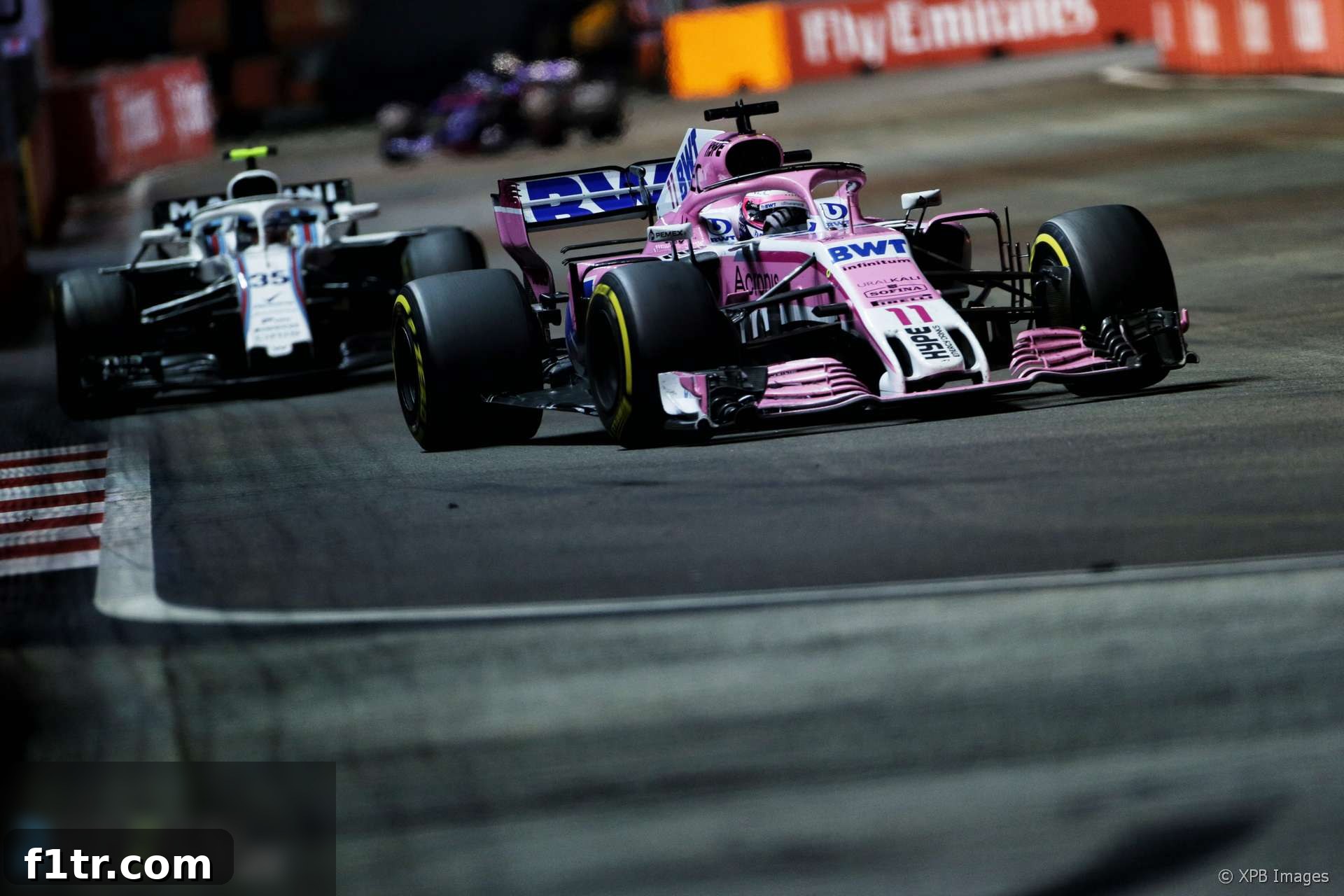
FIA race director Charlie Whiting says he doesn’t believe Sergio Perez intended to hit Sergey Sirotkin in the incident which led to Perez receive a drive-through penalty.
Whiting, who can refer incidents for to the stewards for investigation but does not rule on them, said his interpretation of the collision was that Perez misjudged how close he was to the Williams.
Advert | Become a Supporter & go ad-free
“I haven’t spoken to him, nor are the stewards as far as I’m aware, but it’s hard to believe that a driver would actually intend to hit a car,” said Whiting.
“He’d been trying hard to get past Sirotkin and he looked a little bit frustrated. And I just think he misjudged how far he was in front of him because obviously you saw how closely they were racing all the way through [turn] 14, 15, 16, 17, and I think he just misjudged it.”
Analyzing the Perez-Sirotkin Collision: Intent, Misjudgment, and F1 Stewarding
The intense world of Formula 1 often brings moments of thrilling racing intertwined with controversial incidents, and the clash between Sergio Perez and Sergey Sirotkin was certainly one such event. This specific collision resulted in a drive-through penalty for Perez, igniting discussions across the paddock and among fans about driver intent, on-track judgment, and the role of race control. At the heart of the matter, then FIA Race Director Charlie Whiting offered his nuanced perspective, suggesting that while the incident warranted a penalty, it was more a case of misjudgment rather than a deliberate act of aggression from the Mexican driver.
Charlie Whiting’s Assessment: Misjudgment, Not Malice in F1 Racing
Charlie Whiting, a revered figure in Formula 1 race management, was quick to share his initial thoughts on the contact between Sergio Perez and Sergey Sirotkin. While his role primarily involved referring incidents to the stewards for formal investigation rather than ruling on them directly, Whiting’s vast experience and unique vantage point offered crucial insights. He adamantly stated that he didn’t believe Perez intended to hit Sirotkin, a sentiment echoed by his long-standing understanding of driver psychology and the pressures of Grand Prix racing. According to Whiting, it was highly improbable that any driver would deliberately seek to collide with another car, given the inherent risks and consequences involved.
Whiting’s interpretation stemmed from observing the dynamic battle unfolding on track. He noted Perez’s persistent attempts to overtake Sirotkin, which, while aggressive, suggested a driver pushing the limits rather than aiming for contact. “He’d been trying hard to get past Sirotkin and he looked a little bit frustrated,” Whiting commented, highlighting a common emotional state among drivers engaged in fierce wheel-to-wheel combat. This frustration, however, wasn’t seen as a precursor to intentional malice. Instead, Whiting concluded that Perez simply “misjudged how far he was in front of him.” This assessment pointed to a momentary lapse in judgment regarding spatial awareness, particularly significant given the tight, multi-corner sequence from Turn 14 through Turn 17 where the cars were racing in extremely close proximity. Such intricate sections of a track demand absolute precision, and even the slightest miscalculation can lead to contact.
The context of close racing, where fractions of an inch can determine an overtake or a collision, supports Whiting’s view. Drivers operate at the very edge of control, relying on instinct and precise perception. In the heat of the moment, with adrenaline pumping and championship points on the line, an error in judgment, especially regarding the exact position of a competitor, is a plausible scenario. Whiting’s analysis underscored that while the outcome was penalizable, the underlying cause was a racing misstep rather than a wilful act to disrupt a competitor’s race.
Sergio Perez’s Account: Closing the Door and Accepting the Consequence
On the other side of the incident, Sergio Perez offered his own perspective, acknowledging his role in the collision. It was an eventful race for Perez, who had already been involved in contact with his Force India teammate, Esteban Ocon, earlier in the Grand Prix. This previous incident, while separate, may have added to his determination or frustration during the later battle with Sirotkin. Perez described the encounter as “hard racing,” indicating the intensity of the fight for track position. He explicitly mentioned Sirotkin’s robust defending, including “moving under braking,” a tactic that, while legal within certain parameters, can be unsettling for an attacking driver and often pushes the boundaries of acceptable defensive driving.
Perez detailed his struggle during the braking phase, noting “a lot of lock-ups just at the end of braking,” which suggests he was pushing his car to its absolute limit to gain an advantage. His intention, he explained, was to “close the door” on Sirotkin as he tried to complete the overtake. This phrase is common in motorsport, referring to moving across the track to block an opponent’s return line or prevent them from retaking the position. However, Perez conceded that his execution might have been flawed: “I tried to close the door but I think he was too close there.” This statement points to the critical timing involved in such maneuvers; closing the door too early, or without sufficient clearance, inevitably leads to contact.
Significantly, Perez demonstrated a degree of introspection and sportsmanship by acknowledging his potential error and accepting the stewards’ decision. “I have to see the incident but I probably closed the door earlier than I should so I have to double-check but I think it was fair, the penalty,” he added. This admission aligns with Whiting’s interpretation of a misjudgment rather than an intentional hit. A driver willing to scrutinize their own actions and agree with a penalty, even in the heat of competition, speaks volumes about the racing incident being an unfortunate consequence of aggressive driving rather than deliberate foul play. His acceptance highlights the tight margins in F1 where even veteran drivers can miscalculate in the pursuit of speed and position.
Advert | Become a RaceFans supporter andgo ad-free
The Spectrum of Penalties: From Drive-Through to Black Flag in F1
The stewards’ decision to issue a drive-through penalty to Sergio Perez sparked debate, not just about the incident itself, but also about the range and application of penalties in Formula 1. Charlie Whiting took the opportunity to elaborate on the options available to the stewards, highlighting that much harsher sanctions could have been imposed had the incident been deemed more severe or deliberate. A drive-through penalty requires the driver to enter the pit lane, drive through it at the pit lane speed limit, and re-join the race without stopping. While costly in terms of track position and race time, it is one of the less severe in-race penalties.
Whiting pointed out that “they could have given him a 10-second stop-and-go penalty and the next step would have been a black flag.” A 10-second stop-and-go is considerably more punitive, requiring a driver to stop in their pit box for ten seconds before their team can work on the car, effectively costing more time than a drive-through. The ultimate sanction, a black flag, signifies immediate disqualification from the race. This escalation of penalties illustrates the fine line between a typical racing incident and an act considered dangerously aggressive or unsportsmanlike.
To contextualize the severity of Perez’s penalty, Whiting drew a comparison to a high-profile incident from the previous year: Sebastian Vettel’s collision with Lewis Hamilton during a Safety Car period at the 2017 Azerbaijan Grand Prix. In that instance, Vettel was found to have deliberately steered his car into Hamilton’s, an action that earned him a 10-second stop-go penalty. Whiting’s comparison was crucial in explaining why Perez’s drive-through was deemed appropriate. The key differentiator was intent and circumstances. Vettel’s incident occurred under Safety Car conditions, meaning cars were traveling at reduced speeds, and his action was explicitly judged as deliberate. “The Safety Car was out in Baku so you could say it wasn’t… I wouldn’t say safer, but less likely to cause a big accident than when you’re travelling at racing speeds,” Whiting clarified. Despite the lower speed, the deliberate nature of Vettel’s contact made it a more egregious offense.
Conversely, Perez’s clash with Sirotkin happened at full racing speeds, within a dynamic overtaking maneuver. While still a contact incident, the lack of deliberate intent, as interpreted by Whiting and seemingly accepted by Perez, placed it in a different category. The stewards, in their decision-making, must carefully weigh factors such as intent, the speed of the cars, the potential for serious harm, and the impact on the race outcome. This complex process ensures that penalties are proportionate to the offense, distinguishing between a racing misjudgment and an act of dangerous driving or aggression. The stewards’ choice of a drive-through for Perez, rather than a harsher penalty, reflected their assessment that it was primarily a racing incident resulting from a miscalculation, rather than a deliberate ramming maneuver akin to Vettel’s prior infraction.
Sirotkin’s Defensive Driving: No Foul Play, Says Whiting
Following the collision, Sergio Perez’s team raised a complaint regarding Sergey Sirotkin’s driving, specifically accusing the Williams driver of unfairly changing his line under braking. This is a common point of contention in F1, as drivers are allowed to defend their position but must not make erratic or dangerous moves that could jeopardize a competitor’s safety, particularly in the braking zone. Whiting confirmed that Force India had indeed asked race control to review Sirotkin’s actions, citing incidents in Turns Seven and Fourteen.
However, after reviewing the footage, Whiting and his team found no evidence to support Perez’s claims. “We didn’t see anything that gave us any trouble,” he stated. Despite the initial finding, Perez reportedly reiterated his complaint, prompting a second review by race control. Even then, the verdict remained unchanged. Whiting’s explanation revealed why Sirotkin’s actions were deemed acceptable within the rules of engagement.
He observed that “Sergey was maybe just being circumspect and moving over to the right going into turn 14 but as they were approaching the corner just moved slightly left.” This description suggests that Sirotkin was making a standard defensive move – perhaps positioning his car to make it harder for Perez to overtake – but critically, it was not deemed overly aggressive or unpredictable. Whiting emphasized that “it wasn’t as if Sergio was really close, he was a good distance back.” This detail is key; for a defensive move to be deemed illegal or dangerous, the attacking car must be sufficiently close to be affected significantly, or the defensive maneuver must be sudden and severe.
Whiting concluded, “So I just said to them he’s going to have to get a lot closer if we’re going to start looking at exactly what [Sirotkin] was doing under braking. It really wasn’t an issue for us.” This response clearly indicated that, in the judgment of race control, Sirotkin’s defensive movements were well within acceptable limits and did not constitute an illegal blocking maneuver. The onus was on Perez to get closer to Sirotkin for any defensive move to become a scrutinizable offense. This highlights the subjective nature of judging defensive driving, where proximity and the degree of movement are critical factors in determining legality.
Advert | Become a RaceFans supporter andgo ad-free
Navigating the Fine Line: Aggressive Racing vs. Dangerous Driving in F1
The Perez-Sirotkin incident, like many others in Formula 1, underscores the perpetual challenge of distinguishing between aggressive, hard racing and genuinely dangerous driving. F1 is a sport built on daring overtakes, wheel-to-wheel battles, and drivers pushing their machines and themselves to the absolute limit. This inherent competitiveness often results in close shaves, contact, and the occasional collision. The very essence of what makes F1 exciting — the bravery and skill of drivers fighting for every inch of track — also creates scenarios where judgment calls are incredibly difficult.
The role of the FIA Race Director and the stewards is critical in maintaining this delicate balance. They are tasked with upholding safety and fairness without stifling the spectacle of racing. Their decisions aim to deter truly dangerous behavior, such as deliberate contact or reckless driving, while allowing for the robust and spirited competition that fans crave. Incidents like Perez’s drive-through penalty serve as a reminder that there’s a fine line. Drivers are expected to race hard, but also to assume responsibility for their actions and the safety of their competitors. A misjudgment leading to contact, even if unintentional, can still be penalized because it affects the integrity of the race and the safety of all participants.
Moreover, these incidents and their subsequent penalties have broader implications. For drivers, a penalty means lost time, potential loss of championship points, and can affect their reputation. For teams, it can impact their standing in the constructors’ championship and even influence team dynamics, especially when teammates are involved, as was the case with Perez and Ocon earlier in the same race. The consistency and clarity of stewarding decisions are vital for drivers to understand the boundaries and for the sport to maintain its credibility. Every incident, every review, and every penalty contributes to the evolving jurisprudence of F1 racing, shaping how drivers approach overtakes and defensive maneuvers in future races.
Conclusion: A Nuanced Call in the Heat of Battle
In conclusion, the collision between Sergio Perez and Sergey Sirotkin was a complex racing incident, meticulously analyzed by Charlie Whiting and the FIA stewards. While Perez received a drive-through penalty, the prevailing sentiment from race control was that it stemmed from a misjudgment in the heat of battle rather than any malicious intent. Perez’s own admission of potentially closing the door too early further corroborated this view, demonstrating a willingness to accept accountability for his actions on track. The comparison with Sebastian Vettel’s more deliberate contact with Lewis Hamilton underscored the nuanced criteria used by stewards to differentiate between various forms of on-track transgressions, leading to proportionate penalties.
Furthermore, the rejection of Perez’s complaint regarding Sirotkin’s defensive driving highlighted the stringent standards applied to accusations of illegal blocking, reaffirming that Sirotkin’s maneuvers were within the bounds of fair racing. This incident encapsulates the relentless intensity of Formula 1, where drivers push limits, mistakes can occur, and race control must make challenging calls to balance competition with safety. Ultimately, the outcome served as a critical reminder of the razor-thin margins that define Grand Prix racing and the constant quest for precision and responsibility in the pursuit of victory.
2018 F1 season
- F1 feared “death knell” for Drive to Survive after Ferrari and Mercedes snub
- McLaren staff told us we were “totally crazy” to take Honda engines in 2018 – Tost
- ‘It doesn’t matter if we start last’: How Red Bull’s junior team aided Honda’s leap forward
- Honda’s jet division helped F1 engineers solve power unit problem
- McLaren Racing losses rise after Honda split
Browse all 2018 F1 season articles