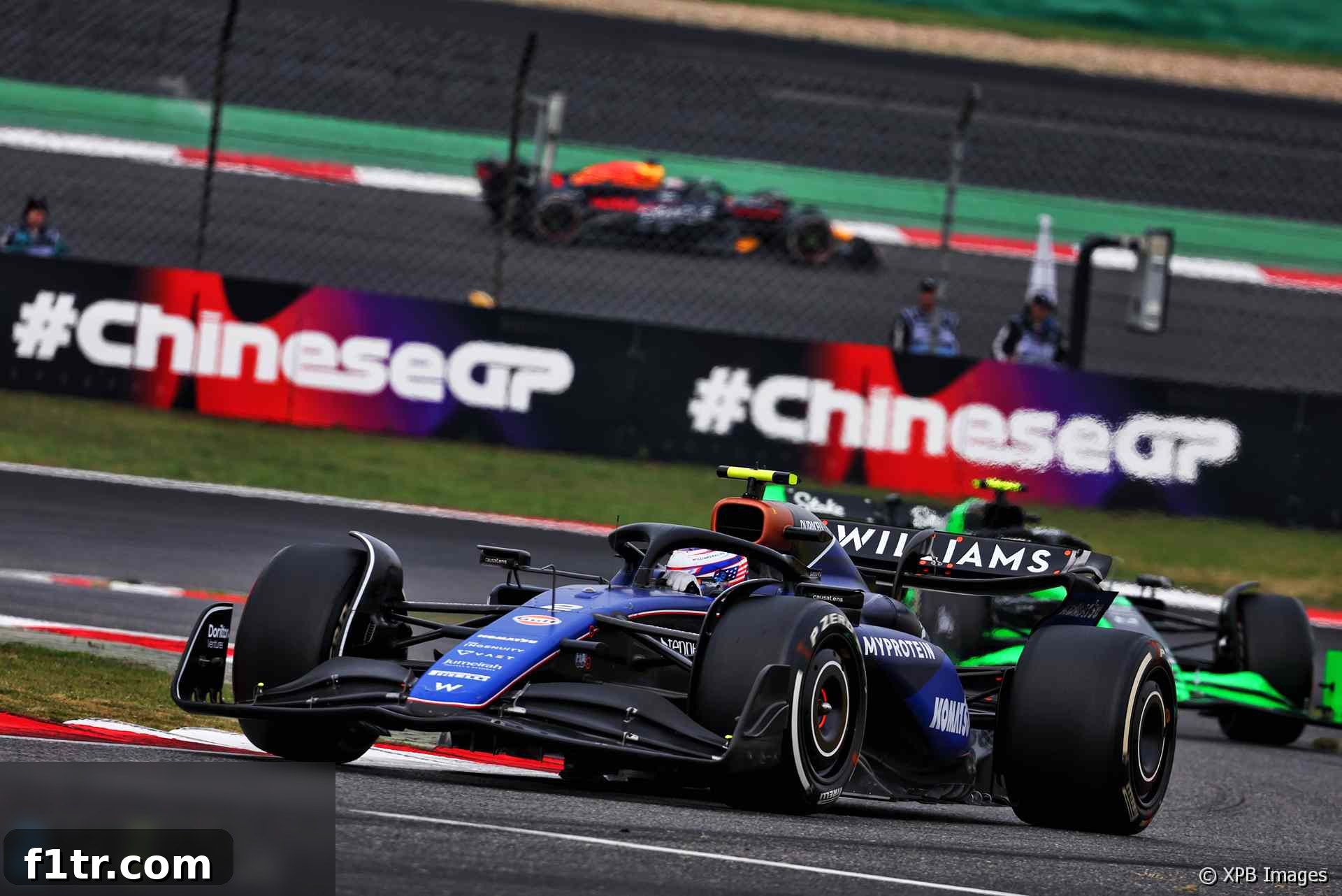
Logan Sargeant’s Penalty Points Scare: Navigating F1’s Strict Safety Car Rules at the Chinese Grand Prix
The return of Formula 1 to the iconic Shanghai International Circuit for the Chinese Grand Prix delivered a thrilling spectacle, but also a stark reminder of the sport’s uncompromising rulebook. Amidst the high-speed action, Williams driver Logan Sargeant found himself under scrutiny, incurring a penalty that brought him dangerously close to an automatic race ban. This incident, alongside a separate investigation involving his teammate Alexander Albon, highlighted the razor-thin margins and complex interpretations that define top-tier motorsport.
Sargeant’s Safety Car Infraction: A Costly Overtake
The pivotal moment for Logan Sargeant occurred during a Safety Car period, a phase of the race designed to neutralize competition and ensure driver safety. As the Safety Car was deployed, the field slowed, and drivers were expected to maintain position unless otherwise instructed or permitted. Sargeant’s incident unfolded as Nico Hulkenberg, driving for Haas, emerged from the pit lane, rejoining the track alongside Sargeant as they approached the crucial Safety Car line.
According to the stewards’ report, Hulkenberg initially reached the Safety Car line marginally ahead. However, Sargeant subsequently moved in front of the Haas driver. This seemingly minor maneuver was deemed a breach of regulations, specifically Article 55.8 of the Sporting Regulations, which prohibits overtaking another car during a Safety Car period, except under very specific circumstances such as a car being waved past or entering the pits itself. The interpretation of “overtaking” in such a dynamic situation, especially with cars at different speeds (one exiting the pits, one already on track), often presents a challenge for drivers.
The Steward’s Verdict and Sargeant’s Perspective
Following a review, the stewards handed Logan Sargeant a 10-second time penalty, which was applied to his race time, and, more significantly, two penalty points on his Super Licence. Sargeant, who ultimately finished 17th, acknowledged the penalty but expressed his confusion regarding the precise order. “From my perspective, I thought I crossed the line first,” he stated. “When the cars are going at such different speeds, I don’t know how I could’ve known the true order.” This statement underscores the difficulty drivers face in accurately judging positions when merging from the pit lane under Safety Car conditions, where the relative speeds of vehicles can be highly deceptive.
The stewards, however, rely on objective data and video evidence to make their judgments. Their decision was likely influenced by a similar scenario earlier in the race involving Mercedes driver Lewis Hamilton and Alpine’s Pierre Gasly. In that instance, Gasly had also passed Hamilton under Safety Car conditions despite Hamilton reaching the line first. The key difference was that Gasly immediately rectified the situation by allowing Hamilton back through, thus negating the need for a penalty. Sargeant did not afford Hulkenberg the same opportunity, leaving the stewards with no choice but to penalize the infraction.
The Looming Threat of a Race Ban: F1’s Penalty Point System
The two penalty points incurred in China pushed Logan Sargeant’s total to eight points on his Super Licence. This places him in a precarious position, just four points away from the automatic accumulation of 12 penalty points, which triggers a one-race ban. The F1 penalty point system is designed to penalize persistent rule infringements, with points remaining on a driver’s licence for a rolling 12-month period. For Sargeant, these eight points will remain active until at least the Italian Grand Prix later in the season, meaning any further misstep could see him sidelined.
For a young driver in his second season, striving to establish himself in Formula 1, the threat of a race ban is particularly significant. It not only means missing out on crucial track time and potential development but also carries a considerable psychological burden. Teams meticulously track these points, as a banned driver creates a logistical challenge, requiring a substitute and impacting team dynamics. The pressure on Sargeant to drive flawlessly for the foreseeable future has undoubtedly intensified, adding another layer of challenge to his demanding role.
Alexander Albon’s Acrobatic Defense: A Different Outcome
In contrast to Sargeant’s penalty, his Williams teammate Alexander Albon successfully navigated a stewards’ investigation, avoiding a sanction for an incident involving Pierre Gasly. Albon was investigated for allegedly forcing Gasly off the track during a battle for position at Turn 14, a notorious corner on the Shanghai circuit known for its challenging entry and exit lines.
The stewards’ detailed ruling provided a fascinating insight into the nuances of wheel-to-wheel racing. They noted that “Car 23 [Albon] clearly had its front axle at least alongside the mirror of the other car by the apex of the corner.” This positioning is crucial, as it indicates Albon had established a legitimate claim to the racing line. Furthermore, the stewards determined that “The car was driven in a safe and controlled manner throughout the manoeuvre (entry, apex and exit) and did not, in our view, (deliberately) force the other car off the track at the exit.”
Perhaps most tellingly, the stewards observed, “The line taken by car 23 was a natural line for that corner and we could not expect car 23, in these circumstances, to have taken a different line to create further space for car 10 [Gasly].” This interpretation highlights the expectation for drivers to defend their position using natural racing lines, without being overly conservative to accommodate a challenging rival. The stewards even suggested that Gasly’s brief departure from the track “may have left the track briefly because the car bottomed out over the kerb,” implying that Gasly’s own car setup or execution might have contributed to the incident, rather than purely Albon’s actions.
This ruling provides valuable clarification on the fine line between aggressive, fair racing and punishable dangerous driving. It underscores that drivers are expected to race hard but within the bounds of safety, and that stewards meticulously analyze every aspect of a maneuver before issuing a verdict. For Williams, Albon avoiding a penalty was a welcome relief, especially given their ongoing battle to secure precious points in the constructors’ championship.
The Enduring Challenge of Formula 1 Regulations
The 2024 Chinese Grand Prix served as a microcosm of the complexities inherent in Formula 1 racing. From the stringent application of Safety Car rules to the nuanced interpretation of aggressive overtaking maneuvers, every decision by the stewards carries significant weight for drivers and teams. Logan Sargeant’s brush with a race ban is a powerful reminder of the precision required and the constant pressure on drivers to adhere to every facet of the rulebook. Meanwhile, Alexander Albon’s successful defense illustrates the sophisticated understanding of racing dynamics that often dictates the outcome of investigations. As the season progresses, these incidents will undoubtedly contribute to the ongoing narrative of F1, where talent, strategy, and strict adherence to rules intertwine to define success.
2024 Chinese Grand Prix: Further Insights and Controversies
The Chinese Grand Prix weekend was not without its other notable moments and controversies, adding layers of discussion and analysis to an already eventful race. These incidents, much like Sargeant’s penalty and Albon’s close call, underscore the constant scrutiny under which Formula 1 operates.
- Alonso and Sainz incidents prompt changes to Formula 1’s rules
- Aston Martin fail in bid to have Alonso’s Shanghai penalty reviewed
- Mercedes cleared over Hamilton pit stop infraction as ‘nearly all teams in breach’
- Aston Martin petitions FIA to review Alonso’s penalty for Sainz collision
- “You need to be more on it”: 12 unheard radio exchanges from the Chinese GP
Browse all 2024 Chinese Grand Prix articles