Red Bull’s Bold Gamble: Horner Details Verstappen’s Saudi GP Tactical Decision Amid Penalty Threat
Red Bull team principal Christian Horner recently shed light on a pivotal strategic decision made during the highly anticipated Saudi Arabian Grand Prix. Horner openly admitted that the team intentionally chose not to relinquish Max Verstappen’s lead, even when faced with the looming threat of a penalty. This audacious tactical call aimed to safeguard crucial track position and avoid the detrimental effects of running in ‘dirty air’, a decision that ultimately shaped the race’s dynamic and sparked considerable debate.
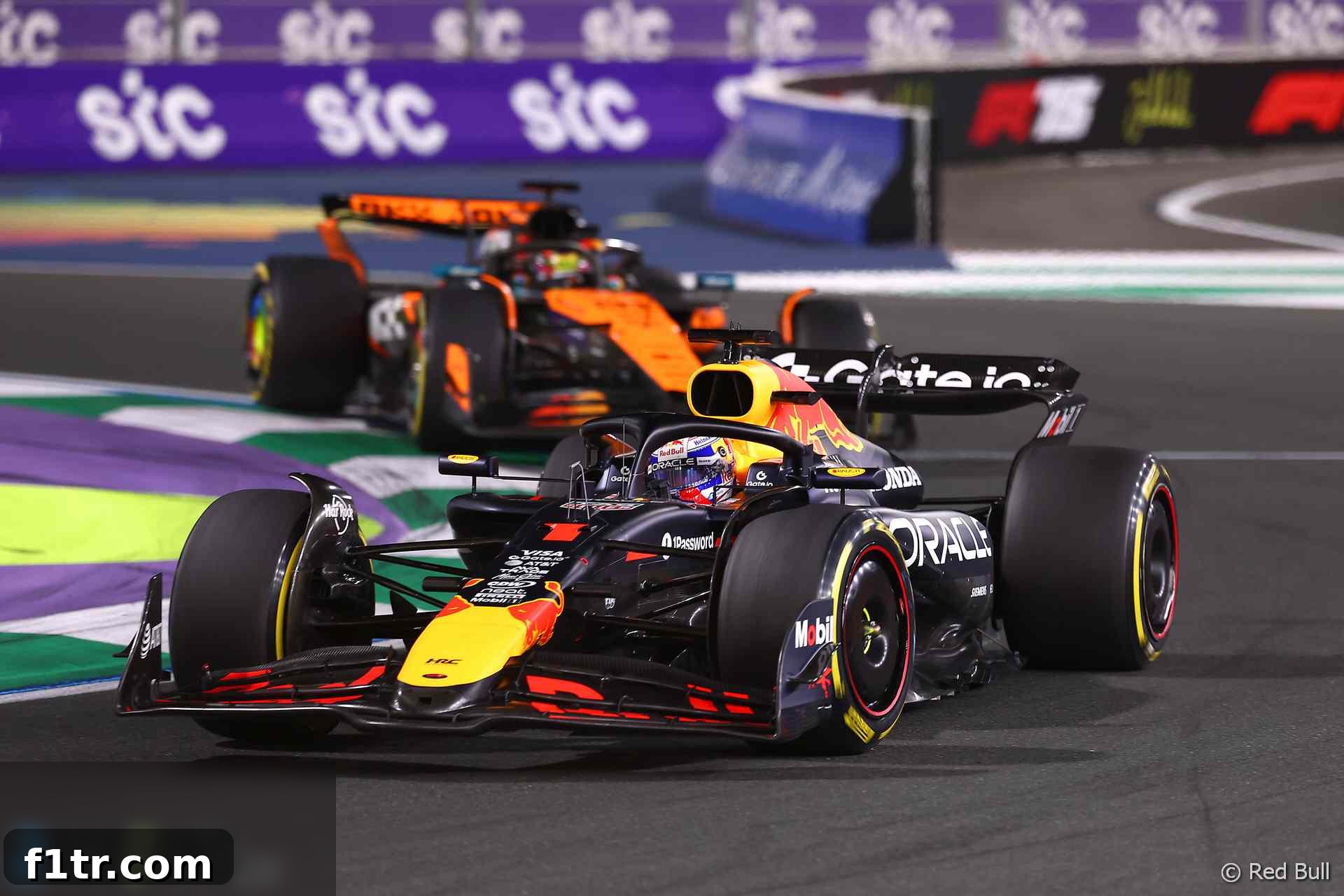
The incident in question occurred early in the race. Starting from pole position, Max Verstappen momentarily lost his advantage to McLaren’s Oscar Piastri on the sprint to the first corner. In a swift counter-move, the Red Bull driver navigated across the run-off area at Turn 1, effectively retaking the lead from Piastri. This maneuver immediately caught the attention of the race stewards, placing the incident under investigation and setting the stage for Red Bull’s controversial strategic choice.
The Calculated Risk: Why Red Bull Held Position
Horner confirmed that Red Bull was fully aware of the potential consequences, acknowledging that returning the position to Piastri could have averted a penalty for Verstappen. However, the team deliberately opted against it, prioritizing the tangible benefits of leading the race. “If we had given the position back… we chose not to at the time, because it would have put us under pressure from the cars behind, plus the benefit of clean air is never to be underestimated,” Horner articulated in an interview with the BBC, highlighting the core of their strategic thinking.
The concept of ‘clean air’ is paramount in modern Formula 1. When a car is running directly behind another, it experiences turbulent air, commonly known as ‘dirty air’. This disturbed airflow significantly reduces aerodynamic efficiency, leading to less downforce, increased tire degradation, and higher fuel consumption. By maintaining the lead, Verstappen was able to operate in undisturbed air, maximizing his car’s performance, managing his tires optimally, and setting his own pace without being dictated by the car ahead.
This tactical gamble underscores the high-stakes nature of F1 strategy, where immediate track position often trumps the risk of a potential time penalty, especially on circuits where overtaking is notoriously difficult. Red Bull’s confidence in their car’s pace and Verstappen’s ability to build a sufficient gap to mitigate any future penalty played a crucial role in this decision-making process.
Race Dynamics and Outcome: Piastri’s Victory
Following the controversial first-lap incident, Verstappen quickly established a lead of 2.6 seconds over Piastri. As the first stint progressed, the McLaren driver began to show signs of struggling with tire degradation, further cementing Red Bull’s decision to maintain track position. Despite Piastri losing time during his subsequent pit stop and Verstappen being instructed to activate his engine’s maximum power mode on his in-lap to maximize his gap, the tactical advantage shifted. Ultimately, Piastri regained the lead of the race when Verstappen eventually pitted.
The race concluded with Oscar Piastri claiming a hard-fought victory. When questioned if allowing Piastri into the lead earlier to avoid a penalty would have offered Verstappen a better chance at winning, Horner remained resolute. He argued that the challenging nature of the Jeddah Corniche Circuit, particularly its high-speed first sector, would have made overtaking exceedingly difficult, even without the added complication of dirty air.
“No, I think overtaking at that circuit, as you saw, is so hard,” Horner stated. “And when you run in the dirty air, to get close, particularly in that awesomely quick first sector. There would have been no chance.” This viewpoint underscores Red Bull’s belief that conceding track position would have effectively surrendered their chances of victory, making their initial tactical decision a calculated risk they felt compelled to take.
The Stewards’ Verdict: A Reduced Penalty
The stewards’ handling of the incident also drew significant attention. Horner’s initial explanation to the stewards for the reduced penalty, from the customary 10 seconds to five, was that the decision on the track was “a very marginal call.” However, the official decision released by the stewards presented a different rationale, detailing the nuances of their ruling.
In their formal statement, the stewards unequivocally declared that “it was [Piastri’s] corner and he was entitled to be given room,” further asserting that Verstappen “left the track and gained a lasting advantage that was not given back” and subsequently “stayed in front of [Piastri] and sought to build on the advantage.” Despite these clear findings, they cited only one mitigating factor for reducing the severity of Verstappen’s penalty: that “this was [a] lap one and turn one incident.”
This clarification from the stewards highlights the complexities of adjudicating track limit infringements, especially during the opening stages of a race. While the foul itself was clear – gaining an advantage off-track – the context of it being a first-lap, first-corner skirmish was deemed sufficient to warrant a lesser punishment. This distinction often aims to account for the heightened chaos and unpredictability inherent in race starts, where drivers are vying for position and incidents can occur more readily. The stewards’ decision, therefore, balanced the infraction with the specific circumstances of its occurrence.
Red Bull’s Confidence in Jeddah Pace
Despite the penalty and ultimately finishing behind Piastri, Horner expressed considerable optimism regarding Red Bull’s performance in Jeddah, viewing it as an encouraging sign for the season ahead. He pointed to the team’s strong pace, particularly during the race stints, as a testament to their car’s capabilities.
“On that first stint we were able to pull away,” Horner observed. “On the second stint we were 4.8 seconds behind when we left the pit lane and we finished the race 2.6 seconds behind Oscar. So we had the pace in that race to win it outright, which has really been the first time, I think, this year that we’ve had the upper hand in pace on race day to the McLarens.”
This assessment by Horner indicates a significant boost in confidence within the Red Bull camp, suggesting that the team believes they have finally found a competitive edge over their McLaren rivals on race day. The ability to close a substantial gap and demonstrate superior raw pace provides a strong foundation for future races, fueling hopes of challenging for victories and potentially even championship contention. The Jeddah performance, from Red Bull’s perspective, was not merely about a tactical decision but also about validating their car’s developmental progress and underlying speed, setting an exciting precedent for the remainder of the racing calendar.
Implications for Future Races and F1 Regulations
Red Bull’s calculated risk in Jeddah and the subsequent stewards’ decision underscore broader themes within Formula 1 regarding race control, strategic daring, and the enforcement of regulations. The incident reignites discussions about track limits and the consistency of penalty application, especially when a driver gains a “lasting advantage.” Teams will undoubtedly analyze this scenario closely, potentially influencing future tactical decisions where the balance between track position and penalty risk is finely weighed.
Moreover, the strategic battle between Red Bull and McLaren, highlighted by Horner’s comments on pace, suggests an intensifying rivalry. As the season progresses, these tactical chess matches, coupled with the relentless pursuit of aerodynamic efficiency and tire management, will become even more critical. The Jeddah race served as a stark reminder that in the hyper-competitive world of Formula 1, every decision, from the cockpit to the pit wall, carries immense weight and can dictate the ultimate outcome.
2025 Saudi Arabian Grand Prix Insights
- Red Bull’s Tactical Decision: Avoiding a Penalty in Jeddah Confirmed by Horner
- Norris’s Starts Show Improvement Against Verstappen’s Pace
- McLaren’s Rivals Just One Upgrade Away from Leading – Brown
- Russell Shared His Opinion with Race Control on Verstappen’s First Lap Corner Cut
- Doohan’s Dramatic Last-Place Pass at Jeddah
Explore all 2025 Saudi Arabian Grand Prix articles