The 2025 Formula 1 season has, for many, been defined by the remarkable resurgence of the Williams Racing team. After a challenging 2024 season which saw them finish a disappointing second-to-last in the Constructors’ Championship standings, the iconic British outfit arrived at the Spanish Grand Prix in an unexpected fifth position in the championship. This dramatic turnaround has been fueled by consistent points finishes from both Carlos Sainz Jnr and Alexander Albon, who have collectively scored in the last four consecutive rounds. Their performance has captivated fans and pundits alike, suggesting a genuine step forward for a team long yearning to reclaim its former glory. However, the wave of optimism surrounding Williams faced a significant test as the F1 circus rolled into the demanding Circuit de Catalunya for the Spanish Grand Prix weekend.
Prior to arriving in Barcelona, the team’s engineers and drivers had expressed a cautious outlook, anticipating that the Circuit de Catalunya’s unique characteristics would expose inherent weaknesses within their FW47 challenger. Friday’s free practice sessions seemed to confirm these apprehensions, casting a shadow over what has otherwise been a brilliant start to their 2025 campaign. The fast, flowing corners and varied demands of the Spanish track traditionally act as a rigorous barometer for a car’s overall aerodynamic efficiency and mechanical balance. For Williams, a team still finding its feet after years of struggle, this particular venue presents a stern examination of their development progress and underlying car philosophy.
The Demands of Circuit de Catalunya: A Benchmark for Performance
The Circuit de Catalunya in Barcelona is widely regarded as one of the most comprehensive test tracks on the Formula 1 calendar, often providing a definitive assessment of a car’s capabilities. Its diverse layout features a challenging mix of high-speed corners, a lengthy main straight, and technical slower sections, making it an ideal proving ground for an F1 car’s complete package. The circuit places immense demands on aerodynamic efficiency, particularly through its long, sweeping turns such as Turn 3 and the high-speed sequence leading into the final sector. To excel here, cars require precise front-end grip, stable rear-end balance, and robust tire management. Furthermore, the high-energy loads exerted on the Pirelli tires typically lead to significant degradation, making strategic pit stops and careful tire conservation critical for a strong race performance. For developing teams like Williams, these exacting conditions can quickly highlight any remaining areas for improvement or fundamental design limitations, offering a stark reality check.
Teams’ 2024 Performance in Context: Barcelona’s Persistent Challenges for Williams
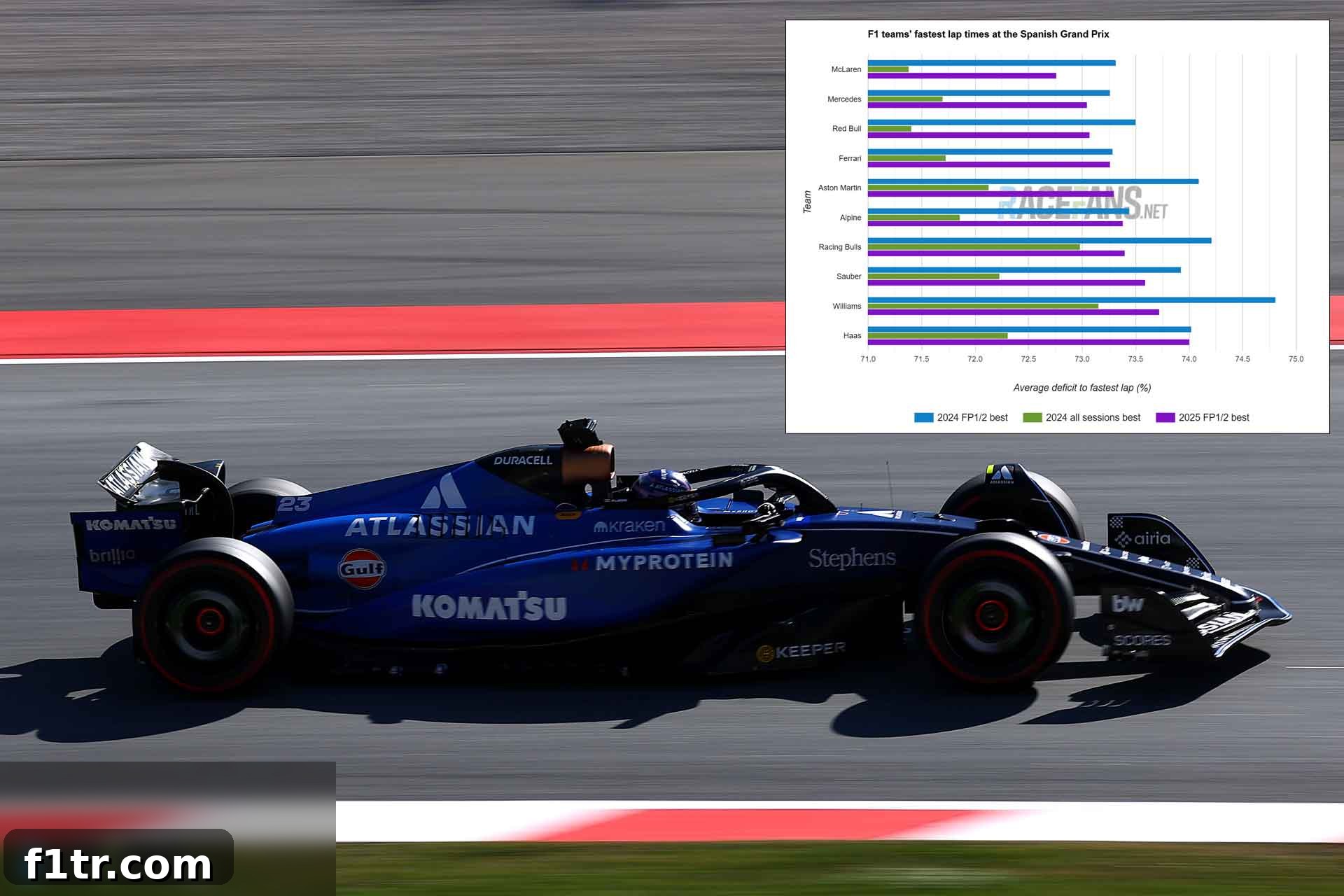
Looking back at the previous year, the Circuit de Catalunya consistently proved to be one of the most challenging venues for the Williams team. In the 2024 qualifying session, the team found themselves lagging by a substantial half-second relative to the next-slowest competitor, a stark indicator of their car’s unsuitability for the track’s specific demands. This significant gap wasn’t merely a matter of minor fine-tuning; it pointed to a deeper struggle with aerodynamic performance, overall downforce levels, and mechanical grip that the FW46 chassis experienced on this particular layout. Interestingly, Barcelona was also not a particularly strong hunting ground for another team that has shown impressive form in 2025: Racing Bulls (formerly known as RB). Their struggles in 2024 at this circuit suggest that the track’s unique characteristics might similarly challenge their current car, despite their overall improved performance this season. Understanding these historical trends is vital for contextualizing the current weekend’s results and anticipating potential shifts in the competitive order.
The data from 2024 illustrates a clear performance deficit for Williams at this track, establishing a critical benchmark against which their 2025 progress can be objectively measured. While the team has undeniably improved across various circuits, the specific demands of Barcelona represent a formidable obstacle, potentially unveiling weaknesses that were less apparent on other, less aerodynamically sensitive tracks. The expectation was that if they could perform respectably here, it would truly validate their development efforts. However, early indications from Friday’s practice sessions suggest the challenge remains as potent as ever, requiring a concerted effort to overcome its inherent difficulties.
Teams’ Progress vs 2024: A Relative Measure in the Spanish Heat
The hot ambient and track conditions prevalent at the Circuit de Catalunya during Friday’s practice sessions added another layer of complexity for all teams. Under these challenging circumstances, no team managed to lap quicker than they did in 2024. This isn’t necessarily a sign of stagnation across the grid, but rather reflects a combination of factors including higher track temperatures, potential changes in tire compounds, and a greater emphasis during practice on long-run performance and race simulation rather than outright single-lap pace. Among the entire field, Racing Bulls and Williams were the teams that came closest to matching their previous year’s performance. For Williams, this indicates a relative improvement compared to their historical deficit, even if the absolute lap times weren’t faster than last year.
Paradoxically, Red Bull, often the benchmark for ultimate pace, were among those furthest from their 2024 speed. This deviation from their usual dominant form could be attributed to a number of strategic factors, including experimental setup changes, a greater focus on gathering comprehensive data for the race, or perhaps a more conservative approach to engine and tire management in the intense heat. However, what was truly striking was Max Verstappen’s unwavering ability to still be incredibly quick relative to his immediate rivals, lapping just three tenths of a second off Oscar Piastri, who topped the Friday timing sheets for McLaren. This once again underlines Verstappen’s exceptional talent and adaptability, extracting maximum performance even when the car might not be at its absolute peak or when the team is actively exploring different configurations. On the other hand, a noticeable disparity emerged between Verstappen and his teammate, Yuki Tsunoda, whose pace was significantly further off during this crucial stage of the weekend. This performance gap reportedly caused some concern on the other side of the Red Bull garage, hinting at potential setup imbalances or driver comfort issues that the team will need to meticulously address ahead of Saturday’s all-important qualifying session.
The absence of faster overall lap times compared to 2024 across the board suggests that the competition is incredibly tight, and perhaps the cars are nearing their performance ceiling given the current technical regulations and track conditions. For Williams, closing the gap to their 2024 times, even if not surpassing them in absolute terms, represents a positive trend in their development curve, but their relative performance against their 2025 rivals is what truly holds significance for their championship aspirations.
Williams’ Friday Struggles Confirmed: 2024 and 2025 Times in Comparison
Despite managing to get closer to their 2024 pace than many other teams, Williams’ ranking at the conclusion of Friday’s practice sessions was only marginally better: ninth instead of tenth. This seemingly small improvement in absolute track position, however, belies a potentially more hopeful underlying trend for the team. Crucially, the gaps between cars across the intensely competitive midfield are significantly tighter this year compared to last season. This means that a few tenths of a second, which might have made little practical difference in 2024’s wider performance spread, could now translate into gaining several valuable positions on the grid. This heightened competitiveness offers both a formidable challenge and a tangible opportunity for Williams; while it’s harder to stand out, even minor improvements can yield substantial gains in qualifying and the race.
The pre-weekend predictions from the Williams camp proved remarkably accurate. On Thursday, even before any running commenced, Alexander Albon candidly predicted that Barcelona would be one of the toughest venues for the team’s current car concept. His concerns were unfortunately echoed by teammate Carlos Sainz Jnr after Friday’s running, who confirmed that their pre-event apprehensions had indeed been realised. Sainz articulated the difficulties faced by the team with striking clarity, stating, “It’s tricky, a bit like we expected, coming into a track that, looking at the corners, is exactly the kind of corners where we knew we were going to struggle with the characteristics of our car.”
The Spanish driver further elaborated on their challenges during the pivotal practice sessions: “Right from the start in FP1 I felt how tricky it was. We tried to do some set-up changes for FP2 that seemed to go in a good direction but for some reason we still didn’t find much lap time and we are in that battle towards the back of the midfield. So we need to see how to take another step, because clearly we are not looking like a Q3 contender.” This honest and introspective assessment highlights the inherent struggle of the FW47 chassis on circuits demanding high-speed stability and maximum aerodynamic efficiency, traits that the Circuit de Catalunya epitomizes. The team’s apparent inability to translate promising setup changes into significant lap time improvements in FP2 suggests a fundamental characteristic of the car that is proving difficult to overcome in the short term, requiring a deeper dive into data overnight.
The immediate challenge for Williams now is to delve deep into the vast amounts of data collected on Friday, identify precise areas for improvement, and implement changes that can genuinely unlock performance for Saturday. While a Q3 appearance might seem significantly out of reach based on Friday’s raw pace, the incredibly tight midfield dynamics mean that even marginal gains could potentially elevate them from the fringes of the top ten to a more competitive position. The primary goal will be to optimize their car for Saturday’s critical qualifying session, focusing intently on maximizing single-lap performance, while simultaneously keeping a vigilant eye on tire degradation characteristics for the demanding conditions of Sunday’s Grand Prix.
First and Second Practice Times: The Fierce Midfield Battle Heats Up
The detailed timesheets from the first (FP1) and second (FP2) practice sessions provide a crucial snapshot of the competitive order and highlight which teams are best positioned to capitalize on Williams’ challenging weekend. Beyond the consistent and often impressive pace shown by Racing Bulls, Pierre Gasly’s Alpine and Nico Hulkenberg’s Sauber appeared particularly strong and competitive on Friday. These teams seem optimally placed to leverage any struggles Williams might encounter, potentially pushing the British team further down the congested midfield order. The midfield remains fiercely contested, with very little separating multiple teams on raw pace, meaning that even small errors or minor performance deficits can have significant consequences for grid positions and, ultimately, for securing valuable championship points.
Carlos Sainz Jnr, ever the realist, remained grounded about their prospects for the remainder of the weekend, concluding with a frank assessment: “For sure I don’t think we’re going to see a performance we saw in Miami and Imola, even if we [find] a good direction with the set-up tonight. We seem to be one second off the pace every lap that we do here.” This candid statement underscores the severity of the challenge and suggests that even optimal setup changes might only serve to mitigate, rather than entirely eliminate, their current performance deficit at the Circuit de Catalunya. A one-second gap in modern Formula 1 is truly substantial and indicates a deep-seated issue with the car’s inherent characteristics for this particular track layout.
Despite the somewhat grim outlook from Friday, Sainz reiterated the team’s unwavering determination: “So there’s a lot of things to understand and things to work on, but we don’t give up. We will try different things with both cars, Alex and I, for tomorrow and see if we can find something that gives us a bit of an edge.” This fighting spirit is absolutely crucial for Williams as they navigate this difficult weekend. The immediate focus will be on extracting every last tenth of a second, potentially trying unconventional setup directions, and ensuring flawless driving from both Sainz and Albon. Every minute detail, from brake balance adjustments to nuanced aerodynamic tweaks, will be meticulously scrutinized overnight in the fervent hope of finding that elusive ‘edge’ that could make the critical difference between a frustrating weekend and a surprisingly strong recovery.
The practice sessions have undeniably set the stage for a truly crucial qualifying session on Saturday, where securing a strong grid position at the Circuit de Catalunya is historically vital for achieving race success. The challenge ahead for Williams is immense, but their resilience, strategic thinking, and ability to adapt will be put to the ultimate test. The outcome of their collective efforts overnight will undoubtedly determine whether their impressive 2025 resurgence can successfully weather this Spanish storm, or if Barcelona indeed proves to be their formidable Achilles’ heel, halting their momentum.
Complete First and Second Practice Times at Circuit de Catalunya
Below is a comprehensive breakdown of the fastest lap times recorded during the first (FP1) and second (FP2) free practice sessions at the Circuit de Catalunya, providing a detailed look at individual driver and team performance. This data offers critical insights into the competitive landscape ahead of qualifying and the main race.
| P. | # | Driver | Team | FP1 time | FP2 time | Gap | Laps |
|---|---|---|---|---|---|---|---|
| 1 | 81 | Oscar Piastri | McLaren-Mercedes | 1’14.294 | 1’12.760 | 56 | |
| 2 | 63 | George Russell | Mercedes | 1’14.751 | 1’13.046 | 0.286 | 64 |
| 3 | 1 | Max Verstappen | Red Bull-Honda RBPT | 1’14.085 | 1’13.070 | 0.310 | 48 |
| 4 | 4 | Lando Norris | McLaren-Mercedes | 1’13.718 | 1’13.070 | 0.310 | 60 |
| 5 | 16 | Charles Leclerc | Ferrari | 1’14.238 | 1’13.260 | 0.500 | 64 |
| 6 | 12 | Andrea Kimi Antonelli | Mercedes | 1’15.369 | 1’13.298 | 0.538 | 62 |
| 7 | 14 | Fernando Alonso | Aston Martin-Mercedes | 1’14.798 | 1’13.301 | 0.541 | 48 |
| 8 | 10 | Pierre Gasly | Alpine-Renault | 1’14.746 | 1’13.385 | 0.625 | 58 |
| 9 | 6 | Isack Hadjar | Racing Bulls-Honda RBPT | 1’14.605 | 1’13.400 | 0.640 | 55 |
| 10 | 30 | Liam Lawson | Racing Bulls-Honda RBPT | 1’14.339 | 1’13.494 | 0.734 | 57 |
| 11 | 44 | Lewis Hamilton | Ferrari | 1’14.096 | 1’13.533 | 0.773 | 58 |
| 12 | 27 | Nico Hulkenberg | Sauber-Ferrari | 1’14.865 | 1’13.592 | 0.832 | 51 |
| 13 | 22 | Yuki Tsunoda | Red Bull-Honda RBPT | 1’14.643 | 1’13.683 | 0.923 | 58 |
| 14 | 55 | Carlos Sainz Jnr | Williams-Mercedes | 1’14.935 | 1’13.721 | 0.961 | 60 |
| 15 | 23 | Alexander Albon | Williams-Mercedes | 1’13.839 | 1.079 | 32 | |
| 16 | 18 | Lance Stroll | Aston Martin-Mercedes | 1’14.786 | 1’13.839 | 1.079 | 41 |
| 17 | 5 | Gabriel Bortoleto | Sauber-Ferrari | 1’15.155 | 1’13.959 | 1.199 | 50 |
| 18 | 31 | Esteban Ocon | Haas-Ferrari | 1’14.005 | 1.245 | 30 | |
| 19 | 87 | Oliver Bearman | Haas-Ferrari | 1’14.597 | 1’14.126 | 1.366 | 46 |
| 20 | 43 | Franco Colapinto | Alpine-Renault | 1’15.530 | 1’14.303 | 1.543 | 50 |
| 21 | 50 | Ryo Hirakawa | Haas-Ferrari | 1’15.298 | 2.538 | 23 | |
| 22 | 45 | Victor Martins | Williams-Mercedes | 1’15.522 | 2.762 | 26 |
Don’t Miss a Single Moment of Formula 1 Action!
Stay updated with all the latest stories, analyses, and exclusive insights from the world of F1, delivered directly to your inbox. No spam, just pure racing content – your ultimate guide to motorsport.
More from the 2025 Spanish Grand Prix
Stay informed with our comprehensive coverage of the 2025 Spanish Grand Prix. Explore more articles and in-depth analyses below to catch up on all the weekend’s developments:
- Verstappen: Don’t blame Spanish GP penalty for hitting Russell if I narrowly lose title
- Russell’s radio comments influenced Red Bull’s decision to let him past Verstappen
- Verstappen says he won’t make any changes to his driving to avoid a ban
- ‘No issues’ with Verstappen but ‘it’d be different if he’d taken me out’ – Russell
- Ferrari “don’t want us to talk much” about “massive” Spanish GP problems – Hamilton
Browse all 2025 Spanish Grand Prix articles