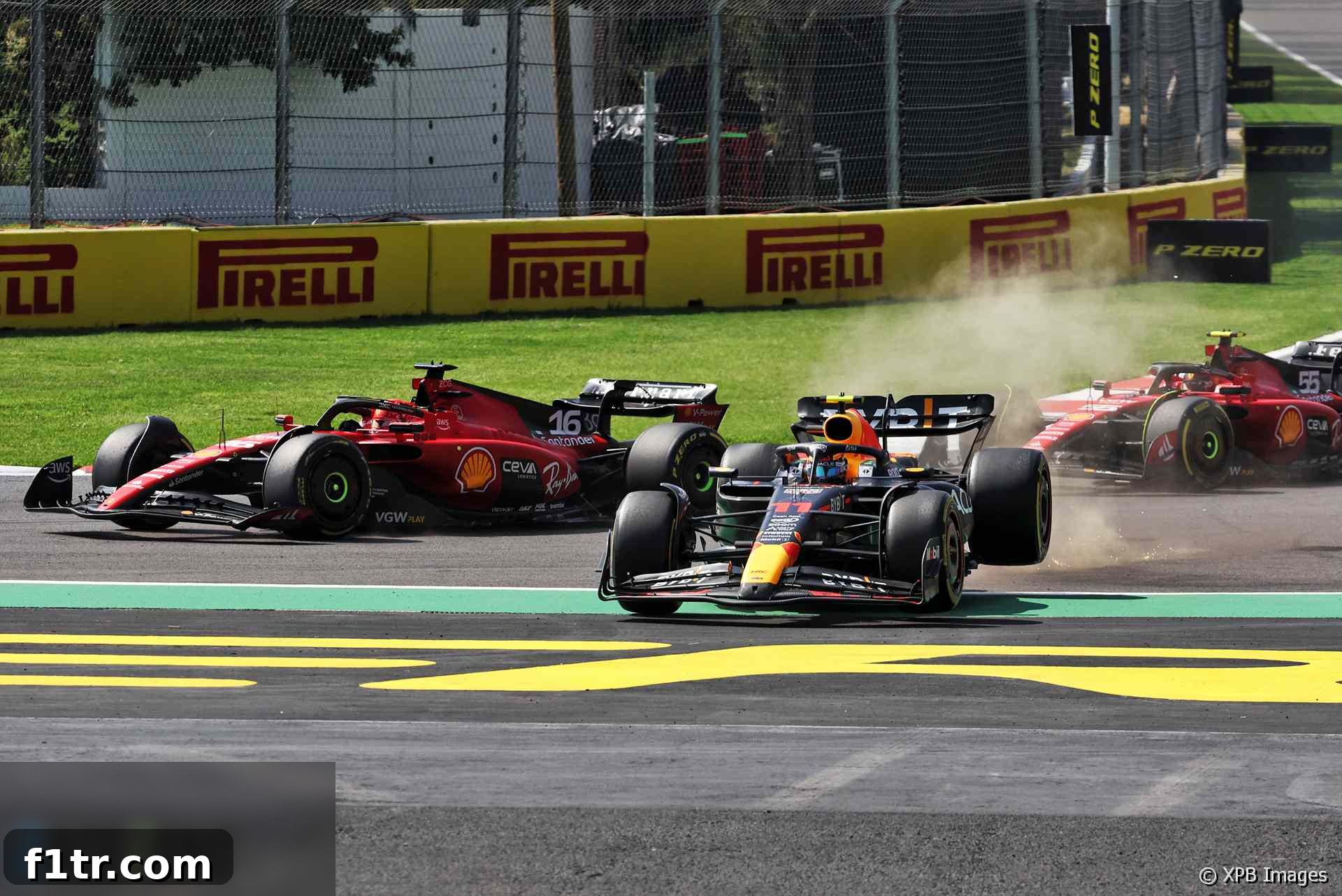
In the high-octane world of Formula 1, every decision, especially on the opening lap, carries immense weight. At the recent Mexican Grand Prix, the fervent home crowd watched with bated breath as Red Bull Racing’s Sergio Perez, starting from fifth, attempted a daring maneuver at the very first corner of his home race. This ambitious move, aiming to sweep around the outside of both Charles Leclerc and his teammate Max Verstappen to seize the lead, ultimately resulted in a collision with Leclerc and premature retirement for the Mexican hero. Following the incident, Verstappen offered a nuanced perspective on his teammate’s risky gambit, acknowledging the immense pressure and desire inherent in competing on home soil.
Advert | Become a Supporter & go ad-free
Speaking after a race that saw him claim another dominant victory, Max Verstappen expressed his empathy for Perez’s decision. “I understand because it’s his home grand prix and you want to be on the podium,” Verstappen remarked, shedding light on the immense psychological pull of racing in front of a passionate home crowd. For any athlete, the desire to perform exceptionally well and deliver a memorable result for their compatriots is powerful, often pushing the boundaries of what might be considered a calculated risk. Verstappen fully acknowledged this emotional drive: “I fully understand that he went around the outside and he tried.” This insight from a fellow competitor highlights the unique pressures faced by drivers like Perez in such a high-stakes environment.
However, Verstappen’s understanding was tempered with a professional’s tactical assessment of the incident. While recognizing the motivation, he subtly hinted at areas where the execution could have been refined. “Looking at the footage I think he could have left a little bit more space,” Verstappen observed, providing a candid, post-race analysis. This comment underscores the razor-thin margins that separate triumph from disaster in Formula 1’s opening laps. Yet, he was quick to acknowledge the potential glory if the move had paid off: “But at the other end, if it would have worked, you look amazing.” This sentiment perfectly encapsulates the high-risk, high-reward nature of bold opening lap overtakes. Ultimately, Verstappen attributed the outcome to the excitement and desire for a podium finish. “I think it’s just more like that excitement of wanting to be on the podium and this time it didn’t work out, unfortunately,” he concluded, offering a compassionate yet objective view of his teammate’s misfortune.
Verstappen himself had a front-row seat to the unfolding drama, though his focus remained squarely on his own race. Starting from third on the grid, his primary objective was a clean start and an early advantage. He recounted seeing little of the actual collision between Leclerc and Perez, a testament to the split-second decision-making and tunnel vision required at the start of a Grand Prix. “We all trust each other and of course you are all on the limit braking into the corner, but it was all fine I think,” he explained, describing the usual chaos of Turn 1. It was only as he navigated the corner that he realized something significant had occurred on his outside. “But then, of course, I saw my outside that something happened, luckily we could stay out of trouble.” His ability to maintain composure and avoid getting entangled in the melee was crucial, setting the stage for his subsequent domination of the race.
Indeed, Verstappen’s start was nothing short of spectacular, proving to be a decisive factor in his eventual victory. From his third-place grid slot, he masterfully launched his Red Bull, seizing the lead almost immediately as the pack jostled for position into Turn 1. This early ascendancy proved invaluable. “My start definitely made it a bit easier for me in the first stint,” he affirmed. Taking command of the race from the outset allowed him to dictate the pace, manage his tires effectively, and execute his planned strategy with minimal interference from trailing cars. The importance of clear air and an unobstructed path cannot be overstated in modern F1, especially when attempting a multi-stop strategy. His exceptional getaway provided the necessary breathing room, laying the foundation for a controlled performance.
The initial race strategy for Verstappen involved a two-stop approach, a tactical decision that benefited greatly from his early lead. “Because I was going to do a two-stop [strategy] so that of course gave me those extra couple seconds that would look great on the plot [graph of his race position] anyway, if we would have made it happen,” Verstappen elaborated. By building a substantial lead early on, he created a crucial time buffer that would absorb the duration of his pit stops, ensuring he could rejoin the track without losing too many positions or critical time to rivals. This strategic foresight, combined with his raw pace, allowed Red Bull to optimize their tire usage and remain flexible, adapting to the challenging conditions of the Autódromo Hermanos Rodríguez. The altitude and track layout in Mexico are notorious for putting immense strain on tires, making strategic management paramount.
Advert | Become a RaceFans supporter andgo ad-free
Verstappen commenced the race on the medium compound tires, a common starting choice, but quickly made an early switch to the more durable hard compound, signaling his intention to run a longer stint before a second pit stop. Managing tire degradation at the high-altitude Mexican circuit is always a significant challenge, and Verstappen acknowledged this complexity. “The tyres around here, it’s always very hard to manage but I think we had quite decent pace on them,” he noted, expressing confidence in the team’s setup and tire performance. The decision to pit earlier than some rivals, transitioning to the hard compound, proved astute. “Of course we opted to box a bit earlier. I think also on the hard tyre we were quite competitive and I closed a lot of that pit stop [gap] back down,” he stated, highlighting his ability to quickly nullify the time lost in the pits by maintaining a blistering pace on the fresh, harder rubber. This aggressive yet controlled strategy was unfolding perfectly.
However, the carefully constructed race strategy was dramatically disrupted by an unforeseen incident involving Kevin Magnussen. The Haas driver suffered a heavy crash, which initially triggered a Safety Car period to allow for track clear-up. This was swiftly followed by a Red Flag, suspending the race entirely, due to the extensive barrier repairs required. This timing was particularly critical for Verstappen, as he had already made his second scheduled pit stop just prior to the race suspension. The red flag effectively nullified any strategic advantage he had built up, as all cars were allowed to change tires and prepare for a standing restart. “It would have been quite interesting to the end to see how much faster I could have gone on a new set of hard tyres,” he mused, reflecting on the potential of his pre-red flag strategy. “I think the strategy was looking great.”
The red flag forced a complete reset, transforming the remaining laps into an entirely new sprint race. “But then of course we had the red flag, so basically everything that we did we could throw in the bin and start over,” Verstappen candidly admitted. This scenario demanded immediate adaptability and a fresh approach. The new focus shifted squarely back to the basics: a strong restart and maintaining track position. “But then again it was all about having a good start and try to keep the lead into turn one which we did,” he recounted. Once the lead was secured after the restart, the challenge evolved into meticulous “pace management to the end to keep the tyres alive, looking after the car, the brakes, everything.” This post-red flag phase highlighted not only Verstappen’s raw speed but also his exceptional ability to manage critical components under pressure, ensuring the car endured to the checkered flag for yet another impressive victory in a season dominated by his performance.
Become a RaceFans Supporter
RaceFans is run thanks in part to the generous support of its readers. By contributing £1 per month or £12 per year (or the same in whichever currency you use) you can help cover the costs of creating, hosting and developing RaceFans today and in the future.
Become a RaceFans Supporter today and browse the site ad-free. Sign up or find out more via the links below:
- Become a RaceFans Supporter
- RaceFans Supporter FAQ
Advert | Become a RaceFans supporter andgo ad-free
2023 Mexican Grand Prix
- ‘I’m so s*** in qualifying’: Norris berates himself despite pole-winning lap
- Ferrari reaping the benefits of having F1’s most closely-matched team mates
- Norris had “no chance” to beat Verstappen in Mexico even without Q1 exit
- Transcript: How Ricciardo’s race went awry soon after he was told to “bring it home”
- Mercedes see “very encouraging signs” from Austin floor update
Browse all 2023 Mexican Grand Prix articles