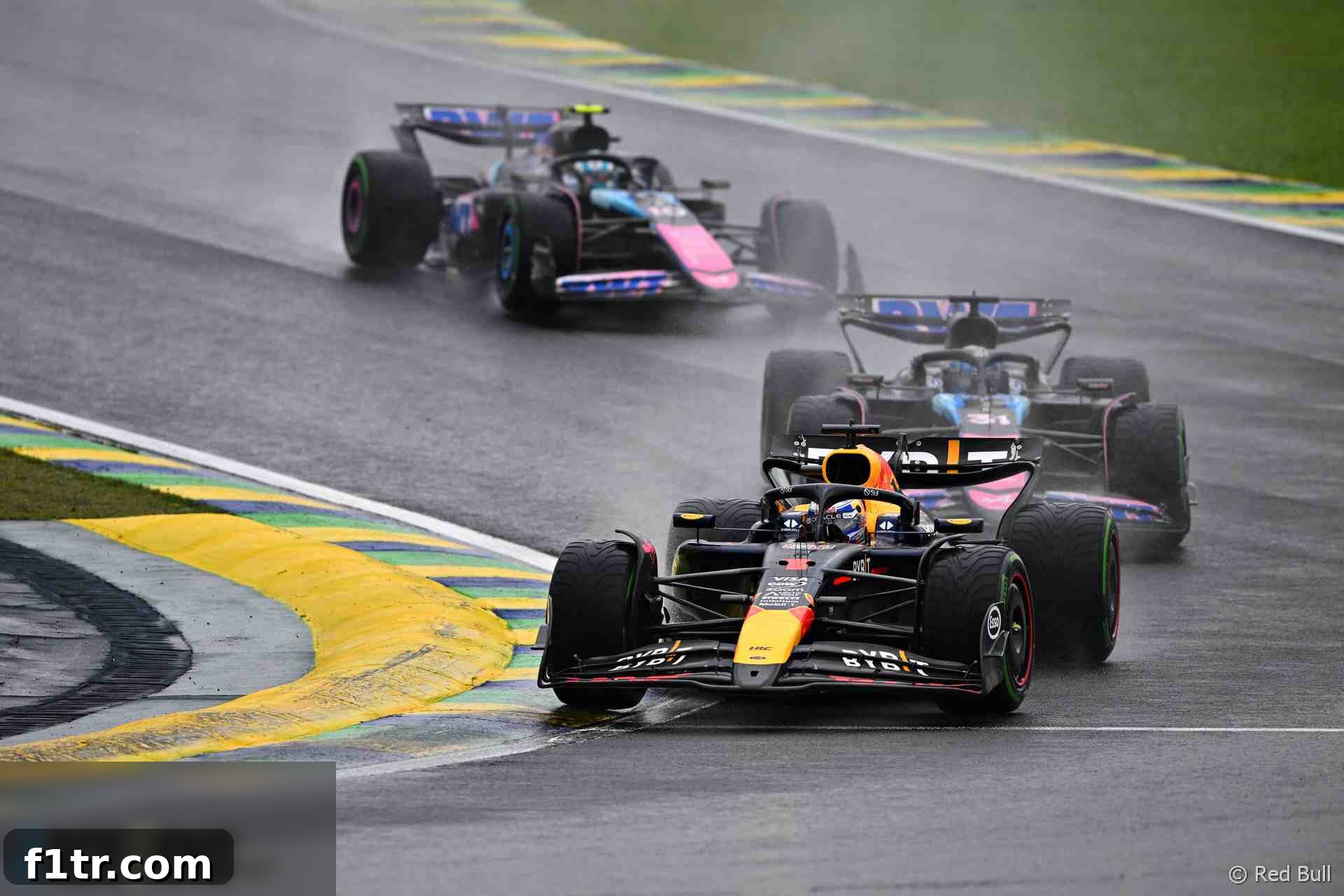
The Brazilian Grand Prix at Autódromo José Carlos Pace, affectionately known as Interlagos, consistently delivers thrilling Formula 1 action and unpredictable outcomes. This weekend’s sprint event promises to be no exception, with a weather forecast that could dramatically reshape championship narratives and provide Red Bull and their rivals with a strategic puzzle. As the F1 circus descends upon São Paulo, several key storylines are poised to unfold, making this a truly unmissable race weekend for fans worldwide.
Cloudy with a Chance of Championship Drama: The Interlagos Weather Factor
Interlagos is notorious for its capricious weather, and this year’s forecast suggests another potentially rain-affected weekend. Last year’s race served as a prime example of how quickly fortunes can change under the Brazilian skies. Max Verstappen, despite facing a penalty in the sprint race, a Q1 exit in qualifying for the main Grand Prix, and a missed opportunity for fresh tyres under a Virtual Safety Car period, ultimately capitalised on a red-flag situation. This unexpected turn allowed him to fit new rubber and storm to victory, solidifying his path to a fourth world championship while Lando Norris struggled to keep pace.
For the upcoming sprint event and the Grand Prix, early indications point to a significant chance of rain. Forecasts suggest a 70% probability of precipitation during the sprint race and a 43% chance during the main event. A well-timed dose of rain could be precisely what Verstappen’s championship aspirations need, potentially turning the tide in what has been a closely contested season. Wet conditions at Interlagos often lead to chaotic races, opening up opportunities for bold strategies and exceptional driver skill to shine through. Teams like Red Bull, known for their strong performance in mixed conditions, might find this forecast particularly advantageous, giving Verstappen a vital edge in the fiercely competitive title fight. The dynamic nature of rain-affected races can shake up the grid, providing a level playing field where car performance is less dominant than driver talent and quick decision-making, offering a thrilling spectacle for fans and a high-stakes challenge for all competitors.
- Verstappen’s Race Ban Threat Fades After 11 Consecutive Rounds Without Penalty Points
The Momentum Game: Who Truly Holds the Advantage in the Title Fight?
Following Lando Norris’s victory at the Mexican Grand Prix, Formula 1 presenter James Hinchcliffe remarked on Norris’s “momentum.” While a first win in seven races, including sprint events, is certainly a significant achievement, it prompts a deeper examination of who truly carries the momentum in the high-stakes title fight. Verstappen, for instance, has secured four wins in the last six races and has not missed a podium finish since the summer break, a testament to his remarkable consistency and the formidable pace of his Red Bull machinery. This consistent performance paints a contrasting picture to the narrative of Norris’s sole recent triumph.
Within McLaren, Norris undoubtedly holds the upper hand, having out-scored his teammate Oscar Piastri in every race since his car experienced issues at Zandvoort. Piastri, on the other hand, has seemingly struggled to regain his earlier season form, appearing somewhat out of sorts since a challenging weekend in Baku. However, both McLaren drivers cannot afford to become complacent, particularly with Verstappen’s relentless pursuit. Had it not been for an ill-timed Virtual Safety Car on the penultimate lap in Mexico, which curtailed his charge, Verstappen would likely be arriving in Brazil within striking distance, if not already holding, the points lead. The relentless nature of the championship means that perceived momentum can be fleeting, and every race presents a new opportunity to gain or lose ground. The intricate dance of points accumulation, strategic decisions, and on-track performance will determine who truly holds the psychological and mathematical advantage as the season progresses towards its climax. Interlagos, with its unique challenges, offers another critical juncture in this captivating battle for supremacy, where the definition of “momentum” will be tested against the raw results of qualifying and race day.
- 2025 Formula 1 Drivers’ Championship Points Calculator
Advert | Become a RaceFans supporter andgo ad-free
Home Hero: Gabriel Bortoleto’s Interlagos Debut
Gabriel Bortoleto has been nothing short of a revelation in his debut season with Sauber, consistently impressing alongside his seasoned teammate Nico Hulkenberg. His raw speed over a single lap has been a highlight, often translating into strong starting positions that he has skillfully converted into valuable championship points. His impressive performances have injected much-needed dynamism into the Sauber team, showcasing his potential as a future star in Formula 1.
While his scoring rate experienced a slight dip leading into the Mexican Grand Prix, Bortoleto delivered a crucial points finish just ahead of his much-anticipated return home. This weekend marks a truly special occasion for the young Brazilian, as he will make the first home appearance for a Brazilian driver since the legendary Felipe Massa in 2017. The roar of the passionate Interlagos crowd, synonymous with Brazilian motorsport, will undoubtedly provide an immense surge of motivation for Bortoleto. Securing another points finish in front of his home fans would not only be a significant personal achievement but would also undoubtedly be met with a rapturous reception from the adoring crowd, further cementing his place as a national sporting hero. The pressure on his shoulders will be immense, but his calm demeanor and consistent results suggest he is more than capable of rising to the occasion, adding another compelling narrative to the Brazilian Grand Prix weekend.
Turn One Tensions: Navigating Interlagos’s Opening Lap Scrutiny
The opening lap of the Mexican Grand Prix saw a significant portion of the field opt to bypass Turn 2, cutting the corner to gain an advantage. This maneuver caused intense frustration among rivals, with prominent drivers such as Lewis Hamilton, Fernando Alonso, and George Russell openly complaining about race control’s perceived failure to take decisive action. The incident ignited a debate about track limits, sporting fairness, and the consistency of stewarding decisions, leaving many to wonder if the matter would be addressed or if race control would implement changes for future events to prevent such widespread corner-cutting.
The ramifications of such tactics were particularly evident for Oscar Piastri. He was the sole driver who went wide at Turn 1 but chose to rejoin the track before Turn 2, a decision that severely compromised his race. In retrospect, Piastri must surely regret not following the example of drivers like Charles Leclerc, who rejoined the track further ahead of Yuki Tsunoda, a move that undoubtedly delayed Piastri’s progress for several crucial laps. This highlights the fine line between aggressive driving and tactical misjudgment, especially in the opening stages of a race.
Given the specific characteristics of Interlagos, it would be highly surprising if many drivers attempt to replicate those controversial tactics this weekend. Cutting the first corner at Interlagos, known as the ‘S do Senna’, offers significantly less of an advantage compared to the Mexico City layout. The higher corner speeds and the steep, downhill nature of the ‘S’ sequence make it much trickier and riskier to execute any form of corner-cutting without incurring damage or a penalty. The unique topography and challenging nature of the Interlagos circuit demand a more disciplined and precise approach from drivers, especially during the frantic opening lap, ensuring that fair play and track limit adherence will be under intense scrutiny from both competitors and officials.
Haas’s Unexpected Late Surge and the Constructors’ Championship Battle
The Haas F1 Team, one of the last outfits to introduce a significant upgrade package to their car, did so at their home race in Austin, and the investment has demonstrably paid dividends. Their strategic decision and the subsequent development work were emphatically validated at the Mexican Grand Prix, where Oliver Bearman delivered a stunning fourth-place finish, matching the team’s best-ever result in Formula 1. This remarkable performance not only boosted morale within the team but also signaled a significant shift in their competitive standing, proving that late-season upgrades can indeed alter the championship landscape.
Should Haas continue this impressive form into the remaining rounds, there could be a valuable financial and reputational payoff. Their strong showing in Mexico allowed them to overtake Sauber for eighth place in the Constructors’ Championship, a crucial position that comes with increased prize money and prestige. As they head into the final four rounds of the season, Haas now finds themselves within a tantalizing 10 points of both Racing Bulls and Aston Martin, two teams that have generally been considered stronger competitors throughout the season. This tight battle at the lower end of the constructors’ standings adds another layer of excitement to the Brazilian Grand Prix. Every point gained or lost will have significant implications not only for bragging rights but also for the financial health and future development capabilities of these teams. Haas’s late surge demonstrates the unpredictable nature of Formula 1 and highlights the importance of continuous development throughout the entire season, proving that perseverance can lead to unexpected success.
Advert | Become a RaceFans supporter andgo ad-free
Pirelli’s Hard Choices: Tyre Strategy at Interlagos
For the Brazilian Grand Prix, Pirelli has made a strategic choice by nominating the C2, C3, and C4 tyre compounds. This selection, comprising the medium, soft-medium, and soft compounds in their range, presents a different dynamic compared to recent races in Mexico and Austin, where there was a larger ‘step’ or gap between the compounds available. While there isn’t a significant performance delta between the chosen compounds this weekend, it’s crucial to note that Pirelli’s overall selection is one stage harder than what was provided at Interlagos last year. This harder compound choice is typically made to manage the higher energy demands of the circuit, prevent excessive degradation, and potentially allow for more strategic variation in race stints.
If the weather holds dry for the main Grand Prix, drivers and strategists will have to carefully consider how these harder compounds will perform on the demanding Interlagos asphalt, especially with the circuit’s undulating nature and abrasive surface. The harder selection could lead to longer stints, fewer pit stops, or perhaps even a greater emphasis on tyre management during qualifying to save softer compounds for the race. The sprint race, however, presents a different challenge entirely. With the regulations often mandating specific tyre usage for sprint events, the question arises: will it be soft tyres for everyone in the sprint race? This would create a high-speed, flat-out dash with potentially significant degradation over the shorter distance, adding another tactical layer to an already complex weekend. The interplay between these tyre choices, the potential for rain, and the unique characteristics of Interlagos will undoubtedly shape the strategic battle on the track, forcing teams to make astute decisions under pressure.
Are You Heading to the Brazilian Grand Prix? Share Your Interlagos Experience!
If you’re among the fortunate fans making the pilgrimage to Brazil for this weekend’s electrifying race at Interlagos, we would love to hear from you! Your unique perspectives and experiences from the ground contribute immensely to the global F1 community. Whether it’s your first time or you’re a seasoned attendee, share your anticipation, tell us about the atmosphere, the best vantage points, or any insights you gather from the paddock and stands. Your stories help bring the Grand Prix experience to life for those watching from afar.
- Forum: Going to the Brazilian Grand Prix at Interlagos
Who do you believe will emerge as the team to beat in the Brazilian Grand Prix this year? Will it be Red Bull solidifying their championship lead, or can McLaren maintain their momentum? Perhaps a dark horse will emerge from the pack to challenge for victory. Have your say and cast your predictions below!
Miss Nothing from RaceFans
Get a daily email with all our latest stories – and nothing else. No marketing, no ads. Sign up here:
2025 Brazilian Grand Prix
- 2026 rules will stop F1 teams making “strategic” engine changes for performance
- Tsunoda admits he could have “easily” scored points in Brazil
- Top 10: Most controversial penalty calls during a Formula 1 title fight
- Verstappen is eighth F1 driver to race from pits to podium: Brazilian GP stats
- Verstappen’s latest setback makes this season look even more like a 2007 repeat
Browse all 2025 Brazilian Grand Prix articles