The Terrifying Aerodynamic Lift: Matevos Isaakyan’s Miraculous Escape at Spa-Francorchamps in the BR Engineering BR1
The world of endurance racing is a captivating blend of speed, strategy, and sheer bravery. Few circuits encapsulate this spirit quite like Spa-Francorchamps, an iconic track revered and feared in equal measure. In 2018, during the FIA World Endurance Championship’s 6 Hours of Spa, this legendary circuit once again delivered a chilling reminder of motorsport’s inherent dangers, as SMP Racing driver Matevos Isaakyan experienced a terrifying aerial crash in his BR Engineering BR1 LMP1 prototype. While the incident sent shockwaves through the paddock and among fans, Isaakyan’s miraculous escape underscored the relentless advancements in motorsport safety, even as it highlighted the extreme forces at play in top-tier endurance racing.
Unveiling the Drama: Fan Footage Captures the Full Extent
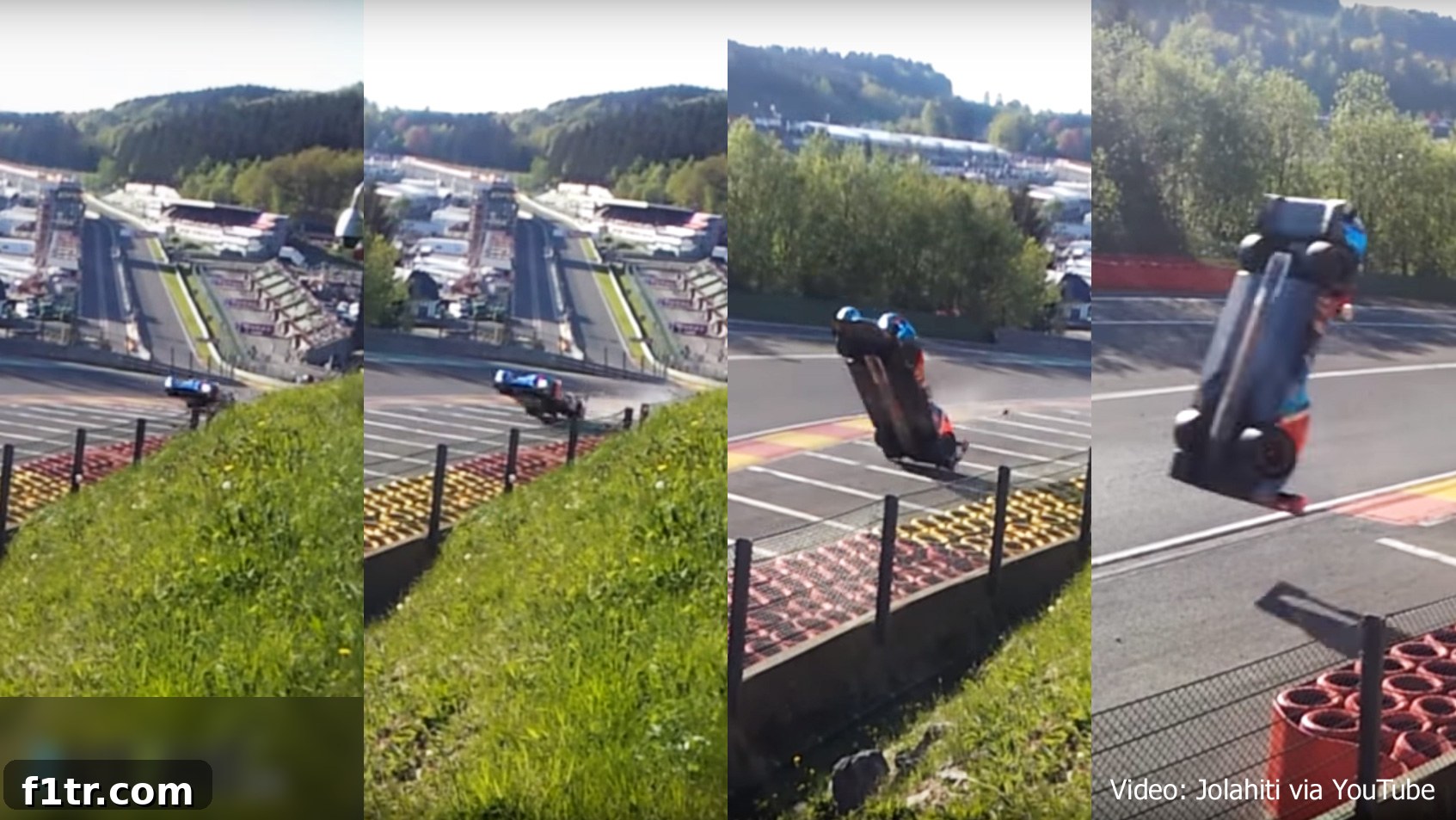
The full, harrowing drama of Matevos Isaakyan’s shunt was initially obscured from the live television broadcast, leaving many viewers unaware of the severity of the incident. It was only through a fan-shot video, which quickly circulated online, that the true extent of the aerial acrobatics became apparent. The footage, an unvarnished testament to the power and peril of LMP1 racing, showed Isaakyan’s car, number 17, veering off the track at the infamous Raidillon corner – a high-speed, uphill sequence that demands absolute precision and commitment. As the car left the asphalt, its underbody, designed for optimal ground effect and downforce, suddenly became an aerodynamic wing, creating immense lift. This catastrophic loss of aerodynamic stability at such high velocity caused the front of the BR1 to dramatically pitch skywards, flipping the entire prototype violently into the protective barriers.
The images were stark, raw, and deeply unsettling, revealing a spectacle of destructive power that official broadcasts often shy away from. For many motorsport enthusiasts, the sight was reminiscent of infamous aerodynamic lifts that have plagued prototypes in the past, serving as a stark reminder that even with sophisticated engineering and rigorous safety protocols, the laws of physics can assert themselves with terrifying consequence. That Isaakyan emerged from the wreckage unharmed, albeit shaken, was a testament to the robust construction of the BR Engineering BR1’s carbon fibre monocoque and the comprehensive safety systems mandated by the FIA.
The BR Engineering BR1’s Baptism of Fire: A Challenging Debut
The 2018 6 Hours of Spa marked the highly anticipated debut of the BR Engineering BR1 LMP1 prototype, a car developed by BR Engineering in collaboration with Dallara for SMP Racing. As a privateer entry aiming to challenge the dominant Toyota Gazoo Racing in the top-tier LMP1 class, the BR1 carried significant aspirations. However, its inaugural race weekend at Spa proved to be a challenging one, marred by not one, but two significant incidents at the treacherous Raidillon/Eau Rouge complex.
Prior to Isaakyan’s race-day scare, DragonSpeed driver Pietro Fittipaldi had suffered a high-speed crash in a sister BR1 during qualifying. Fittipaldi’s incident, also at Raidillon, resulted in leg fractures, immediately raising concerns about the car’s stability at the limit or the inherent risks of pushing such sophisticated machinery around one of the world’s most demanding circuits. While Fittipaldi’s injuries were serious, the fact that Isaakyan walked away from an even more visually dramatic accident offered a glimmer of reassurance regarding the car’s structural integrity under extreme impact.
The LMP1 class in the WEC represents the pinnacle of sports car racing, featuring highly advanced prototypes with monstrous horsepower, intricate hybrid systems, and cutting-edge aerodynamics designed to generate immense downforce. These cars are finely tuned machines, operating on a knife-edge between maximum grip and catastrophic instability. The Spa incidents, particularly the aerodynamic lift experienced by Isaakyan, immediately prompted discussions within the engineering teams and regulatory bodies about the car’s aerodynamic characteristics and potential vulnerabilities when encountering disturbed air or off-line excursions at extreme speeds.
Echoes of the Past: Aerodynamic Lifts and Motorsport Safety
The images of Isaakyan’s BR1 soaring through the air inevitably drew comparisons to some of motorsport’s most infamous aerial crashes, most notably those involving the Mercedes-Benz CLR at the 1999 Le Mans 24 Hours. During that race, both Peter Dumbreck and Mark Webber experienced spectacular aerodynamic flips, leading to significant changes in prototype design and safety regulations. These incidents highlighted a critical challenge in high-downforce racing cars: while their design focuses on pushing the car into the ground, a sudden disruption of airflow underneath or over the car can transform downforce into deadly lift, often with catastrophic consequences.
Modern motorsport, and WEC in particular, operates under a stringent set of safety regulations enforced by the FIA. These rules govern everything from chassis construction and crash structures to cockpit protection (like the “shark fin” and later, the halo-like structures) and driver harnesses. Track safety has also evolved dramatically, with the introduction of energy-absorbing barriers like Tecpro, gravel traps, and significantly larger run-off areas. Isaakyan’s ability to walk away from such a violent shunt is a testament to the cumulative efforts of engineers, designers, and regulators who continuously strive to make these incredibly fast machines as safe as possible.
However, the Spa incident served as a powerful reminder that while risks can be mitigated, they can never be entirely eliminated, especially when cars are pushed to their absolute limits on circuits as challenging as Spa-Francorchamps. The Raidillon/Eau Rouge complex itself is a testament to this, demanding incredible bravery as drivers tackle a steep uphill compression followed by a blind crest, all at full throttle. Any slight misjudgment or contact with the curbs can lead to a loss of control, and in high-downforce cars, this can sometimes manifest as an aerodynamic take-off.
The Road to Le Mans: Shifting Dynamics for SMP Racing
The 6 Hours of Spa is traditionally considered the ultimate dress rehearsal for the crown jewel of the endurance racing calendar: the 24 Hours of Le Mans. For SMP Racing, the incidents at Spa presented both immediate and long-term challenges. While Isaakyan was fortunately uninjured, Fittipaldi’s leg fractures meant a significant setback for the DragonSpeed team and highlighted the fragility of driver availability in the gruelling WEC season.
Despite the setbacks, SMP Racing pressed on with their BR1 program. Isaakyan’s teammates, Vitaly Petrov and Mikhail Aleshin, in the third BR1 entered for the race, managed to navigate the challenging conditions and ultimately finish fifth, demonstrating the car’s potential when it stayed on track. A major boost for the team’s profile and prospects for Le Mans came with the announcement that former Formula 1 World Champion Jenson Button would join the Petrov/Aleshin car for the legendary 24-hour race. Button’s vast experience and star power undoubtedly brought renewed attention and hope to the SMP Racing effort as they prepared for the ultimate endurance challenge, aiming to put the Spa incidents behind them and demonstrate the BR1’s true capabilities.
The WEC landscape at the time was intensely competitive, with Toyota, Rebellion Racing, and other privateer LMP1 entries vying for supremacy. The performance and reliability of the BR1 would be under immense scrutiny, especially after the dramatic debut at Spa. The team would need to meticulously analyse the incidents, learn from them, and ensure that the cars were as robust and aerodynamically stable as possible for the monumental task of completing 24 hours of racing at Le Mans.
Spa-Francorchamps: A Circuit That Tests the Limits
Spa-Francorchamps, nestled in the Ardennes forest of Belgium, is more than just a race track; it’s a living legend. Spanning over 7 kilometres, its undulating layout, fast straights, and technical corners make it a favourite among drivers and fans alike. Its unpredictability, often exacerbated by the region’s notoriously fickle weather, adds another layer of challenge. But no section of the track is more iconic, or more feared, than the Eau Rouge/Raidillon complex.
This sequence begins with a rapid descent into the compression of Eau Rouge, a left-hand bend, immediately followed by a steep climb through the right-hand Raidillon corner, cresting blindly at its summit. Drivers experience extreme G-forces as they compress into the valley and then are hurled upwards. It’s a place where courage is measured in milliseconds, and where the slightest error can have profound consequences. Both Isaakyan’s and Fittipaldi’s crashes at Raidillon underscore the unforgiving nature of this particular corner, highlighting why it remains one of the ultimate tests in motorsport, pushing both man and machine to their absolute limits.
Conclusion: The Enduring Spirit of Endurance Racing
Matevos Isaakyan’s spectacular aerial crash at the 2018 6 Hours of Spa was a stark and unforgettable moment in the FIA World Endurance Championship. It served as a vivid reminder of the fine line between control and catastrophe in top-level motorsport, particularly in the high-speed, aerodynamically sensitive LMP1 prototypes. While the images of the BR Engineering BR1 flipping through the air were terrifying, Isaakyan’s miraculous escape without injury underscored the phenomenal strides made in driver safety over the decades. It also highlighted the constant learning curve for new car designs, particularly when debuting on circuits as demanding as Spa-Francorchamps.
The incident, along with Pietro Fittipaldi’s earlier crash, undoubtedly presented SMP Racing with significant challenges in their debut season. Yet, the spirit of endurance racing is one of resilience and determination. Teams and drivers constantly adapt, learn from setbacks, and push forward, driven by the desire to conquer the ultimate challenges that races like Le Mans and circuits like Spa present. As the WEC season continued, the focus shifted to refining the BR1, ensuring its stability, and harnessing its potential, all while never forgetting the dramatic lessons learned on the hallowed asphalt of Spa-Francorchamps.
Stay Connected with Motorsport News
Follow us on social media for the latest updates and breaking news from the world of motorsport:
- Join us on Facebook
- Follow us on Twitter
- Get daily email updates
Further Reading: World Endurance Championship
Delve deeper into the FIA World Endurance Championship:
Browse all World Endurance Championship articles