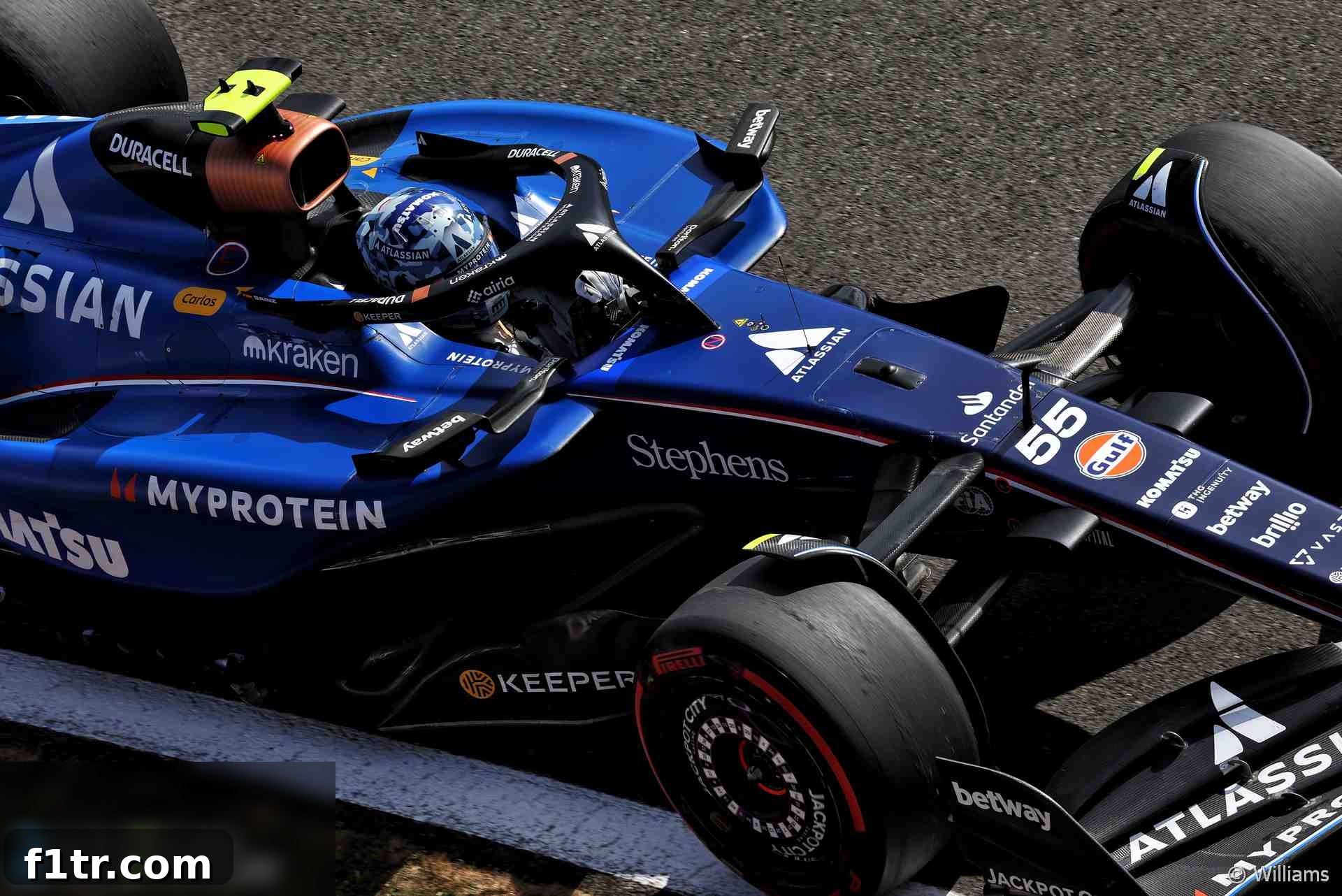
Williams F1’s FW47 Struggles: Unlocking Performance Amidst Persistent Cooling Challenges
The illustrious Williams Racing team finds itself in a challenging mid-season predicament, grappling with persistent cooling issues that are preventing its FW47 challenger from unleashing its full potential. Team Principal James Vowles has candidly acknowledged these technical hurdles, underlining the critical impact they are having on the team’s performance and strategic execution throughout the current Formula 1 campaign.
The Persistent Cooling Enigma: A Deep Dive into F1 Technical Challenges
Formula 1 is a relentless crucible of technological innovation, where every component must operate at peak efficiency under extreme conditions. Among the myriad technical challenges, maintaining optimal operating temperatures for critical systems – including the engine, energy recovery systems (ERS), and brakes – is paramount. Insufficient cooling can lead to a cascade of problems: reduced power output, compromised reliability, and even catastrophic failures. For the Williams FW47, these cooling limitations have become a significant bottleneck, directly impacting its competitive edge.
Vowles elaborated on the gravity of the situation, stating, “We’ve obviously been hindered by this cooling issue that’s been there for a few races this year, but probably more marked in the Austria retirement when we were running in a very strong position.” This quote highlights not just the existence of the problem but its insidious effect on potential points-scoring opportunities. Alexander Albon, one of Williams’ talented drivers, has unfortunately borne the brunt of these technical woes, retiring from two consecutive races earlier in the year due to related issues. His early retirement in Austria, where he was running impressively in sixth place, serves as a stark reminder of the performance that is being left on the table.
The intricate dance between cooling and aerodynamic efficiency is at the heart of this challenge. To improve cooling, engineers often need to open up more vents or enlarge existing ones on the car’s bodywork. However, such modifications inevitably increase aerodynamic drag, which directly reduces top speed and overall aerodynamic efficiency. This creates a difficult compromise: sacrificing speed for reliability, or pushing the limits and risking mechanical failure. Williams’ struggle indicates that they are currently unable to find a balance that allows for both optimal cooling and uncompromised pace, forcing them into difficult decisions that impact their competitiveness.
Impact on Driver Performance and Race Strategy
The repercussions of persistent cooling problems extend far beyond the technical department; they permeate the cockpit and dictate race strategy. Drivers are forced to adopt a more conservative approach, managing engine temperatures by lifting and coasting, altering lines, or even short-shifting – all actions that inevitably cost precious lap time. For a driver like Alexander Albon, who is known for extracting the maximum from his machinery, having to constantly manage these limitations can be incredibly frustrating and mentally taxing.
Race engineers, too, face an uphill battle. Strategic calls regarding tire management, overtake opportunities, and even pit stop timings can be influenced by cooling constraints. A car that is running hot may struggle to maintain performance during crucial stints, rendering aggressive strategies unviable. This severely limits the team’s ability to react to changing race conditions or capitalize on rival’s mistakes, placing them at a distinct disadvantage in the cutthroat environment of Formula 1.
The recent British Grand Prix at Silverstone offered another layer of complexity. While the cooling issues are a consistent concern, the team’s car also proved less competitive in the wet phases of the race. This suggests that while cooling is a primary concern, the FW47 also has underlying performance characteristics that make it less adept in certain conditions, further complicating the team’s overall development picture. Identifying and addressing these multifaceted challenges requires a systematic and comprehensive engineering approach.
Williams’ Technical Response and Development Pathway
In response to these critical issues, Williams has demonstrated proactive efforts to understand and mitigate the problems. A dedicated test was conducted during the first practice session for the British Grand Prix, aimed at gathering more crucial data on the cooling problems. This hands-on approach is vital in Formula 1, where empirical data often unlocks solutions that simulation alone cannot provide.
However, as Vowles explained, immediate fixes come with a performance cost. “We have solutions in place that mean we can get the car through the race but it’s at the cost of performance,” he admitted. This statement underscores the frustrating dilemma faced by the engineering team. Their immediate goal is to find “containment” – a permanent, performance-neutral solution. “Ideally what we’re looking for is containment that allows us to make sure we’re not throwing away anything in terms of performance going forward and the team is working diligently on that.” The emphasis on “diligently” speaks volumes about the intensity and focus within the Grove-based team to overcome this fundamental weakness.
The development cycle in Formula 1 is relentless. Teams are constantly pushing the boundaries of physics and engineering, and even minor design flaws can have significant ramifications. Williams’ technical team is undoubtedly under immense pressure to innovate, exploring every avenue from redesigned cooling ducts to advanced material applications, all while ensuring reliability and preserving aerodynamic integrity. The path to overcoming such deep-seated technical challenges is rarely straightforward, requiring iterative design, rigorous testing, and a deep understanding of complex fluid dynamics and thermodynamics.
Mid-Season Performance: Highs, Lows, and the Road Ahead
The current season for Williams has been a story of promising starts tempered by subsequent challenges. As Vowles reflected, “In terms of where we are at this point in the season, we’re now about midway and obviously a very strong start and then falling away a little bit as others have added performance to their car.” This narrative is common in Formula 1, where the development race is as crucial as the on-track competition. Teams that can consistently bring effective upgrades tend to climb the pecking order, while those who struggle with development or face fundamental car issues can quickly lose ground.
The Silverstone weekend provided a microcosm of Williams’ current performance profile. Vowles observed, “What we’re observing recently is that we’re definitely able to have a strong race car. Right at the end of the race when it dried up […] the car was quick.” This suggests that in optimal, dry conditions, the FW47 possesses a respectable baseline performance. However, he quickly added, “But we weren’t quick enough in those intermediate conditions when it was wet and we weren’t quick enough in qualifying which are two areas we absolutely have to work on and improve as we go forward.” This highlights key areas of weakness beyond just cooling: adaptability to changing conditions and raw single-lap pace, which are critical for strong grid positions.
For a team like Williams, every point scored in the Constructors’ Championship is vital. The difference between finishing one position higher can translate into millions of dollars in prize money, directly impacting future development budgets. Therefore, addressing these performance gaps is not merely about on-track glory but about securing the financial stability and long-term competitiveness of the team.
Anticipating Spa: A Critical Juncture with a Minor Upgrade
As the Formula 1 circus heads to Spa-Francorchamps, a circuit renowned for its high-speed straights and challenging elevation changes, Williams will introduce a “small update.” The timing of this upgrade is crucial, especially given that it will be a Sprint weekend, meaning only a single practice session before qualifying. This drastically reduces the time available for teams to fine-tune their cars and evaluate new components, adding another layer of pressure.
Despite the new parts, Vowles’ primary focus remains on extracting the maximum from the existing package. “Now we have a small update coming to Spa but what we really have to do there is just make sure we capitalise on the car performance that we have available to us,” he asserted. This pragmatic approach acknowledges that while new parts are welcome, mastering the current car’s characteristics and mitigating its weaknesses is equally, if not more, important. Spa’s unique demands, particularly its long flat-out sections and rapid corners, will put a significant premium on both aerodynamic efficiency and engine cooling – areas where Williams is currently struggling. How the FW47 performs here will offer a crucial litmus test for their development progress.
Strategic Outlook and Championship Aspirations
Despite the challenges, Williams maintains an optimistic outlook for the remainder of the season. The goal remains clear: to consistently score points and solidify their position in the Constructors’ Championship. “There’s still points that we can score between here and the end of the year. It’s making sure that we execute the weekends cleanly and take every opportunity that comes towards us,” Vowles affirmed.
This emphasis on “clean execution” speaks to the broader performance requirements in F1: flawless pit stops, strategic brilliance, and error-free driving are just as important as raw car pace. For a team working to overcome technical hurdles, capitalizing on every single opportunity becomes paramount. Whether it’s a safety car period, a rival’s mistake, or an unexpected change in weather conditions, Williams must be ready to seize the moment.
Ultimately, James Vowles’ tenure as Team Principal at Williams is defined by this ongoing battle to elevate the team back to consistent competitiveness. Overcoming the cooling issues of the FW47 is not merely a technical fix; it’s a foundational step towards building a truly competitive package for the future. The resilience and dedication shown by the team in confronting these difficulties will be crucial determinants of their success in the latter half of the season and beyond.