2019 French Grand Prix: Vettel Denies Hamilton Grand Slam in Paul Ricard Thriller
The 2019 Formula 1 French Grand Prix at Circuit Paul Ricard delivered a compelling blend of dominant performance, strategic brilliance, and dramatic midfield battles that kept fans engaged until the very last lap. While Lewis Hamilton secured a commanding victory for Mercedes, it was Sebastian Vettel who orchestrated a crucial late-race manoeuvre, expertly snatching the fastest lap from the British driver and denying him a rare ‘grand slam’ achievement. This comprehensive race recap delves into the pivotal moments, individual driver performances, and strategic decisions that ultimately shaped an eventful Sunday afternoon in Le Castellet, offering an in-depth look at the data behind the headlines.
Hamilton’s Masterclass: A Near-Perfect Weekend at Paul Ricard
Lewis Hamilton arrived at Paul Ricard in formidable form, and his weekend performance was nothing short of a masterclass. Having secured pole position with a blistering lap during qualifying, he set the tone for what many anticipated would be a dominant race. True to expectation, the reigning world champion executed a flawless start and proceeded to lead every single lap of the Grand Prix, showcasing the sheer pace and reliability of his Mercedes W10. His ability to manage the race from the front, controlling tyre degradation and maintaining a comfortable gap to his competitors, underscored his exceptional talent and the formidable package Mercedes had developed for the 2019 season.
As the race entered its concluding stages, Hamilton appeared destined for a prestigious ‘grand slam.’ This rare achievement in Formula 1 requires a driver to start from pole position, lead every lap, win the race, and record the fastest lap. With victory secured and having led from start to finish, only the fastest lap remained. On his final tour of the circuit, running on 29-lap-old hard (C2) tyres, Hamilton posted a commendable time of 1’32.764, which initially seemed more than sufficient to complete his comprehensive domination. The tension was palpable as fans awaited confirmation of this remarkable feat, a true testament to absolute superiority on track.
Vettel’s Strategic Gambit: Snatching the Fastest Lap Point
However, the narrative of Hamilton’s seemingly perfect sweep was dramatically altered in the final moments by Sebastian Vettel. The Ferrari driver, who started seventh on the grid, had a tactical ace up his sleeve – a pristine, unused set of soft (C4) tyres. In a calculated and bold move, Ferrari called Vettel into the pits on the penultimate lap of the race, performing a rapid tyre change to equip him with the grippier compound. This late-race pit stop was a clear indication of their intention to challenge for the fastest lap point, a strategic initiative that had been introduced in the 2019 season to add an extra layer of intrigue to races.
The gamble paid off spectacularly. On his one flying lap with the fresh soft tyres, Vettel pushed the Ferrari SF90 to its absolute limits, extracting every ounce of performance. He recorded a scorching 1’32.740, beating Hamilton’s time by an incredibly narrow margin of just 0.024 seconds. This razor-thin difference highlighted the immense performance capabilities of both cars, yet it was Vettel’s strategic foresight and flawless execution that secured the crucial extra championship point. This unexpected twist denied Hamilton the ‘grand slam’ and injected a late burst of excitement into an otherwise controlled race at the front. Following the race, Vettel commented that he had not been able to fully deploy his stored energy during that final push, hinting that even more pace might have been available had conditions or further opportunities allowed, making his achievement all the more impressive.
Midfield Drama and Unforgettable Performances
Williams’ Pit Stop Prowess and the Kubica-Russell Duel
Away from the headline battle at the front, the rear of the grid also provided its share of compelling storylines and notable moments. Williams, despite enduring a challenging season marked by significant performance deficits, delivered an unexpected highlight by executing the fastest pit stop of the entire race for Robert Kubica. This impressive display of teamwork and efficiency in the pit lane, clocking in at 29.792 seconds, offered a small but significant morale boost for the struggling British outfit, demonstrating their underlying capability.
Furthermore, the race marked a rare and significant occasion for Kubica, as he finished ahead of his highly-rated rookie teammate, George Russell, for the first time that year. Their intra-team battle was intense and ultimately led to a dramatic incident involving Russell. While attempting to overtake Kubica, Russell ran wide, went off track, and unfortunately hit a bollard, damaging his front wing. This necessitated an unscheduled extra pit stop, severely compromising his race and illustrating the fine margins and high stakes involved in even the battles at the back of the grid.
Kvyat’s Ascent and Giovinazzi’s Missed Opportunity
Daniil Kvyat of Toro Rosso demonstrated truly remarkable race craft and determination, making the most progress during the French Grand Prix. Starting from a lowly 19th position on the grid, the Russian driver climbed an impressive five places by the checkered flag. His assertive and skillful driving culminated in a crucial late-race manoeuvre where he muscled past his teammate, Alexander Albon. Albon, who was running on harder tyres and had earlier suffered a setback after hitting a bollard, was unable to defend against Kvyat’s charge, highlighting the varying fortunes and strategic implications within the Toro Rosso garage.
Conversely, it was a frustrating and ultimately disappointing race for Antonio Giovinazzi. The Alfa Romeo driver started inside the top 10, a promising grid position that offered a genuine chance at scoring his first Formula 1 points. However, his race quickly unravelled. He ended up losing the most positions of any driver, eventually finishing six places lower than where he started. His struggle was largely attributed to a premature pit stop after just seven laps on his original set of worn soft compound tyres. This aggressive strategy clearly backfired, putting him on the back foot for the remainder of the Grand Prix and costing him a valuable opportunity to register points.
Comprehensive Race Data and Analysis
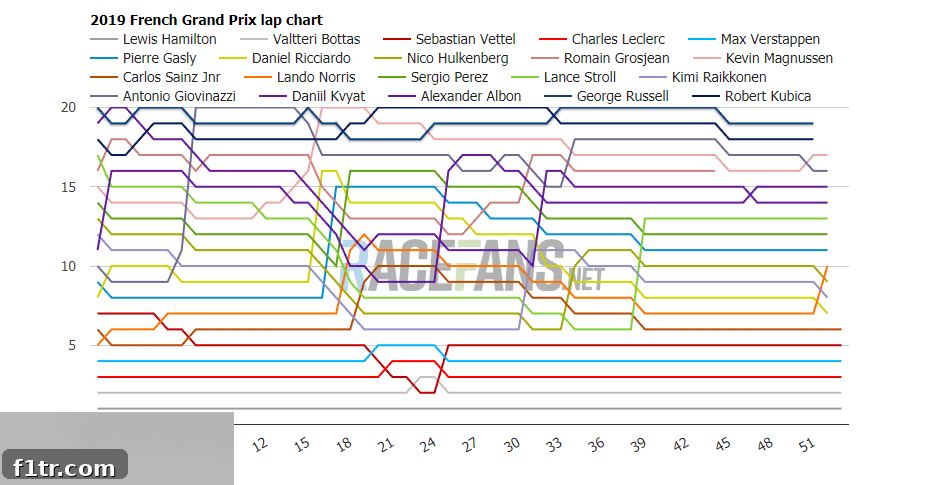
2019 French Grand Prix Lap Chart
The interactive lap chart below provides a dynamic and visual overview of the race progression, illustrating the positions of each driver on every single lap. This visualization helps to understand overtakes, strategy impacts, and general performance trends throughout the Grand Prix. Click on a driver’s name to highlight their specific trajectory during the race, and right-click to reset the view. Toggle drivers using the controls provided for a more focused analysis.
2019 French Grand Prix Race Chart
This interactive race chart visualizes the constantly evolving gaps between each driver relative to the leader’s average lap time throughout the Grand Prix. This perspective offers deep insights into how drivers gained or lost time against the benchmark. For clarity and focus, very large gaps that distort the visualization have been omitted. Users can scroll to zoom in on specific sections, drag to pan across the timeline, and right-click to reset the view. Toggle drivers using the controls provided for detailed comparisons.
Position Change Analysis
The final finishing order often belies the intense battles and strategic plays that unfold during a Grand Prix. Analyzing the position changes from the start of the race to the finish offers a clearer picture of who performed well under pressure and whose strategies didn’t quite pay off. While front-runners like Lewis Hamilton, Valtteri Bottas, Charles Leclerc, and Max Verstappen maintained their grid positions, many others experienced significant fluctuations:
| Driver | Start position | Lap one position change | Race position change |
|---|---|---|---|
| Lewis Hamilton | 1 | 0 | 0 |
| Valtteri Bottas | 2 | 0 | 0 |
| Sebastian Vettel | 7 | 0 | 2 |
| Charles Leclerc | 3 | 0 | 0 |
| Max Verstappen | 4 | 0 | 0 |
| Pierre Gasly | 9 | 1 | -2 |
| Daniel Ricciardo | 8 | -2 | 1 |
| Nico Hulkenberg | 13 | 1 | 4 |
| Romain Grosjean | 16 | -2 | |
| Kevin Magnussen | 15 | 1 | -2 |
| Carlos Sainz Jnr | 6 | 1 | 0 |
| Lando Norris | 5 | -1 | -5 |
| Sergio Perez | 14 | 1 | 2 |
| Lance Stroll | 17 | 2 | 4 |
| Kimi Raikkonen | 12 | 1 | 4 |
| Antonio Giovinazzi | 10 | 1 | -6 |
| Daniil Kvyat | 19 | -1 | 5 |
| Alexander Albon | 11 | -5 | -4 |
| George Russell | 20 | 1 | 1 |
| Robert Kubica | 18 | 1 | 0 |
As previously highlighted, Daniil Kvyat showcased an exceptional ability to move through the field, gaining an impressive 5 positions from his challenging starting grid slot. Nico Hulkenberg, Lance Stroll, and Kimi Raikkonen also demonstrated strong race pace and effective strategy, each climbing 4 places. Their performances illustrate the impact of well-executed plans and consistent driving. Conversely, Antonio Giovinazzi faced the most significant setback, dropping 6 positions from his promising starting point, underscoring the difficulties he encountered during the race. Lando Norris, despite a strong qualifying, also lost 5 places, indicating potential struggles with race pace or tyre management throughout the Grand Prix.
2019 French Grand Prix Lap Times
This interactive visualization meticulously presents all the individual lap times recorded by the drivers during the 2019 French Grand Prix. To ensure a clearer and more meaningful analysis, exceptionally slow laps—typically attributed to pit stops, incidents, or safety car periods—have been excluded. Users can intuitively scroll to zoom in on specific parts of the race, drag to pan across the timeline to follow the flow of the event, and toggle individual drivers using the control below to examine their performance trends and consistency in detail.
2019 French Grand Prix Fastest Laps
The battle for the fastest lap proved to be one of the French Grand Prix’s most thrilling and pivotal moments. This table summarizes each driver’s single fastest lap during the race, offering critical insight into their car’s ultimate performance capability and their ability to extract maximum speed at various stages. It highlights the raw pace potential of each team and driver, often influenced by tyre choice, fuel load, and specific track conditions.
| Rank | Driver | Car | Fastest lap | Gap | On lap |
|---|---|---|---|---|---|
| 1 | Sebastian Vettel | Ferrari | 1’32.740 | 53 | |
| 2 | Lewis Hamilton | Mercedes | 1’32.764 | 0.024 | 53 |
| 3 | Valtteri Bottas | Mercedes | 1’33.586 | 0.846 | 43 |
| 4 | Charles Leclerc | Ferrari | 1’33.828 | 1.088 | 40 |
| 5 | Max Verstappen | Red Bull-Honda | 1’34.162 | 1.422 | 38 |
| 6 | Carlos Sainz Jnr | McLaren-Renault | 1’34.561 | 1.821 | 52 |
| 7 | Nico Hulkenberg | Renault | 1’34.754 | 2.014 | 45 |
| 8 | Daniel Ricciardo | Renault | 1’34.873 | 2.133 | 47 |
| 9 | Lance Stroll | Racing Point-Mercedes | 1’34.924 | 2.184 | 44 |
| 10 | Kimi Raikkonen | Alfa Romeo-Ferrari | 1’34.950 | 2.210 | 46 |
| 11 | Sergio Perez | Racing Point-Mercedes | 1’35.014 | 2.274 | 42 |
| 12 | Alexander Albon | Toro Rosso-Honda | 1’35.029 | 2.289 | 51 |
| 13 | Antonio Giovinazzi | Alfa Romeo-Ferrari | 1’35.115 | 2.375 | 50 |
| 14 | Pierre Gasly | Red Bull-Honda | 1’35.150 | 2.410 | 42 |
| 15 | Lando Norris | McLaren-Renault | 1’35.197 | 2.457 | 47 |
| 16 | Daniil Kvyat | Toro Rosso-Honda | 1’35.225 | 2.485 | 43 |
| 17 | Romain Grosjean | Haas-Ferrari | 1’35.691 | 2.951 | 42 |
| 18 | Kevin Magnussen | Haas-Ferrari | 1’35.692 | 2.952 | 50 |
| 19 | George Russell | Williams-Mercedes | 1’35.830 | 3.090 | 51 |
| 20 | Robert Kubica | Williams-Mercedes | 1’36.608 | 3.868 | 50 |
Vettel’s chart-topping fastest lap vividly demonstrates the effectiveness of his audacious late-race tyre change strategy. While Hamilton’s time on worn hard tyres was incredibly close, the fresh soft tyres provided precisely the crucial edge needed to secure the extra point. The data also clearly highlights the performance disparity between the top three teams and the rest of the field, with Valtteri Bottas and Charles Leclerc’s fastest laps being over eight tenths and a second slower than Vettel’s, respectively. It is also insightful to observe that many drivers achieved their fastest laps towards the very end of their stints or the race itself, as fuel loads lightened and track conditions evolved, showcasing the optimization strategies employed by teams.
2019 French Grand Prix Tyre Strategies
Tyre strategy is frequently a decisive factor in Formula 1, and the 2019 French Grand Prix at Paul Ricard was no exception. The smooth asphalt surface of the circuit is generally known for its low tyre degradation, which typically allows for a variety of strategic approaches. Below is a detailed breakdown of the tyre choices and stint lengths for each driver, offering insights into how teams attempted to optimize their race performance:
| Stint 1 | Stint 2 | Stint 3 | |
|---|---|---|---|
| Lewis Hamilton | C3 (24) | C2 (29) | |
| Valtteri Bottas | C3 (23) | C2 (30) | |
| Charles Leclerc | C3 (21) | C2 (32) | |
| Max Verstappen | C3 (20) | C2 (33) | |
| Sebastian Vettel | C3 (25) | C2 (26) | C4 (2) |
| Carlos Sainz Jnr | C3 (19) | C2 (34) | |
| Daniel Ricciardo | C3 (16) | C2 (36) | |
| Kimi Raikkonen | C2 (31) | C3 (21) | |
| Nico Hulkenberg | C2 (34) | C3 (18) | |
| Lando Norris | C3 (18) | C2 (34) | |
| Pierre Gasly | C4 (17) | C2 (35) | |
| Sergio Perez | C3 (18) | C2 (34) | |
| Lance Stroll | C2 (39) | C3 (13) | |
| Daniil Kvyat | C2 (32) | C3 (20) | |
| Alexander Albon | C3 (25) | C2 (27) | |
| Antonio Giovinazzi | C4 (7) | C2 (27) | C3 (18) |
| Kevin Magnussen | C3 (16) | C2 (36) | |
| Robert Kubica | C3 (24) | C2 (27) | |
| George Russell | C3 (25) | C2 (8) | C3 (18) |
| Romain Grosjean | C2 (31) | C3 (13) |
The overwhelming majority of the field opted for a standard one-stop strategy, which proved to be the optimal choice given Paul Ricard’s characteristics. This typically involved starting on the medium (C3) compound and then switching to the more durable hard (C2) compound for a long second stint. Sebastian Vettel’s unique three-stint approach, incorporating the C4 soft tyres at the very end, was a specialized strategy solely aimed at securing the fastest lap point. Antonio Giovinazzi’s race was severely compromised by his unusually short first stint on the C4s, forcing him onto an unconventional and ultimately detrimental two-stop strategy. Interestingly, several drivers, including Kimi Raikkonen, Nico Hulkenberg, Lance Stroll, and Daniil Kvyat, began their races on the harder C2 compounds, a reverse strategy designed to enable a longer first stint and potentially an aggressive push on softer tyres later in the Grand Prix.
2019 French Grand Prix Pit Stop Times
Pit stops are absolutely critical in Formula 1, serving as pivotal moments where precious seconds can be gained or lost, profoundly impacting a driver’s race outcome. A meticulously executed pit stop is a testament to a team’s efficiency and precision. Below is a detailed breakdown of how long each driver’s pit stops took, offering insights into the performance of the pit crews and the consistency across the paddock:
| Driver | Team | Pit stop time | Gap | On lap | |
| 1 | Robert Kubica | Williams | 29.792 | 24 | |
| 2 | Carlos Sainz Jnr | McLaren | 29.920 | 0.128 | 19 |
| 3 | Kimi Raikkonen | Alfa Romeo | 29.975 | 0.183 | 31 |
| 4 | Sebastian Vettel | Ferrari | 30.044 | 0.252 | 25 |
| 5 | Max Verstappen | Red Bull | 30.118 | 0.326 | 20 |
| 6 | Lewis Hamilton | Mercedes | 30.186 | 0.394 | 24 |
| 7 | Charles Leclerc | Ferrari | 30.203 | 0.411 | 21 |
| 8 | Pierre Gasly | Red Bull | 30.228 | 0.436 | 17 |
| 9 | Daniil Kvyat | Toro Rosso | 30.233 | 0.441 | 32 |
| 10 | Alexander Albon | Toro Rosso | 30.279 | 0.487 | 25 |
| 11 | Valtteri Bottas | Mercedes | 30.412 | 0.620 | 23 |
| 12 | Sebastian Vettel | Ferrari | 30.468 | 0.676 | 51 |
| 13 | Lando Norris | McLaren | 30.576 | 0.784 | 18 |
| 14 | Kevin Magnussen | Haas | 30.832 | 1.040 | 16 |
| 15 | Romain Grosjean | Haas | 30.837 | 1.045 | 31 |
| 16 | Antonio Giovinazzi | Alfa Romeo | 30.842 | 1.050 | 7 |
| 17 | Lance Stroll | Racing Point | 30.849 | 1.057 | 39 |
| 18 | Nico Hulkenberg | Renault | 30.884 | 1.092 | 34 |
| 19 | Daniel Ricciardo | Renault | 31.031 | 1.239 | 16 |
| 20 | Antonio Giovinazzi | Alfa Romeo | 31.697 | 1.905 | 34 |
| 21 | George Russell | Williams | 31.950 | 2.158 | 25 |
| 22 | Sergio Perez | Racing Point | 37.286 | 7.494 | 18 |
| 23 | George Russell | Williams | 37.494 | 7.702 | 33 |
Williams’ pit crew for Robert Kubica set a remarkable benchmark, executing the fastest stop of the race in an impressive 29.792 seconds. This was a significant achievement for a team often battling at the back, highlighting their pit lane efficiency. The consistency demonstrated by many teams, with most stops hovering around the 30-second mark, underscores the incredible precision and coordination demanded in modern Formula 1. However, some exceptions stand out: Sergio Perez’s significantly slower stop indicates a potential issue for Racing Point, while George Russell’s two slower stops, particularly his second one which was exacerbated by the need for a front wing change, visibly impacted his race performance. Sebastian Vettel’s second pit stop, for his fastest lap attempt, was also efficient at 30.468 seconds, demonstrating the team’s ability to react quickly.
Related 2019 French Grand Prix Content
For those eager to delve deeper into the events and analysis of the 2019 French Grand Prix, explore these related articles and comprehensive coverage:
- 2019 French Grand Prix Star Performers
- Top ten pictures from the 2019 French Grand Prix
- Hamilton urges change in F1 after supreme display in France
- Mercedes poised to equal McLaren’s 31-year-old consecutive wins record
- Paddock Diary: French Grand Prix day four
Browse all 2019 French Grand Prix articles