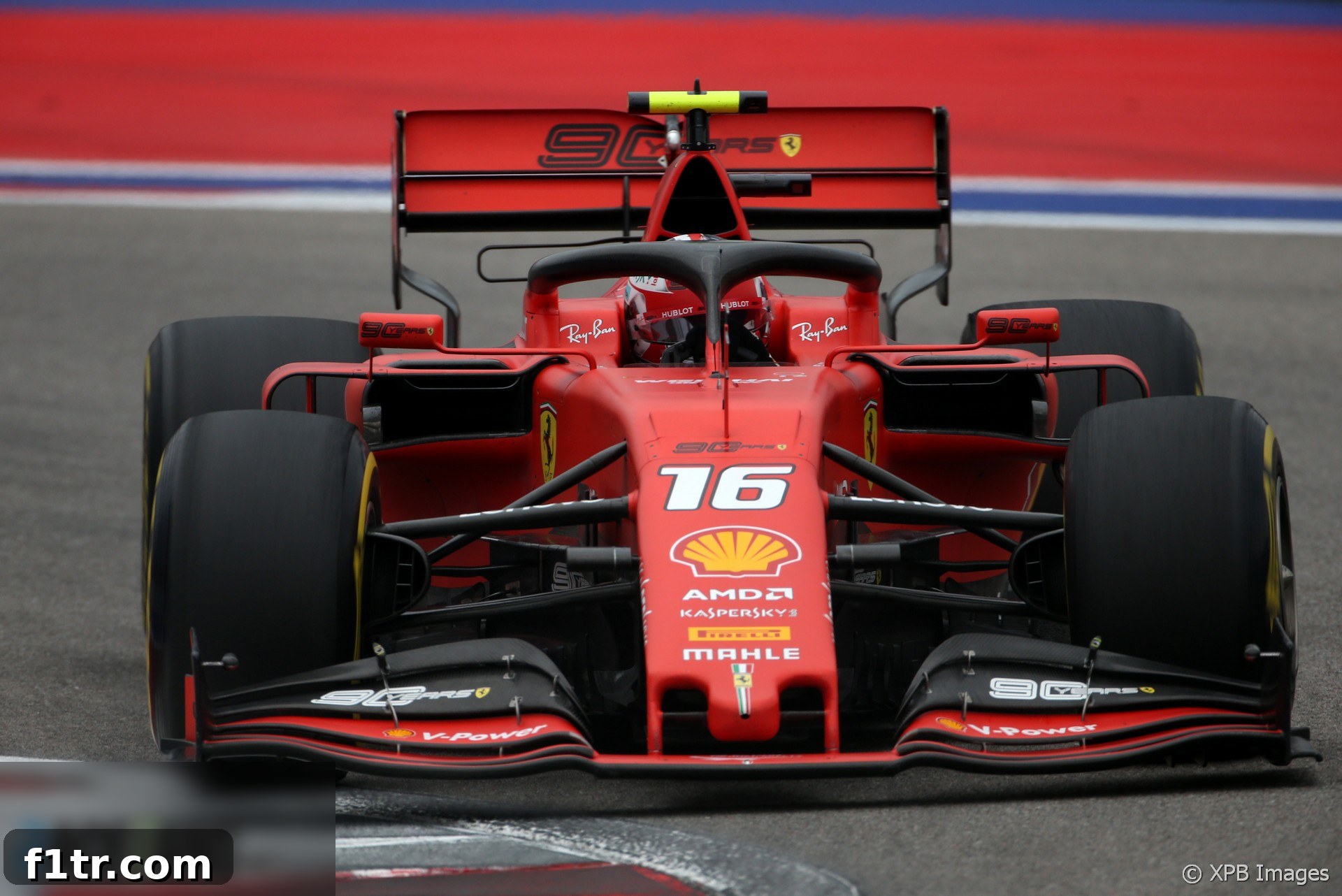
The 2019 Russian Grand Prix qualifying session at the Sochi Autodrom delivered a thrilling spectacle, culminating in Charles Leclerc securing his fourth consecutive pole position. The Ferrari driver demonstrated exceptional pace throughout, ultimately outpacing his rivals by a significant margin. However, the session was not without its drama, as Mercedes’ Lewis Hamilton skillfully denied Ferrari a front-row lockout, relegating Sebastian Vettel to the second row with a stunning final lap.
The strategic nuances of tyre choices, unexpected incidents, and intense midfield battles painted a vivid picture of the teams’ and drivers’ fight for optimal grid positions. As the sun set over Sochi, the stage was perfectly set for a captivating race, with differing tyre strategies among the front runners promising an intriguing start.
Q1: Early Drama and Unexpected Exits
The first qualifying segment, Q1, immediately set a dramatic tone, with several notable incidents impacting the grid. Daniil Kvyat, the local hero, faced an unfortunate setback even before the session began. A persistent engine issue in final practice proved terminal, leading to a complete engine change and effectively ending his qualifying hopes. With a hefty grid penalty already looming, his inability to participate in Q1 condemned him to start from the very back of the grid, a frustrating outcome for the Toro Rosso driver on home soil.
Kvyat was soon joined at the rear of the grid by Red Bull’s Alexander Albon, whose challenging weekend took a turn for the worse. During his Q1 attempt, Albon lost control of his RB15 at the tricky Turn 13, spinning backwards and making heavy contact with the barrier. The significant damage to the rear of his car immediately brought out the red flags, halting the session and adding to Red Bull’s woes after Max Verstappen had already incurred a grid penalty. The incident not only compromised Albon’s qualifying but also put immense pressure on his mechanics for repairs before the race.
When the session resumed, with precious minutes ticking away, Sebastian Vettel, who had yet to register a competitive time, wasted no time. The German Ferrari driver immediately headed out and put in a blistering lap, not only securing his place in Q2 but also momentarily topping the timesheets, showcasing Ferrari’s raw speed. This impressive recovery put Pierre Gasly, in the Toro Rosso, precariously in the drop zone. However, any fears of both Toro Rosso cars being eliminated early were quickly assuaged as Gasly delivered a crucial lap, narrowly escaping elimination and advancing to Q2.
As is often the case, the Williams drivers, George Russell and Robert Kubica, found themselves struggling at the back. Russell voiced his frustration over team radio about being sent out into heavy traffic, highlighting the critical importance of clear track space for a clean lap. The battle for the final Q2 spot ultimately boiled down to a tense showdown between the two Alfa Romeo drivers. Kimi Raikkonen appeared poised to progress, but a costly error at Turn 10 compromised his lap. Seizing the opportunity, his teammate Antonio Giovinazzi delivered a strong performance, perfectly capitalizing on Raikkonen’s mistake and edging him out by the slimmest of margins to claim the final spot in Q2, adding an unexpected twist to the session.
Drivers eliminated in Q1
| 16 | Kimi Raikkonen | Alfa Romeo-Ferrari | 1’34.840 |
| 17 | George Russell | Williams-Mercedes | 1’35.356 |
| 18 | Robert Kubica | Williams-Mercedes | 1’36.474 |
| 19 | Alexander Albon | Red Bull-Honda | 1’39.197 |
| 20 | Daniil Kvyat | Toro Rosso-Honda | No time |
Q2: Strategic Plays and Midfield Mastery
Q2 introduced a crucial strategic element into the qualifying battle, particularly regarding tyre choices for the start of the race. Ferrari, demonstrating unwavering confidence in their SF90’s pace, opted for the soft compound tyres for both Charles Leclerc and Sebastian Vettel. This decision meant they would start the Grand Prix on the faster, but less durable, red-walled tyres. Max Verstappen, piloting the sole remaining Red Bull, followed suit, also selecting soft tyres, aligning himself with Ferrari’s aggressive strategy.
Charles Leclerc continued to assert his dominance, consistently setting the pace and showcasing why he was considered the pole favourite. On his initial run, he pulled out a substantial six-tenths lead over Sebastian Vettel, comfortably securing his passage into Q3. A minor moment saw him run wide over one of the prominent sausage kerbs, audibly scraping the underside of his car, but thankfully without any detrimental impact on his performance or the car’s integrity.
In contrast to Ferrari and Red Bull, Mercedes made a strategic play by choosing the medium compound tyres for both Lewis Hamilton and Valtteri Bottas. This decision positioned them on a different race strategy for the start, prioritizing durability and a potentially longer first stint over outright initial grip. Hamilton, despite being on the harder compound, proved incredibly competitive, trailing Vettel by only a fraction of a second. Both Mercedes drivers navigated Q2 successfully, securing their spots in the final segment on the yellow-walled mediums, setting up an intriguing strategic battle for Sunday.
The midfield battle in Q2 was equally intense, with drivers pushing their machinery to the absolute limit. Romain Grosjean, in the Haas, provided one of the session’s most memorable moments. Expressing genuine bewilderment over team radio – “I don’t know what to do,” followed by “I honestly don’t know what to do” – he somehow conjured a superb final lap. This stellar effort propelled him to sixth place, surprisingly outpacing both McLaren drivers and showcasing the latent potential of his VF-19 on a hot lap.
The Renault drivers also demonstrated strong form, both Daniel Ricciardo and Nico Hulkenberg managing to squeeze into Q3. Ricciardo’s late improvement was particularly impactful, as it ultimately sealed Pierre Gasly’s fate, ending the Toro Rosso driver’s qualifying participation and denying him a Q3 berth by a mere 0.008 seconds. The Racing Point duo, Sergio Perez and Lance Stroll, failed to advance. Stroll’s lap was marred by a slight untidiness, while Kevin Magnussen, despite having the newer specification Haas, couldn’t quite match Grosjean’s remarkable pace in the older kit, leading to his elimination.
Antonio Giovinazzi, fresh from his Q1 success, couldn’t replicate his earlier heroics and bowed out in Q2. His performance, however, demonstrated a step forward for the Italian, though it wasn’t enough to challenge for the top ten positions in the fiercely competitive midfield.
Drivers eliminated in Q2
| 11 | Pierre Gasly | Toro Rosso-Honda | 1’33.950 |
| 12 | Sergio Perez | Racing Point-Mercedes | 1’33.958 |
| 13 | Antonio Giovinazzi | Alfa Romeo-Ferrari | 1’34.037 |
| 14 | Kevin Magnussen | Haas-Ferrari | 1’34.082 |
| 15 | Lance Stroll | Racing Point-Mercedes | 1’34.233 |
Q3: The Fight for Pole and Front-Row Drama
The final qualifying segment, Q3, commenced with palpable tension as the top ten drivers vied for pole position. The initial runs highlighted the strategic divergence of Q2. The Mercedes drivers, Lewis Hamilton and Valtteri Bottas, on their medium compound tyres, found themselves over half a second adrift of Charles Leclerc’s pace-setting Ferrari, which was on the quicker softs. Hamilton reported feeling time loss due to “oscillations” during gear changes, a subtle yet critical detail, while the team identified potential gains for him through the challenging Turn 2.
As the session progressed, the Ferraris continued to dictate terms. Sebastian Vettel was the first to improve on Hamilton’s initial benchmark. However, Leclerc, unleashing another stunning display of raw speed, conclusively outpaced his teammate by three-tenths of a second, solidifying his provisional pole. Bottas slotted into fourth position, just ahead of Max Verstappen, who, despite his grid penalty, was still pushing for the highest possible starting spot.
The final runs brought the qualifying session to a nail-biting climax. Sebastian Vettel, eager to challenge for pole, pushed hard but admitted to a “little wobble” in the crucial final sector of his lap. Despite this minor imperfection, he improved his lap time significantly. Yet, his slight hesitation provided a golden opportunity for Lewis Hamilton. The Mercedes driver, known for his ability to extract every ounce of performance when it matters most, delivered a magnificent final lap. Hamilton masterfully split the two Ferraris, snatching a sensational front-row spot, a testament to his skill and the Mercedes W10’s adaptability despite the medium tyres.
Charles Leclerc, despite having provisionally secured pole, was not entirely satisfied with his own final run, particularly the exit from the last corner. However, even with his self-assessed imperfection, he found yet more time, improving his already impressive lap and ultimately clinching his fourth consecutive pole position by a commanding four-tenths of a second. This remarkable streak underscored Leclerc’s growing confidence and prowess behind the wheel of the Ferrari. Meanwhile, Valtteri Bottas chose to abandon his final attempt at a flying lap, recognizing that further improvement on the mediums against the soft-shod Ferraris and a determined Hamilton would be exceedingly difficult. This decision allowed Max Verstappen to elevate himself to fourth place, benefiting from Bottas’s retirement from the final push.
The midfield battle for positions within the top ten also saw some spirited performances. Carlos Sainz Jnr put in a commendable effort to claim sixth place for McLaren, continuing his strong season. He was closely followed by Nico Hulkenberg in the Renault, who demonstrated solid pace. Lando Norris, Sainz’s McLaren teammate, expressed some disappointment with the initial half of his lap but still secured eighth place, underpinning McLaren’s strong double Q3 appearance. Romain Grosjean, still marveling at his Q2 performance, communicated to his Haas team that ninth was likely the absolute best the car could manage, having pushed Daniel Ricciardo down to the tenth and final spot in Q3.
Top ten in Q3
| 1 | Charles Leclerc | Ferrari |
| 2 | Lewis Hamilton | Mercedes |
| 3 | Sebastian Vettel | Ferrari |
| 4 | Max Verstappen | Red Bull-Honda |
| 5 | Valtteri Bottas | Mercedes |
| 6 | Carlos Sainz Jnr | McLaren-Renault |
| 7 | Nico Hulkenberg | Renault |
| 8 | Lando Norris | McLaren-Renault |
| 9 | Romain Grosjean | Haas-Ferrari |
| 10 | Daniel Ricciardo | Renault |
2019 Russian Grand Prix
- Williams clarifies reasons for Kubica and Russell’s retirements in Sochi
- 2019 Russian Grand Prix Star Performers
- Top ten pictures from the 2019 Russian Grand Prix
- Vettel vs Leclerc round two: Complete Ferrari Russian Grand Prix team radio transcript
- Hamilton triumphs as Ferrari’s micro-management backfires
Browse all 2019 Russian Grand Prix articles