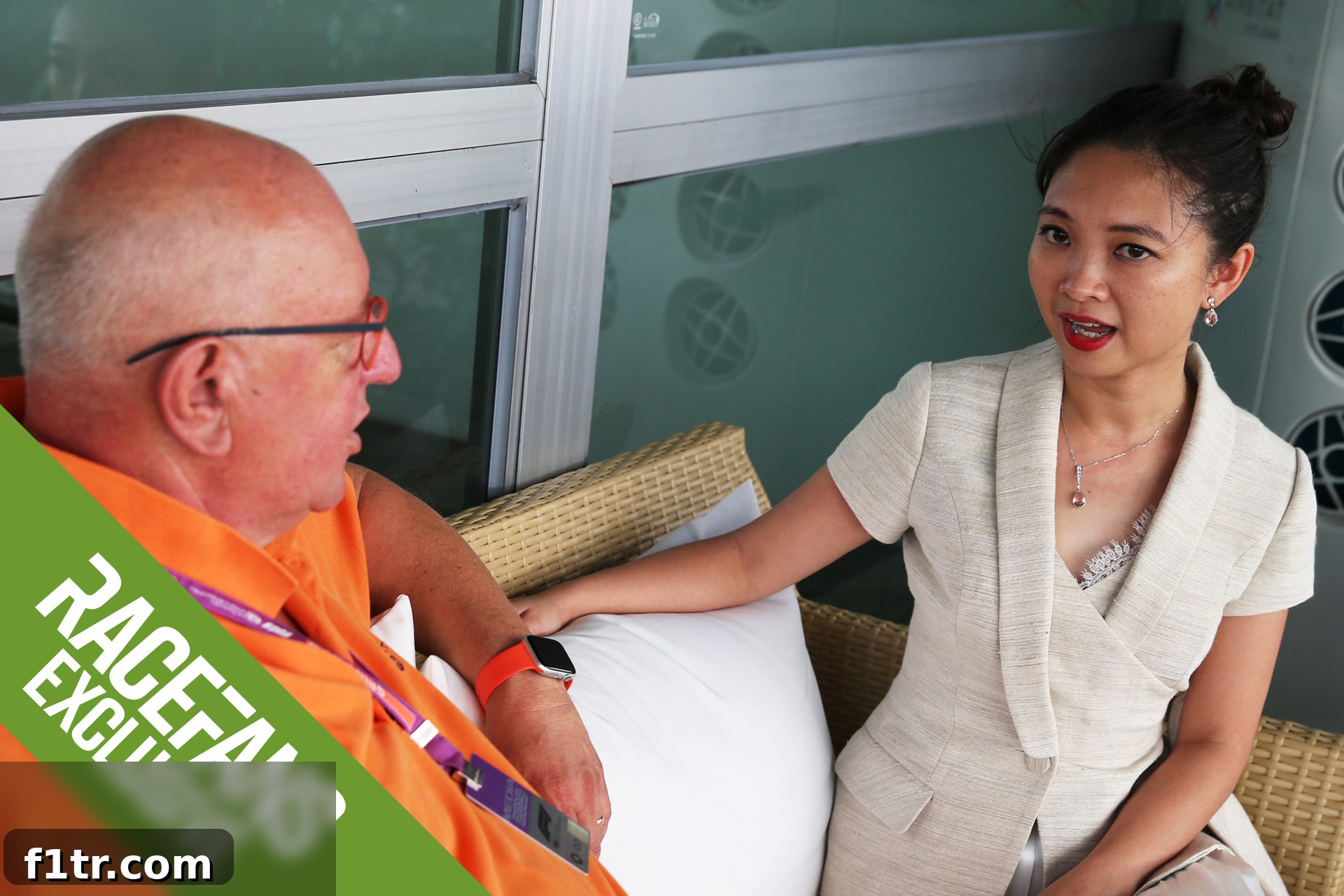
As the bustling Formula 1 patio in Singapore hummed with activity, I had the pleasure of exchanging business cards with Le Ngoc Chi, the dynamic CEO of Vietnam Grand Prix Corporation (VGPC). Her warm smile, upon noticing my effort to decipher her name, immediately put me at ease: “Just call me ‘Chi’,” she offered.
Advert | Become a Supporter & go ad-free
This marked Chi’s inaugural international media interview since her appointment, transitioning from within Vingroup – Vietnam’s colossal multi-business conglomerate and the primary promoter of the country’s highly anticipated Formula 1 Grand Prix. Despite the significance of the occasion, Chi exuded remarkable composure throughout our conversation, betraying no hint of nervousness.
Her professional background, spanning finance, legal, mergers and acquisitions, real estate, and hospitality, might seem a world away from the high-octane realm of Formula 1. Yet, her diverse experience across industries like pharmaceuticals and automobiles (which she also touched upon in her career) clearly equips her for the challenge. It’s evident that Chi is not just embracing but genuinely relishing the opportunity to lead what is poised to become Vietnam’s most significant international sporting event.
At the helm of VGPC, Chi is spearheading Vietnam’s ambitious endeavor to join Formula 1’s exclusive roster of elite venues. This is a monumental task for an emerging Asian nation with no established motorsport culture. She is perfectly positioned to articulate Vietnam’s compelling vision for securing a place alongside F1 stalwarts like Singapore, the USA, and other global motorsport hubs.
Vietnam’s Grand Ambition: More Than Just a Race
“The government, specifically the city of Hanoi, and most notably Mr. Chung Nguyen – then Chairman [Mayor] of Hanoi, truly the visionary behind this whole initiative – expressed a strong desire to bring Formula 1 to Vietnam,” Chi began, outlining the foundational motivations. “The reasons are abundantly clear: Formula 1 offers a wealth of benefits and positive impacts for our nation.”
She further clarified Vingroup’s integral role: “Vingroup serves as the key backer for the event in Vietnam, and VGPC operates as a vital member of this group. Having been a long-time employee of Vingroup, I assumed the role of CEO for the Vietnam Grand Prix Corporation, tasked with bringing this dream to fruition.”
Vingroup, under the astute leadership of 51-year-old Pham Nhat Vuong, is a powerhouse valued at an impressive $14 billion, employing over 43,000 individuals. Its vast interests permeate nearly every facet of Vietnamese daily life, extending from real estate and retail to healthcare and education. Notably, the conglomerate also ventured into the automotive industry by establishing VinFast – Vietnam’s first indigenous car brand, based on previous generation BMW 5 Series architecture and boldly launched at the 2018 Paris Motor Show. Vingroup’s entrepreneurial spirit also saw the creation of its own mobile phone brand, further underscoring its expansive reach and technological ambition.
“Vingroup’s commitment to this project transcends mere corporate gain,” Chi emphasized. “Our driving force is the greater good of our country and the enhancement of life for the Vietnamese people. We recognize that Formula 1 is far more than just a race; it’s a global entertainment and sporting spectacle that unlocks myriad opportunities. These opportunities span boosting tourism, attracting crucial international investment, fostering cross-border cooperation, and facilitating mutual exchange activities.”
Chi highlighted the pivotal role of technology. “Formula 1 is synonymous with cutting-edge technology, isn’t it? The advanced engineering in those cars, and especially with VinFast, resonates deeply with our national aspirations. We aspire for Vietnam to embrace and integrate the best technological advancements the world has to offer, and F1 provides an unparalleled platform for this exchange.”
Shaping Global Perception: Vietnam as the New Asian Dragon
The second, equally vital aspect of hosting the Vietnam Grand Prix is to powerfully showcase Hanoi and the entire country to a global audience, leveraging F1’s immense annual reach. Chi openly acknowledged that for many, the public perception of Vietnam remains inextricably linked to the war of 1955-75, a conflict that tragically claimed over three million lives. This F1 event offers a crucial opportunity to redefine that narrative.
“We possess an incredibly strong desire to present our true identity to the world,” Chi affirmed. “All too often, people approach us with questions like, ‘Vietnam? Is that still a war zone?’ We are determined to convey that this chapter is firmly in our past. Today, Vietnam is a nation on a rapid developmental trajectory; we are proudly emerging as the ‘new dragon of Asia.’ Over recent years, we’ve consistently achieved some of the highest GDP growth rates globally. We want to showcase this modern, vibrant Vietnam, and particularly our capital, Hanoi, to the world.”
She painted a vivid picture of Hanoi: “Hanoi is a land synonymous with peace, a city rich in unique traditions. It boasts incredible cuisine, stunning beauty, and a population renowned for its warmth and friendliness. These are the qualities we wish to highlight through the international lens of Formula 1.”
Advert | Become a RaceFans supporter andgo ad-free
And the third aspect?
“Pride. National pride,” Chi stated unequivocally. “Mr. Pham Nhat Vuong, Vietnam’s first and most prominent billionaire, is a deeply patriotic individual. He consistently speaks of his profound love and pride for our country. By undertaking an event of this magnitude, we all collectively share in that immense sense of pride and achievement for Vietnam.”
Crafting the Fan Experience: Beyond the Track
Every Formula 1 Grand Prix caters to two distinct audience segments: the live spectators at the track, primarily local or regional enthusiasts, and the vast global television audience. While television broadcasts effectively showcase the host country, the live audience is critical for the event’s financial viability and atmosphere. So, what innovative experiences await those who attend the inaugural Vietnam Grand Prix?
“Our goal is to cultivate a truly festive atmosphere for everyone,” Chi explained. “This involves integrating various festivals – celebrating our food, rich culture, and diverse entertainment. We are finalizing plans for concerts, exhilarating support races, and ensuring that these events extend far beyond the circuit perimeter. We envision this vibrant atmosphere permeating the entire city of Hanoi.”
Drawing parallels with established F1 venues, she added, “Singapore does an outstanding job in this regard, but we are committed to creating something uniquely Vietnamese. We want to craft an immersive experience for all attendees, appealing not only to fervent F1 fans but also to those who may be new to the sport.”
VGPC’s marketing strategy targets three key demographics. “Firstly, we are reaching out to regions with well-established motorsport cultures and communities. These are individuals who are often eager to travel and witness a brand-new race, to discover what unique offerings we have. Secondly, we’re focusing on general tourism. If visitors are already planning a trip to Asia, they can seamlessly combine their desired travel destination with the excitement of such a grand event. Thirdly, we are strategically targeting regional audiences. Vietnam maintains robust business relationships with neighboring countries like Thailand, Singapore, and Malaysia, all of which boast passionate motorsport communities keen to experience F1 on our home turf.”
Chi acknowledged the existing presence of three F1 events in Asia, emphasizing, “It’s not about competing directly with other Grands Prix. Rather, we firmly believe there is ample room for everyone within the Asian motorsport landscape.”
She conceded that a ‘top-down’ approach, where a country simultaneously develops a motorsport culture alongside hosting an F1 race, is a challenge. However, she expressed unwavering confidence in Vietnam’s burgeoning motorsport community. Despite its relatively small size, she described it as highly enthusiastic, highlighting the presence of a well-established go-kart track in the south. The Hanoi F1 street circuit itself features a purpose-built section running through a park, ingeniously designed to double as a karting facility post-event, fostering grassroots development.
Advert | Become a RaceFans supporter andgo ad-free
“With Formula 1’s arrival, coupled with robust government support and the dedicated core of our motorsport community, we are absolutely confident that the motorsport landscape in Vietnam will grow exponentially over the coming years,” Chi asserted. “We are thrilled to be an integral part of this exciting growth journey.”
The Hanoi Circuit: A Hybrid Marvel Designed for the Future
Lewis Hamilton, a prominent figure in Formula 1, recently advocated for new venues to embrace street races, drawing a stark contrast to the experience of India’s Buddh International Circuit. That purpose-built track, constructed at immense expense, ultimately hosted only three races, highlighting the financial and logistical challenges of entirely new permanent facilities in nascent motorsport markets. In light of this, it’s particularly insightful to learn that VGPC, after careful consideration, briefly explored but ultimately dismissed plans for a fully permanent track in Hanoi.
“The selected area for our circuit is one of Hanoi’s most dynamically developed districts,” Chi explained. “We want to vividly demonstrate the city’s vitality. With an abundance of excellent local cuisine and a community brimming with enthusiasm for the track, our primary aim is to showcase the vibrant essence of Hanoi.”
The impressive circuit layout spans 5.607 kilometers, incorporating 23 turns. A highlight is the main straight, stretching over one-and-a-half kilometers, where Formula 1 cars are projected to reach breathtaking speeds of 340 kilometers per hour. This project marks a significant milestone, representing the first official circuit collaboration between the renowned circuit design firm of Hermann Tilke and Formula 1’s dedicated motorsports division, led by the esteemed Ross Brawn. The purpose-built section of the track deliberately integrates challenging esses and corners, drawing inspiration from legendary circuits like Japan’s Suzuka and Germany’s Nürburgring, promising a thrilling and technical challenge for drivers.
Chi confirmed that construction on the pit garage area is rapidly progressing into its final stages. This impressive three-level fixed structure, spanning 300 meters, features a design thoughtfully inspired by the Imperial Citadel of Thang Long, a historical landmark right in Hanoi, blending modern functionality with local heritage.
“As you can see, our circuit is not purely a street track,” Chi elaborated on its unique hybrid nature. “Approximately two-thirds of the circuit utilizes existing public roads, forming the street-circuit element. The remaining one-third is an entirely new construction, situated within a park area that will be temporarily closed for the event. This distinctive design endows it with some of the best characteristics of a permanent circuit, offering a balanced and engaging racing experience.”
Our conversation took place at the very venue of F1’s first-ever night race, Singapore, naturally prompting the question of Hanoi following suit. “Yes, it certainly has the potential,” Chi acknowledged regarding a night race, “but we are not pursuing that option. We will host a day race.”
She further detailed the planned timing: “The exact start time is yet to be definitively determined, but we are looking at approximately 2 to 3 PM. Our intention is to enable a broad viewership across Europe, and hopefully a significant audience in continental America, to tune in and experience the race live with us.”
Chi shared projections for spectator numbers, expecting a formidable ‘footfall of 300,000 spectators over the three-day event.’ She assured that all facilities, week-long plans, and operational procedures have been meticulously designed to accommodate such large crowds seamlessly. To cater to a wide range of attendees, four distinct ticket tiers will be offered: affordable general admission, grandstand seating, the circuit’s exclusive hospitality suites, and the premium Paddock Club experience, ensuring accessibility for all budgets.
Go ad-free for just £1 per month>> Find out more and sign up
VGPC specifically requested the first weekend in April for the Grand Prix, citing primarily climatic considerations. “We will have just emerged from spring, offering wonderfully pleasant temperatures with virtually no rain, perhaps just a light sprinkle,” Chi explained. “The weather will be humid but dry, with temperatures likely in the mid-20s (Celsius), providing comfortable conditions even at night.” She added optimistically that with Easter scheduled for the following weekend, they hope visitors will extend their stay, transforming their F1 trip into a longer holiday exploring Vietnam.
Ensuring Readiness: A Commitment to Excellence
Whenever a new venue makes its debut on the Formula 1 calendar, questions regarding its readiness are inevitable. The sport’s history is replete with instances of last-minute scrambles and close calls; for example, Korea’s track in Mokpo received its final sign-off just days before its inaugural event. Tragically, in the eyes of many, India’s Buddh circuit outside Delhi never truly felt complete, contributing to its short-lived tenure.
Chi, however, conveyed an unequivocal message of confidence, asserting that every detail would be meticulously in place for Hanoi to flawlessly host the fourth round of the 2020 F1 calendar, just seven months away from our interview.
“Firstly, I want to state emphatically that we are absolutely confident. We are perfectly on track and strictly adhering to our schedule, fully prepared to deliver our inaugural Grand Prix on April 3-5, 2020,” she declared. “Secondly, we’ve received tremendous support from Formula 1. All their various divisions – be it marketing, the motorsport division, or the technical side – have been incredibly helpful, following our progress very closely on every single aspect of this undertaking. Their close oversight is a testament to their confidence; they would simply not place us on the calendar if they weren’t assured of our readiness, as their reputation is also intrinsically linked to our success.”
Chi outlined three critical stages remaining before Hanoi is fully prepared to welcome Formula 1 for the first time.
“The first stage is construction. At our circuit, the only permanent structures are the pit building and, of course, the track itself. If you visit Vietnam now, you will see the pit building proudly standing, already in its complete form. We are currently focusing on the interior work, including crucial elements like ventilation and advanced medical facilities. We anticipate completing this phase by the end of this year. Early next year, we will apply the final touches, particularly the interior fit-out. As for the track, while some sections already exist, one-third is entirely new construction. We are scheduled to commence asphalt laying for this purpose-built section next month.
“The asphalt quality will be paramount for the track,” Chi underscored, “as we are committed to ensuring it meets the absolute highest standards. This single factor can determine a track’s success, and the racers will know instantly. Therefore, we are absolutely certain we will adhere to the very strict standards and requirements set by the FIA for track quality. So, on the construction front, everything is proceeding precisely on time.”
Concurrently, preparations for essential operational aspects such as traffic flow and stringent security measures – “we need to ensure that people are completely safe,” Chi emphasized – are well underway. The third crucial pillar of Chi’s plan, the comprehensive marketing and sales campaigns, successfully launched in late July.
“All these combined factors are generating incredibly positive momentum for us right now,” Chi concluded. “We firmly believe this momentum will continue to build significantly from now until the end of March, enabling us to achieve our target of drawing a vibrant crowd to our momentous event.”
The monumental challenge of introducing a brand-new race to the highly competitive Formula 1 calendar should never be underestimated. The sport’s recent history is dotted with numerous short-lived venues that failed to establish a lasting presence. However, with the Vietnam Grand Prix, the stakes are exceptionally high, not only for VGPC and the nation of Vietnam but also for the championship itself. As the first entirely new F1 race of the Liberty Media era, Hanoi represents a critical test case and a beacon of ambition for the future of Formula 1 in emerging markets.
RacingLines
- The year of sprints, ‘the show’ – and rising stock: A political review of the 2021 F1 season
- The problems of perception the FIA must address after the Abu Dhabi row
- Why the budget cap could be F1’s next battleground between Mercedes and Red Bull
- Todt defied expectations as president – now he plans to “disappear” from FIA
- Sir Frank Williams: A personal appreciation of a true racer
Browse all RacingLines columns