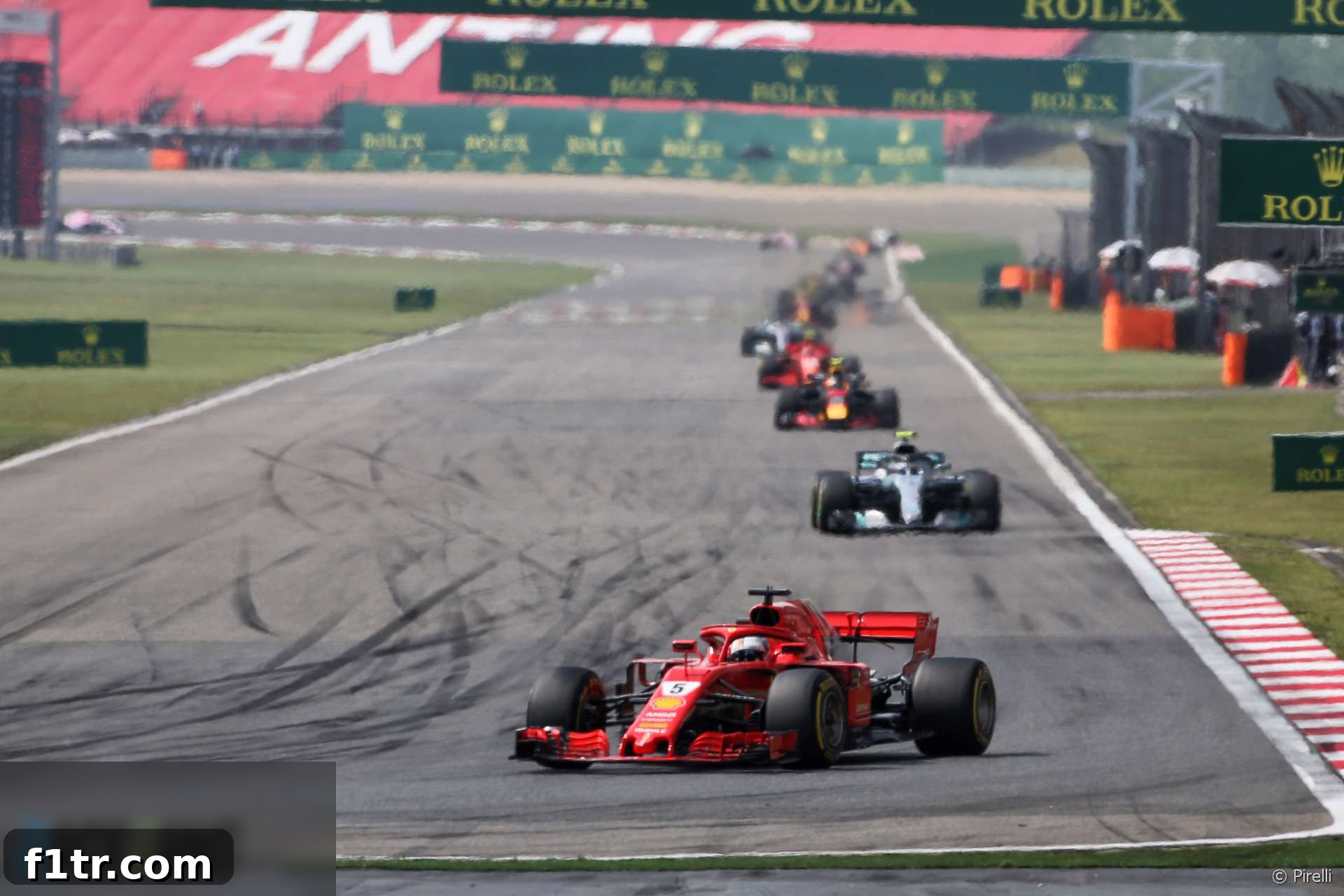
Sebastian Vettel Critiques Safety Car Deployment Strategy in Chinese Grand Prix
In the high-octane world of Formula 1, where milliseconds and strategic masterstrokes dictate victory, the deployment of the Safety Car (SC) can be a pivotal, and often contentious, moment. Following the 2018 Chinese Grand Prix, four-time world champion Sebastian Vettel expressed strong disapproval regarding the timing of the Safety Car intervention. He argued that the decision unfairly compromised his race and that of then-leader Valtteri Bottas, sparking a broader dialogue within the F1 community about the delicate equilibrium between race safety and sporting integrity.
The Flashpoint: An Ill-Timed Safety Car in Shanghai
The incident that drew Vettel’s ire unfolded during the Chinese Grand Prix when scattered debris on the track necessitated the deployment of the Safety Car. At this critical juncture, Sebastian Vettel, driving for Ferrari, was comfortably holding second place, locked in pursuit of Mercedes’ Valtteri Bottas, who was leading the race. Both front-running drivers had just crossed the pit lane entry line when the Safety Car was called out. This precise timing became the focal point of Vettel’s grievance, as it immediately presented a significant and irreversible strategic disadvantage to the leaders.
For those new to Formula 1 dynamics, a Safety Car period is implemented to allow marshals to safely clear hazards from the track. While essential for safety, it also “bunches up” the entire field, effectively erasing any hard-earned time gaps built by the leading drivers. More critically, it creates a ‘free pit stop’ window for many cars: stopping for new tyres under Safety Car conditions results in less time loss compared to pitting under normal racing conditions. Drivers who have already passed the pit entry when the SC is deployed are often left in a strategic bind, unable to capitalize on this opportunity without sacrificing valuable track position.
Vettel’s Core Criticism: Fairness and Reaction Time
Vettel articulated his frustration with clarity, asserting that race control should have managed the Safety Car’s deployment in a way that did not disproportionately penalize the front-runners. He specifically suggested an initial application of the Virtual Safety Car (VSC) to ‘freeze’ the race and allow teams a crucial grace period to react, before committing to a full Safety Car deployment.
“The timing of the Safety Car was bad for Valtteri and myself because we had no chance to react,” Vettel explained. “And the race wasn’t frozen either. Normally the race is frozen for one or two crossings of Safety Car line. But it wasn’t, the Safety Car was there straight away so basically we were taken out of the race and didn’t have the chance to [decide to] jump on fresh tyres or stay out.”
This statement encapsulates a fundamental issue: the absence of a transitional buffer. In many race scenarios, an immediate VSC or a slight delay in a full SC deployment allows drivers a vital lap or even half-lap to assess their tyre situation and make an informed pit stop decision. By the time Vettel and Bottas had passed the pit entry, this strategic window had abruptly closed, compelling them to remain on track with potentially older tyres. Meanwhile, competitors further down the order gained a significant strategic advantage by pitting for fresh rubber under the neutralized conditions, effectively making a ‘free’ stop and rejoining the race with better pace potential.
The Strategic Ripple Effect: High Stakes of Safety Car Deployment
The sudden appearance of the Safety Car often triggers a frantic flurry of activity in the pit lane, as teams scramble to execute strategic decisions that can either make or break their race. A shrewdly timed pit stop during a Safety Car period can propel a driver several positions up the order, while a missed opportunity can lead to the loss of vital championship points and potential podium finishes. Vettel underscored this point, stating that had the Safety Car been deployed just moments earlier, allowing him to reach the pit entry, he would have unequivocally opted for a pit stop to take on new tyres.
This complex strategic dilemma is by no means novel in Formula 1. The sport’s history is replete with instances where Safety Car deployments have had a profound and often controversial impact on race outcomes, frequently disadvantaging those who were leading. Vettel himself drew a direct comparison to the 2014 Hungarian Grand Prix, where a remarkably similar scenario unfolded, resulting in a distinct disadvantage for the race leaders who had already passed the pit entry when the Safety Car was deployed.
“I think after 2014 in Hungary we were in a similar situation where the leaders were disadvantaged because the Safety Car came once they came past the pit entry. I understand if something happens and you have to react straight away, that you can’t always respect where cars are relative to each other,” he acknowledged, demonstrating an understanding of the inherent pressures and challenges faced by race control in making real-time decisions.
However, Vettel swiftly followed up with a critical observation: “But we had two laps of the debris on the track so why not call the Safety Car half a minute sooner and then everybody has a chance to decide whether they pit or not.” This suggests that in situations where debris is visible over a sustained period, race control might possess a small window to optimize the timing of the Safety Car deployment. Such optimization could, in theory, minimize the adverse sporting impact on the leaders while still ensuring the paramount safety of the track marshals.
The Virtual Safety Car: An Evolving Solution
Vettel’s suggestion for an initial Virtual Safety Car (VSC) phase before a full Safety Car deployment is a topic frequently debated within F1 circles. The VSC system, introduced precisely to address situations like this, mandates all drivers to slow down to a prescribed delta time. This effectively neutralizes racing conditions without necessitating the physical Safety Car on track, thereby ‘freezing’ the time gaps between cars. This crucial difference prevents the ‘bunching up’ effect and mitigates the ‘cheap pit stop’ advantage associated with a full SC.
Had a VSC been deployed first in Shanghai, it would have provided teams with precious extra seconds, or even a full lap, to deliberate and decide on their strategic course of action. They could have opted to pit under VSC conditions, accepting a minor time loss, or chosen to wait for a potential full Safety Car. The absence of this critical transitional phase, according to Vettel, was a key factor contributing to the perceived unfairness and the subsequent disruption to the race leaders’ strategies.
Balancing Safety and Sporting Integrity: An Enduring Challenge for F1
Despite his fervent criticism regarding the timing, Vettel unequivocally conceded that the Safety Car deployment itself was a necessary and justifiable intervention. The absolute priority of ensuring the safety of marshals, who must venture onto the track to clear hazards, is non-negotiable. He estimated that marshals require a secure window of approximately one-and-a-half to two minutes to safely carry out their duties, thus making a Safety Car deployment entirely warranted for track clearance.
“I don’t know the gaps but I think yes the Safety Car was justified because you have to give the marshals a one-and-a-half or two-minute window to clean the track. But in my point of view it’s not right to send it when you actively change the race,” Vettel asserted, capturing the essence of the ongoing dilemma.
This nuanced statement perfectly encapsulates the core challenge confronting Formula 1 Race Control and the FIA: how to prioritize absolute safety without unduly influencing the competitive outcome of the race. Every decision concerning Safety Car deployment carries immense weight, as it possesses the power to dramatically reshape the race order, overturn established strategies, and even impact championship standings. The perpetual challenge lies in meticulously crafting and implementing procedures that maximize safety while simultaneously minimizing any unfair sporting detriment, particularly to those drivers who have earned their track position through superior pace and consistent performance.
The Evolving Debate and Future of F1 Regulations
Incidents such as the one witnessed during the 2018 Chinese Grand Prix serve as invaluable learning experiences for the FIA and Formula 1 management. The discussions ignited by prominent drivers like Sebastian Vettel frequently lead to comprehensive reviews of existing regulations and operational procedures. The overarching objective is a continuous refinement of the rules to ensure they are fairer, safer, and more transparent, thereby preserving the enthralling spectacle of racing while upholding the most stringent standards of safety.
The very introduction and subsequent evolution of the Virtual Safety Car system stand as powerful testaments to this unwavering commitment to improvement. However, as Vettel’s insightful comments indicate, there remain complex scenarios where the execution of these procedures can still lead to perceived injustices. The relentless pursuit of the perfect Safety Car protocol – one that is universally fair, consistently applied, and impervious to ambiguous interpretation – remains an enduring and complex challenge for Formula 1.
Conclusion: A Call for Strategic Precision and Fair Play
Sebastian Vettel’s critique of the Safety Car timing at the 2018 Chinese Grand Prix was far more than a mere complaint; it was a thoughtful and critical analysis of a fundamental procedural issue within Formula 1. His comments powerfully underscored the profound impact such decisions have on race strategy and the competitive landscape of the sport. While acknowledging the undeniable imperative of safety, Vettel passionately advocated for a more refined and strategically precise approach to Safety Car deployment, one that grants leading drivers a fair opportunity to react and does not arbitrarily undermine their hard-won track position.
His appeal for a more considerate deployment strategy, perhaps incorporating a preliminary Virtual Safety Car phase, resonates deeply with many within the motorsport world. It vividly highlights the ongoing tension between safety imperatives and the foundational principles of sporting fairness that are central to Formula 1’s appeal. As the sport continues its relentless evolution, the debate surrounding Safety Car rules will undoubtedly remain a significant focal point, consistently driving efforts for continuous improvement in how F1 deftly balances its dual responsibilities of delivering exhilarating competition and ensuring uncompromising safety.
Don’t miss anything new from RaceFans
Follow RaceFans on social media:
- Join RaceFans on Facebook
- Follow RaceFans on Twitter
- Get daily email updates from RaceFans
Browse all 2018 F1 season articles