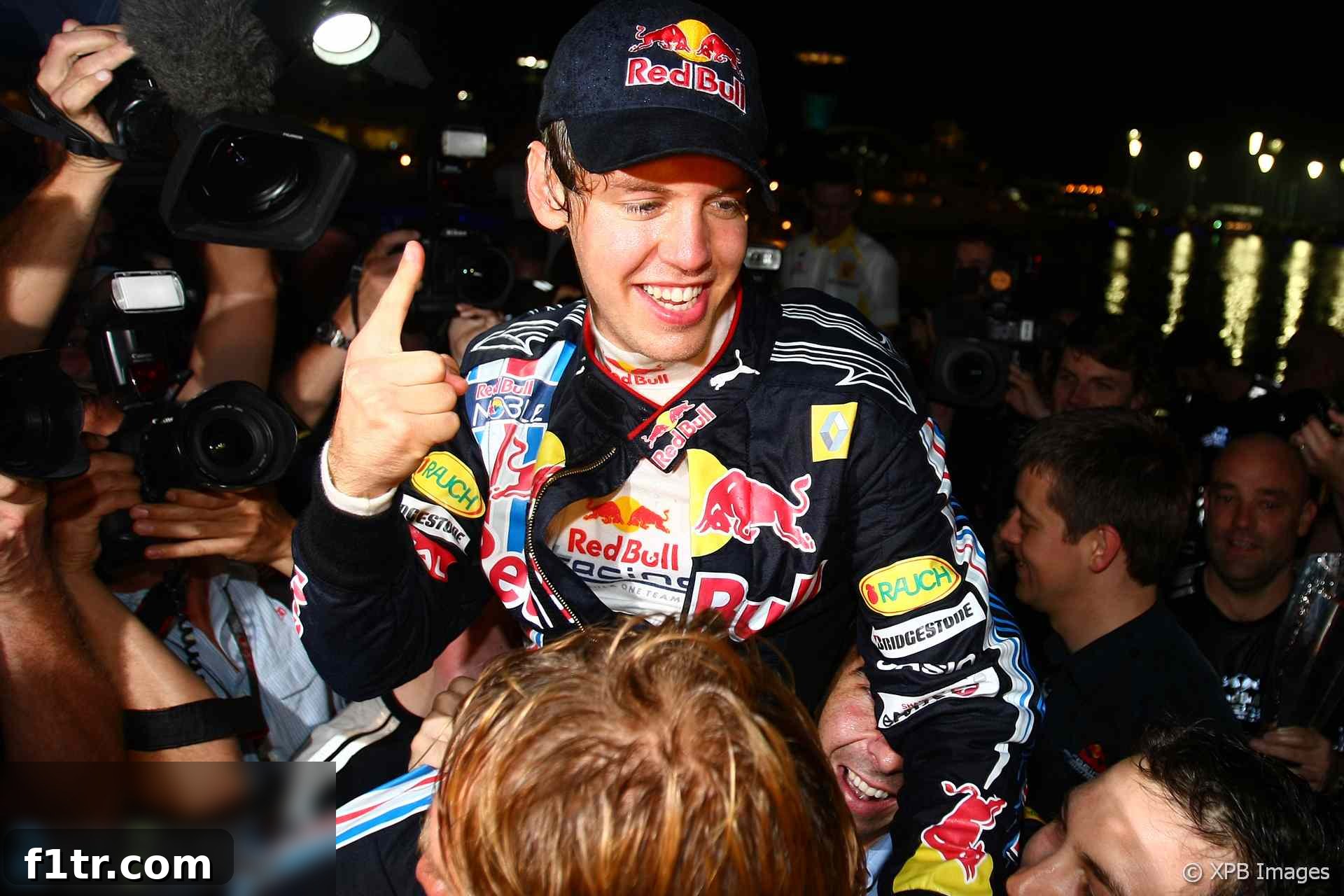
The 2009 Formula 1 season finale at the inaugural Abu Dhabi Grand Prix delivered a captivating spectacle, marked by unexpected turns of events and brilliant drives. While the championship title had already been secured, the battle for pride, podium places, and crucial constructors’ points ensured a thrilling conclusion to an unforgettable year. In the end, it was Sebastian Vettel who skillfully capitalized on a stroke of misfortune for Lewis Hamilton, steering his Red Bull to a dominant victory – his fourth of the 2009 campaign.
The Yas Marina Circuit, making its highly anticipated debut on the Formula 1 calendar, provided a unique and challenging backdrop. Its stunning architecture, twilight setting, and blend of fast sections and intricate corners promised an exciting contest. After a strong qualifying performance, it was McLaren’s Lewis Hamilton who secured pole position, demonstrating impressive pace that suggested he was the man to beat. Vettel, starting alongside him, was eager to challenge, while the Brawn GP duo of Jenson Button and Rubens Barrichello, despite having secured the drivers’ and constructors’ titles respectively, were still pushing for strong finishes.
Hamilton’s Early Lead and Unforeseen Retirement
As the lights went out for the final time in 2009, Lewis Hamilton made a superb getaway from pole position. Utilising the KERS boost to perfection, he rocketed into the lead, swiftly establishing a margin over the chasing Red Bull of Sebastian Vettel. It appeared to be a textbook start for the McLaren driver, who looked poised to dominate the race given his qualifying form and the clear track ahead. However, even in these nascent stages, subtle indications of trouble began to surface. On the very first lap, Hamilton out-braked himself into the challenging turn six chicane, a momentary lapse that allowed Vettel to briefly close the gap. While KERS helped him pull away on the subsequent straight, it was a precursor to the issues that would ultimately define his race.
Further back, the opening lap saw its share of drama. Mark Webber, eager to gain positions, made contact with Rubens Barrichello at the very first turn. The impact was significant enough to dislodge a section of Barrichello’s Brawn GP front wing, immediately compromising the Brazilian’s car handling. Recognising the opportunity, Jenson Button, the newly crowned world champion, seized the moment, deftly squeezing past his teammate to move into fourth place.
Despite his early lead, Hamilton’s struggles with braking intensified as the race progressed. What initially seemed like minor errors quickly developed into a persistent and serious problem. By lap 11, another significant lock-up saw him lose almost all of his hard-earned advantage over Vettel. The McLaren pit wall began to communicate with their driver, attempting to diagnose and mitigate the issue. It soon became apparent that a fundamental problem with the right-rear of the car was causing the severe braking instability. Tragically, the team had no choice but to instruct Hamilton to retire the car. This marked a rare and unfortunate milestone for the young Briton – his first mechanical retirement in an astounding 52 Formula 1 races, a testament to his remarkable reliability up to that point. His exit dramatically reshaped the race, handing the lead to Sebastian Vettel and setting the stage for a Red Bull one-two.
Vettel Assumes Control and the Pit Stop Scare
With Hamilton out of the picture, Sebastian Vettel found himself in a commanding position. The young German, who had been pushing Hamilton relentlessly, now had a clear road ahead and the opportunity to control the race from the front. His pit stop, a crucial moment in any Grand Prix, unfolded with relative calm, allowing him to maintain his lead. However, it was not entirely without a heart-stopping moment.
As Vettel’s Red Bull entered its pit box, Jaime Alguersuari, the Toro Rosso driver, inadvertently swung into Vettel’s designated spot. Alguersuari was grappling with a gearbox problem and had intended to retire his car, but in the confusion, he almost caused a major incident. The quick-thinking Red Bull mechanics sprang into action, gesturing frantically for Alguersuari to move, clearing the way just in time for Vettel’s arrival. This minor scare quickly passed, and Vettel’s stop was completed efficiently. Alguersuari, meanwhile, failed to complete his next lap and officially retired from the Grand Prix.
Having pitted slightly earlier than Vettel, Mark Webber emerged from his first stop in second place. Once the initial round of pit stops had cycled through, Vettel found himself with a comfortable and healthy lead of over six seconds, allowing him to dictate the pace and manage his tyres effectively. This clinical performance from Vettel underlined his growing maturity and skill, firmly cementing his status as a future world champion contender.
Midfield Marvels and Grueling Battles
The middle phase of the Abu Dhabi Grand Prix was characterized by intense strategic battles and some standout performances from the midfield. One driver who particularly shone was Kamui Kobayashi. Filling in for Timo Glock at Toyota, the Japanese driver rose to an astonishing third place after the early pit stops, emerging as the highest-placed single-stopper. His rise was partly attributed to some smart and aggressive driving on the first lap, where he managed to box in Kimi Raikkonen. This strategic move prevented the Ferrari driver from effectively exploiting his KERS boost, demonstrating Kobayashi’s sharp race craft and fearless approach.
After Jenson Button completed his first pit stop, he re-joined the track just ahead of Kobayashi. This set the stage for a thrilling resumption of their earlier battle, reminiscent of their exciting exchanges in Interlagos. However, this time it was the lighter-fuelled Kobayashi who held the advantage. With a display of audacious skill, he seized the opportunity to make a decisive move, diving down the inside of Button at turn eight, completing a brilliant overtake. This aggressive, yet clean, maneuver further highlighted Kobayashi’s potential and added significant excitement to the race.
The time lost by Button in his duel with Kobayashi would prove costly in the dying stages of the race. As the second round of pit stops concluded, Button found himself rapidly closing in on Mark Webber, who was visibly struggling with his brakes. The Australian driver was losing significant time in the braking zones, offering Button a glimmer of hope for snatching second place. However, the clock was against the Briton. With only the final lap remaining to launch a serious attack, Webber, despite his car’s issues, mounted a brilliant defensive effort, repelling Button’s advances and holding onto second place by the narrowest of margins in a truly exciting finish.
A Commanding Victory and Season-Defining Performances
While Webber and Button engaged in their nail-biting battle for second, Sebastian Vettel enjoyed an untroubled and serene run to victory. His commanding performance saw him cross the finish line over 17 seconds ahead of his teammate, a testament to his exceptional pace and strategic management of the race. It was a well-deserved win that capped off a phenomenal season for the young German and for Red Bull Racing, signaling their emergence as a dominant force in Formula 1.
Behind the Red Bull one-two and Button, Rubens Barrichello finished fourth, securing a solid result for Brawn GP in their final race under that name. One place behind him, Nick Heidfeld brought his BMW Sauber home in fifth, marking the final Grand Prix for BMW as a constructor. Heidfeld had expressed concerns about his teammate Robert Kubica’s pace during practice, and indeed, Kubica’s race unravelled after a spin while attempting to overtake Sébastien Buemi, causing him to slip down the order.
The remarkable performance of Kamui Kobayashi, who finished an outstanding sixth, was a major talking point. His aggressive, yet controlled, drive provided a significant boost to Toyota’s chances of securing a budget approval for the following season, demonstrating the raw talent within their ranks. His teammate, veteran driver Jarno Trulli, backed him up in seventh, ensuring a strong double points finish for the Japanese manufacturer. Sébastien Buemi, after his incident with Kubica, managed to hold on to score the final point in eighth place for Toro Rosso.
Robert Kubica ultimately finished tenth, just behind Nico Rosberg. Heikki Kovalainen delivered a strong recovery drive, climbing from 18th on the grid to finish 11th. For Kimi Raikkonen, his inability to make significant progress early in the race meant he finished his final Grand Prix for Ferrari in a somewhat subdued 12th position, a bittersweet end to his tenure with the Scuderia.
The race also marked farewells for other prominent drivers with their respective teams. Fernando Alonso, soon to join Ferrari, concluded his last race for Renault in 14th, behind Kazuki Nakajima. Vitantonio Liuzzi, in his final outing, managed to outperform his Force India teammate Adrian Sutil, finishing 15th ahead of Giancarlo Fisichella. Romain Grosjean was the last classified runner, bringing his Renault home in 18th.
Looking Ahead: The Off-Season and 2010 Prospects
As the curtains fell on the 2009 Formula 1 season at the stunning Yas Marina Circuit, the paddock transitioned into the customary off-season, brimming with unanswered questions and intense speculation about the 2010 grid. The Abu Dhabi Grand Prix provided a final opportunity for drivers to make a statement, and some certainly seized it. Performances like Kamui Kobayashi’s inspired drive and Vitantonio Liuzzi’s solid finish undoubtedly strengthened their respective cases for retention by their teams in 2010. Their displays of talent and determination offered a glimpse into a potentially brighter future for both drivers.
Conversely, for drivers like Romain Grosjean, who faced a tougher end to the season, the off-season brought a period of considerable uncertainty and anxiety. The fierce competition for coveted seats on the Formula 1 grid meant that every performance, particularly in the season finale, was under intense scrutiny. The 2009 Abu Dhabi Grand Prix, while a celebration of Sebastian Vettel’s victory and Red Bull’s ascendancy, also served as a stark reminder of the cutthroat nature of top-tier motorsport, where careers could be made or broken in a single race.
The 2009 Abu Dhabi Grand Prix was more than just a race; it was a grand finale that offered a glimpse into the future of Formula 1. It showcased the talent of a rising star in Sebastian Vettel, reaffirmed Red Bull’s potential, and introduced a spectacular new venue to the calendar. The drama, the strategic plays, and the raw speed combined to deliver a truly memorable closing chapter to the season, leaving fans eagerly anticipating what the next year would bring.
Abu Dhabi Grand Prix Resources:
- Abu Dhabi Grand Prix Race Result
- Final 2009 F1 Championship Standings
- Rate the Race: Abu Dhabi