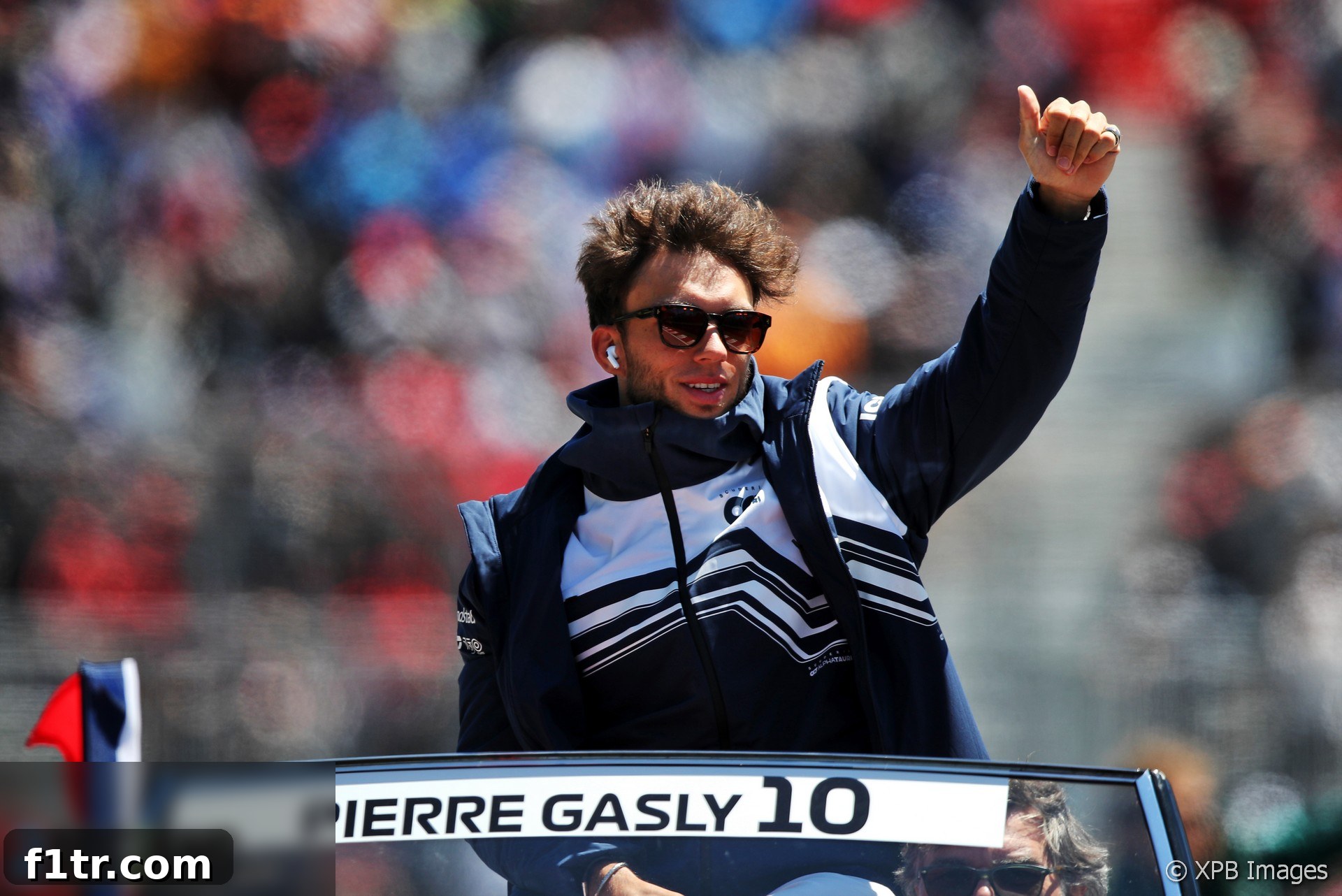
Pierre Gasly’s F1 Crossroads: Red Bull’s Dilemma and the Future of Its Junior Talent
In the high-octane arena of Formula 1, a driver’s trajectory is often a complex weave of raw talent, strategic team decisions, and sheer timing. Unlike the select few, such as Lewis Hamilton or Max Verstappen, who seemingly chart their own course, most drivers find their futures intricately linked to the whims and exigencies of team politics and performance. For those nurtured within the competitive crucible of a major team’s junior academy, the expectation is a clear, upward progression to the pinnacle of the sport – a seat with the senior squad.
However, as recent developments at Red Bull Racing vividly illustrate, this well-trodden path can abruptly diverge, leading to unexpected crossroads. The announcement that Sergio Perez had extended his contract to remain alongside Max Verstappen until the end of 2024 sent palpable ripples throughout the paddock. While undoubtedly a rational and strategic maneuver for Red Bull, securing a consistent points-scorer and a pragmatic secondary driver, this extension casts a considerable shadow over the career prospects of Pierre Gasly, a driver who has demonstrably proven his worth since a challenging initial stint with the senior team. His current predicament raises profound questions about his long-term future within the Red Bull empire and, indeed, his overall standing in Formula 1.
Sergio Perez: The Strategic Cornerstone of Red Bull’s Championship Ambitions
Red Bull’s decision to extend Sergio Perez’s contract was, from an analytical and strategic standpoint, impeccably sound. Perez has undeniably solidified his position as a vital asset for the Milton Keynes-based squad, consistently delivering strong performances and securing crucial points in their relentless pursuit of the Constructors’ Championship. His ability to perform reliably, often bringing the car home in strong positions and acting as a buffer against rival teams, perfectly complements Verstappen’s aggressive and often dominant championship charges.
Furthermore, Perez has displayed remarkable maturity and grace in accepting the role of a ‘number two’ when team orders have necessitated it. This pragmatic understanding of his position within the team’s overarching goals, particularly when it comes to maximizing points for the Constructors’ title, is an invaluable trait. His wealth of experience, calm demeanor under pressure, and proven race-winning ability make him a known quantity – a reliable performer who can either support Verstappen directly or score significant points independently, ensuring Red Bull remains a formidable force on all fronts. His impressive track record, culminating in clutch victories, further underscores his immense value. Therefore, from Red Bull’s perspective, retaining Perez offers not only stability but also a fortified foundation for their immediate and ambitious championship aspirations.
Pierre Gasly’s Tumultuous Journey: A Testament to Resilience and Redemption
Pierre Gasly’s progression through the Red Bull system has been an emotional rollercoaster, marked by both soaring highs and challenging lows. After a promising junior career, he earned his F1 debut with Toro Rosso, Red Bull’s then-junior team. Following just one full season in the sport, Gasly was unexpectedly called up to the senior Red Bull Racing squad for the 2019 season. This rapid promotion, arguably premature, placed immense pressure on the young Frenchman, thrusting him directly into comparison with his generational talent teammate, Max Verstappen. His performance, under the intense scrutiny of a front-running team, struggled to meet the sky-high expectations. In a swift and notoriously brutal mid-season move, Gasly was demoted back to Toro Rosso, replaced by another Red Bull protégé, Alexander Albon.
Such a public demotion could have irrevocably shattered the confidence of many drivers, but Gasly responded with extraordinary resilience and a steely determination. He didn’t just return to the junior squad (now rebranded as AlphaTauri); he engineered a spectacular career renaissance. Before the tumultuous 2019 season concluded, he snatched his first F1 podium finish under deeply emotional circumstances at the Brazilian Grand Prix, a poignant moment following the tragic death of his close friend Anthoine Hubert earlier that year. The following season, at the 2020 Italian Grand Prix, Gasly delivered a stunning, unexpected maiden F1 victory, a landmark achievement that underscored his undeniable talent, newfound maturity, and unwavering self-belief.
His impressive run of form extended powerfully into the 2021 season. While a repeat victory eluded him, Gasly delivered a campaign of remarkable consistency and often extracted more performance from the AlphaTauri car than its theoretical capabilities suggested. He finished a commendable ninth in the drivers’ standings, significantly out-scoring his rookie teammate, Yuki Tsunoda, by a commanding 78 points. Franz Tost, the ever-candid team principal of AlphaTauri, frequently lauded Gasly for his leadership qualities and exceptional performances, publicly stating that he was more than ready for a well-deserved second chance at Red Bull. These consistently strong results firmly cemented Gasly’s reputation as one of Formula 1’s most capable, resilient, and, arguably, undervalued talents, making his current career predicament all the more intriguing and perplexing.
Red Bull’s Driver Merry-Go-Round: A History of Ruthless Pragmatism
Red Bull’s junior driver program is legendary for its ruthless efficiency and uncompromising “sink or swim” philosophy. While it has successfully propelled prodigious talents like Sebastian Vettel and Max Verstappen to championship glory, it has also, with equal frequency, cast aside numerous promising careers. Gasly’s experience is far from unique in the annals of Red Bull’s driver roster history. Six years prior, Daniil Kvyat endured an equally abrupt demotion from Red Bull Racing to pave the way for the meteoric rise of the young Verstappen. While that high-stakes gamble unequivocally paid off, as symbolically indicated by the ‘1’ emblazoned on Verstappen’s current car, it initiated a dramatic chain of events that has profoundly impacted Red Bull’s driver lineup for years to come.
This relentless driver merry-go-round saw Daniel Ricciardo ultimately depart the team in pursuit of new challenges, leading to Gasly and Albon being successively installed as replacements, only to be dropped in turn. The ultimate irony, and a significant deviation from Red Bull’s long-established philosophy of promoting from within, was the eventual recruitment of Sergio Perez – a highly experienced driver who had never been part of the Red Bull junior program. This strategic move, while undeniably pragmatic for securing immediate championship success, signals either a profound shift in Red Bull’s driver strategy or at least a willingness to bypass their own meticulously curated talent pipeline when an external, proven solution presents itself as the optimal choice.
This dynamic leaves proven talents like Gasly, who has meticulously rebuilt his career and repeatedly proven his credentials on track, in an exceptionally challenging position. Despite his clear capabilities, the direct path to Red Bull Racing appears blocked, presenting him with seemingly limited options for advancing his career to the sport’s absolute pinnacle.
Gasly’s Dilemma: Navigating the Complex F1 Driver Market
As Pierre Gasly approaches the conclusion of his current contract at the end of next season, which will mark his fifth full year with the junior team, he stands at a pivotal juncture demanding a monumental decision. The superficially easy choice would be to remain at AlphaTauri, a comfortable and familiar environment where he is the undisputed team leader and a revered figure. However, the fundamental purpose of a junior team within Formula 1 is to serve as a launchpad for greater success, not a long-term destination for established talent. Five years ensconced within a junior team is far from Gasly’s ambitious aspirations, and it is highly improbable that such a prolonged tenure was Red Bull’s intended trajectory for him either.
Prior to the formal announcement of Perez’s extended deal, Gasly had articulated his unwavering conviction, speaking exclusively to RaceFans, that he was more than prepared for a second opportunity at Red Bull Racing and fully capable of proving his worth within the senior squad. “The driver I am today is way better than the driver I was after one year,” Gasly stated confidently, reflecting on his growth and maturation. “If they saw at the time I was the right fit for the team after such a short time, then now there are even more reasons to think I’m prepared to get that seat.” This powerful statement underscores his robust self-belief and undeniable readiness for the formidable challenge of a top team seat.
However, the landscape has now shifted dramatically. In the aftermath of the Monaco Grand Prix, upon learning of Perez’s extended contract, Gasly candidly admitted he is now “considering all options.” He openly acknowledged the profound impact this development has on his deeply held career ambitions: “The impact it has on my career and with the ambitions that I have, it’s obviously affected it.” Crucially, discussions are actively underway with Helmut Marko, Red Bull’s formidable motorsport consultant, to determine “what’s best for all of us and how do we go forward from there.”
Gasly further clarified his precarious position, stating, “Beyond 2023 I consider all options as I don’t have anything beyond that. These are things we need to discuss with Helmut. Obviously they want to keep me in the programme but we need to see how to make this work. It’s just normal conversations that are ongoing.” This nuanced statement indicates a pragmatic willingness to explore alternatives while maintaining an open, albeit likely delicate, dialogue with his current influential backers at Red Bull. A potential avenue could be a ‘loan’ or ‘sponsored driver’ arrangement. Alexander Albon, for instance, now races for Williams but significantly maintains sponsorship ties with Red Bull. A similar arrangement could hypothetically be explored for Gasly, allowing Red Bull to retain a valuable asset while he competes elsewhere on the grid. Gasly has indicated openness to such a strategic plan, stating, “At the moment, I would say yes. I don’t want to elaborate because I don’t want to make headlines about what’s happening.” This hints at ongoing internal discussions about various creative solutions.
Beyond the Red Bull sphere, the wider F1 driver market presents a complex and ever-shifting puzzle. Should Gasly see out the final year of his AlphaTauri deal, he would emerge as a highly attractive free agent precisely as other coveted vacancies inevitably appear across the grid. He could realistically cast a speculative eye towards McLaren, where Daniel Ricciardo’s contract expires at the end of 2023, and his performance has been under intense scrutiny. Another potential landing spot could be Alpine, a French team where Gasly’s nationality could be a significant factor. More ambitiously, Gasly might even entertain the long-shot dream of securing a spot at Mercedes, particularly if Lewis Hamilton chooses not to extend his illustrious career beyond his current deal. However, such a coveted seat would undoubtedly see the Silver Arrows having the luxury of selecting from the very best drivers in the entire market, making it an exceptionally long shot for any aspiring talent, even one of Gasly’s proven caliber.
The Broader Impact: Red Bull’s Junior Driver Logjam and Future Prospects
Sergio Perez’s contract extension reverberates far beyond Pierre Gasly’s immediate future; it creates a significant and intensifying logjam within Red Bull’s notoriously competitive junior driver program. Red Bull is, undeniably, not short of burgeoning talent in its extensive development pipeline. Despite recent unfortunate developments regarding Juri Vips, the program boasts a formidable roster of promising young drivers, including talents like Dennis Hauger, Liam Lawson, Jehan Daruvala, and Ayumu Iwasa, all fiercely competing in Formula 2. This group, along with a cohort of other promising young prospects climbing through the lower echelons of motorsport, is all vying for the ultimate prize: a coveted seat in Formula 1, with AlphaTauri traditionally serving as the essential proving ground and direct gateway.
However, with both Red Bull Racing seats now firmly locked up until the conclusion of the 2024 season, and with Gasly, a proven F1 race winner and a model example of their junior system’s success, seemingly unable to secure the promotion he has repeatedly earned, what critical message does this send to the eager young talents currently battling it out in the cutthroat environment of F2? The sight of a highly desired F1 seat within the Red Bull family being occupied by an experienced driver who originated outside their meticulously developed program can hardly be inspiring for those who have dedicated years, often at significant personal and financial cost, to navigating its challenging and often brutal ranks. It inevitably raises profound questions about the long-term viability, perceived fairness, and ultimate attractiveness of the Red Bull junior system if its most successful and dedicated graduates face what appears to be an impenetrable glass ceiling.
This evolving situation compels these young drivers to critically re-evaluate their own career trajectories. They might now be incentivized to explore opportunities with other F1 teams earlier in their careers, rather than solely banking on the Red Bull ladder, which appears increasingly congested at the very top. The pressure on the AlphaTauri seats will undeniably intensify, as these positions become the only realistic, direct pathway to F1 within the Red Bull empire, at least for the foreseeable future. The decision also places AlphaTauri in a delicate strategic position, potentially needing to balance the crucial development of raw new talent with the retention of an experienced, high-performing driver like Gasly, even if his ultimate ambitions clearly lie elsewhere.
Conclusion: A Defining Moment for Gasly and Red Bull’s Future Strategy
Pierre Gasly stands at a critical and defining juncture in his Formula 1 career. His demonstrable resilience, raw speed, and consistent, high-level performances ever since his initial demotion from Red Bull have firmly established him as a top-tier driver unequivocally deserving of a competitive, front-running seat. However, the intricate web of team politics, strategic decisions, and the unforgiving nature of the Red Bull hierarchy have conspired to place him in an unenviable and deeply uncertain position. The extension of Sergio Perez’s contract, while strategically logical for Red Bull’s immediate championship goals, undeniably creates a significant and formidable roadblock for Gasly’s aspirations to return to a top-tier team.
Gasly’s decisions in the coming months will be absolutely pivotal, not only for his own professional trajectory but also as a potential indicator of Red Bull’s evolving philosophy regarding its acclaimed and historically successful junior driver program. Will he ultimately seek opportunities beyond the protective, yet increasingly restrictive, Red Bull umbrella, aiming to prove his formidable worth with another constructor on the grid? Or will a creative, perhaps unprecedented, solution be found to keep his exceptional talent within their orbit, albeit in a different capacity? The unfolding drama of Pierre Gasly’s Formula 1 future will undoubtedly emerge as one of the most compelling and closely watched narratives in motorsport as the highly competitive driver market begins its annual cycle of speculation and negotiation. It serves as a stark reminder of the brutal reality of Formula 1: that while innate talent is indispensable, timing, opportunistic openings, and the intricate strategic machinations of teams often hold the ultimate sway in shaping a driver’s destiny.