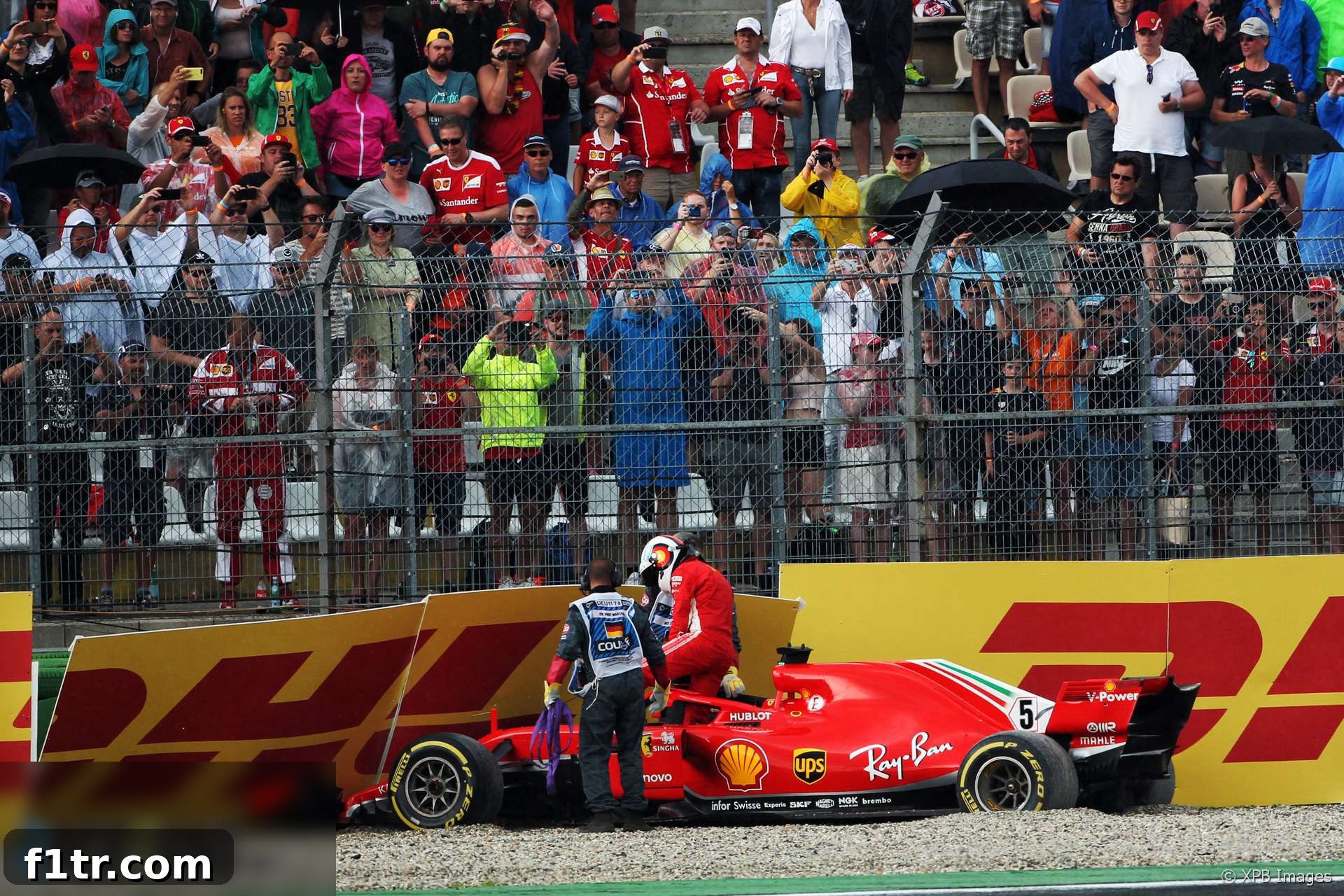
Sebastian Vettel described the incident that prematurely ended his challenge at the 2018 German Grand Prix as nothing more than a minor error, despite its catastrophic outcome for his race and championship aspirations.
Advert | Become a Supporter & Go Ad-Free
Sebastian Vettel’s Hockenheim Heartbreak: A “Small Mistake” with Monumental Consequences
The 2018 Formula 1 season presented an enthralling title fight between two titans of the sport: Sebastian Vettel of Ferrari and Lewis Hamilton of Mercedes. Both drivers, multiple world champions, were locked in a fierce battle, with momentum swinging between their respective teams. The German Grand Prix at Hockenheim, Vettel’s home race, was poised to be a crucial turning point, and indeed it was – though not in the way Ferrari fans had hoped.
The Race Unfolds: Dominance, Strategy, and the Onset of Rain
Heading into the German Grand Prix, Sebastian Vettel held an eight-point lead over Lewis Hamilton in the drivers’ championship. Starting from pole position, Vettel appeared to be in a commanding position, dominating the early stages of the race. His Ferrari SF71H looked formidable, showcasing impressive pace and handling, particularly in the dry conditions. He managed his tires effectively, building a comfortable lead over Valtteri Bottas, his closest competitor and Hamilton’s Mercedes teammate, who started second.
The race narrative seemed perfectly scripted for Vettel. A victory at Hockenheim would not only extend his championship lead but also provide a massive psychological boost at his home circuit. However, Formula 1 is a sport famously unpredictable, and the weather often plays the most dramatic role. As the race progressed towards its latter stages, dark clouds began to gather over the Hockenheimring, and the ominous threat of rain loomed large.
Strategic decisions became paramount. Teams had to weigh the risks of staying out on slick tires versus pitting for intermediates or wets. Some drivers gambled, while others conserved their existing tire sets, hoping the rain would either hold off or be light enough to manage. Lewis Hamilton, starting from a lowly 14th on the grid due to a hydraulic failure in qualifying, had been meticulously carving his way through the field, showcasing his exceptional race craft and resilience. His climb made his eventual position highly significant, putting him in a prime spot to capitalize on any unfolding drama.
The Pivotal Moment: Motodrom Hairpin, Lap 52
On lap 52, with light rain beginning to fall and increasing in intensity in certain sectors, the race took a dramatic and decisive turn. Sebastian Vettel, still leading, was navigating the treacherous conditions when disaster struck at the Motodrom hairpin, a section of the track known for its close-proximity grandstands and high-speed entry into a tight corner. As he braked for the corner, his Ferrari, running on older slick tires, lost grip on the damp tarmac.
The car slid helplessly across the runoff area, making unavoidable contact with the barrier. The impact was not severe in terms of speed, but it was enough to damage the front wing and nose of the Ferrari, leaving Vettel stranded in the gravel. The sight of his red car beached and out of the race sent shockwaves through the Ferrari garage and among his legions of fans. In a moment of raw, unadulterated frustration, the furious driver was seen pummelling his steering wheel with his hands, a vivid display of his despair at the sudden, cruel end to his dominant performance.
Speaking to the media shortly after the incident, Vettel articulated his immediate thoughts: “Well I was in the barrier and realised that I don’t get out from there.” He reflected on the nature of his error, downplaying its magnitude in terms of driving skill but acknowledging its monumental impact: “I don’t think it was a huge mistake. It was a huge impact on the race because we retired there.” His statement underscored the fine margins in Formula 1, where a seemingly minor miscalculation can lead to the most devastating outcomes.
The Aftermath: Apologies, Confidence, and A Shifting Title Battle
Despite the crushing disappointment, Vettel maintained a remarkably philosophical outlook on the immediate psychological toll. He expressed his belief that the incident wouldn’t haunt his sleep, stating, “[But] it’s not like tonight I will have difficulties to fall asleep because of what I have done wrong. It’s disappointing because up to that everything was sweet. But as I said we didn’t need the rain.” This sentiment highlighted his professional resilience but also perhaps a deep understanding of the unpredictable elements that can influence a race.
His choice of tires at the time of the crash also came under scrutiny. Vettel was on an older set of slick tires, unlike some of his rivals, including the eventual victor, Lewis Hamilton, who had recently pitted for fresher rubber or was on a different strategy. Addressing this, Vettel admitted, “They weren’t fresh but I guess it was slippery for everyone.” This comment subtly acknowledged the challenging conditions without fully blaming the tire choice, emphasizing the collective struggle for grip in the rain.
In a true display of sportsmanship and accountability, Vettel immediately apologised to his team for the crash. He recognized their impeccable work throughout the weekend and took full responsibility for the error. “Apologies to the team, they did everything right. I had it in my hands, a small mistake, big disappointment.” This public acknowledgement cemented his commitment to Ferrari and demonstrated his leadership qualities, even in moments of personal failure.
Despite the immediate setback, Vettel exuded confidence in Ferrari’s potential for the remainder of the season. He firmly believed in the strength of their car and their capabilities as a team. “We have a strong car so I think we can be as confident or more than anybody else. It was a very positive weekend,” he asserted, underscoring that one isolated incident shouldn’t overshadow the overall competitive package they possessed. His conviction was clear: this was just “one of those moments, my mistake,” and it wouldn’t define their championship charge.
The Domino Effect: Hamilton’s Victory and Momentum Shift
Vettel’s retirement dramatically altered the complexion of the race and, more significantly, the championship battle. Lewis Hamilton, who had skillfully navigated the chaotic conditions and benefited from a perfectly timed safety car deployment and an aggressive strategy call from Mercedes, clinched an improbable victory. From 14th on the grid, Hamilton’s triumph was a masterclass in opportunistic driving and strategic brilliance, further solidifying his reputation as a rain master.
The outcome was a brutal swing in the championship standings. Instead of extending his lead, Vettel found himself trailing Hamilton by 17 points. This single incident at Hockenheim was a critical turning point in the 2018 season, shifting the psychological momentum decisively in favor of Hamilton and Mercedes. Ferrari’s dream of a home victory evaporated, replaced by the bitter taste of what might have been. The season, which had promised so much for Vettel and Ferrari, began to unravel from this moment, with subsequent races further illustrating the lasting impact of this “small mistake.”
The German Grand Prix of 2018 serves as a poignant reminder of the razor-thin margins in Formula 1. A driver pushing the absolute limits, a sudden change in weather, and a momentary lapse can combine to create a monumental consequence. For Sebastian Vettel, it was a moment that encapsulated the agony and ecstasy of high-stakes motorsport, a stark lesson that even the smallest mistake can lead to the biggest disappointments and drastically alter the course of a championship.
Advert | Become a RaceFans supporter andgo ad-free
Further Reading: The 2018 F1 Season and Beyond
- F1 feared “death knell” for Drive to Survive after Ferrari and Mercedes snub
- McLaren staff told us we were “totally crazy” to take Honda engines in 2018 – Tost
- ‘It doesn’t matter if we start last’: How Red Bull’s junior team aided Honda’s leap forward
- Honda’s jet division helped F1 engineers solve power unit problem
- McLaren Racing losses rise after Honda split
Browse all 2018 F1 season articles