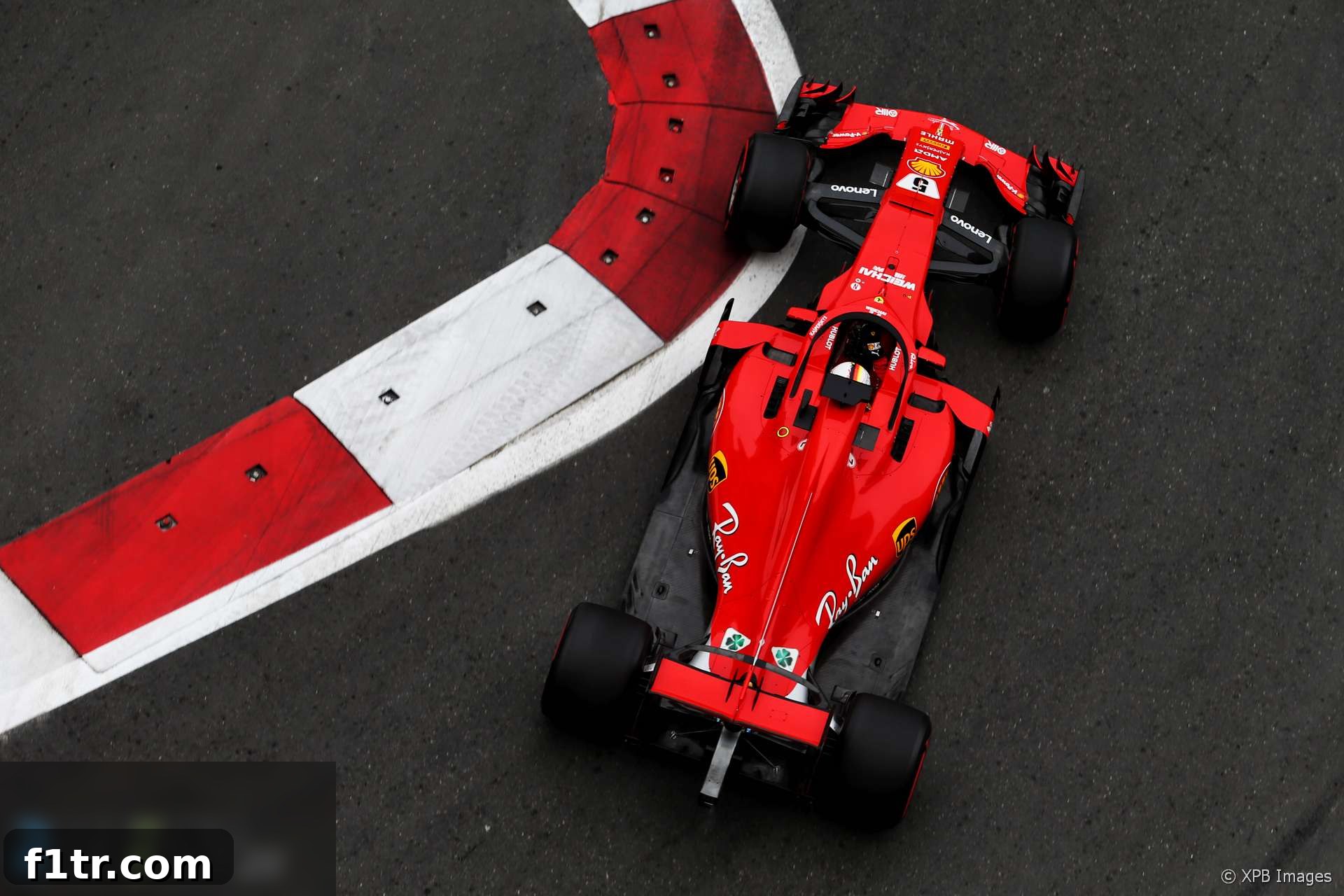
Azerbaijan Grand Prix: Sebastian Vettel Dominates Final Practice as Qualifying Looms Amidst Drama
The stage is set for a thrilling qualifying session at the Azerbaijan Grand Prix, following a dramatic and revealing third practice (FP3) session. Ferrari’s Sebastian Vettel emerged as the fastest driver, laying down a formidable lap time that underscored his team’s strong contention for pole position. However, the session was not without its moments of high tension, with a late crash by Sergey Sirotkin bringing out the yellow flags and disrupting the final crucial minutes of preparation for many competitors.
Advert | Become a Supporter & go ad-free
Vettel Leads the Charge: Ferrari’s Unwavering Pace
Sebastian Vettel’s best effort of 1 minute 43.091 seconds during FP3 solidified Ferrari’s position as a leading contender this weekend. While this time didn’t eclipse the blistering pace set by his teammate Kimi Raikkonen in Friday’s second practice session, it demonstrated consistent performance and the team’s ability to extract maximum potential from their SF71H chassis on the demanding Baku City Circuit. The German driver, known for his precision and aggressive driving style, looked comfortable and quick, navigating the unique challenges of the street circuit with apparent ease. His performance suggests that Ferrari has found a sweet spot with their car setup, giving them a significant edge heading into the critical qualifying showdown.
Despite almost all drivers utilizing the grippy ultra-soft tyres for the majority of the session, a general trend saw very few improving on the quickest times established during Friday’s running. This could be attributed to evolving track conditions, varying fuel loads, or teams focusing on race simulations rather than outright single-lap pace. Nevertheless, Vettel’s ability to top the session, even if not setting a new weekend benchmark, speaks volumes about Ferrari’s strong form and their readiness to challenge for victory.
Mercedes on the Hunt: Hamilton and Bottas Close the Gap
Chasing the red machines, Lewis Hamilton systematically chipped away at his lap times, steadily improving throughout the session to secure the second-fastest spot. The reigning world champion finished within four-tenths of a second of Vettel’s leading Ferrari, a gap that indicates Mercedes has made significant progress in understanding the circuit and optimizing their W09 EQ Power+ challenger. Hamilton’s relentless pursuit of perfection saw him continually push the limits, demonstrating his characteristic determination.
Just behind the top two, the battle for third, fourth, and fifth positions was incredibly tight, with three drivers separated by little more than a tenth of a second. Kimi Raikkonen, despite not improving on his Friday best, showed strong pace to secure third. Following him was Max Verstappen, who enjoyed what was arguably his smoothest session of the weekend so far, exhibiting the raw speed and confidence often associated with the young Dutchman. Valtteri Bottas rounded out this tightly packed trio, placing his Mercedes in fifth. The narrow margins between these front-runners promise an electrifying qualifying battle, where every thousandth of a second will count.
Red Bull’s Contrasting Fortunes: Verstappen’s Smooth Ride, Ricciardo’s Struggle
While Max Verstappen delivered a promising performance for Red Bull, indicating strong potential for the team, his teammate and Friday pace-setter, Daniel Ricciardo, found himself unexpectedly far down the order in 12th position. This stark contrast highlights the complexities of the Baku circuit and the fine margins that differentiate a stellar lap from an average one. Ricciardo’s inability to match his earlier pace, despite the use of ultra-soft tyres, will be a point of concern for the Red Bull garage as they prepare for qualifying. The team will be working diligently to understand the data and help Ricciardo rediscover the blistering speed he showcased on Friday, which saw him set the fastest time of the weekend until that point.
Despite these varied performances, all four Mercedes-powered drivers managed to feature in the top 10, underscoring the strength of the German manufacturer’s power unit. This suggests that while Ferrari and Red Bull have demonstrated outright pace, Mercedes’ customer teams, Force India and Williams, are also benefiting from competitive powerplants, enabling them to fight for strong midfield positions.
Midfield Melee: Haas’s Potential and Williams’s Woes
The midfield battle proved to be as intense and unpredictable as ever. Kevin Magnussen continued to impress, brilliantly demonstrating the raw potential of the Haas VF-18 by setting the seventh-fastest time. The American team has consistently shown flashes of brilliance this season, and Magnussen’s performance here further reinforces their capability to challenge for significant points. His consistent pace and ability to extract performance from the car will undoubtedly boost the team’s morale.
However, it was a more challenging session for his teammate, Romain Grosjean. The Frenchman struggled significantly with the balance of his car, spinning twice and voicing numerous complaints over the team radio. His difficulties highlight the intricate nature of car setup on a circuit like Baku, where precision and confidence are paramount. Grosjean’s struggles underscore the fine line between success and frustration in Formula 1, even within the same team.
The session’s most significant incident occurred with just under 10 minutes remaining when Sergey Sirotkin crashed at the exit of Turn 3. The Williams driver lost control, making heavy contact with the barriers. This unfortunate incident not only ended his session prematurely but also brought out the yellow flags, disrupting the final flying laps for many drivers who were attempting to improve their times or fine-tune their qualifying simulations. Such interruptions can have a profound impact on a team’s preparation, forcing them to adapt quickly ahead of the decisive qualifying session.
Renault and Toro Rosso: Seeking Gains on the Grid
The Renault drivers, Carlos Sainz Jnr and Nico Hulkenberg, found themselves languishing towards the bottom of the timesheets. This was largely due to their strategic choice to spend a significant portion of the session running on the harder super-soft tyres, likely focusing on long-run data and race pace rather than outright qualifying simulations. Their true potential is expected to be revealed in qualifying when they switch to softer compounds. Meanwhile, Brendon Hartley of Toro Rosso propped up the timesheets, having locked up at one point while deftly avoiding a potential collision with Sebastian Vettel’s Ferrari. These moments underscore the high-pressure environment and split-second decisions required from F1 drivers.
Azerbaijan Grand Prix Third Practice Results: A Detailed Breakdown
Here’s a comprehensive look at the individual performances and the final standings from the intense third practice session, providing a clear picture of who excelled and who faced challenges ahead of qualifying. These times offer a crucial snapshot of each team’s current form and potential pecking order.
| Pos. | No. | Driver | Car | Best lap | Gap | Laps |
|---|---|---|---|---|---|---|
| 1 | 5 | Sebastian Vettel | Ferrari | 1’43.091 | 17 | |
| 2 | 44 | Lewis Hamilton | Mercedes | 1’43.452 | 0.361 | 16 |
| 3 | 7 | Kimi Raikkonen | Ferrari | 1’43.493 | 0.402 | 17 |
| 4 | 33 | Max Verstappen | Red Bull-TAG Heuer | 1’43.519 | 0.428 | 17 |
| 5 | 77 | Valtteri Bottas | Mercedes | 1’43.569 | 0.478 | 20 |
| 6 | 11 | Sergio Perez | Force India-Mercedes | 1’43.936 | 0.845 | 9 |
| 7 | 20 | Kevin Magnussen | Haas-Ferrari | 1’43.958 | 0.867 | 11 |
| 8 | 18 | Lance Stroll | Williams-Mercedes | 1’44.123 | 1.032 | 8 |
| 9 | 31 | Esteban Ocon | Force India-Mercedes | 1’44.220 | 1.129 | 11 |
| 10 | 35 | Sergey Sirotkin | Williams-Mercedes | 1’44.534 | 1.443 | 9 |
| 11 | 14 | Fernando Alonso | McLaren-Renault | 1’44.763 | 1.672 | 12 |
| 12 | 3 | Daniel Ricciardo | Red Bull-TAG Heuer | 1’44.861 | 1.770 | 17 |
| 13 | 10 | Pierre Gasly | Toro Rosso-Honda | 1’44.905 | 1.814 | 16 |
| 14 | 16 | Charles Leclerc | Sauber-Ferrari | 1’45.218 | 2.127 | 15 |
| 15 | 8 | Romain Grosjean | Haas-Ferrari | 1’45.261 | 2.170 | 12 |
| 16 | 55 | Carlos Sainz Jnr | Renault | 1’45.432 | 2.341 | 15 |
| 17 | 27 | Nico Hulkenberg | Renault | 1’45.456 | 2.365 | 11 |
| 18 | 2 | Stoffel Vandoorne | McLaren-Renault | 1’45.505 | 2.414 | 13 |
| 19 | 9 | Marcus Ericsson | Sauber-Ferrari | 1’45.910 | 2.819 | 17 |
| 20 | 28 | Brendon Hartley | Toro Rosso-Honda | 1’46.186 | 3.095 | 11 |
Advert | Become a RaceFans supporter andgo ad-free
Third Practice Visual Gaps
Sebastian Vettel – 1’43.091
+0.361 Lewis Hamilton – 1’43.452
+0.402 Kimi Raikkonen – 1’43.493
+0.428 Max Verstappen – 1’43.519
+0.478 Valtteri Bottas – 1’43.569
+0.845 Sergio Perez – 1’43.936
+0.867 Kevin Magnussen – 1’43.958
+1.032 Lance Stroll – 1’44.123
+1.129 Esteban Ocon – 1’44.220
+1.443 Sergey Sirotkin – 1’44.534
+1.672 Fernando Alonso – 1’44.763
+1.770 Daniel Ricciardo – 1’44.861
+1.814 Pierre Gasly – 1’44.905
+2.127 Charles Leclerc – 1’45.218
+2.170 Romain Grosjean – 1’45.261
+2.341 Carlos Sainz Jnr – 1’45.432
+2.365 Nico Hulkenberg – 1’45.456
+2.414 Stoffel Vandoorne – 1’45.505
+2.819 Marcus Ericsson – 1’45.910
+3.095 Brendon Hartley – 1’46.186
Drivers more than ten seconds off the pace omitted.
Advert | Become a RaceFans supporter andgo ad-free
Comprehensive Practice Overview: FP1, FP2, and FP3 Combined
A look at the complete practice times from across all three sessions offers valuable insights into the teams’ strategies and overall performance trends. While FP3 provided the latest snapshot, understanding the progression through FP1 and FP2 reveals how teams adapted to the circuit and developed their car setups. It highlights drivers who found pace early and maintained it, versus those who struggled or made significant gains later on.
| Pos | Driver | Car | FP1 | FP2 | FP3 | Fri/Sat diff | Total laps |
|---|---|---|---|---|---|---|---|
| 1 | Daniel Ricciardo | Red Bull-TAG Heuer | 1’44.277 | 1’42.795 | 1’44.861 | +2.066 | 76 |
| 2 | Kimi Raikkonen | Ferrari | 1’46.861 | 1’42.864 | 1’43.493 | +0.629 | 60 |
| 3 | Max Verstappen | Red Bull-TAG Heuer | 1’45.559 | 1’42.911 | 1’43.519 | +0.608 | 55 |
| 4 | Sebastian Vettel | Ferrari | 1’46.513 | 1’44.127 | 1’43.091 | -1.036 | 73 |
| 5 | Lewis Hamilton | Mercedes | 1’45.200 | 1’43.603 | 1’43.452 | -0.151 | 71 |
| 6 | Valtteri Bottas | Mercedes | 1’44.242 | 1’43.570 | 1’43.569 | -0.001 | 71 |
| 7 | Fernando Alonso | McLaren-Renault | 1’46.465 | 1’43.700 | 1’44.763 | +1.063 | 71 |
| 8 | Esteban Ocon | Force India-Mercedes | 1’45.237 | 1’43.814 | 1’44.220 | +0.406 | 70 |
| 9 | Carlos Sainz Jnr | Renault | 1’48.741 | 1’43.834 | 1’45.432 | +1.598 | 62 |
| 10 | Sergio Perez | Force India-Mercedes | 1’45.075 | 1’44.142 | 1’43.936 | -0.206 | 66 |
| 11 | Kevin Magnussen | Haas-Ferrari | 1’47.434 | 1’43.977 | 1’43.958 | -0.019 | 58 |
| 12 | Nico Hulkenberg | Renault | 1’46.749 | 1’44.091 | 1’45.456 | +1.365 | 55 |
| 13 | Lance Stroll | Williams-Mercedes | 1’46.590 | 1’44.459 | 1’44.123 | -0.336 | 65 |
| 14 | Romain Grosjean | Haas-Ferrari | 1’46.856 | 1’44.425 | 1’45.261 | +0.836 | 62 |
| 15 | Sergey Sirotkin | Williams-Mercedes | 1’46.480 | 1’45.007 | 1’44.534 | -0.473 | 70 |
| 16 | Pierre Gasly | Toro Rosso-Honda | 1’46.492 | 1’44.712 | 1’44.905 | +0.193 | 73 |
| 17 | Charles Leclerc | Sauber-Ferrari | 1’46.875 | 1’44.940 | 1’45.218 | +0.278 | 66 |
| 18 | Brendon Hartley | Toro Rosso-Honda | 1’46.747 | 1’45.051 | 1’46.186 | +1.135 | 79 |
| 19 | Stoffel Vandoorne | McLaren-Renault | 1’47.967 | 1’45.288 | 1’45.505 | +0.217 | 63 |
| 20 | Marcus Ericsson | Sauber-Ferrari | 1’47.073 | 1’46.042 | 1’45.910 | -0.132 | 47 |
Anticipating Qualifying: The Battle for Baku Pole
With third practice concluded, all eyes now turn to qualifying, where the grid positions for the Azerbaijan Grand Prix will be determined. The session has highlighted Ferrari’s impressive speed, with Sebastian Vettel leading the way, suggesting they have a strong package for the challenging street circuit. Mercedes, led by Lewis Hamilton, appears to be closing the gap, setting the stage for a classic Red vs. Silver arrow battle at the front. Max Verstappen’s strong showing in FP3 positions Red Bull as a dark horse, capable of springing a surprise.
The incident involving Sergey Sirotkin, while unfortunate, has added an element of unpredictability. Drivers who had their final runs compromised will need to quickly adapt and find their rhythm in qualifying. Tyre strategy will also play a crucial role, with the ultra-softs being the preferred compound for single-lap pace, but their degradation characteristics needing careful management over a qualifying run.
The unique blend of high-speed straights and tight, technical sections at the Baku City Circuit promises a captivating qualifying session. Every corner will demand precision, and every hundredth of a second will matter. Fans can expect a fierce contest as drivers push their cars to the absolute limit in pursuit of pole position for what is anticipated to be a thrilling race day.
Go ad-free for just £1 per month>> Find out more and sign up
More on the 2018 Azerbaijan Grand Prix
- 2018 Azerbaijan Grand Prix Star Performers
- Top ten pictures from the 2018 Azerbaijan Grand Prix
- Baku provides another race to remember – but not for luckless Bottas
- Leclerc is first points-scorer from Monaco in 978 races
- Paddock Diary: Azerbaijan Grand Prix day four
Browse all 2018 Azerbaijan Grand Prix articles