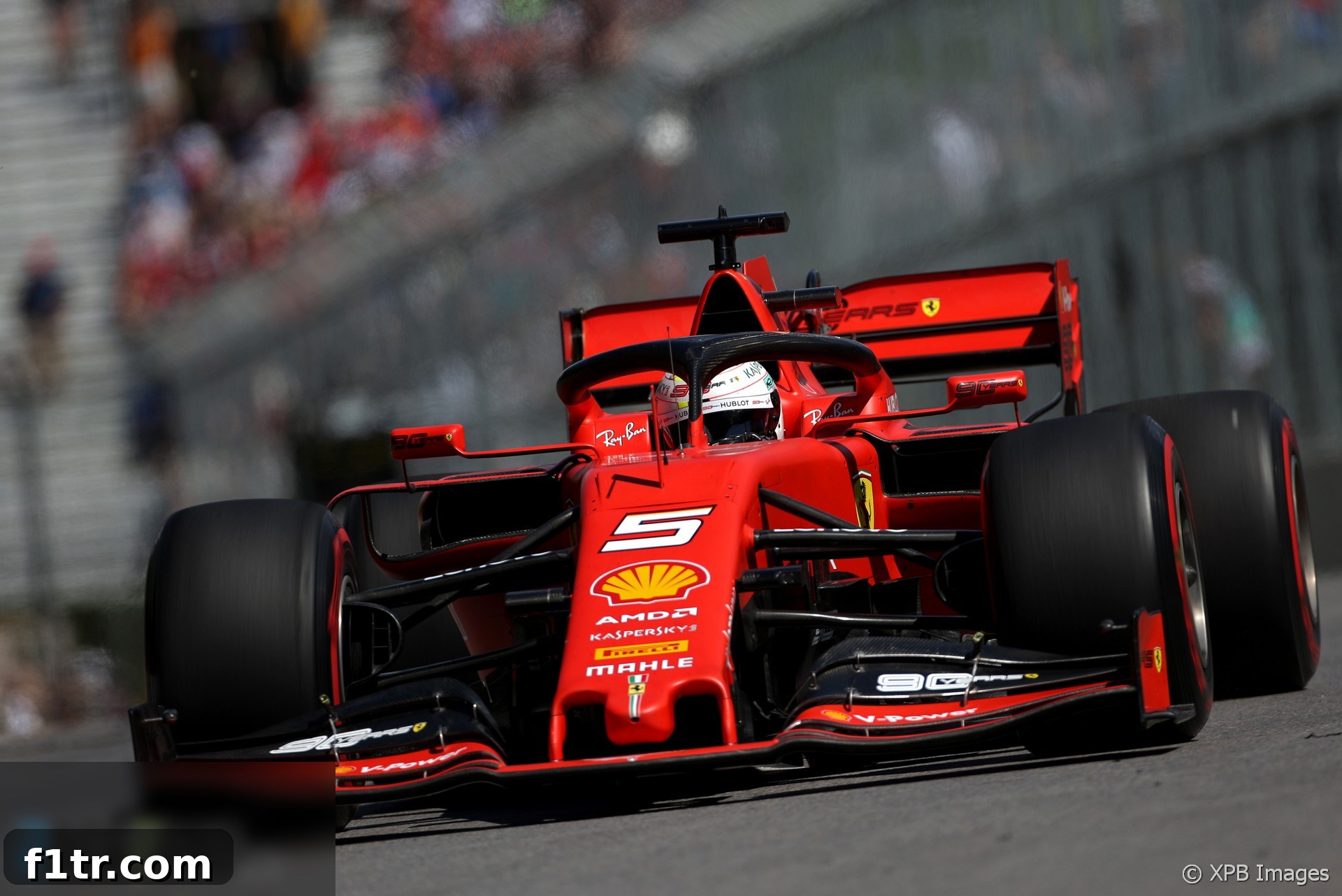
Sebastian Vettel Sounds Note of Caution Despite Ferrari’s Practice Dominance at Circuit Gilles Villeneuve
Formula 1 veteran Sebastian Vettel isn’t getting carried away by Ferrari’s impressive showing in Friday’s practice sessions for the Canadian Grand Prix. Despite topping the timesheets alongside teammate Charles Leclerc, the four-time world champion believes the Scuderia still has a significant deficit to overcome against rivals Mercedes, especially considering the day’s unusual circumstances which included a crash for Lewis Hamilton.
The iconic Circuit Gilles Villeneuve in Montreal witnessed a rather eventful start to the race weekend. While Ferrari seemed to find a surprising surge of pace, securing the top two spots in the afternoon session, Vettel remained grounded in his assessment. “We’re not the fastest,” he stated unequivocally after the session, dampening expectations that Ferrari had suddenly leaped ahead of their main competitors. This cautious stance by the German driver suggests a deeper understanding of the competitive landscape, looking beyond the raw lap times displayed on the monitors.
Ferrari’s Friday Pace: A Deceptive Picture for the Canadian Grand Prix?
The free practice sessions often paint a misleading picture of the pecking order in Formula 1, and Friday in Montreal was no exception. Charles Leclerc and Sebastian Vettel both put in strong lap times, suggesting that Ferrari might have found an answer to Mercedes’ consistent dominance throughout the season. However, their closest rival, Lewis Hamilton, saw his second practice session cut short by an unfortunate incident. A spin into the wall at turn 7 meant the Mercedes driver was unable to complete his planned long runs or crucial performance assessments, potentially skewing the overall data and making direct comparisons less reliable. This incident, while minor in terms of Hamilton’s well-being, had a significant impact on the transparency of the session, as Vettel alluded to, making it difficult to gauge true performance levels across the field.
Vettel elaborated on his skepticism, acknowledging the raw lap times but emphasizing the underlying performance gap he perceives. “I know in terms of result if you look at the one-lap performance it looks maybe like that this afternoon,” he explained to reporters. “But I think there’s still quite a reasonable gap to Mercedes.” This statement highlights a nuanced understanding of Formula 1 performance, where raw pace over a single lap in practice can often be deceptive. Teams might be running different fuel loads, engine modes, or experimental car setups, all of which can drastically alter lap times, making direct, conclusive comparisons challenging.
Unlocking Mercedes’ Hidden Potential and Ferrari’s Ongoing Challenge
Indeed, earlier in first practice, the Mercedes machinery had demonstrated a clear advantage, with Hamilton’s car reportedly almost a second quicker than Ferrari’s best efforts, even as Ferrari continued to struggle to match the Silver Arrows’ consistent pace. Vettel’s concern stems from the belief that Mercedes still holds a significant edge, particularly in cornering speed – a critical factor on a circuit like Montreal which combines long, high-speed straights with demanding chicanes and tight hairpins. The German driver anticipates that Mercedes can unlock substantially more performance from their W10 challenger, especially once they fine-tune their setup and fully exploit their car’s inherent strengths, which have proven formidable throughout the season.
The dynamic between Ferrari and Mercedes has been a season-long narrative, often characterized by Ferrari’s impressive straight-line speed balanced against Mercedes’ superior performance through corners and more effective tire management. Vettel’s comments suggest that despite the practice session’s outcome, these fundamental differences between the two cars might still favor Mercedes when it comes to the crucial qualifying session and the gruelling race conditions on Sunday. The ability of Mercedes to consistently deliver performance under pressure remains a key factor in their success, and Vettel is acutely aware of this.
Optimizing the SF90: “Car Feels Not Yet The Way I Want It”
Adding another layer to his cautious outlook, Vettel admitted that he wasn’t entirely comfortable with the feel of his SF90. “Also the car feels not yet the way I want it,” he revealed, a sentiment that speaks volumes about a driver’s confidence in their machinery. This connection with the car is crucial for a driver of Vettel’s calibre, whose success often hinges on a deep understanding of his vehicle’s limits and the ability to push it with absolute conviction. A car that doesn’t inspire confidence can lead to marginal losses in lap time across the challenging and unforgiving Canadian circuit, where precision and aggressive driving are paramount.
The complexities of setting up a modern Formula 1 car are immense, especially at a unique hybrid circuit like Montreal that demands a finely tuned compromise between aerodynamic efficiency for the long straights and maximum downforce for the tight, technical corners. Vettel hinted at ongoing development and crucial setup adjustments, stating, “We have some, I wouldn’t say ‘tricks up our sleeve,’ but stuff that we want to try and get a read on and we’ll see.” This suggests that Ferrari’s engineering team will be working tirelessly overnight, analyzing reams of data, making meticulous changes, and potentially unlocking hidden performance from their package. The primary goal will be to improve the car’s balance, responsiveness, and overall driveability, thereby allowing both Vettel and Leclerc to extract maximum pace and confidence from their SF90.
The Delicate Balance of Tire Strategy at Circuit Gilles Villeneuve
Beyond car setup and competitive analysis, Sebastian Vettel also voiced significant concerns regarding tire durability, specifically with the softest compound available for the Canadian Grand Prix weekend. “The tyres didn’t last very long, the very soft compound,” he observed, pointing to a critical factor that could define the race strategy. The Circuit Gilles Villeneuve is notoriously tough on tires due to its high-speed nature, heavy braking zones leading into slow corners, and the aggressive traction demands out of chicanes. Pirelli’s softer compounds often struggle with blistering and excessive degradation here, making robust tire management a critically important aspect of any successful race strategy.
The feedback gathered from Friday’s practice sessions regarding tire wear will be instrumental for teams in finalizing their strategies for both qualifying and the race. If the soft tires degrade too quickly, it could push teams towards a more conservative strategy in qualifying, perhaps opting for medium tires to ensure a cleaner start, or forcing multiple pit stops during the Grand Prix, adding another layer of complexity to an already challenging race. Understanding how to extract optimal performance from each compound without prematurely destroying the tires will be a key differentiator between success and struggle in Montreal, where track position is vital but tire life can dictate the outcome.
Track Evolution and The Weekend Ahead: Anticipating Conditions
The initial conditions of the track also played a significant role in what Vettel described as an “interesting session.” “Obviously quite bit slippery, quite dirty to start with,” he noted, highlighting the typical characteristics of the Circuit Gilles Villeneuve at the beginning of a race weekend. Being a semi-permanent street circuit, the track surface often starts off dusty and low on grip. However, as more cars run laps across the weekend and rubber gets laid down, the track progressively “rubbers in” and offers significantly more grip. This phenomenon, known as track evolution, is a crucial factor that teams must anticipate and adapt to throughout the weekend, often seeing lap times drop considerably from Friday to Sunday.
Vettel emphasized the importance of this ongoing evolution: “But I think the track will improve the whole weekend so the key will be to go with the track.” This means that car setups and driving styles that might work optimally on Friday might not be as effective on Saturday during qualifying or on Sunday for the Grand Prix. Teams need to predict how the track will evolve and adjust their cars accordingly, finding a fine balance that remains competitive as grip levels steadily increase. This continuous adaptation is a hallmark of Formula 1 and presents a particular challenge at venues like Montreal, demanding flexibility and foresight from engineers and drivers alike.
Looking ahead to Saturday’s qualifying session, the pressure will be immense on Ferrari to translate any genuine pace into a strong grid position, ideally on the front row. Mercedes, despite Lewis Hamilton’s FP2 setback, remains the benchmark in Formula 1, and their ability to extract peak performance when it truly matters is well-documented. The Canadian Grand Prix weekend promises to be a thrilling battle of wits, engineering prowess, and sheer driving speed, with Vettel’s cautious optimism setting the stage for an intense fight at the sharp end of the grid. Ferrari will be hoping their ‘tricks up their sleeve’ and continued development can bridge the perceived gap to Mercedes and allow them to challenge for victory.
The strategic decisions around tire compounds, coupled with the ever-improving track conditions and the ongoing pursuit of optimal car setup, will define who emerges victorious from what is shaping up to be a captivating Canadian Grand Prix, showcasing the best of Formula 1.