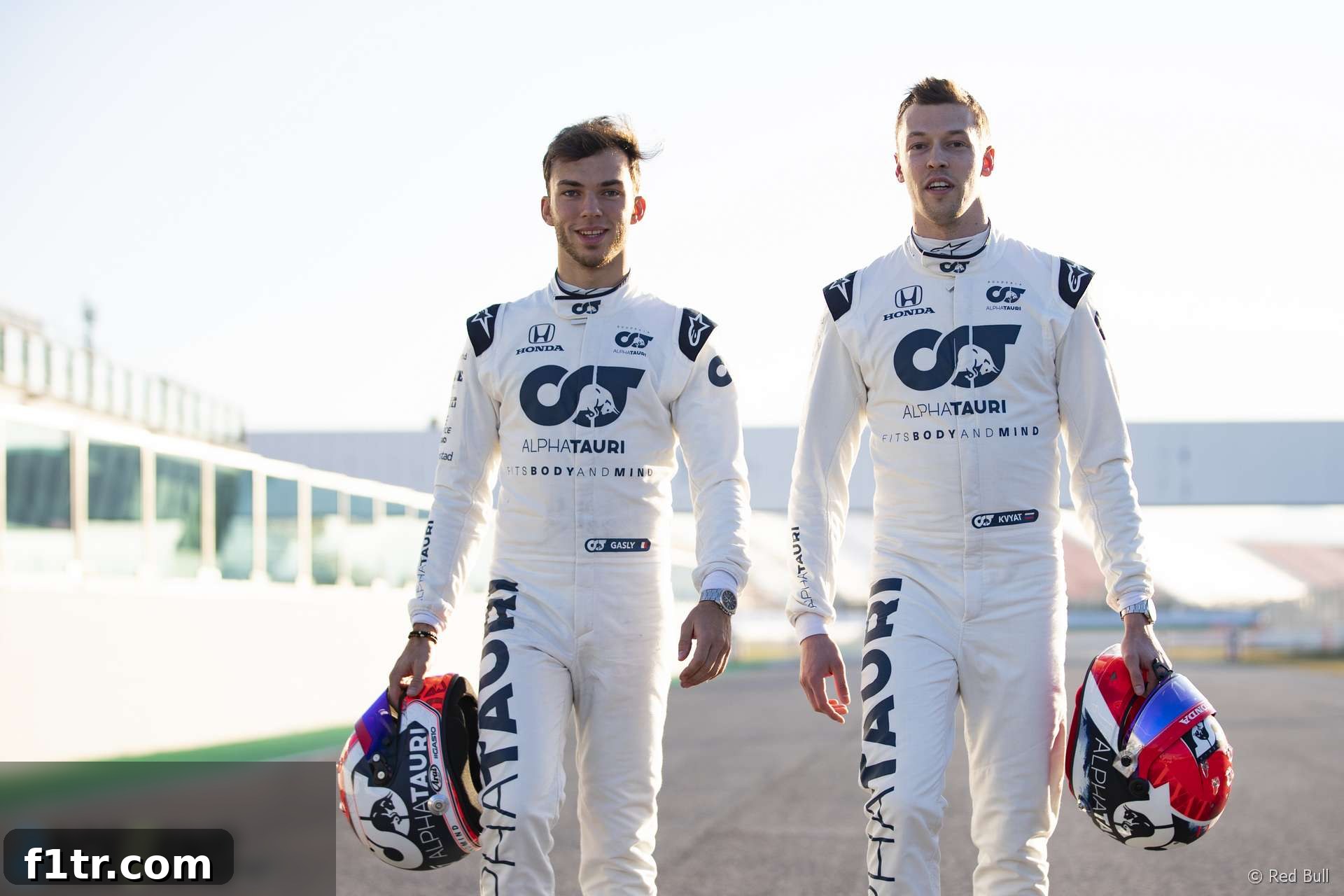
In the dynamic world of Formula 1, team principals often make bold statements about their driver pairings. This year, Franz Tost, the seasoned team principal of AlphaTauri, has declared his current line-up as the strongest the team has ever fielded since its inception as Toro Rosso in 2006. This significant endorsement highlights the team’s ambitions and the perceived strength of their chosen drivers as they embark on a new chapter under the AlphaTauri brand. Such declarations are not made lightly and speak volumes about the confidence within the team’s leadership regarding their competitive prospects for the season ahead.
Franz Tost on AlphaTauri’s Strongest Driver Line-up Yet
When questioned about whether Pierre Gasly and Daniil Kvyat constitute his best driver pairing to date, Franz Tost offered a resounding affirmation, delving into the individual merits and collective potential of the two talents.
Yes, I would absolutely underline this, because when we analyse both drivers, their capabilities are truly exceptional. Daniil Kvyat possesses a fantastic natural speed and an inherent talent for racing. His career trajectory showcases significant achievements, including race victories and championships in junior categories, most notably in GP3. He has consistently demonstrated raw pace and a competitive spirit that sets him apart.
Equally impressive is Pierre Gasly, who also boasts a strong record of success, having secured multiple race wins and clinching the highly competitive GP2 championship. Furthermore, his performances in the latter half of last season were nothing short of spectacular. One simply needs to recall his magnificent second-place finish in Sao Paulo, where he masterfully defended against Lewis Hamilton for an entire lap, holding off one of the sport’s greatest drivers to secure a memorable podium. This particular race served as a powerful testament to his racecraft, composure under pressure, and undeniable skill.
The combination of Kvyat’s raw speed and Gasly’s proven race-winning ability and resilience makes for an incredibly potent and balanced driver line-up. Both drivers bring a wealth of experience, not just from their time in Formula 1 but also from their successful junior careers, which has forged them into formidable competitors. Their understanding of the team, having both previously driven for Toro Rosso, now AlphaTauri, also contributes to a cohesive and focused unit, capable of maximizing the performance of our car and pushing the team forward.
Quotes: Dieter Rencken
Advert | Become a RaceFans supporter and go ad-free
Social Media Pulse: Insights from the F1 Paddock
Social media platforms continue to be a vital source for immediate updates and behind-the-scenes glimpses from the world of Formula 1. Teams and drivers frequently share their experiences, thoughts, and crucial moments with fans, fostering a deeper connection and offering unique perspectives on the sport.
Among the notable posts recently shared, the Visa Cash App RB F1 Team (formerly AlphaTauri) captured the excitement surrounding Pierre Gasly’s initial experience with the new car. A video snippet featured Gasly mic’d up, allowing fans to hear his raw, unedited reactions to his first drive. This type of content offers an authentic insight into a driver’s perspective and the immediate feedback loop between man and machine, highlighting the special connection drivers form with their new challengers at the start of a season.
Meanwhile, Williams Racing provided an update from pre-season testing, emphasizing “Progress” as the key takeaway from the first test session. This post, often accompanied by visual content, typically reflects a team’s ongoing efforts to refine their car, address any initial issues, and steadily improve performance ahead of the competitive racing calendar. For Williams, a team focused on rebuilding, such updates underscore their commitment to development and their aspirations for a stronger showing.
- For comprehensive coverage and to find more official F1 accounts to follow, explore the F1 Twitter Directory.
Further Insights from the Motorsport World
Beyond the immediate headlines of Formula 1, the broader landscape of motor racing constantly generates significant developments and discussions. Here are more motor racing links of interest, offering diverse perspectives on track developments, endurance racing strategies, and initiatives promoting inclusivity in motorsport.
Advert | Become a Supporter & go ad-free
Drivers Weigh In on COTA Track Resurfacing (Sportscar365)
The Circuit of the Americas (COTA) in Texas has undergone significant resurfacing efforts, a move that often sparks debate among drivers regarding its impact on racing characteristics. One driver notably commented on the outcome: “It’s still bumpy, but maybe a bit less bumpy on the new surface than the old surface. It’s got a lot of character to it and I’m not averse to having a few bumps on a race track.” This perspective highlights the balance between smooth, fast surfaces and those that present a unique challenge, often preferred by drivers who appreciate tracks with distinct personalities and demands. Resurfacing projects are crucial for safety and performance, yet maintaining a track’s unique ‘character’ is a constant consideration in modern motorsport.
Toyota Remains Committed to Hypercar – Vasselon (Motorsport Week)
In the realm of endurance racing, particularly the World Endurance Championship (WEC), the Hypercar class represents the pinnacle of competition. Pascal Vasselon, a key figure at Toyota Gazoo Racing, reaffirmed the manufacturer’s unwavering commitment to the Hypercar formula. Vasselon also elaborated on Toyota’s strategic decision to forgo the LMDh regulations, stating that “it does not meet with the company’s motivations for endurance racing.” This clarification underscores Toyota’s long-term vision for top-tier endurance competition, prioritizing specific technical and philosophical alignments over broader category participation, reinforcing their dedication to developing cutting-edge hybrid technology within the Hypercar framework.
FIA Disability and Accessibility Commission Supports Disabled Drivers Through New Safety Equipment Grant (FIA)
The FIA, motorsport’s governing body, continues its crucial work beyond the track with initiatives aimed at fostering inclusivity. The FIA Disability and Accessibility Commission has announced a significant program to support disabled drivers by offering the no-cost supply of a range of essential safety equipment. This initiative is a testament to the FIA’s commitment to making motorsport accessible to a wider demographic, removing financial and logistical barriers that might prevent talented individuals with disabilities from pursuing their passion for racing. Such grants not only enhance safety but also promote diversity, ensuring that skill and determination, rather than physical limitations or financial constraints, are the primary determinants of participation in motorsport.
We always endeavour to credit original sources. If you have a tip for a link to feature in the next RaceFans round-up please send it in via the contact form.
Advert | Become a RaceFans supporter and go ad-free
Comment of the Day: The Shifting Sands of F1 Innovation and Regulation
The intricate balance between fostering innovation and maintaining fair competition in Formula 1 is a perpetual source of debate. Stephen Crowsen (@Drycrust) eloquently captured this sentiment in his “Comment of the day,” expressing his disappointment regarding perceived inconsistencies in how the FIA governs technical novelties.
Being an advocate for innovation, it is profoundly disappointing to witness genuine innovation seemingly being stifled or, conversely, selectively allowed within the sport.
Last season, the Formula 1 community witnessed a controversial decision where Renault’s race results from the Japanese Grand Prix were disqualified. The reason? They had implemented an innovative system for adjusting brake bias. Critically, this system did not explicitly breach any existing technical regulations. Instead of acknowledging and potentially integrating this ingenious solution as a valid innovation that could have benefited all competing teams by pushing the boundaries of engineering, the stewards chose a different path. They disqualified Renault, citing a breach of Sporting Regulation 27.1, which stipulates that “the driver must drive the car alone and unaided.” This interpretation effectively drew a line in the sand, determining that certain forms of driver assistance, even if technically clever and not explicitly forbidden, were outside the spirit of the regulation.
Fast forward to the current season, and we observe Mercedes introducing a highly innovative system – the Dual Axis Steering (DAS). This groundbreaking mechanism allows drivers to adjust the toe angle of the front wheels by pushing or pulling the steering wheel. What is particularly striking, and forms the crux of the current controversy, is that Mercedes has received the blessing of the FIA for this system. However, to my admittedly untrained legal mind, it appears that the Dual Axis Steering system might, at least in principle, contravene technical regulation 10.2.1. This regulation clearly states: “With the steering wheel fixed, the position of each wheel centre and the orientation of its rotation axis must be completely and uniquely defined by a function of its principally vertical suspension travel, save only for the effects of reasonable compliance which does not intentionally provide further degrees of freedom.”
The apparent discrepancy in judgment between the Renault brake bias case and the Mercedes DAS system raises significant questions about the consistency of regulatory interpretations and the criteria applied when assessing innovation. If Renault’s system was deemed to provide an ‘aid’ to the driver, despite not breaking specific technical rules, how is DAS, which provides a direct, driver-controlled adjustment to the car’s geometry during a lap, interpreted differently? This perceived double standard risks creating an environment where the FIA’s rulings on innovation are seen as arbitrary, potentially discouraging smaller teams from investing in creative solutions if there’s no clear, consistent framework for what constitutes a permissible advancement versus an illegal aid or design. The integrity of F1’s competitive landscape hinges on transparent and equitable application of its rulebook.
Stephen Crowsen (@Drycrust)
Happy Birthday to Our Motorsport Enthusiasts!
A very special happy birthday goes out to Bt52B and Bt52B! We hope you have a fantastic day celebrating your passion for motorsport.
If you’d like to receive a birthday shout-out in a future round-up, simply let us know when yours is via the contact form or by adding your details to our comprehensive list here. We love celebrating our community members!
On This Day in F1 History
- Born today in 1953: Satoru Nakajima. A revered figure in Japanese motorsport, Nakajima was the first full-time Japanese Formula 1 driver, making his debut in 1987 with Lotus-Honda. Known for his consistent performances and for paving the way for future Japanese talent in F1, he competed in 80 Grands Prix, scoring 16 career points. His career highlights include a notable fourth-place finish at the 1987 British Grand Prix and a fastest lap at the 1989 Australian Grand Prix, demonstrating his talent against the era’s giants.