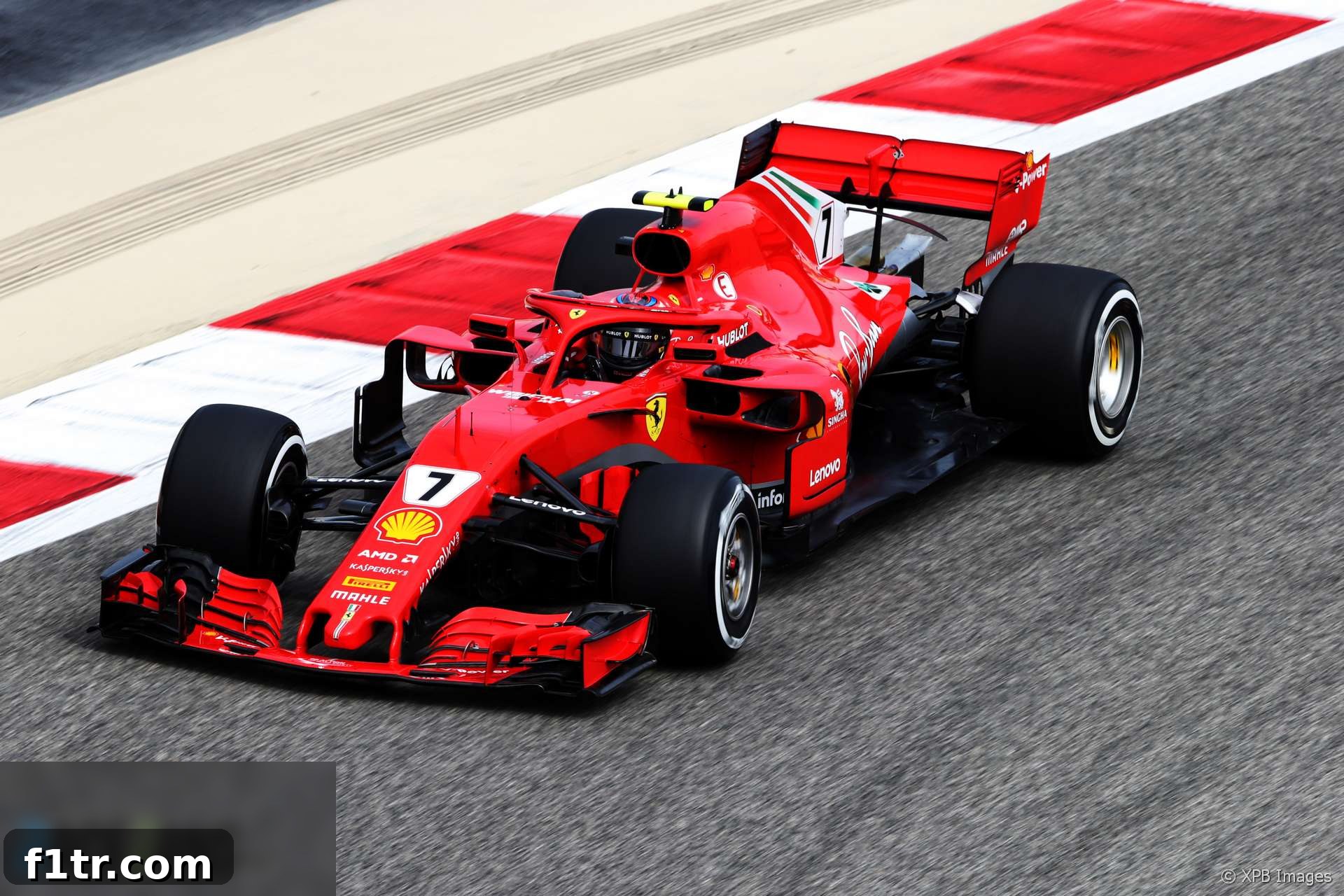
The final practice session for the Bahrain Grand Prix delivered a captivating preview of what promises to be a fiercely contested qualifying and race weekend. Ferrari’s Kimi Raikkonen emphatically stamped his authority at the top of the timesheets, showcasing exceptional pace and consistency. However, his teammate, Sebastian Vettel, experienced a session riddled with challenges, leaving some questions regarding his car’s optimal setup for the crucial qualifying rounds.
Raikkonen, the experienced Finn, appeared in sublime form throughout the 60-minute session. His best lap of 1’29.868 not only positioned him comfortably ahead of the pack but also came within mere hundredths of a second of his impressive best time from Friday’s practice sessions. This level of sustained performance from Raikkonen highlights Ferrari’s strong potential on the Sakhir International Circuit, signaling that the Scuderia is very much in contention for pole position and a strong race result. The consistency across sessions suggests a well-balanced car and a driver perfectly attuned to the conditions.
In stark contrast, Sebastian Vettel’s session was marred by a series of unfortunate incidents. His troubles began almost immediately after leaving the pits for his first significant run, approximately a quarter of an hour into the session. A critical issue emerged when his right-hand sidepod wing worked loose, necessitating an immediate return to the garage for urgent repairs. This mechanical setback severely compromised his track time and rhythm, vital elements for fine-tuning the car before qualifying.
After the repairs, Vettel eventually managed to complete a timed run, which, despite the earlier disruptions, was remarkably good enough to secure fifth position by the end of the session. However, the problems persisted. On his final attempt to improve his lap time, Vettel reported significant driveability issues emanating from his power unit. This further prompted his team to instruct him to return to the pits, curtailing his session prematurely and potentially leaving him with an incomplete understanding of his car’s ultimate performance envelope under race conditions. These issues will undoubtedly be a primary concern for the Ferrari engineers as they prepare for qualifying.
While Raikkonen led the charge for Ferrari, Mercedes and Red Bull also showed flashes of brilliance, indicating a tight battle at the front. Lewis Hamilton, for Mercedes, initially looked set to challenge Raikkonen’s dominance, at one point being eight-tenths of a second behind the Finn. Interestingly, the Mercedes pit wall communicated to Hamilton that they observed a “power difference” between his lap and Raikkonen’s, hinting at either a discrepancy in engine modes or a significant performance advantage held by Ferrari on this particular Saturday morning.
Hamilton’s initial strong showing, however, was later eclipsed by a late surge from the Red Bull drivers. Max Verstappen and Daniel Ricciardo, both utilizing the same super-soft tires as their rivals, delivered impressive runs in the closing stages of FP3. Their rapid improvements saw them leapfrog Hamilton, securing second and third positions respectively. This late burst of pace from Red Bull underscores their capabilities and suggests they could be dark horses for a podium finish. Verstappen also had a minor, though ultimately harmless, encounter with Raikkonen at the apex of Turn 1, a brief moment of close quarters racing that demonstrated the intensity of the competition.
Valtteri Bottas, Hamilton’s Mercedes teammate, concluded the session in sixth place. His session was not without incident either, as he experienced a heavy lock-up at Turn 1, a moment that would have cost him precious time and confidence. Bottas finished just three-tenths of a second quicker than the leading Renault, driven by Nico Hulkenberg, indicating the close proximity of performance among the top two-thirds of the grid and the pressure on every driver to extract maximum performance.
The midfield battle proved to be as enthralling as ever, with several teams demonstrating encouraging pace ahead of qualifying. Toro Rosso, in particular, continued to impress, building on their strong showing in the season opener. Pierre Gasly confidently steered his car into the top 10, a significant achievement for the team. His teammate, Brendon Hartley, was just a mere hundredth of a second slower, placing him right on the cusp of the top 10. The consistency and speed from both Toro Rosso drivers, powered by the Honda engine, suggest a genuine threat to established midfield runners. However, their positions were separated by Fernando Alonso’s McLaren, illustrating the incredibly fierce competition for a coveted spot in Q3, where every tenth of a second will count.
Haas also had a mixed session. Romain Grosjean piloted the highest-placed Haas car to 12th position, but his final run was compromised by slow traffic on the racing line as he approached the final corner, an all too common frustration in practice sessions. Kevin Magnussen, in the other Haas, finished further down the order in 15th. Force India’s Esteban Ocon and Sergio Perez found themselves in 13th and 14th respectively, indicating that they have work to do to break into the top ten. Further back, Sauber’s Marcus Ericsson and Charles Leclerc, along with Williams drivers Sergey Sirotkin and Lance Stroll, continued to grapple with their cars, highlighting the challenges faced by the teams at the rear of the grid.
The final practice session confirmed that the 2018 Bahrain Grand Prix is shaping up to be a thrilling affair. Raikkonen’s dominant performance has firmly established Ferrari as a benchmark, though Vettel’s struggles will keep the team on edge. Red Bull’s late charge signals their intent to challenge the front-runners, while Mercedes will be analyzing their “power difference” data closely. The incredibly tight midfield promises a captivating qualifying session where strategy, car setup, and driver skill will be paramount. With such fine margins separating many of the competitors, every team will be pushing to extract maximum performance and secure the best possible grid position for Sunday’s main event.
| Pos. | No. | Driver | Car | Best lap | Gap | Laps |
|---|---|---|---|---|---|---|
| 1 | 7 | Kimi Raikkonen | Ferrari | 1’29.868 | 15 | |
| 2 | 33 | Max Verstappen | Red Bull-TAG Heuer | 1’30.393 | 0.525 | 8 |
| 3 | 3 | Daniel Ricciardo | Red Bull-TAG Heuer | 1’30.452 | 0.584 | 8 |
| 4 | 44 | Lewis Hamilton | Mercedes | 1’30.691 | 0.823 | 14 |
| 5 | 5 | Sebastian Vettel | Ferrari | 1’30.719 | 0.851 | 8 |
| 6 | 77 | Valtteri Bottas | Mercedes | 1’30.781 | 0.913 | 16 |
| 7 | 27 | Nico Hulkenberg | Renault | 1’31.144 | 1.276 | 11 |
| 8 | 55 | Carlos Sainz Jnr | Renault | 1’31.200 | 1.332 | 12 |
| 9 | 10 | Pierre Gasly | Toro Rosso-Honda | 1’31.438 | 1.570 | 18 |
| 10 | 14 | Fernando Alonso | McLaren-Renault | 1’31.445 | 1.577 | 13 |
| 11 | 28 | Brendon Hartley | Toro Rosso-Honda | 1’31.460 | 1.592 | 18 |
| 12 | 8 | Romain Grosjean | Haas-Ferrari | 1’31.513 | 1.645 | 14 |
| 13 | 31 | Esteban Ocon | Force India-Mercedes | 1’31.554 | 1.686 | 17 |
| 14 | 11 | Sergio Perez | Force India-Mercedes | 1’31.564 | 1.696 | 14 |
| 15 | 20 | Kevin Magnussen | Haas-Ferrari | 1’31.737 | 1.869 | 14 |
| 16 | 9 | Marcus Ericsson | Sauber-Ferrari | 1’31.859 | 1.991 | 17 |
| 17 | 2 | Stoffel Vandoorne | McLaren-Renault | 1’31.860 | 1.992 | 14 |
| 18 | 16 | Charles Leclerc | Sauber-Ferrari | 1’32.047 | 2.179 | 19 |
| 19 | 35 | Sergey Sirotkin | Williams-Mercedes | 1’32.463 | 2.595 | 11 |
| 20 | 18 | Lance Stroll | Williams-Mercedes | 1’32.865 | 2.997 | 12 |
Third Practice Session Visual Gaps
Kimi Raikkonen – 1’29.868
+0.525 Max Verstappen – 1’30.393
+0.584 Daniel Ricciardo – 1’30.452
+0.823 Lewis Hamilton – 1’30.691
+0.851 Sebastian Vettel – 1’30.719
+0.913 Valtteri Bottas – 1’30.781
+1.276 Nico Hulkenberg – 1’31.144
+1.332 Carlos Sainz Jnr – 1’31.200
+1.570 Pierre Gasly – 1’31.438
+1.577 Fernando Alonso – 1’31.445
+1.592 Brendon Hartley – 1’31.460
+1.645 Romain Grosjean – 1’31.513
+1.686 Esteban Ocon – 1’31.554
+1.696 Sergio Perez – 1’31.564
+1.869 Kevin Magnussen – 1’31.737
+1.991 Marcus Ericsson – 1’31.859
+1.992 Stoffel Vandoorne – 1’31.860
+2.179 Charles Leclerc – 1’32.047
+2.595 Sergey Sirotkin – 1’32.463
+2.997 Lance Stroll – 1’32.865
Drivers more than ten seconds off the pace omitted.
Combined Practice Times: A Weekend Overview
Analyzing the combined practice times provides a comprehensive picture of the teams’ and drivers’ performance progression throughout the Bahrain Grand Prix weekend. This overview highlights who has consistently performed, who has found significant improvements, and who might be struggling to adapt to the challenging desert circuit conditions.
| Pos | Driver | Car | FP1 | FP2 | FP3 | Fri/Sat diff | Total laps |
|---|---|---|---|---|---|---|---|
| 1 | Kimi Raikkonen | Ferrari | 1’31.458 | 1’29.817 | 1’29.868 | +0.051 | 65 |
| 2 | Sebastian Vettel | Ferrari | 1’31.470 | 1’29.828 | 1’30.719 | +0.891 | 62 |
| 3 | Valtteri Bottas | Mercedes | 1’31.364 | 1’30.380 | 1’30.781 | +0.401 | 71 |
| 4 | Max Verstappen | Red Bull-TAG Heuer | 1’30.745 | 1’30.393 | -0.352 | 42 | |
| 5 | Daniel Ricciardo | Red Bull-TAG Heuer | 1’31.060 | 1’30.751 | 1’30.452 | -0.299 | 53 |
| 6 | Lewis Hamilton | Mercedes | 1’32.272 | 1’30.472 | 1’30.691 | +0.219 | 67 |
| 7 | Nico Hulkenberg | Renault | 1’33.104 | 1’31.220 | 1’31.144 | -0.076 | 63 |
| 8 | Carlos Sainz Jnr | Renault | 1’32.885 | 1’31.601 | 1’31.200 | -0.401 | 67 |
| 9 | Pierre Gasly | Toro Rosso-Honda | 1’32.779 | 1’31.232 | 1’31.438 | +0.206 | 82 |
| 10 | Fernando Alonso | McLaren-Renault | 1’33.223 | 1’31.282 | 1’31.445 | +0.163 | 66 |
| 11 | Stoffel Vandoorne | McLaren-Renault | 1’33.364 | 1’31.422 | 1’31.860 | +0.438 | 74 |
| 12 | Brendon Hartley | Toro Rosso-Honda | 1’33.497 | 1’32.908 | 1’31.460 | -1.448 | 83 |
| 13 | Romain Grosjean | Haas-Ferrari | 1’32.516 | 1’31.591 | 1’31.513 | -0.078 | 70 |
| 14 | Esteban Ocon | Force India-Mercedes | 1’33.794 | 1’31.809 | 1’31.554 | -0.255 | 71 |
| 15 | Sergio Perez | Force India-Mercedes | 1’33.662 | 1’31.868 | 1’31.564 | -0.304 | 74 |
| 16 | Kevin Magnussen | Haas-Ferrari | 1’32.971 | 1’31.969 | 1’31.737 | -0.232 | 68 |
| 17 | Marcus Ericsson | Sauber-Ferrari | 1’33.508 | 1’32.733 | 1’31.859 | -0.874 | 71 |
| 18 | Charles Leclerc | Sauber-Ferrari | 1’33.278 | 1’32.372 | 1’32.047 | -0.325 | 76 |
| 19 | Lance Stroll | Williams-Mercedes | 1’33.379 | 1’32.382 | 1’32.865 | +0.483 | 64 |
| 20 | Sergey Sirotkin | Williams-Mercedes | 1’33.467 | 1’32.474 | 1’32.463 | -0.011 | 77 |
The combined times reveal that Kimi Raikkonen’s fastest lap from FP2 remains the overall benchmark for the weekend, narrowly beating his FP3 effort and Sebastian Vettel’s best from FP2. This highlights Ferrari’s strong baseline performance, particularly on Friday. Red Bull drivers Max Verstappen and Daniel Ricciardo showed significant improvement from Friday to Saturday, indicated by their negative Friday/Saturday difference, suggesting they’ve found a better setup as the track evolved. Conversely, drivers like Valtteri Bottas and Lewis Hamilton saw their best times come from FP2, with slight regression in FP3, perhaps due to different testing programs or track conditions. The high lap counts for drivers like Pierre Gasly and Brendon Hartley underscore Toro Rosso’s diligent efforts to gather data and optimize their Honda-powered machines. These combined statistics offer a valuable insight into the underlying performance trends and strategies adopted by each team as they fine-tune for qualifying and the race.
2018 Bahrain Grand Prix Coverage
For more in-depth analysis and behind-the-scenes content from the exhilarating 2018 Bahrain Grand Prix, explore our comprehensive coverage:
- Top ten pictures from the 2018 Bahrain Grand Prix
- Vettel’s narrow win bodes well for 2018 title fight
- 2018 Bahrain Grand Prix Star Performers
- McLaren go 100 races without a win as Hamilton equals Raikkonen record
- Vote for your 2018 Bahrain Grand Prix Driver of the Weekend
Browse all 2018 Bahrain Grand Prix articles