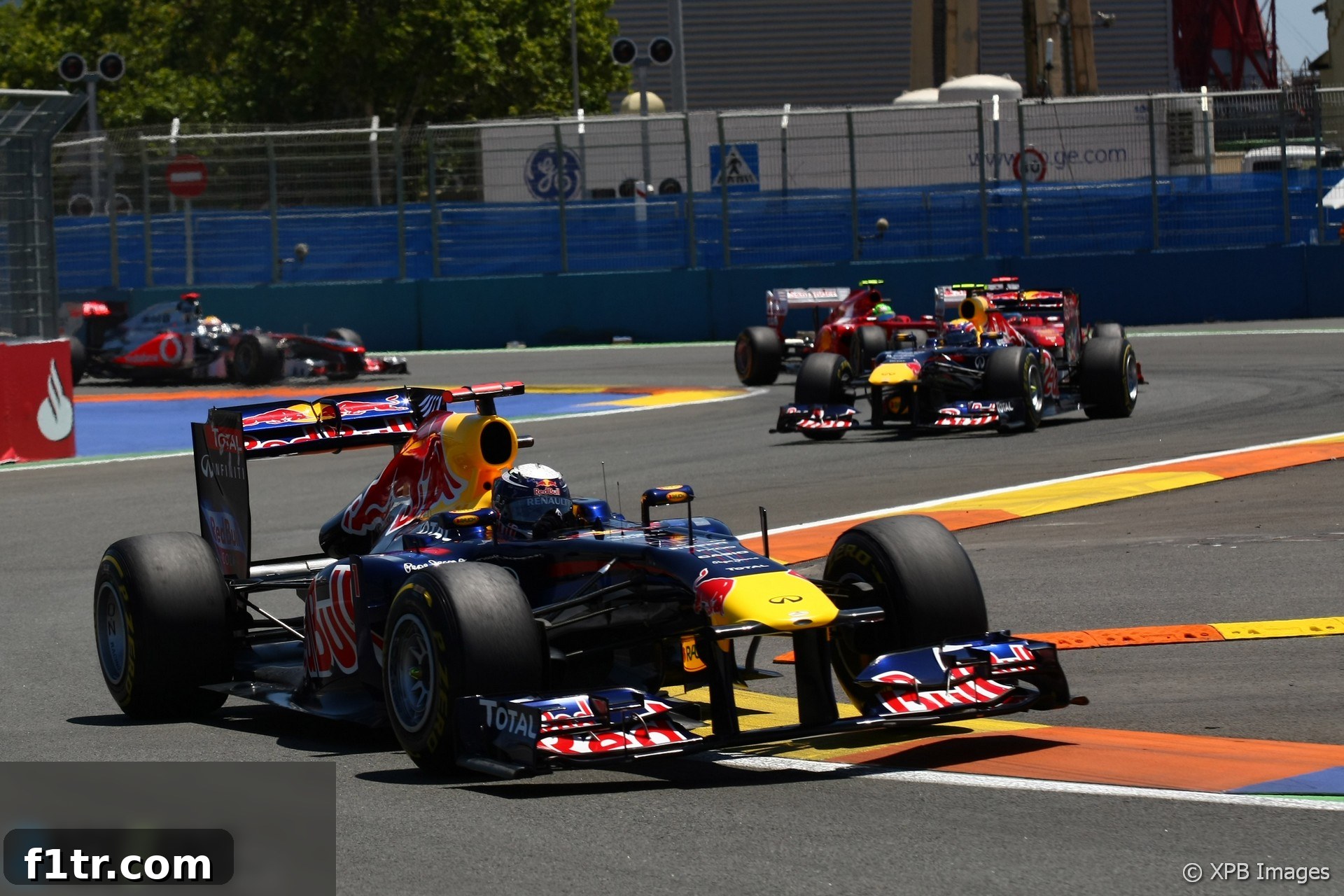
Vettel Masters Valencia: A Dominant Victory at the European Grand Prix
The Valencia Street Circuit bore witness to another masterclass performance from Sebastian Vettel, as the Red Bull Racing driver secured a commanding victory at the European Grand Prix. It was business as usual for the reigning champion, who navigated 57 laps of the challenging urban track with an apparent ease that belied the intense competition in Formula 1. This sixth win of the season further solidified his seemingly unassailable lead in the drivers’ championship, sending a clear message to his rivals about his relentless pursuit of another world title.
While Vettel enjoyed a relatively untroubled run at the front, the battle behind him was fierce and tactical. Fernando Alonso, driving for Ferrari, delivered a superb performance to split the formidable Red Bull duo, clinching a well-deserved second place. His podium finish came at the expense of Mark Webber, who finished third, and a fading challenge from the McLarens, Lewis Hamilton and Jenson Button, whose races were plagued by various issues and strategic missteps. The European Grand Prix in Valencia often delivered unpredictable racing, but on this occasion, the top step of the podium was never truly in doubt, making the strategic chess match for the remaining positions the true highlight of the event.
Pre-Race Buzz and Grid Dynamics
Leading up to the European Grand Prix, the Formula 1 paddock was buzzing with anticipation. Sebastian Vettel, having demonstrated exceptional form throughout the season, arrived in Valencia as the clear favorite. His pole position, secured during a blistering qualifying session, only amplified expectations of another dominant display. The unique characteristics of the Valencia Street Circuit, known for its tight corners and long straights facilitating DRS overtakes, promised an exciting strategic battle, especially concerning tyre degradation and pit stop windows. The front row was completed by his Red Bull teammate Mark Webber, setting the stage for a potential team one-two, while Lewis Hamilton and Fernando Alonso lined up on the second row, eager to challenge the Red Bull supremacy.
The grid was a mix of seasoned champions and ambitious young talents, each with their own objectives for the race. Ferrari, with Alonso and Felipe Massa, aimed to capitalise on any Red Bull slip-ups and collect crucial constructor points. McLaren, with Hamilton and Button, were looking to reignite their championship challenge after a series of inconsistent performances. The midfield battle, as always, was expected to be intense, with teams like Mercedes, Force India, and Sauber all vying for points in a highly competitive season.
The Start: Vettel’s Command and Midfield Scramble
As the lights went out, the air crackled with tension. Sebastian Vettel launched perfectly from pole position, immediately asserting his authority and holding his lead into the first corner. The opening lap, however, was a whirlwind of activity behind him. While Vettel pulled away with characteristic precision, Mark Webber found himself in a fierce battle to defend his second position from the fast-starting Ferraris.
It was Felipe Massa who truly made the best getaway from the second row, demonstrating blistering acceleration off the line. He aggressively looked down the inside of Webber at Turn 2, attempting a bold overtake. However, Massa judiciously backed out of the move, perhaps sensing the risk of a collision so early in the race. This brief hesitation allowed Fernando Alonso, who had maintained his position, to slip back through and claim third place, forming an immediate Ferrari sandwich behind Vettel and Webber. Further down the order, Lewis Hamilton experienced a less than ideal start, dropping to fifth place behind both Ferraris. Meanwhile, Nico Rosberg in the Mercedes capitalised on the initial jostling to demote Jenson Button, pushing the McLaren driver down to sixth.
Early Race Dynamics and Strategic Plays
The early laps of the European Grand Prix quickly established the pecking order at the front, though the battles further down the field were far from settled. Vettel, in his Red Bull, was already in a league of his own, steadily extending his lead with clinical precision. The focus, therefore, shifted to the unfolding drama for the remaining podium spots and the crucial points-paying positions.
Button moves forward
Jenson Button, determined to regain ground after his difficult start, wasted no time in fighting back. Utilizing the DRS zones, he homed in on Nico Rosberg’s Mercedes. On lap five, Button executed a textbook move, cleanly slipping past Rosberg at Turn 2, showcasing his racecraft and the McLaren’s underlying pace. This early battle set the tone for the highly competitive nature of the midfield, where every position was hard-fought.
Up ahead, Fernando Alonso was relentless in his pursuit of the Red Bulls. He kept immense pressure on Mark Webber, staying within DRS range for several laps, constantly probing for an opportunity to pass. This high-stakes chase highlighted Alonso’s unwavering determination to extract maximum performance from his Ferrari. Lewis Hamilton, for a period, mirrored Alonso’s aggressive approach, staying close to Felipe Massa. However, as the first stint wore on, Hamilton’s pace began to drop, indicating potential tyre wear issues or a differing strategy.
Hamilton was indeed the first of the front runners to make a pit stop, diving into the pits on lap 11 for a fresh set of soft tyres. This early stop was a clear indication of McLaren’s strategy to try and undercut their rivals, hoping for a quicker out-lap and clean air. Ferrari, in contrast, opted to keep Alonso and Massa out for two more crucial laps, aiming to maximise the life of their tyres. When Alonso eventually pitted, he maintained his strong track position. However, Massa’s slightly longer stint saw him lose a place to the now faster Hamilton, showcasing the razor-thin margins and critical timing involved in pit stop strategies.
Mid-Race Battles and Strategic Unfoldings
Following the first round of pit stops, the top three positions remained unchanged initially, with Vettel comfortably leading, followed by Webber and Alonso. However, the strategic battle was intensifying. Alonso, now even closer to Webber after their respective stops, capitalized on the DRS zone and his superior pace on fresh tyres to execute a decisive overtake on lap 20, snatching second place from the Australian. This move was a testament to Alonso’s aggressive driving and Ferrari’s effective strategy in the early phase of the race.
Meanwhile, Lewis Hamilton’s race continued to unravel somewhat. He started to drop back from the leading trio, indicating further struggles with either his car’s setup or tyre management. Recognizing the need to react, McLaren brought Hamilton in for his second pit stop significantly earlier than his closest rivals. His focus now shifted from challenging the leaders to consolidating fourth place and fending off Felipe Massa, who was still very much in contention. The other McLaren, driven by Jenson Button, was facing even deeper trouble. Roughly halfway through the race, Button reported a failure of his Kinetic Energy Recovery System (KERS). The loss of this crucial power boost severely hampered his ability to defend or attack, relegating him to a more defensive and frustrating race.
Webber hits trouble
Having successfully passed Mark Webber, Fernando Alonso initially hoped to make inroads into Sebastian Vettel’s substantial lead. However, Vettel’s pace proved too formidable, and Alonso, despite his best efforts, began to slip back from the dominant Red Bull driver. The second round of pit stops offered a glimmer of hope for Webber. Through a well-executed pit stop by the Red Bull crew, Webber managed to jump back in front of Alonso, momentarily reclaiming second position. Yet, this regain of position was destined to be short-lived, as the strategic chess match entered its final critical phase.
Webber made his third and final pit stop earlier than Alonso, switching to the medium compound tyres. The hope was that an early switch would allow him to build a gap or maintain pace. However, the medium tyres, while more durable, simply weren’t quick enough to match the Ferrari’s performance or Alonso’s driving. Alonso, extending his final stint on his current set of tyres, capitalised on Webber’s relatively slower pace on the mediums. When the Ferrari driver eventually came in for his last pit stop, he emerged comfortably back in second place, solidifying his impressive drive and leaving Webber to chase him down.
The closing stages of the race saw Fernando Alonso come under renewed pressure from Mark Webber, who was pushing hard despite his tyre disadvantage. The two championship contenders found themselves navigating through traffic, notably having to pick their way past the battling Kamui Kobayashi and Paul di Resta. Alonso, with his characteristic defensive brilliance, held his position with remarkable composure. As if Webber’s challenge wasn’t enough, he was later instructed to short-shift due to a technical problem developing in his Red Bull, further cementing Alonso’s well-earned second place.
Vettel’s Unchallenged Victory and Final Laps
As the race entered its twilight laps, Sebastian Vettel made his final, perfectly timed pit stop. The stop was executed flawlessly by the Red Bull crew, and he emerged still firmly in the lead, his advantage over Alonso utterly insurmountable. The final stint for Vettel was a serene procession, a testament to his car’s performance and his own exceptional skill. He managed his medium tyres with expert precision, crossing the finish line with a comfortable ten-second lead over Fernando Alonso, further cementing his dominance in the 2011 season.
Further back, the battle for fourth place was heating up between Lewis Hamilton and Felipe Massa. Hamilton had begun his last stint a full six laps before Massa, an aggressive strategic gamble that initially gave him track position. However, over the final stint, Massa, on fresher and potentially better-suited tyres, began to reel in the McLaren driver. While Hamilton was too far back to challenge for a podium position, he held off the charging Ferrari driver to secure a valuable fourth place, a small consolation in what had been a challenging race for McLaren. Jenson Button, plagued by his KERS problem, had a lonely run to sixth place, a disappointing result given his earlier potential.
Outside the top six, the points positions were fiercely contested. Nico Rosberg secured a commendable seventh place for Mercedes, passing Jaime Alguersuari on lap 38 with a well-timed move. Alguersuari, driving for Toro Rosso, was arguably one of the standout performers of the day, making just two pit stops – a rarer strategy among the frontrunners – and gaining an impressive ten places from his starting position to finish eighth. This demonstrated the effectiveness of a well-executed alternative strategy. Adrian Sutil for Force India and Nick Heidfeld for Renault rounded out the top ten, collecting valuable points, just ahead of Sauber’s Sergio Perez. Perez, notably, started the race on medium tyres and completed the entire Grand Prix with a single pit stop, showcasing another masterclass in tyre management.
Remarkably, all 24 drivers managed to finish the race, a testament to the reliability of the modern Formula 1 cars and the relatively clean nature of the event. However, only the top seven drivers finished on the lead lap, highlighting the substantial gap created by the dominant Red Bull and Ferrari machines. A notable incident involved Michael Schumacher, who slipped to 17th after a costly collision with Vitaly Petrov following his first pit stop. Schumacher’s Mercedes suffered a broken front wing, forcing him to complete an entire lap with the damaged aero hanging precariously off his car, severely impacting his pace and ultimately ruining his race.
Championship Implications and Season Outlook
Sebastian Vettel’s sixth victory out of eight races underscored his absolute dominance in the current Formula 1 season. This relentless performance meant his championship lead was now more than three race wins’ worth of points, putting him in an almost unassailable position halfway through the calendar. His consistency, combined with the unparalleled performance of his Red Bull RB7, made him the overwhelming favourite for the drivers’ title, and each subsequent race only seemed to strengthen his grip.
While Vettel celebrated, the battle for second in the championship intensified. Mark Webber, despite his strategic difficulties and technical problems during the race, managed to salvage third place on the podium. This crucial points haul meant he was now tied for second place in the drivers’ standings with Jenson Button. Button’s KERS failure had hampered his potential, but his consistency in earlier races kept him in contention. Fernando Alonso’s brilliant second place brought him closer to this battle, demonstrating Ferrari’s growing strength and his own ability to extract maximum performance, even when the car wasn’t the absolute fastest. The constructors’ championship also saw Red Bull further extend its lead, with Ferrari and McLaren fighting tooth and nail for second place, knowing that every point was vital.
The European Grand Prix in Valencia thus concluded as another chapter in Sebastian Vettel’s dominant season, yet it also highlighted the fierce competition and strategic depth among the chasing pack. The race served as a reminder of the intricate dance between driver skill, team strategy, and the unpredictable nature of Formula 1. As the season progressed, the focus would increasingly turn to who could possibly mount a challenge to Vettel’s reign, or at the very least, consistently claim the remaining podium spots.
F1 race reviews
- Antonelli lucks in for second win and becomes youngest F1 championship leader
- Emotional Antonelli grabs first Formula 1 victory in Chinese Grand Prix
- Russell sees off Ferrari threat to lead Mercedes one-two in Melbourne
- Norris clinches F1 title by two points as Verstappen wins finale at Yas Marina
- McLaren strategy blunder in Losail hands Verstappen crucial win and shot at title
Read all F1 race reviews