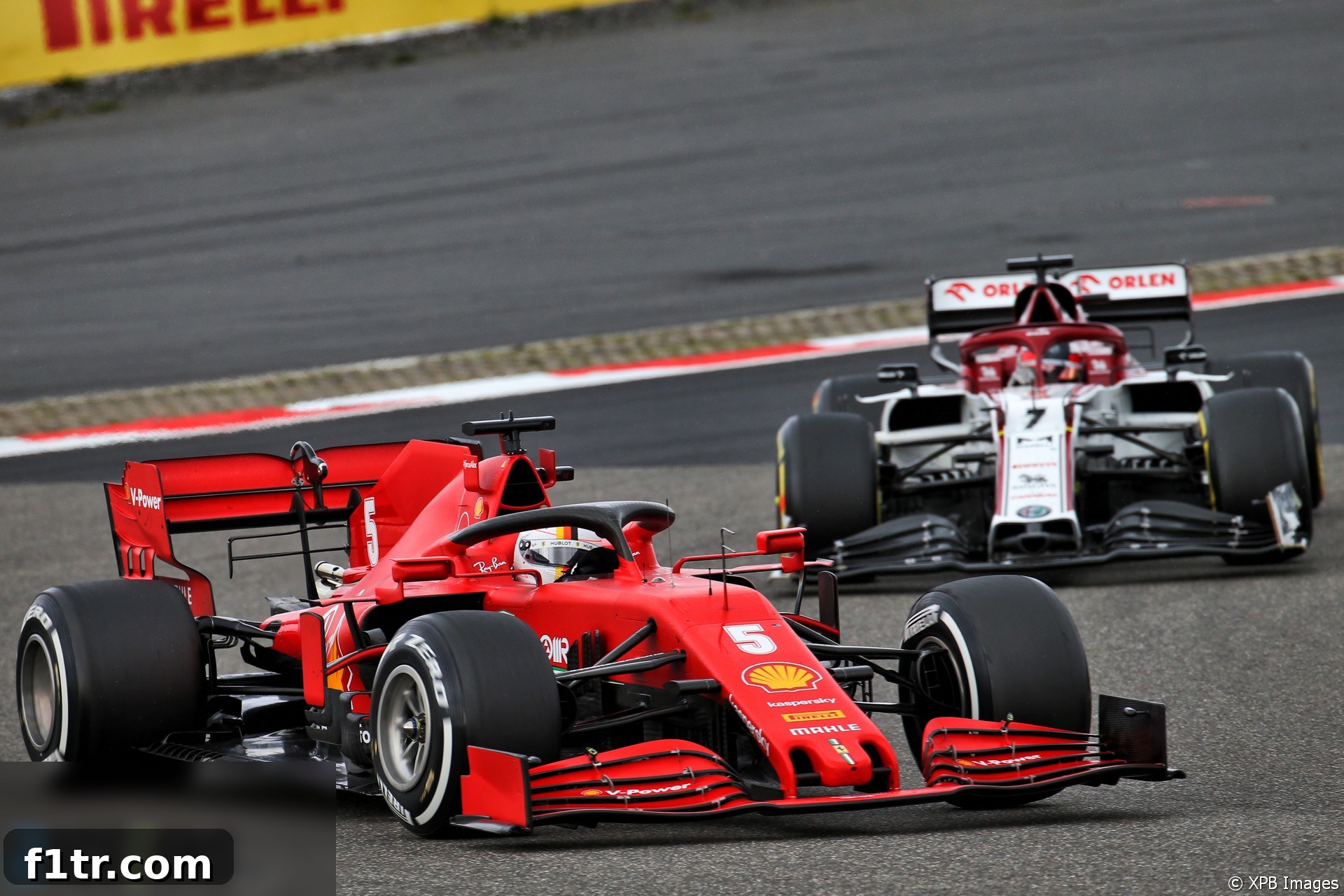
The 2020 Formula 1 season delivered unexpected twists and turns, with the return of the iconic Nürburgring for the Eifel Grand Prix adding another layer of intrigue. Among the narratives that emerged from the demanding German circuit was the challenging weekend faced by four-time world champion Sebastian Vettel. Reflecting on an early-race spin that severely compromised his performance, Vettel candidly admitted to taking “probably too much risk,” a decision that he felt left him “stuck” for the remainder of the race.
Advert | Become a Supporter & go ad-free
The Cold Nürburgring and a Risky Overtake
The Nürburgring, famed for its rich motorsport history and challenging layout, presented unique conditions for the Eifel Grand Prix. Unseasonably cold temperatures and the ever-present threat of rain made tyre management and driver precision paramount. For Sebastian Vettel, driving for Ferrari during what was already a difficult season for the Italian Scuderia, every opportunity to gain track position was crucial. It was in this high-pressure environment that the incident unfolded on lap 11.
Attempting to make a move on Antonio Giovinazzi’s Alfa Romeo, Vettel launched an attack into Turn 1, a key overtaking spot. However, the move proved to be ill-fated. As he navigated the corner, pushing hard to get past his rival, Vettel lost control of his Ferrari SF1000. The car spun, a costly error that immediately put him on the back foot. The consequence of the spin was more than just lost track position; the aggressive rotation of the car resulted in flat-spotted tyres, severely compromising their integrity and performance. This necessitated an unscheduled and early pit stop, forcing Vettel onto an alternative strategy much sooner than planned and dropping him to the very back of the field.
The German driver, known for his relentless pursuit of performance, did not shy away from acknowledging his part in the setback. He openly admitted that the attempt to pass Giovinazzi carried an excessive degree of risk, especially given the challenging conditions. “We lost a position to the Alfa and then we got stuck,” Vettel explained, detailing the immediate aftermath of the spin and the subsequent impact on his race. The tight nature of the Nürburgring, combined with the ‘dirty air’ phenomenon in modern Formula 1, made overtaking incredibly difficult. “It was very, very difficult to pass, very difficult to follow,” he lamented.
Stuck in the Pack: The Struggle to Recover
The early pit stop, forced by the flat-spotted tyres, thrust Sebastian Vettel into a race of recovery from the tail end of the grid. However, climbing through the competitive midfield proved to be an arduous task, particularly with a car that lacked the outright pace to dominate. Vettel highlighted the persistent struggle he faced when attempting to make progress. “I was only really gaining in the very last part of the straight,” he noted, emphasizing the limited opportunities for clean overtakes. The aerodynamic turbulence created by cars ahead, often referred to as ‘dirty air’, significantly hindered his ability to follow closely and prepare for an attack.
His post-race analysis further elaborated on the cause of the spin itself. “I think when I was crossing behind him, I lost the car in the wake. I need to have a look again but probably it was too much risk at the time.” This explanation sheds light on the fine margins drivers operate within. The turbulent air coming off Giovinazzi’s Alfa Romeo likely reduced the downforce on Vettel’s Ferrari at a critical moment, leading to the loss of grip and the subsequent spin. It was a classic example of a driver pushing the limits in pursuit of a gain, only for the unseen forces of aerodynamics to catch him out.
For a driver of Vettel’s caliber, a four-time world champion, being “stuck” in the midfield is a particularly frustrating experience. The incident at the Eifel Grand Prix was symptomatic of a broader struggle that Ferrari, and Vettel himself, endured throughout the 2020 season. The SF1000 chassis was widely regarded as underperforming, lacking both aerodynamic efficiency and straight-line speed compared to its rivals. This deficit meant that even when Vettel drove faultlessly, scoring points was often a Herculean task, let alone making significant progress from a compromised position.
The Safety Car Gamble and Final Disappointment
As the Eifel Grand Prix progressed, a late-race Safety Car deployment offered Sebastian Vettel a glimmer of hope. Safety Cars, often triggered by incidents on track, bunch up the field, effectively neutralizing previous time gaps and creating strategic opportunities. Ferrari seized this chance, bringing Vettel in for a fresh set of soft tyres, hoping the superior grip and performance of new rubber would allow him to make a decisive charge in the closing laps and snatch a points-paying position.
However, despite the strategic gamble, the outcome remained unchanged. Vettel found himself once again battling Antonio Giovinazzi, the very driver he had spun while trying to overtake earlier in the race. Despite the fresh tyres and the compressed field, he was still unable to find a way past the Alfa Romeo for that coveted tenth place and the final championship point. Ultimately, Vettel crossed the finish line in 11th place, agonizingly close but still outside the points.
The frustration was palpable in his post-race comments. “With the Safety Car, there was a chance for points, but it didn’t happen,” Vettel stated, underscoring the missed opportunity. His candid assessment continued, “I think we were a little bit faster than where we were, but it was very tricky. So not the first race where we get stuck. Shame that we didn’t take any points away.” This sentiment encapsulated the struggles of his 2020 season: moments of potential pace often thwarted by car limitations, strategic challenges, or, as in this case, an early mistake that set the tone for the entire race.
Broader Implications: Ferrari’s 2020 Season and Vettel’s Legacy
Sebastian Vettel’s challenging Eifel Grand Prix weekend was more than just an isolated incident; it was a microcosm of Ferrari’s arduous 2020 Formula 1 season. The Scuderia, traditionally a powerhouse in the sport, found itself battling in the midfield, a position unfamiliar and uncomfortable for a team of its stature. The SF1000 was a difficult car, lacking the competitive edge to fight at the front, and drivers often expressed frustration with its handling and unpredictable nature. This underperformance put immense pressure on both Vettel and his teammate, Charles Leclerc, to extract every ounce of potential from a recalcitrant machine.
For Vettel, in particular, the 2020 season carried significant weight as it was his final year with Ferrari before his move to Aston Martin. His struggles were amplified by the contrast with his earlier, highly successful years in Formula 1, which included four consecutive world championships with Red Bull Racing. The Eifel Grand Prix incident, where a veteran driver admitted to taking “too much risk” and subsequently getting “stuck,” highlighted the mental and emotional toll of a difficult campaign. It illustrated a driver pushing beyond the immediate capabilities of his machinery, driven by a champion’s instinct to compete and score points, even when the odds were stacked against him.
The Nürburgring itself, returning to the F1 calendar after a significant hiatus, offered a challenging but welcome spectacle. Its high-speed sections, technical corners, and undulating terrain, combined with the cold October weather, tested drivers and teams to their limits. The conditions exacerbated any car deficiencies and rewarded precise, confident driving. Vettel’s spin, while a personal error, also underscores the fine line between aggression and overdriving in such demanding circumstances. In an era where midfield battles are fiercely contested, even a minor misstep can unravel an entire race strategy and deny a team valuable championship points.
Advert | Become a RaceFans supporter andgo ad-free
Conclusion: A Race of What-Ifs for Vettel
The 2020 Eifel Grand Prix will likely be remembered by Sebastian Vettel as a race of missed opportunities and frustrating limitations. His early spin while battling Antonio Giovinazzi, an admission of excessive risk-taking, set the tone for a challenging afternoon. The flat-spotted tyres, the unscheduled pit stop, and the subsequent battle against the unyielding forces of dirty air and the Nürburgring’s unforgiving layout conspired to keep him out of the points. Despite a late Safety Car offering a potential lifeline and a fresh set of soft tyres, Vettel was unable to capitalize, ultimately finishing just outside the top ten in 11th place.
This incident encapsulates the complexities of Formula 1: the razor-thin margins between success and failure, the delicate balance between aggression and caution, and the profound impact of car performance on a driver’s ability to execute. For a multi-world champion like Vettel, such an outcome is undoubtedly difficult to digest, highlighting the broader struggles Ferrari faced in a challenging season. The Eifel Grand Prix served as a stark reminder of the relentless competition in Formula 1 and how quickly fortunes can change with a single, albeit self-admitted, misjudgment on track. While the ambition to overtake was clear, the execution carried a risk that ultimately proved too high, leaving Vettel to reflect on a race where he felt truly “stuck.”
2020 Eifel Grand Prix Related Articles
- Renault “not scared of anywhere” in remaining races
- Bottas “needs a miracle” to overturn Hamilton’s 69-point lead
- 2020 Eifel Grand Prix Star Performers
- Leclerc sees ‘quite a few positives’ in Ferrari’s Nurburgring weekend
- Mercedes relied on DAS “more than ever” at cold Nurburgring
Browse all 2020 Eifel Grand Prix articles