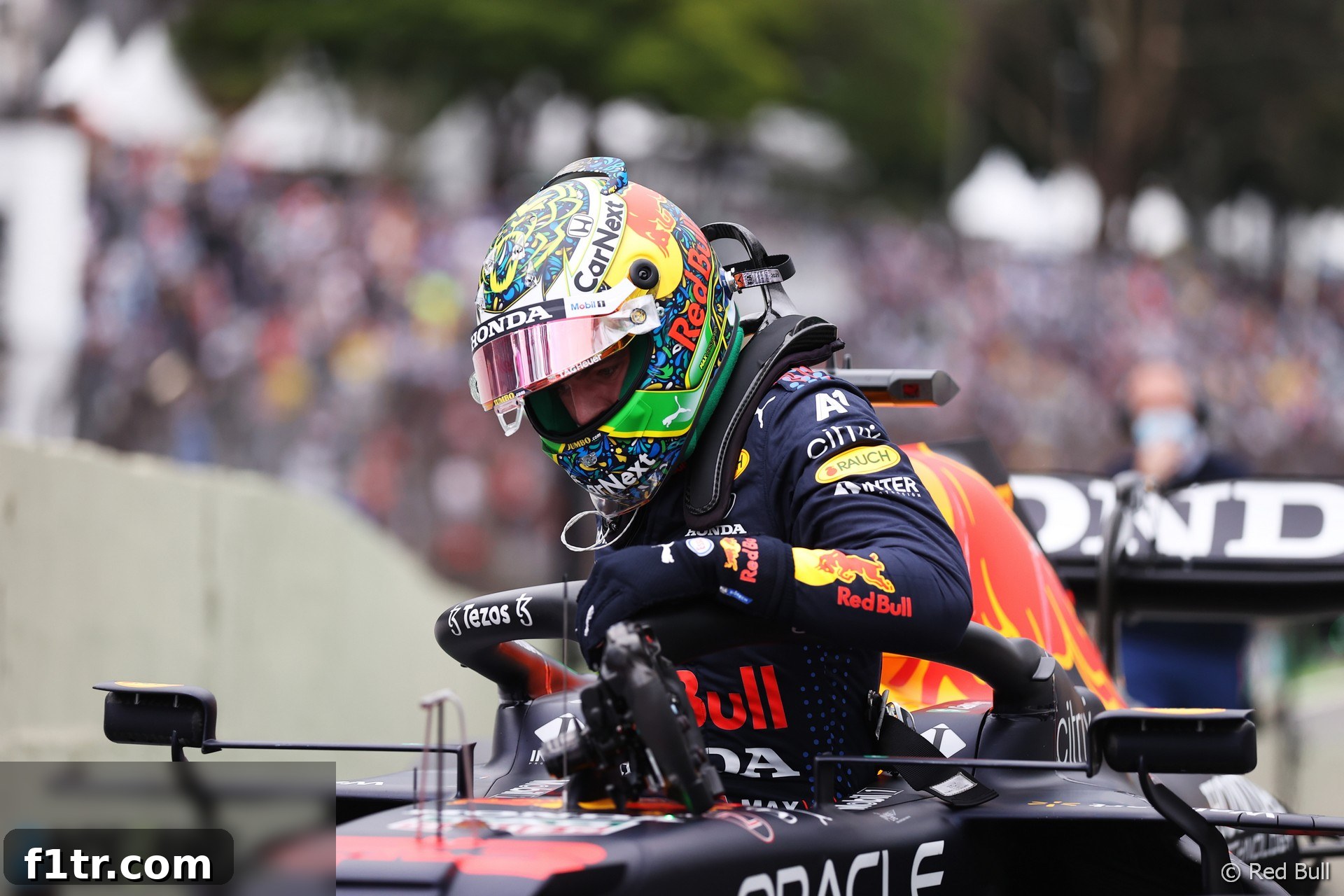
In a high-stakes moment that sent ripples through the 2021 Formula 1 championship, Red Bull Racing driver Max Verstappen was handed a hefty €50,000 (£42,600) fine by the stewards at the Sao Paulo Grand Prix. The penalty stemmed from his breach of strict parc fermé regulations, specifically for touching the rear wing of Lewis Hamilton’s Mercedes car after the qualifying session. This incident ignited further controversy amidst an already fiery championship battle, highlighting the intense scrutiny under which both drivers and teams operated.
Advert | Become a Supporter & go ad-free
The events unfolded after the qualifying session for the sprint race, where Hamilton had secured pole position. Immediately following his qualifying run, Verstappen approached Hamilton’s Mercedes W12, closely inspecting and touching its rear wing. This seemingly innocuous action quickly became the subject of an intense investigation, with stewards meticulously reviewing various forms of evidence, including amateur video footage captured by a fan in the grandstands, secure CCTV footage from the pit lane, and crucial onboard camera material from several cars, including Verstappen’s own. The purpose of this extensive review was to precisely ascertain the nature and extent of Verstappen’s interaction with the rival car.
At the same time, Hamilton’s Mercedes was already under separate investigation for a potential technical infringement related to its Drag Reduction System (DRS) flap on the rear wing, an outcome that further compounded the weekend’s drama. The stewards’ deliberations regarding this technical breach were ongoing, raising the possibility of a severe penalty for Hamilton, which could potentially elevate Verstappen to pole position for the sprint qualifying race – a significant advantage in the championship hunt.
Understanding the Breach: Parc Fermé Regulations
The stewards ultimately ruled that Verstappen’s actions constituted a “breach of the regulation” which, despite appearing minor, “has potential for serious consequences.” The parc fermé rules in Formula 1 are designed to ensure fairness and prevent any unauthorized modifications or tampering with cars between qualifying and the race, or between sessions like sprint qualifying and the main Grand Prix. Once cars are in parc fermé, teams and drivers are severely restricted in what they can do to them. This strict environment is crucial for maintaining the integrity of the competition, ensuring that the car that qualifies is essentially the same car that races.
However, after careful consideration of all available evidence, the stewards concluded that Verstappen’s contact with the wing was made with “insignificant” force and that he had caused “no direct harm” to the car. This finding was pivotal in determining the severity of his penalty. While acknowledging the rule violation and its inherent risks, the lack of demonstrable damage led them to impose a financial penalty rather than a sporting one, such as a grid drop, which would have had a direct impact on the race outcome.
The stewards’ decision to limit the penalty to a fine meant that Verstappen, who qualified second, stood to inherit pole position for the sprint race if Hamilton were to be penalized for the DRS infringement. This scenario was widely anticipated, adding another layer of complexity to the already tense championship narrative between the two title contenders.
Crucially, the stewards emphasized that Verstappen’s physical interaction had no discernible effect on Hamilton’s car. Their detailed report stated: “There is absolutely no movement of any of the wing elements on car 44 when Verstappen touches the back of the wing and the stewards are satisfied, from watching all the videos, his body position and the video of the wing, that there was insignificant force when Verstappen touched the wing.” This affirmation was vital in differentiating Verstappen’s actions from any malicious intent or actual tampering that could have altered the car’s performance.
Stewards’ Official Ruling: Detailed Explanation
The stewards meticulously heard testimony from the driver of car 33, Max Verstappen, and a team representative from Red Bull Racing. Their investigation was thorough, involving a comprehensive review of multiple video sources.
Key evidence included a fan-captured video taken from across the track, CCTV footage providing a clear view of the pit lane, and crucial onboard camera footage from cars 14 (Alonso), 33 (Verstappen), 44 (Hamilton), and 77 (Bottas). Collectively, these diverse camera angles provided an unambiguous and detailed picture of the precise sequence of events within parc fermé immediately following the qualifying session.
The footage confirmed that Verstappen, after exiting his own car, proceeded to the rear of his vehicle. There, he removed his racing gloves and placed his right hand into the slot-gap of his car’s rear wing – an action he later explained as a habitual check. Subsequently, he moved to car 44 (Lewis Hamilton’s Mercedes) and replicated this action, touching the rear wing in two distinct locations. These points of contact were on either side of the DRS (Drag Reduction System) actuation device, specifically on the bottom rear side of the wing in the area of the slot gap. Importantly, the stewards noted that Verstappen’s contact was never near the critical DRS actuator mechanism or the end fixation points of the wing.
High-definition video obtained from the rear-facing roll-hoop camera on car 44 provided particularly critical insight. This footage clearly demonstrated that there was absolutely no movement or deflection of any of the wing elements on car 44 when Verstappen made contact. Based on their exhaustive review of all video evidence, coupled with an analysis of Verstappen’s body position during the interaction, the stewards were definitively satisfied that the force applied by Verstappen when touching the wing was indeed insignificant.
During the hearing, it became apparent to the stewards that a common practice among drivers has evolved, where they routinely touch rival cars after qualifying sessions and races. This was also Verstappen’s explanation for his actions: he claimed it was merely a habit to touch this specific area of the car, which had become a focal point of speculation and technical discussions between Red Bull and Mercedes in recent races, particularly concerning the flexibility and legality of each other’s rear wings. While this general tendency has largely been perceived as harmless and, consequently, has not been uniformly policed by officials, the stewards underscored that it unequivocally constitutes a breach of the stringent parc fermé regulations and inherently carries significant potential to cause harm or lead to allegations of tampering.
Considering all factors, the stewards weighed several crucial points: on one hand, their firm opinion that no direct harm was caused in this specific instance, and the absence of any prior precedents for penalties issued for this particular type of infringement. On the other hand, they acknowledged the clear violation of regulations and the inherent potential for serious consequences such an action could entail. Balancing these considerations, the stewards determined that action was necessary in this case, leading to the imposition of a €50,000 fine. Furthermore, the stewards issued a strong advisory, emphasizing their intention for all teams and drivers to take notice that any future breaches of parc fermé regulations may result in different and potentially more severe penalties from the stewards officiating those specific events.
Advert | Become a RaceFans supporter andgo ad-free
The Wider Context: F1’s Intense Championship Battle
The Sao Paulo Grand Prix was a critical juncture in the 2021 F1 season, a year marked by one of the most enthralling and fiercely contested championships in recent memory. The rivalry between Max Verstappen and Lewis Hamilton, and by extension Red Bull and Mercedes, had reached unprecedented levels of intensity. Every on-track battle, every pit stop, and every technical detail was scrutinized to the fullest extent. In this climate, any perceived infraction, no matter how small, was magnified and had the potential to ignite further conflict.
The simultaneous investigation into Hamilton’s DRS system added another layer of complexity and potential drama. The Drag Reduction System is a movable element of the rear wing designed to increase straight-line speed by reducing aerodynamic drag. Its deployment is strictly regulated, allowed only in designated zones on the track and only when a driver is within one second of the car ahead. Any deviation from the prescribed dimensions or operational parameters constitutes a technical infringement, which can lead to disqualification from qualifying or a grid penalty, significantly impacting a driver’s race prospects and championship points.
Verstappen’s action of touching Hamilton’s wing, therefore, occurred amidst this highly charged atmosphere. While his defense of it being a “habit” was acknowledged, the stewards’ decision to fine him €50,000 sent a clear message: regardless of intent or actual damage, the sanctity of parc fermé must be upheld. This incident underscored the meticulous nature of F1 regulations and the constant vigilance required from both teams and drivers to navigate a sport where tenths of a second and millimeters of technical specification can mean the difference between victory and defeat, or indeed, a championship.
The ruling served as a stern warning across the paddock, signaling a potential shift in how such minor, habitual interactions with rival cars would be policed in the future. It highlighted the fine line between innocent curiosity and a breach of regulations that safeguard the integrity of the sport, ensuring that the battles are fought purely on skill, strategy, and engineering within the established rules.
2021 Sao Paulo Grand Prix: Related Developments
- Red Bull and Mercedes summoned to FIA hearing on review of Sao Paulo incident
- McLaren must “get back to scoring the results that are on the table” – Seidl
- Hamilton makes his second-biggest climb to victory from 10th on the grid
- F1 releases missing video footage from Verstappen’s car of Hamilton incident
- How Alonso and Ocon “pushed team tactics to the ultimate limit” to delay Gasly
Browse all 2021 Sao Paulo Grand Prix articles