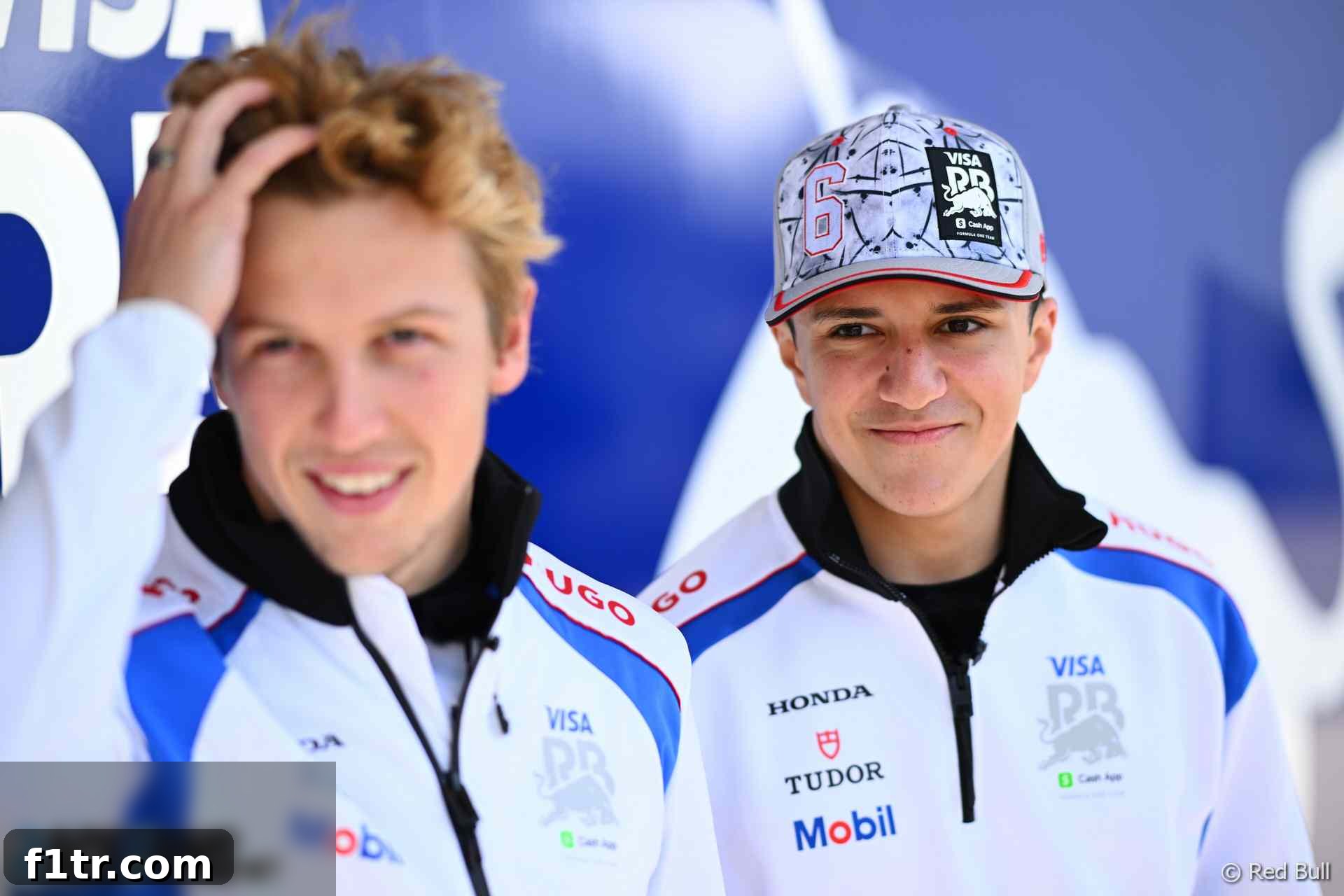
When Isack Hadjar first secured the coveted opportunity to step into the Racing Bulls’ driver lineup for the 2025 Formula 1 season, replacing Liam Lawson, a clear trajectory must have formed in his mind. The ambition would undoubtedly have been to replicate this remarkable ascent a year later, by earning a promotion to the senior Red Bull Racing squad. This initial step was not merely a chance to compete at the pinnacle of motorsport, but a potential springboard to a long and illustrious career at the highest level, positioning him firmly within the Red Bull driver development ecosystem that has launched so many champions.
However, the unpredictable nature of Formula 1, with its sudden shifts and unexpected turns, quickly redefined the landscape for Hadjar. In a dramatic twist that few could have foreseen, within a mere three rounds of the new season, circumstances aligned in a way that saw him and Lawson become teammates. This came about after Yuki Tsunoda, the more experienced and established driver alongside Hadjar, was abruptly promoted to the top Red Bull team. This seismic shift not only rearranged the Racing Bulls garage but also injected a fresh dynamic into the burgeoning careers of both Hadjar and Lawson, placing them under an immediate, intense spotlight.
For Hadjar, while the loss of Tsunoda’s seasoned presence might have been a minor consideration, the change itself affected him relatively little in terms of his immediate role. His focus remained squarely on adapting to the car and delivering performances. For Liam Lawson, however, the impact was considerably more profound, clearly knocking him sideways. Beyond the undeniable blow to his confidence – having been initially overlooked for the Racing Bulls seat and then seeing his temporary replacement become his full-time teammate – Lawson now faced the significant challenge of readapting to a different car. Although this chassis was closely related to the one he had driven the previous year, the nuances of a new setup, a new team dynamic, and the pressure of proving his worth all over again weighed heavily upon him. It was a baptism of fire for Lawson, forcing him to dig deep and find his rhythm amidst a whirlwind of expectations and adjustments.
Tracking Lawson’s progress throughout the challenging season offers a compelling narrative, vividly illustrated by the qualifying gap between him and his new teammate, Isack Hadjar. Initially, Lawson grappled with the intricacies of the new machinery, a period of acclimatization that understandably affected his raw pace. It was not until the critical juncture around the Austrian Grand Prix that he truly began to gel with the car, finding a harmony between his driving style and its characteristics. From that point onwards, his performance curve showed a marked upward trend. By the season’s conclusion, the once-noticeable deficit had virtually evaporated; there was often little to choose between the two drivers over a single flying lap, underscoring Lawson’s determination and his inherent talent to adapt and improve under pressure. This convergence in qualifying pace highlighted not only Lawson’s resilience but also set the stage for an intriguing intra-team battle.
This hard-fought progress within Racing Bulls stands in stark contrast to Lawson’s previous, albeit brief, outings with the senior Red Bull team. During his debut appearances, he found himself a substantial second off the pace of Max Verstappen, a formidable benchmark for any driver. In his second and final outing with Red Bull, the gap, while reduced, remained significant at seven-tenths of a second. These numbers paint a clear picture of the immense challenge presented by stepping into the highly demanding environment of a top-tier team with limited preparation time. The lingering question, therefore, becomes: will Hadjar fare better should he receive a similar call-up? And perhaps more critically, will he be afforded more than just a couple of fleeting opportunities to truly prove his mettle against the likes of Verstappen, a crucial factor often denied to young talents in the past?
Many observers would argue that Lawson deserved a more extended run, a fairer chance before being seemingly cast aside so quickly, especially considering that, unlike Hadjar, he hadn’t even completed a full season of Formula 1 prior to his initial promotion to the Red Bull team. His early performances, though overshadowed by a statistical comparison with an established world champion, hinted at raw potential. However, the unforgiving nature of top-flight motorsport dictates that results speak loudest, and there is no ignoring the fact that Hadjar, over their shared time together at Racing Bulls, consistently held the upper hand. He not only matched Lawson’s pace but frequently surpassed it, delivering a series of notably impressive and often unexpected performances that undeniably caught the eye of the Red Bull management. These standout moments served as compelling evidence of Hadjar’s readiness and capability to perform at the highest level, making his case for future advancement increasingly strong.
Among Hadjar’s array of remarkable displays, his third-place finish at the Zandvoort Grand Prix naturally shines as the undisputed highlight of his season. This was no mere stroke of luck or a result of a chaotic race; it was a performance built on genuine merit and exceptional driving skill. He qualified an outstanding fourth on the grid, demonstrating raw pace and a masterful understanding of the challenging circuit. In the race itself, he gained only a single position through external circumstances – specifically, the late retirement of Lando Norris. This meant that his podium finish was overwhelmingly earned through his own consistent speed, precise driving, and strategic execution, solidifying his reputation as a formidable talent. Such a performance, achieved against a backdrop of intense competition, resonated deeply within the paddock, underscoring Hadjar’s potential to deliver under immense pressure and proving that he possesses the racecraft to convert strong qualifying positions into significant championship points.
The profound knowledge that such exceptional performances were indeed within his grasp occasionally seemed to weigh on Hadjar, exacerbating his frustration on occasions where he fell short in qualifying. This internal struggle was particularly evident even when he managed to reach the coveted Q3 session, as seen in Baku and Singapore, where he sometimes felt he could have extracted more from the car. Conversely, the dangers of pushing the limits were starkly illustrated in Austin, where a crash early in Q1 prematurely ended his qualifying session, reminding everyone of the fine line between brilliance and error in Formula 1. These instances highlighted the immense pressure on young drivers to consistently perform at their peak, a challenge Hadjar was learning to navigate. Liam Lawson, too, demonstrated his ability to mix it with the front-runners, notably holding Yuki Tsunoda’s Red Bull behind him to secure a commendable fifth place in Baku, showcasing his defensive skills and race awareness. As the season progressed into its second half, the competition between the two Racing Bulls drivers intensified, becoming a genuine toss-up as to which of them would cross the chequered flag first, providing thrilling intra-team battles that captivated fans and evaluators alike.
The focus now shifts squarely to Hadjar as he faces the monumental task of demonstrating whether he can extract more performance and greater consistency from Red Bull’s second car than his three immediate predecessors were able to. This challenge is not merely about raw speed; it’s about adaptability, mental fortitude, and the ability to integrate seamlessly into a top-tier team environment. It certainly will not have escaped Hadjar’s attention that Yuki Tsunoda, despite being an experienced driver, ultimately finished the year behind both Racing Bulls drivers in the championship standings. This stark reality serves as a potent illustration of the sheer scale and complexity of the challenge that lies ahead for Hadjar. The Red Bull second seat has historically been a demanding crucible, testing drivers to their absolute limits, and Hadjar must now step up and prove he has what it takes to not only survive but thrive in one of the most scrutinized roles in Formula 1.
The journey of both Hadjar and Lawson through the 2025 season has been a captivating display of emerging talent, resilience, and the relentless pursuit of excellence in Formula 1. Their contrasting paths and intertwined fates underscore the high stakes and unpredictable nature of professional motorsport. Hadjar’s impressive podium at Zandvoort and his consistent head-to-head advantage over Lawson provided compelling evidence of his burgeoning skill, positioning him as a strong contender for future success within the Red Bull hierarchy. Lawson, despite the setbacks, demonstrated his remarkable ability to adapt and significantly close the performance gap, proving his capabilities as a top-flight racing driver deserving of a permanent place on the grid.
The detailed analysis of their qualifying and race pace over the season reveals a fierce rivalry, pushing both individuals to new heights. While Hadjar often showed flashes of brilliance with remarkable one-lap speed, Lawson’s racecraft and ability to manage tires and strategic elements also shone through, especially in the latter half of the season. A close examination of their lap times, accounting for differing race conditions and strategy calls, often indicated minimal separation, reflecting the competitive nature of their pairing. This intense competition undoubtedly benefited both drivers, forcing them to constantly elevate their game in every session, laying a robust foundation for their prospective careers.
Unrepresentative comparisons omitted. Negative value: Hadjar was faster; Positive value: Lawson was faster
Formula 1 Insights & Analysis
- “Overtaking is overtaking”: Domenicali denies F1’s yo-yo racing is “artificial”
- The crashes F1 is trying to prevent may be rare – but the danger is obvious
- F1 returning to India soon after 2027 sounds like wishful thinking
- Verstappen loathes F1’s new generation of cars – but what do his rivals reckon?
- The ‘throwback weekend’ is back in fashion. But it’s a flawed concept – especially for F1
Browse all Formula 1 articles