Analyzing the Dramatic Monza Collision: Lewis Hamilton vs. Max Verstappen
The 2021 Formula 1 season delivered an unforgettable championship battle, characterized by intense wheel-to-wheel racing and escalating tensions between two of the sport’s greatest rivals: Lewis Hamilton and Max Verstappen. Few moments encapsulated this fierce competition as vividly as their dramatic collision at the Italian Grand Prix in Monza, a pivotal incident that not only ended both drivers’ races but also further inflamed their already heated rivalry. This high-stakes clash saw both drivers pointing fingers, offering starkly different accounts of the events that led to their cars ending up in the gravel trap, leaving fans and pundits to debate who, if anyone, was truly at fault.
Advert | Become a Supporter & go ad-free
The Monza Mayhem: A Lap 26 Incident That Shook the Championship
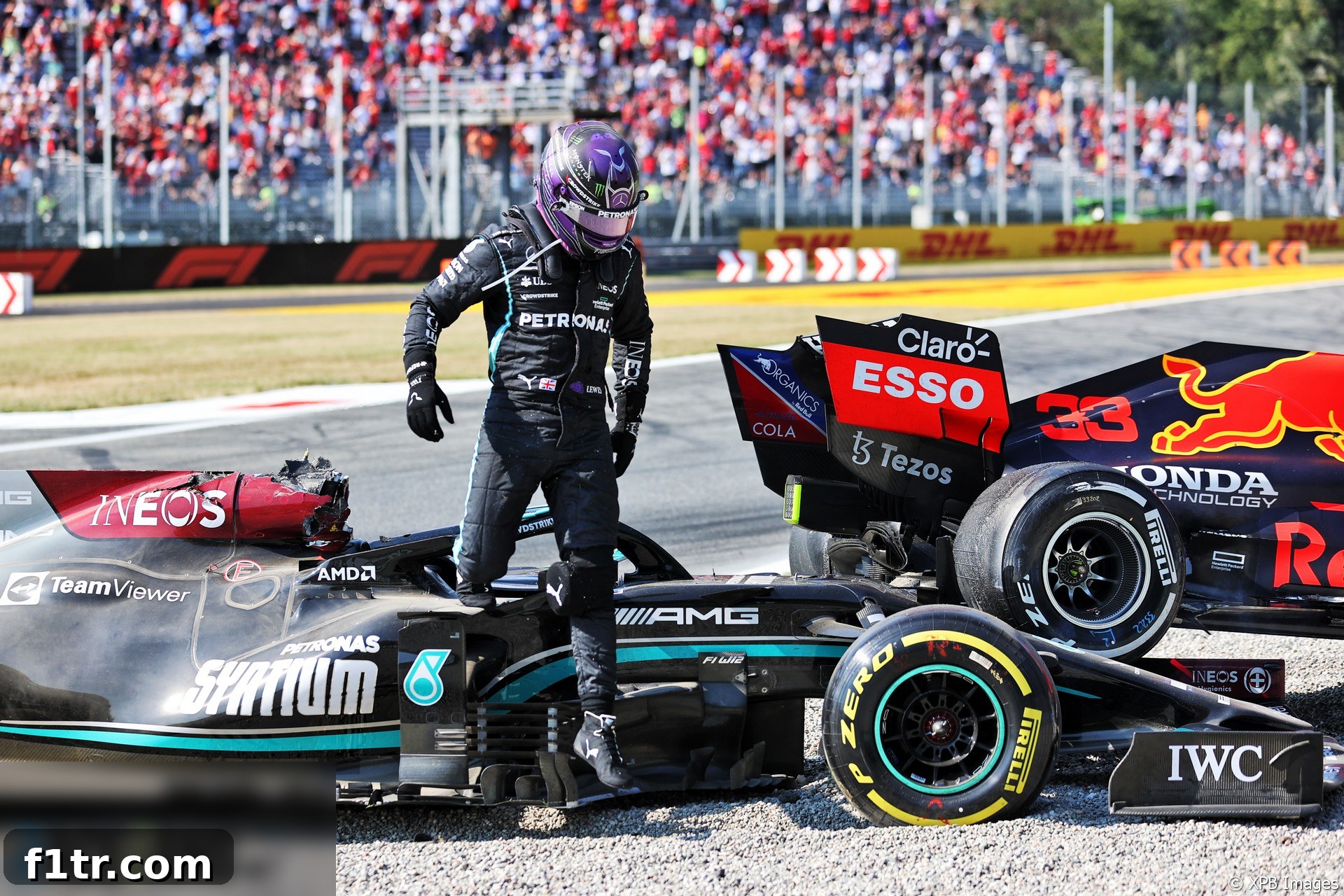
The incident unfolded on lap 26 of the Italian Grand Prix at the iconic Rettifilo chicane. The race had seen its share of thrilling moments, but it was a routine pit stop that set the stage for the dramatic confrontation. Lewis Hamilton had just completed his tire change, emerging from the pit lane directly into the path of Max Verstappen, who was already on track. As Hamilton rejoined, he found himself side-by-side with Verstappen, heading into the formidable Turn 1. Verstappen, demonstrating his characteristic aggressive style, attempted to navigate around the outside of Hamilton at Turn 1, aiming to complete the pass by cutting back to the inside for Turn 2.
However, this daring maneuver took a catastrophic turn. As Verstappen pressed his attack, his Red Bull machine made contact with a high ‘sausage kerb’ positioned on the inside of the corner. This kerb, designed to deter drivers from cutting the chicane, acted like a ramp, launching Verstappen’s car airborne and directly onto Hamilton’s Mercedes. The impact was immediate and decisive: Verstappen’s rear right wheel landed on Hamilton’s halo head protection device, effectively pinning both cars together. The two championship protagonists slid helplessly off track, coming to a dramatic halt in the gravel trap, their races abruptly over.
Miraculously, Hamilton was able to extricate himself from his car, albeit appearing somewhat shaken. He later reported feeling “a little bit stiff and sore in my neck” and acknowledged that Verstappen’s car “landed on my head, but I’ll be okay,” a testament to the life-saving efficacy of the halo device.
Hamilton’s Account: The ‘Car’s Width’ and the ‘Didn’t Give Way’ Argument
From Lewis Hamilton’s perspective, the collision was entirely avoidable and indicative of his rival’s reluctance to yield. Recounting the sequence of events immediately after his pit stop, Hamilton explained, “I came out, I saw Daniel [Ricciardo] came past, Max was coming, I made sure I left a car’s width on the outside for him.” He firmly believed he had provided ample racing room for Verstappen, adhering to a fundamental principle of fair racing.
Hamilton further elaborated on his position heading into the crucial corners: “I went into turn one and I was ahead, I was ahead going into turn two and then all of a sudden he was on top of me.” His belief was that having established a leading position, albeit a marginal one, Verstappen should have recognized the situation and backed out of the move. This conviction was underscored by his direct comparison to an earlier incident on the very first lap of the race.
During the opening lap, Hamilton himself had been forced across the run-off area at the Roggia chicane while attempting to pass Verstappen. In that instance, Hamilton conceded the position and rejoined safely, preventing contact. He viewed this as a crucial precedent, highlighting a racing etiquette he felt Verstappen ignored. “It’s exactly the same scenario as happened in turn four where I went around the outside, I was in exactly the same position but I gave way,” said Hamilton. “And that’s racing. He just didn’t want to give way today.” Hamilton concluded his argument by stating, “He knew into turn two what was going to happen. He knew that he was going over the kerb but he still did it,” implying a deliberate and ultimately reckless decision on Verstappen’s part.
Advert | Become a RaceFans supporter andgo ad-free
Verstappen’s Defense: The ‘Squeezing’ and the Two-Driver Responsibility
Max Verstappen, predictably, offered a contrasting narrative, vehemently rejecting Hamilton’s comparison of the two incidents. For Verstappen, the context and dynamics of the lap 26 collision were distinctly different from the earlier lap one skirmish. “I don’t think you can judge them exactly the same. He just kept on squeezing and squeezing while I was really a lot alongside him,” Verstappen countered, placing the onus of responsibility squarely on Hamilton for not allowing sufficient space.
Verstappen’s core argument revolved around the idea of shared responsibility in wheel-to-wheel racing. “You need two people to work together to make the corner and we are fighting for position. Unfortunately, we touched.” He emphasized that in a championship battle of such intensity, neither driver could be expected to simply yield without a fight, but that cooperation was still necessary to avoid contact.
Addressing the inevitable comparisons to their infamous Silverstone collision earlier in the season, which had resulted in Verstappen’s heavy crash, the Red Bull driver denied any lingering animosity influencing his actions at Monza. “Of course, people automatically start talking about Silverstone. These things happen, of course, it was not nice at the time. I think we are all professional enough to just get on with it and keep on racing each other.” This statement aimed to dismiss any suggestion that his aggression was a form of retaliation, framing it instead as pure racing instinct.
Verstappen reiterated his belief that Hamilton’s actions were the primary cause of the collision: “But then I didn’t expect him to keep squeezing, squeezing, squeezing. Because he didn’t even need to. Even if he would have left me just a car width we would have raced out of turn two anyway and I think he would have probably still been in front.” He maintained that a minor adjustment from Hamilton could have prevented the crash. “But then he just kept on pushing me wider and wider and at one point there was no way to go, he just pushed me onto the sausage kerb and that’s why, at the end of the day, we touched because of the rear tyre bumped up to his tyre.” Verstappen’s explanation highlighted the physical impossibility of continuing without contact once pushed onto the kerb.
The Stewards’ Verdict and the Lingering Impact
Following the dramatic incident, the race stewards swiftly launched an investigation, summoning both drivers to explain their respective roles in the collision. The complexity of the incident, combined with the high stakes of the championship and the differing accounts, meant that the decision was eagerly awaited by the entire F1 community.
Update: Verstappen given three-place grid penalty for Hamilton crash
Ultimately, the stewards concluded their review and levied a three-place grid penalty against Max Verstappen for the subsequent Russian Grand Prix. This decision implied that, in the stewards’ judgment, Verstappen was predominantly to blame for the contact. This penalty was a significant blow in a championship where every point and every grid position mattered immensely. The ruling sparked considerable debate among fans, pundits, and even other drivers, with some agreeing with the decision and others arguing it was a harsh outcome for what they perceived as a “racing incident” – a natural consequence of two fiercely competitive drivers battling for supremacy.
The Monza collision became a defining moment in the 2021 F1 season, underscoring the relentless nature of the Hamilton-Verstappen rivalry. It was an incident that laid bare the contrasting driving philosophies of the two titans: Hamilton’s emphasis on giving space and anticipating outcomes, versus Verstappen’s unyielding aggression and refusal to back down. This dramatic encounter not only added another layer of intrigue to their already captivating championship fight but also prompted wider discussions about racing ethics, driver responsibility, and the fine line between aggressive racing and avoidable contact. As the season progressed, the shadow of Monza lingered, a constant reminder of the high-octane drama and the intense personal and professional battle being waged between two of Formula 1’s most formidable competitors.
Advert | Become a RaceFans supporter andgo ad-free
2021 Italian Grand Prix Coverage
- Who was to blame for Hamilton and Verstappen’s collision at Monza?
- Hamilton-Verstappen crash was ‘a racing incident, no danger’ – Alonso
- Hamilton pleased stewards “set a precedent”, Verstappen “doesn’t fully agree”
- Ricciardo didn’t need title rivals’ latest clash for stunning Monza win
- Why Verstappen’s grid penalty differed from Hamilton’s Silverstone sanction
Browse all 2021 Italian Grand Prix articles