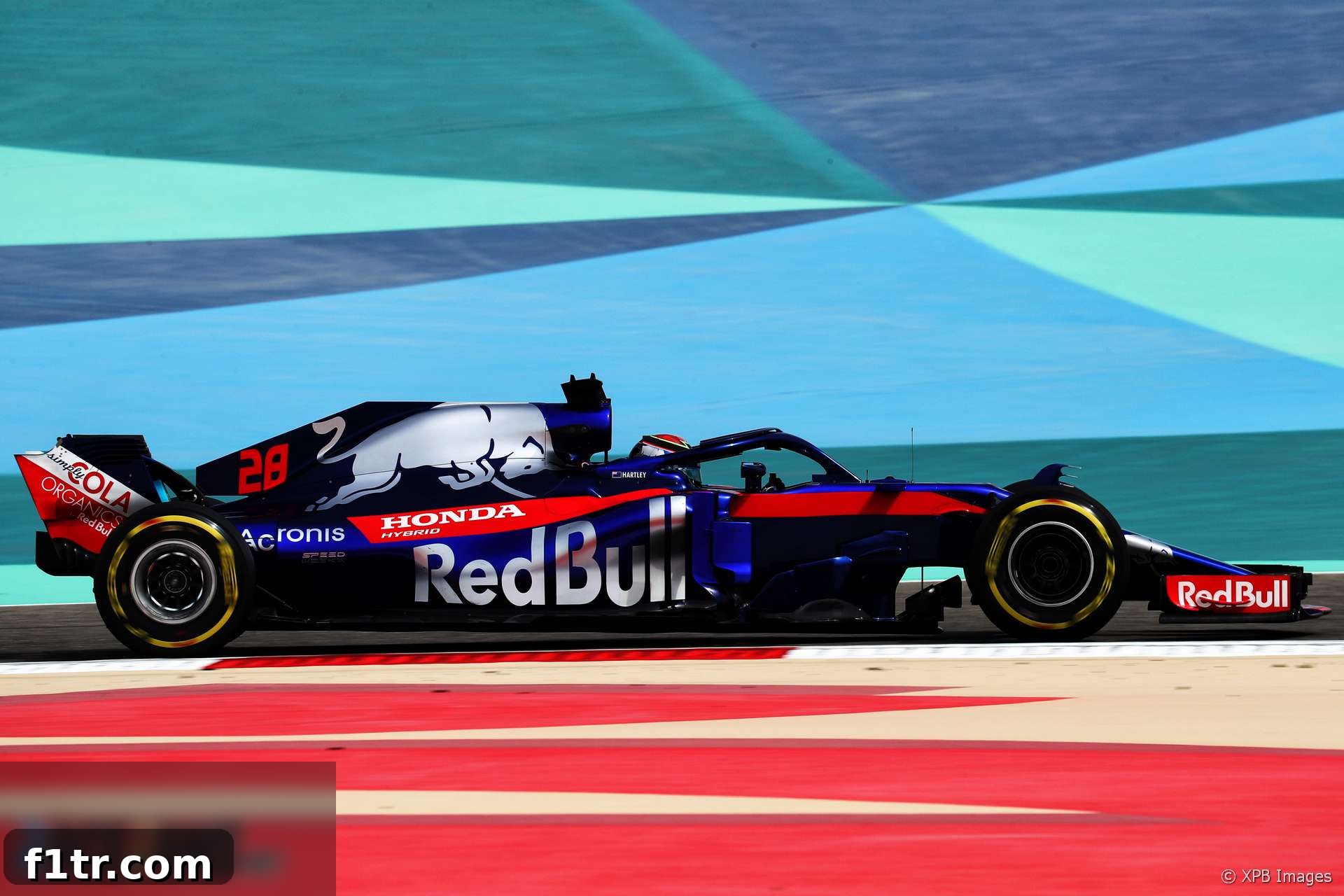
Toro Rosso’s Bahrain Breakthrough: Hartley Optimistic for Sustained Performance, Gasly Seeks Confirmation in Shanghai
Following a surprisingly strong showing at the Bahrain Grand Prix, Scuderia Toro Rosso drivers and management are cautiously optimistic about their prospects for the upcoming Formula 1 season. Brendon Hartley, despite a challenging race weekend himself, firmly believes the team’s newfound competitive edge is not a fleeting phenomenon and expects it to persist as the F1 circus heads to Shanghai for the Chinese Grand Prix this weekend.
The Bahrain Grand Prix saw Pierre Gasly deliver a standout performance, not only qualifying an impressive fifth but also securing a remarkable fourth-place finish, earning valuable points for the team. While Hartley faced a tougher time and couldn’t convert his efforts into points, the collective data and feeling from the car have instilled confidence within the garage. Hartley is convinced that the significant improvements observed in the STR13 chassis are indicative of a genuine step forward, rather than a circuit-specific anomaly.
Advert | Become a Supporter & go ad-free
Advertisement area
“The updates we brought to Bahrain, coupled with the detailed set-up changes we implemented, drastically improved the car’s performance,” Hartley explained, reflecting on the team’s progress. “From what we experienced, I see no reason whatsoever why we shouldn’t continue to have this great race car and maintain this level of competitiveness beyond Bahrain.” His statement underscores a belief that the advancements are fundamental and broadly applicable, rather than tailored to the unique characteristics of the Sakhir circuit.
The improvement in the STR13 was unmistakable, with Hartley noting an immediate and profound difference from his very first lap with the upgraded package during the final practice session. This instant feedback from the car provided early validation for the engineering team’s efforts and boosted driver confidence significantly.
“Even after my initial install lap, I remember saying to the engineers, ‘Wow guys, we’ve truly made a significant step in the right direction here,'” Hartley recounted, highlighting the palpable shift in the car’s behavior. Such instantaneous positive feedback is rare in the high-stakes world of Formula 1, where incremental gains are usually hard-won and often subtle.
Understanding the STR13’s Transformation: Key Technical Gains
Hartley elaborated on the specific areas where the STR13 showed the most noticeable gains, primarily focusing on the car’s balance during cornering—a critical aspect for extracting lap time and driver confidence. While raw grip in the mid-corner is undoubtedly important, Hartley stressed that the nuanced balance across different phases of a corner is what truly separates a good car from a great one.
“It’s all very well having a tremendous amount of grip right at the mid-point of the corner,” he explained. “However, it’s the balance you can maintain through the varying phases of the corner – from entry, through the apex, and especially on exit – that can genuinely make a massive difference to overall lap time and predictability. We saw a big, immediate improvement in this crucial area.” A well-balanced car allows drivers to push harder, carry more speed, and apply power earlier, leading to faster lap times and reduced tyre wear.
Beyond low and medium-speed cornering, the STR13 also demonstrated enhanced performance in faster sections of the track. “Also, in medium-high speed corners, there was definitely more load,” Hartley added, referring to the increased downforce generated by the car. More downforce means better grip, stability, and higher cornering speeds, which is invaluable on circuits with sweeping curves. “I think from my very first lap in Free Practice 3, the difference compared to the previous day’s running was nothing short of huge.” This immediate and substantial improvement points to successful aerodynamic or mechanical upgrades that significantly enhanced the car’s overall performance envelope.
Pierre Gasly’s Caution: Seeking Confirmation in Shanghai
While Hartley expresses robust optimism, his teammate Pierre Gasly, fresh off his career-best F1 finish, maintains a more pragmatic and cautious approach. Gasly acknowledges the team’s remarkable progress but emphasizes the need for consistent performance across different circuits to truly validate their advancements.
“I definitely think we’ve gained a much deeper understanding of our car’s true potential, how to optimize its setup, and how to manage the tyres effectively,” Gasly stated, reflecting on the lessons learned in Bahrain. “But despite that, we still require further confirmation. I believe this weekend in Shanghai will provide an excellent opportunity to truly judge our baseline performance and determine if this potential is equally strong on other types of tracks.”
The Chinese Grand Prix circuit presents a stark contrast to Bahrain. Shanghai International Circuit is known for its unique ‘snail’ Turn 1-4 complex, its incredibly long back straight, and a mix of high-speed and technical corners. This diversity will put the STR13’s new characteristics to the test in a completely different environment, making it an ideal benchmark. If the car performs well here, it would lend significant credence to the team’s belief in a fundamental improvement.
“Undoubtedly, we need to remain quite careful and grounded,” Gasly reiterated. “Bahrain was exceptionally good for us, and at this stage, I genuinely don’t know if we will see a similar level of performance on other circuits. So yes, we are hopeful it’s going to be the same, but we will truly find out tomorrow when we hit the track.” This measured perspective is typical of a young driver in a rapidly evolving sport, keen to avoid premature conclusions and focus on sustained development.
The Significance for Toro Rosso and Honda
For Toro Rosso, the implications of a sustained performance surge are profound. As Red Bull Racing’s junior team, their primary role is to develop young talent and, crucially, to serve as a testbed for Honda’s power units. The 2018 season marked a pivotal year for the partnership between Toro Rosso and Honda, with the Japanese manufacturer keen to demonstrate its capabilities after a challenging period with McLaren.
A strong chassis performance from Toro Rosso, particularly one that offers enhanced driveability and predictable handling, is vital for evaluating the Honda power unit accurately. If the STR13 can consistently deliver performance on various tracks, it not only boosts the confidence in the chassis design but also allows for a clearer assessment of the engine’s contribution. Honda, in turn, can use this feedback to accelerate their development, which has long-term implications for Red Bull Racing, who would later switch to Honda power themselves.
The team’s ability to bring significant, effective updates so early in the season speaks volumes about their design and development capabilities. It suggests a healthy flow of information and resources, potentially leveraging synergies with their senior team, Red Bull Technology. For drivers like Hartley, who was striving to establish himself firmly in F1, and Gasly, who was proving his mettle, consistent competitive showings are critical for their career trajectories.
The Challenge of Consistency in Formula 1
Formula 1 is a relentless development race. While Toro Rosso made a significant leap in Bahrain, other teams will undoubtedly be bringing their own updates and understanding their cars better with each passing race. The challenge for Toro Rosso will be to maintain this momentum, continue to develop the STR13, and adapt to the specific demands of each circuit on the calendar. Bahrain’s smooth surface and high-degradation tyres might have suited their package particularly well. Shanghai, with its different asphalt characteristics, long straights requiring raw power, and demanding technical sections, will offer a fresh test.
Ultimately, the upcoming Chinese Grand Prix is more than just another race for Toro Rosso; it’s a litmus test. It will reveal whether the Bahrain success was a specific peak or the beginning of a sustained upward trend. The team, armed with data and a renewed sense of purpose, is eager to prove that their performance in the desert was not a ‘one-off’ but a true reflection of their growing potential.
Go ad-free for just £1 per month>> Find out more and sign up
2018 F1 season
- F1 feared “death knell” for Drive to Survive after Ferrari and Mercedes snub
- McLaren staff told us we were “totally crazy” to take Honda engines in 2018 – Tost
- ‘It doesn’t matter if we start last’: How Red Bull’s junior team aided Honda’s leap forward
- Honda’s jet division helped F1 engineers solve power unit problem
- McLaren Racing losses rise after Honda split
Browse all 2018 F1 season articles