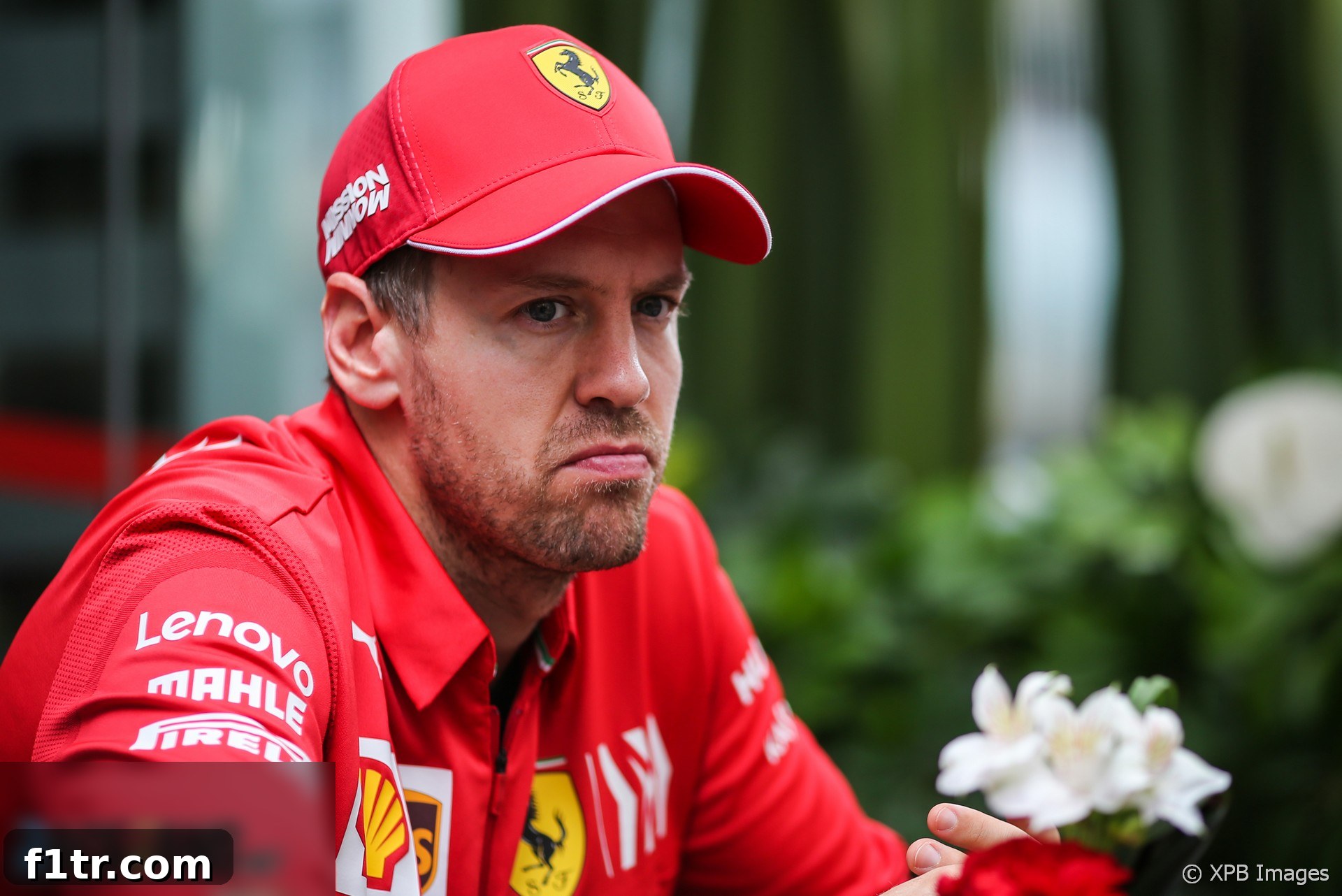
The highly competitive world of Formula 1 often sees teams and drivers scrutinizing every aspect of their rivals’ performance, especially when there are sudden shifts. The 2019 season was no exception, marked by intense battles and underlying technical suspicions. One of the most talked-about moments arose during the United States Grand Prix in Austin, where Sebastian Vettel found himself at the center of a swirling controversy. The Ferrari driver was quick to dismiss pointed claims from competitors that his team’s unexpected dip in performance was directly linked to a recently issued FIA technical directive concerning power units, arguing instead that their strategy and setup choices were the primary culprits.
Vettel Addresses Rival Suspicions Following Austin Performance
Following a remarkable run of strong performances that highlighted Ferrari’s impressive straight-line speed, particularly after the summer break, their pace in Austin raised eyebrows across the paddock. The stark reduction in their top-speed advantage became a major talking point. Notable voices, including Red Bull’s Max Verstappen and Mercedes’ Lewis Hamilton, were among those who publicly suggested that Ferrari’s subdued showing at the Circuit of the Americas was a direct consequence of the FIA’s new technical directive. This directive, issued just ahead of the race weekend, aimed to clarify rules around fuel flow sensors and their potential manipulation, implicitly targeting rumors and theories circulating about certain power unit designs. However, Vettel firmly insisted that the change in Ferrari’s competitive standing stemmed from the specific setup direction they had taken for the Austin circuit, rather than any impact on their engine’s raw power output.
Unpacking Ferrari’s Performance in Austin
“We didn’t lose any power on the engine,” the four-time world champion stated unequivocally, seeking to dispel the growing speculation. He elaborated on Ferrari’s tactical choices: “I think we opted to run probably a bit more downforce than other people.” This strategic decision, while potentially offering advantages in the corners, inherently compromises straight-line speed. It represents a classic Formula 1 trade-off, where teams must balance aerodynamic grip with drag, tailoring their approach to the specific demands of each track.
Vettel further detailed the nuances of their Austin performance: “In quali the comparison was quite clear. We gained a little bit on the straight, not as much as usual, but we didn’t lose as much as usual in the corners. Obviously, one always goes sort of hand-in-hand.” This explanation highlights how their chosen setup impacted their car’s overall balance and performance envelope. While the SF90 might have forfeited some of its characteristic blistering speed on the straights, it was expected to compensate by improving its stability and grip through Austin’s numerous challenging bends. The fact that this didn’t translate into expected overall pace, particularly for his teammate Charles Leclerc during the race, suggested deeper issues that Ferrari was keen to investigate.
“So I think in the race – obviously I wasn’t taking part much of the race – but for Charles we didn’t have the pace that we normally have. But I know it’s not for that reason,” Vettel asserted, referring to his own early retirement from the race due to suspension failure. He strongly reiterated that the technical directive was not the cause. “Obviously there’s other things that made a difference and played a role, which we were looking to understand. We had some races where we were not competitive at all this year so it’s not the only one. So for sure it will matter to understand exactly what happened, to make sure it doesn’t happen again, and we tackle those areas for next year.” This candid admission revealed that Ferrari was facing internal challenges in optimizing their package, pointing to setup intricacies, tire management, or perhaps track-specific characteristics that didn’t align with their car’s strengths, rather than a sudden crippling of their power unit by regulatory clarification.
The FIA Directive and the Echoes in the Paddock
The technical directive in question, TD/039-19, focused on the precise measurement and potential manipulation of fuel flow, particularly concerning the method of signal filtering (“aliasing”) from the mandatory FIA fuel flow sensor. Rumours had circulated for weeks about certain teams potentially exploiting loopholes to momentarily exceed the mandated 100 kg/h fuel flow limit, especially at specific engine RPMs or points on the track. When the directive was issued, effectively closing off any such theoretical avenues, and Ferrari’s performance subsequently wavered, the link was quickly made by rival teams and the media.
Max Verstappen’s outspoken comment that the FIA directive “explains everything” about Ferrari’s performance was perhaps the most direct accusation. This statement resonated widely, fueling the narrative that Ferrari had been operating on the edge of the regulations and was now reined in. Vettel, however, met such claims with a blend of defiance and weariness. “I think the big difference to the past is that a lot of people are being heard, whereas maybe before they were being ignored,” said Vettel, hinting at an underlying political dynamic where rivals felt empowered to voice their suspicions more openly. “Everybody’s free to say what they want. If that is what he thinks, that’s what he might think. But obviously we have a different opinion.” His remarks underscored the often-combative nature of Formula 1, where competitive advantage can quickly lead to scrutiny and accusations, and where public perception can be as important as on-track results.
Ferrari’s Engine Prowess and Chassis Efficiency
Beyond refuting the directive’s influence, Sebastian Vettel was quick to credit Ferrari for their significant advancements, particularly in their engine department, which had undeniably propelled them to a more competitive position in the 2019 season. He acknowledged that their straight-line speed advantage was a combination of potent engine development and an efficient chassis design. “On top of the fact that we have a [high] performing engine we also have a car that is very efficient,” Vettel explained. This efficiency refers to the car’s ability to generate downforce with minimal drag, allowing it to cut through the air more cleanly and achieve higher speeds on the straights, even compared to rivals who might generate more overall downforce.
Vettel then drew a comparison with their key competitors: “In comparison to Mercedes and Red Bull, they have more downforce than us, but maybe they’ve created in a bit of a dirtier way. So you can always argue what is the better package.” This insight highlights the divergent aerodynamic philosophies adopted by the top teams. Mercedes and Red Bull, known for their high-rake concepts and cornering prowess, typically aim for maximum downforce, even if it comes at the expense of some drag. Ferrari, with its lower-rake, more aerodynamically “slippery” design, maximized straight-line speed, particularly with their potent power unit. The debate over which package is “better” often depends on the specific circuit characteristics and the balance between qualifying and race performance.
The Ferrari driver expressed immense pride in his team’s accomplishments, particularly in engine development. “But I think it’s a good sign. Should we have the strongest engine – I don’t know the other manufacturers power figures – that’s a great achievement by us, by our engine department. For the last five years, we had Mercedes having the strongest engine so if it’s now for a couple of months that we are ahead and hopefully it stays like that for the next five years and I don’t care what people think or say.” This statement not only served as a powerful defense of Ferrari’s engineering prowess but also highlighted the emotional investment in reclaiming engine supremacy after years of Mercedes’ dominance in the hybrid era. It reflected a deep-seated belief within the Scuderia that their hard work had paid off, regardless of external scrutiny or rival accusations.
The Lingering Questions of the 2019 Season and Beyond
The controversy surrounding Ferrari’s power unit and the FIA’s technical directives remained a significant subplot throughout the latter part of the 2019 season and even into early 2020. While no public penalties were issued against Ferrari following the Austin events, the FIA did continue to issue further clarifications and eventually reached a “confidential settlement” with the team regarding their 2019 power unit design, a move that sparked considerable frustration and further questions from rival teams. This episode underscored the complex interplay of technical innovation, regulatory oversight, and intense political maneuvering that defines Formula 1.
Vettel’s dismissal of the claims in Austin was a testament to his loyalty and belief in his team, but it also painted a picture of a team grappling with the inherent challenges of F1: understanding performance fluctuations, optimizing an intricate package, and fending off external pressures. The 2019 season, despite its controversies, saw Ferrari make significant strides, particularly with their power unit, setting the stage for future battles and continued technical development. The drive to understand the “other things” that impacted their Austin performance, as Vettel mentioned, became crucial for Ferrari’s ongoing quest for championship success, ensuring that lessons learned could be applied to subsequent seasons and car designs.
More from the 2019 F1 Season
- Crying in the Melbourne car park at 2019 grand prix was my career low – Ocon
- McLaren Racing reports reduced £71 million loss in 2019
- Kvyat: Hockenheim podium last year was “my biggest achievement” so far
- How the FIA’s new encrypted fuel flow meter targets Ferrari’s suspected ‘aliasing’ trick
- “He smashed my office door”: 23 must-see moments from ‘Drive to Survive’ season two
Browse all 2019 F1 season articles